Now open is a revamped, kids-focused area in Looney Tunes Land, a remake of the former Bugs Bunny World and Whistlestop Park. All told, it’s a 5-acre space with nine rides, including two kiddie coasters, as well as still-to-come play areas, a live show and an in-development augmented reality experience.
You’re reading Mr. Todd’s Wild Ride newsletter
Todd Martens’ newsletter delivers news and commentary on the past, present and future of theme parks, right from the theme park capital of the world — Southern California.
By continuing, you agree to our Terms of Service, which include arbitration and a class action waiver. You agree that we and our third-party vendors may collect and use your information, including through cookies, pixels and similar technologies, for the purposes set forth in our Privacy Policy such as personalizing your experience and ads.
I last walked through the area about two summers ago, and it was in a derelict state. I’m happy to report it’s more welcoming, prettier and dotted with plant life and landscaping.
Gone is the vintage Magic Flyer, once Magic Mountain’s oldest coaster (the park’s eldest thrill seeker is now Gold Rusher). Also among the casualties: Tweety’s Escape, a steel swing that placed children in birdcages that had begun to look like mini jails. It was a grim-appearing ride.
The remaining attractions have all received some much-needed TLC. Some even have added mini storylines. What was Whistlestop Train, for instance, is now Taz’s Tasmanian Train Tours. It follows a narrative in which the ride’s titular character has escaped the zoo and is eluding capture, generally causing havoc on the countryside. It’s a calm, slow-moving ride through a small green space, and we see failed attempts to trap Taz, such as an overgrown mice contraption. The ride concludes with a mechanical not-so-hidden Taz, but not before glimpsing a statue of Tasmanian She-Devil in full kiss mode.
A look into the Bugs Bunny-focused area of Magic Mountain’s new Looney Tunes Land.
(Myung J. Chun / Los Angeles Times)
The reimagining comes two years after Six Flags Entertainment Corp. and the Cedar Fair Entertainment Co. completed a merger, which in SoCal brought Magic Mountain and Knott’s Berry Farm under the same ownership. Six Flags’ corporate creative producer Clayton Lawrence says post-merger, the company pinpointed upping the family appeal at Magic Mountain as among its first orders of business.
That meant last summer devoting resources to improving the Hurricane Harbor water park, which Lawrence says specifically attracts families and grandparents. This year, attention was turned to the primary park in Looney Tunes Land.
“We really thought about what this park needs,” Lawrence says. “What will the parents need? How do we slow the guests down a little bit? This park has so many thrills in it — so many coasters — that we wanted to create a place that was nice to take a break from all the action and also develop areas where grandparents and parents could watch little ones burn off energy.”
It’s safe to say that Magic Mountain’s core audience is likely always going to be thrill seekers. And that fan base will be served next year with the planned opening of a new coaster that will overlook the Looney Tunes area.
The kiddie coaster the Road Runner Express at Six Flags Magic Mountain.
(Myung J. Chun / Los Angeles Times)
Magic Mountain attracted 3.3 million visitors in 2024, according to data released by the Themed Entertainment Assn. While Lawrence was not able to break down which percentage of that number included those traveling with children 12 and under, it’s safe to say that a greater family appeal is viewed as one of the ways to boost a SoCal audience.
“There’s a lot of people who grew up coming up here, or their first ride was inside Bugs Bunny World,” Lawrence says. “A lot of families have a daredevil teen who can go on the rides, but they also have a little one. This is about the multi-demo family.”
Looney Tunes Land is broken into four mini areas — Taz-Mania, Road Runner Ridge, Bugs Bunny Play Park and Camp Duck Amok. While there are no major distinctions between the spaces, there are slight differences. Taz’s footprints, for instance, are found in the gravel-colored pavement of Taz-Mania, and in the Daffy Duck locale the flooring looks a bit like rockwork. A small outback-like trail in Taz-Mania will soon be home to an augmented reality game, and a much-needed green space in the Bugs Bunny spot will later this summer be populated with tunnels and little climbing structures.
Asqwer Turki, 13, poses for a picture with Wile E. Coyote at the new Looney Tunes Land at Magic Mountain.
(Myung J. Chun / Los Angeles Times)
There are fun additions to spot on the refreshed rides. The Canyon Cruiser beginner’s coaster, for example, nods to classic Looney Tunes cartoons, specifically prank-filled episodes featuring Daffy Duck, Bugs Bunny and Elmer Fudd. The children’s theater has been remade into Bunny Bowl, and given giant carrots that call the attention of guests.
Such light thematic touches, said Magic Mountain President Brian Oerding, have been missing from parts of the park. They’re vital, he says, in lengthening a guest’s day.
“We’ve learned that softening the hardscape creates a better environment, a better experience, and that means you’re going to want to hang out more,” Oerding says. “Some folks will walk by black asphalt and not think anything about it, but when you look into Looney Tunes Land, and you look at the softness of the pavement and the additional landscaping, we’ve created a happier space. Mom and Dad are happier, and that means they’ll hang out longer.”
Mountain Park President Brian Oerding officially opens the new Looney Tunes Land at Magic Mountain.
(Myung J. Chun / Los Angeles Times)
Looney Tunes Land has also given Magic Mountain some much-needed in-park entertainment, as the area has been lacking a live show for a number of years. “Vacation Mayhem” comes in at just under 15 minutes and features Bugs, Daffy, Porky Pig and Sylvester imagining their perfect getaway spots in song.
Things go wrong, of course, and Bugs even explores some vices by gambling in Las Vegas, which was an odd choice I thought for a kids show, but Looney Tunes did always have a bit of an edge. Nevertheless, the musical numbers, ranging from reworkings of “The Gold Diggers’ Song (We’re in the Money)” to “Hello Muddah, Hello Fadduh (A Letter From Camp)” keep it zipping along.
“If we don’t believe that entertainment and character shows are important, we’re missing it,” Oerding says. “Yes, the rides are cool, but we haven’t done an actual entertainment show in here in a long time.”
And Lawrence says Looney Tunes is essentially a model for the entire park. No, that doesn’t necessarily mean more kiddie rides in the coming years, only that Six Flags is looking at other places where the park can use some beautification.
“This is what we want to do for the rest of the park,” Lawrence says. “Disciplined design. Nice hardscape.”
And here’s hoping for some more plants and an additional fountain or two.
This week in SoCal theme parks
Alexis Rosales of Bell gets drenched by Luke Brodowski, performing as Fluke Mayfield at Knott’s Berry Farm’s Ghost Town Alive! in 2024.
(Allen J. Schaben / Los Angeles Times)
It’s the most wonderful time of the year. Knott’s Berry Farm begins its summer season on Friday, and that means the return of Ghost Town Alive! This interactive live show, now a decade old, is unlike anything at any other SoCal park, and in my mind it’s the best summer entertainment available. This hybrid live-action role-playing game and work of interactive theater enables guests to live out mini-Wild West adventures while interacting with more than two dozen actors. Players follow a loose story centered on the drama in the fictional town of Calico, in the park’s Ghost Town area. It’s silly, it’s wacky and there’s even a daily newspaper. Ghost Town Alive! runs on select days, and I’ll see you there Friday.
World Cup, Lego Style! Carlsbad’s Legoland is celebrating the arrival of the World Cup with a host of limited-time activities and Lego creations. The park, for instance, has built a 30-foot-long re-creation of SoFi Stadium, and elsewhere has created brick versions of a host of soccer stars. There are interactive events as well, such as accuracy challenges and games that have attendees trying to score goals off of Lego minifigures. Legoland’s FIFIA World Cup Experience 2026 launches Thursday and runs through July 19.
Oogie Boogie Bash tickets drop — and a Haunted Mansionstreet parade? The Disneyland Resort’s popular after-hours event Oogie Boogie Bash returns Aug. 18, and tickets for Magic Key passholders go on sale June 16 (the general public sale is June 18). New this year to the Disney California Adventure experience is what the resort is calling “Madame Leota’s Swinging Wake.” Though not a full-scale parade, expect Haunted Mansion characters — the concept art shows floats of the attraction’s “stretching room” portraits — as well as ghostly dancers. But with something new, something must depart. “Madame Leota’s Swinging Wake” is replacing the “Frightfully Fun Parade.” Ticket prices vary by day, starting at $139. October dates, for instance, top off at $199.
“Harry Potter” will hover above Dodger Stadium. A theme park-like drone show is arriving Saturday at Dodger Stadium. More than 1,200 drones will soar over the park as part of a “Harry Potter”-inspired production, which will also feature music, trivia and an appearance from the film’s Bonnie Wright (Ginny Weasley). Expect re-creations of “Potter” iconography such as Hogwarts Castle, magical creatures, the Sorting Hat and more. The hourlong show begins at 9 p.m. and Butterbeer will be on hand. Tickets start at $52.90 for adults.
Tell us your stories. Ask us your questions.
Have a theme park tale to share? Whether it was a good day or less-than-perfect day, I would love to hear about it. Have a question? A tip? A fun photo from the parks to share? Email me at todd.martens@latimes.com. I may feature your note in an upcoming newsletter.
Ride on,
Todd Martens
P.S.
Last week I put out a call for Disneyland fans to share their Carousel of Progress memories. The theater attraction, centered around a rotating auditorium, debuted at the 1964 World’s Fair before making its way to Disneyland in 1967. It was moved to Florida’s Walt Disney World in 1975. The Walt Disney Co. announced recently that the Florida version would be undergoing a top-to-bottom overhaul, but its dedication to technological optimism throughout the decades would remain.
I’m thoroughly enjoying the remembrances. Many cited it as a favorite. “My father was a musician, and it became a family tradition that we’d sit in the back row and sing ‘[There’s] a Great Big Beautiful Tomorrow’ loudly at the top of our lungs from the very beginning of the ride, which I’m sure newcomers thought was weird and probably annoying,” wrote one reader. Another noted, “The mid-60s were exciting years to be a kid, as the future seemed so promising and exciting; the [Carousel of Progress] plugged right into that enthusiasm.”
Many shared similar sentiments. “The animated activities of the characters and their dialogue embraced the ‘Happiest Place on Earth” theme that was prevalent throughout Disneyland in those earlier days,” said one fan. A few, however, called out that the attraction was sponsored by General Electric, making it feel a bit like an advertisement. As one reader summarized: “It was incredibly clunky product placement, even to a kid’s ears.”
Two Dragons’ Den entrepreneurs were branded “delusional” by Touker Suleyman over their valuation after he turned down their pitch, but their vegan pet food brand is now worth £11,000,000.
22:40, 08 Jun 2026Updated 22:42, 08 Jun 2026
Touker Suleyman has stepped down from Dragons’ Den(Image: BBC)
Dragons’ Den stars who Touker Suleyman once labelled “delusional” have revealed their company is now turning over £11,000,000.
The Dragon confirmed at the weekend that he would be departing the show after “ten extraordinary years”.
In a social media post, Touker shared: “It has been an immense privilege to sit in that chair, to meet so many passionate and talented entrepreneurs, and to invest in businesses and people I truly believed in.
“The show gave me a platform not only to invest in leading British founders and companies, but to share hard-won wisdom built over decades in business – and I hope that, in some small way, I made a difference to those who stood opposite me.”
Yet one particular pair of entrepreneurs who faced Touker in the Den were on the receiving end of some scathing criticism from the businessman, reports Wales Online.
Omni founders Dr Guy Sandelowsky and Shiv Sivakumar appeared on the programme last year, seeking investment in their protein-based, vegan pet food brand.
Established in 2021, their brand centred on improving pets’ wellbeing through lab-grown food that was calorie-controlled and environmentally sustainable, while also delivering on taste.
Within two years, they had racked up over £2,500,000 in sales, and were seeking £75,000 from the Dragons in exchange for a 1% stake in their business.
Touker, however, remained wholly unimpressed, declaring he “wouldn’t even get out of bed for” that sum, and bluntly stated: “You’re delusional about what this is really worth.”
Although Deborah Meaden and Steven Bartlett championed the entrepreneurs, Touker rejected Omni’s lifetime value projections, and was swift to utter the infamous words, “I’m out.”
Yet, despite his scathing assessment, the Omni entrepreneurs disclosed in a 2025 interview that their business was valued at £7,500,000, and shortly afterwards, they’d soared to £11,000,000, even collaborating with Springwatch’s Chris Packham.
Reflecting on Touker and also Peter Jones’ brutal comments in the Den, Dr Guy and Shiv previously told Metro: “I feel like when we were in the Den, they were looking at our historical numbers and basing that on our valuation, but what we were basing it on was actually what our revenue was like at that point, because we’re so fast-growing.”
Dr Guy went on: “We can make quite reasonable assumptions about what we’re going to do in the coming months as well, and I felt like that wasn’t necessarily as much their focus. When you look at our run-rate based on our revenue, it’s not as crazy as they were sort of alluding to at all.”
He continued by stressing that their experience in the Den came down to their product, not their numbers.
He added: “In hindsight, the one disadvantage of it is that we didn’t get to show the nation so much of the other stuff we filmed, like the details of our products.”
Speaking back in March 2025, they said the response from the series had been “amazing”, adding: “We’re trying to keep up, honestly, we’re just a small business trying to help pets live happier lives, and we knew that going on the show would increase our exposure.
“But we never imagined the demand that we’re seeing now, we’ve had to re-evaluate our stock levels and the number of people helping with our customer service and packaging, so it’s been really, really positive.”
He went on: “It’s just a testament to the fact that so many people out there watching the show understood what we’re trying to do, aligned with our mission and were willing to give it a go.”
Sharing his announcement that he was stepping down from Dragons’ Den this weekend, Touker’s statement went on: “Stepping back from Dragons’ will give me more time to mentor the entrepreneurs I have invested in, and to give back the 50 years of business experience I have accumulated.
“If I can help the next generation avoid the pitfalls I’ve faced, seize the opportunities I almost missed, and build businesses they are truly proud of, then that will be the most rewarding chapter of my career yet.”
Touker concluded: “To the BBC, to my fellow Dragons past and present, to the production team, and above all to the entrepreneurs who dared to walk through those doors – thank you.
“It has been one of the greatest joys of my career. The fire in the Den burns on. I simply pass the torch.”
After Sara Davies’ departure last year, it has yet to be confirmed who will be joining Deborah Meaden, Peter Jones and Steven Bartlett in the Den.
Dragons’ Den is available to watch on BBC iPlayer.
Tiki, an offshoot of the Midcentury Modern movement, flourished in the ’40s, ’50s and ’60s, but began to experience a decline in the ’70s. Thus, by the ’90s, there were concerns at Disney that the Enchanted Tiki Room — the pivotal 1963 attraction that pioneered audio-animatronics — was no longer in vogue, its singing birds, totems and flowers a relic of another era.
You’re reading Mr. Todd’s Wild Ride newsletter
Todd Martens’ newsletter delivers news and commentary on the past, present and future of theme parks, right from the theme park capital of the world — Southern California.
By continuing, you agree to our Terms of Service, which include arbitration and a class action waiver. You agree that we and our third-party vendors may collect and use your information, including through cookies, pixels and similar technologies, for the purposes set forth in our Privacy Policy such as personalizing your experience and ads.
The company explored some early concepts to remake the Enchanted Tiki Room. One idea was to transform it into an ecological, save-the-rainforest show. Another was to redesign it with a “Lion King” theme.
“Let me tell you, we hated it,” says artist and designer Kevin Kidney of the latter concept.
Kidney, who worked in Disneyland’s art department in the ’90s, says he and his longtime collaborator Jody Daily were “terrified” the Enchanted Tiki Room would disappear, so much so that they began making fliers to advertise the show and putting them up all over L.A., in restaurants, bars and museums. “We started an underground movement to save the Tiki Room even while we were working on these projects. We tried to frame it in a cool, hip way, like, ‘Everyone needs to go and re-experience this amazing show.’”
Trader Sam’s Enchanted Tiki Bar took its influence from Disneyland’s Adventureland attractions, namely the Enchanted Tiki Room and the Jungle Cruise.
(Todd Martens / Los Angeles Times)
Thankfully, cooler heads prevailed, and the Enchanted Tiki Room remains to this day a vital piece of Disneyland history. And now with the modern tiki revival, it’s no longer an archival curiosity. In fact, the connection between Disney and tiki may be as strong as it has ever been, as this spring the Disneyland Hotel’s Trader Sam’s Enchanted Tiki Bar turned 15. Trader Sam’s took its cues heavily from the Adventureland attraction, its bar flanked by tiki totems with slowly wandering eyes. And watching over guests and bartenders is a re-creation of one of the show’s tiki gods.
“The totem pole on the bar, and Koro up in the rafters above the bar, are all original designs and sculpts for the Tiki Room at Disneyland,” Kidney says. “They made new castings for the bar off of the elements from the attraction.”
Kidney and Daily collaborated with Walt Disney Imagineering, the arm of the company devoted to theme park experiences, on some of the early designs for Trader Sam’s. It’s their mug collection, for instance, that was seen in the bar on opening day. And the pair designed a magnificent glowing ship in a bottle, which thanks to a Pepper’s ghost illusion, occasionally looks as if it’s breaking apart and sinking.
Trader Sam’s, says author and historian Sven Kirsten, writer of “The Book of Tiki,” is one of the more influential bars on the modern tiki landscape. Though it didn’t kickstart today’s movement, says Kirsten, it often serves as “a gateway,” introducing Disney’s millions of guests to the scene.
Kirsten says Trader Sam’s has rightfully earned its place among SoCal’s most respected tiki bars. And most popular. An unofficial Instagram page devoted to the bar, keeping tabs on its mug releases and off-menu bartender creations, has more than 39,000 followers.
The erupting volcano “windows” of Trader Sam’s Enchanted Tiki Bar.
(Todd Martens / Los Angeles Times)
“In the early 2010s the craft cocktail revival brought forth these so-called tiki bars that thought if they had a tiki cocktail menu they were a tiki bar,” Kirsten says. “But it was basket lamps and palm leaf wallpaper and that was it. Places like Trader Sam’s and Strong Water and Royal Hawaiian are floor-to-ceiling fully decorated. They’re what a tiki bar should be.”
Before the Disneyland Hotel had Trader Sam’s, the space was home to Hook’s Pointe, which was lightly themed to “Peter Pan.” Yet about a decade after the Walt Disney Co. completed a purchase to assume control of the Disneyland Hotel, Hook’s Pointe was earmaked for renovation.
“We were designing a Caribbean-style bar where Trader Sam’s is now, and that was where I said, ‘Let’s rethink this,’” said Kyle Barnes, an Imagineer who was instrumental in the creation of Trader Sam’s. Barnes was speaking at a recent event hosted by Disney’s fan club D23 on the history of Adventureland and Trader Sam’s.
“I said, ‘That’s more East Coast. This is West Coast.’ Hawaii and Midcentury really fit together with the tiki theme,” Barnes said, noting that the park’s Enchanted Tiki Room was initially pitched as a restaurant and once sat next to the Tahitian Terrace, a Polynesian-themed restaurant complete with hula dancers.
Trader Sam’s is home to many show elements. In addition to the sinking ship, there are bar seats that will begin to drop the longer guests sit in them. Also, there are two theatrical windows looking out toward a volcano, which will erupt when guests order a specific drink. The ship in a bottle and dipping barstools, said Barnes, were inspired by the Adventurers Club at Florida’s Walt Disney World, while the volcano windows were influenced by Florida’s version of the Enchanted Tiki Room.
The Kungaloosh cocktail at Trader Sam’s Enchanted Tiki Bar.
(Todd Martens / Los Angeles Times)
The Adventurers Club closed in 2008, but I was fortunate enough to visit it as a child, and it was instrumental in my love of Disney, theater and, well, bars. Full of actors, puppets and walls filled with artifacts that seemed to spring to life, the Adventurers Club was a place of play, and I still remember as a kid being asked by one of the actors to join the imaginary guild. It was a glimpse into a grown-up world full of revelry, silliness and colorful cocktails.
Trader Sam’s fills a similar niche for me today, and as part of its 15th anniversary, it added the Adventurers Club signature drink, the sweetly tropical Kungaloosh, to its menu. As a kid, I longed to enter an adult world. As a grown-up, I love an adult world with a childlike playfulness.
Tiki bars aren’t perfect, and have occasionally come under criticism as escapist fantasy that appropriates Hawaiian or Polynesian iconography. As such, Trader Sam’s has changed over the years. Shrunken heads, for instance, that once hung from the walls, were years ago removed.
Progress, and part of Trader Sam’s enduring appeal. “The jokes that we accepted long ago, they were jokes for only a part of the population,” says Kidney.
And Trader Sam’s remains full of absurdities — spend some time just soaking up the puns and ephemera that dot the walls. Just be prepared to duck when you see the bartenders reach for a spray bottle.
So cheers to another 15 years, and I hope to see you at the bar.
This week in SoCal theme parks
Space Mountain at night.
(Paul Hiffmeyer / Disneyland Resort)
A refreshed cartoon world. Magic Mountain will on Saturday unveil its new kid-targeted Looney Tunes Land, which is a makeover of its previous Bugs Bunny-focused area. Expect a brand new live show, and spaces designed to represent the personality of characters such as Bugs, Daffy Duck, the Tasmanian Devil, and Wile E. Coyote and Road Runner. Each of the attractions, such as calming train and balloon rides, has received a tune-up. I’ll take a closer look next week!
‘The Odyssey’ comes to Universal. While theme park fans await the opening date of Universal Studios Hollywood’s new “Fast & Furious” coaster, the park is zooming ahead with its Mega Movie Summer promotion. As part of the latter, a ship from Christopher Nolan’s “The Odyssey” will be added to the park’s tram tour. Elsewhere, Minions from “Minions & Monsters” will start meeting with guests, and various dining locations will receive light makeovers to represent films such as “Jaws” and the “Fast & Furious” franchise.
Changes afoot at CityWalk. Universal’s CityWalk is in the midst of a multiyear transformation. New spaces, such as one from Malibu Brewing Co., are on the way, while some legacy retailers are unfortunately disappearing. The latest: Publisher Dark Horse Comics is closing its Things From Another World retail location. The pop-culture shop is slated to close in September. No word yet on what may move into the space.
Space Mountain is back! After a brief overlay as the “Star Wars”-themed Hyperspace Mountain, Disneyland’s classic Space Mountain has returned just in time for the busy summer season. The coaster, which tops off at about 32 mph in near total darkness, should be back in all its vintage glory as of today.
A renewal perk. The Disneyland Resort in a move to create more loyalty among its Magic Key passholders is offering a bonus for those who opt to stick around for another year. A dining promotion, in which annual passholders can receive a dining gift card for as much as $100 if they choose to re-up, is underway through May of next year.
Tell us your stories. Ask us your questions.
Have a theme park tale to share? Whether it was a good day or less-than-perfect day, I would love to hear about it. Have a question? A tip? A fun photo from the parks to share? Email me at todd.martens@latimes.com. I may feature your note in an upcoming newsletter.
Ride on,
Todd Martens
P.S.
I’m curious if any longtime Disneyland fans have any memories of the Carousel of Progress. I’d love to hear them. The theater show, built around a rotating auditorium, debuted at the 1964 World’s Fair before making its way to Disneyland in 1967. It was moved to Florida’s Walt Disney World in 1975.
In case anyone missed it, the Walt Disney Co. announced last week that Carousel of Progress would be undergoing a top-to-bottom overhaul to update the show. No longer will it begin in the distant past, as the refreshed attraction will now start in the 1960s and take guests into the ’80s, the late ’90s and beyond. An ode to technological optimism, the original show was overseen by Walt Disney, but had undergone multiple changes throughout the decades, most notably in its final scene.
I’ll miss its glimpses of the 1920s and 1940s, but concede the attraction was notable today more for its Disney history than its cultural relevancy. Thus, I’m cautiously hopeful that this makeover can ensure the Carousel of Progress remains a Disney staple for decades to come.
Disneyland is no stranger to patriotism. Reflecting America — both its positives and its “hard facts,” to quote park founder Walt Disney — was part of its mission statement.
Over the years, the Walt Disney Co. in its parks has become more focused on its IP — that is, its film and television properties — rather than looking beyond its gates. But remnants from Disneyland’s past remain. The park still hosts a daily flag retreat, a respectful, music-focused ceremony often with the Dapper Dans and the Disneyland Band to honor veterans. Then there’s the animatronic show “Great Moments With Mr. Lincoln,” which is an inspiring, vital work of theme park theater. Using snippets of Lincoln’s most timeless speeches, it illustrates how words can unite rather than divide us, a rarity in today’s partisan-heavy landscape.
You’re reading Mr. Todd’s Wild Ride newsletter
Todd Martens’ newsletter delivers news and commentary on the past, present and future of theme parks, right from the theme park capital of the world — Southern California.
By continuing, you agree to our Terms of Service, which include arbitration and a class action waiver. You agree that we and our third-party vendors may collect and use your information, including through cookies, pixels and similar technologies, for the purposes set forth in our Privacy Policy such as personalizing your experience and ads.
I’ve never believed Disney should stay out of politics. I’d argue that’s impossible, anyway, as all art is political. What a company shows — or chooses to leave out of its content — is a reflection of its values.
This summer, Disneyland is leaning all the way into its patriotic tendencies. A Sam Eagle popcorn bucket, complete with a Fourth of July-style stars and stripes cap, is on the way. And the centerpiece of the festivities will arrive July 2, which is when the Disney California Adventure staple Soarin’ Over California transforms into Soarin’ Across America. Key locations on the hang gilder simulator will include Mount Rushmore National Monument, the Washington Monument, the Statue of Liberty and the Hollywood sign, among many a national park.
Soarin’ Across America shows aerial vistas across the United States, and it’s arriving at a divisive moment in our nation’s political history.
(Disney Parks)
Though designed to celebrate the 250th anniversary of our country’s founding, it’s impossible to ignore that it’s coming at a divisive time in the U.S. Soarin’ Across America’s poster art, as I noted last year when the new version of the attraction was announced, made me cringe, as it features a Statue of Liberty juxtaposed with the American flag and bald eagle — art that conveys a sense of nationalistic pride. In 2026, such emotions are complicated. Our country is disrupting the world, ICE raids have shattered our communities and just the other day, our president was effectively shielded from examination of his finances and legal conduct.
So please forgive me if I don’t exactly want to don the red, white and blue right now. Soarin’ Across America feels like the excited guest showing up to a wedding that’s only happening because the couple can’t get their deposit back.
While I do want to cheer its representation of our national parks — spaces that need all the positive publicity they can get right now, thanks to the administration’s budget cuts and layoffs — I wonder about the inclusion, of, say, Mount Rushmore, which has a long, controversial history, and has been a fascination of President Trump’s.
I’m skeptical, in short, as to how Soarin’ Across America will be read at this moment, a time when many are questioning the relevancy of patriotism and loyalty to a flag. So I was eager to discuss these thoughts with veteran Imagineer Tom Fitzgerald, an executive creative director who recently worked on Main Street, U.S.A.’s Walt Disney animatronic show, who met with me last week.
An attraction poster for Soarin’ Across America released via the Walt Disney Co.’s corporate media site.
(The Walt Disney Co. )
I asked him about potential discomfort around Soarin’ Across America’s patriotic displays. He lightly pushed back, arguing in essence that’s why the attraction is necessary.
“I think we were taking the opposite approach, the optimistic approach, which is what Disney is all about,” Fitzgerald says.
“How can we do something that will help us all celebrate?” he continues. “I know personally when I saw the Artemis II mission recently, I felt like we all came together and said what an astonishing achievement. We were all rooting, going up and coming down. I think that’s more what we wanted to do. Let’s just do a portrait of America, and let the guests go in and just enjoy it. … Let’s just let the audience come in without any preconceived notions and enjoy this four-and-a-half-minute journey.”
I did ask a follow-up, wanting to hear about the conversations that were had at Imagineering to ensure this ride wouldn’t be seen as political, even as it is showing locations such as Mount Rushmore, often a site of protests and criticism from Native Americans.
“I think for us, it’s like, go for the iconic place, and keep it all in the Soarin’ style, with the big music, hang gliding,” Fitzgerland says. “Just make it a journey that just flows from coast to coast.”
A coastal scene from Soarin’ Across America.
(Disney Parks)
Fitzgerald says the ride came together in exactly 12 months, making it a relatively fast, time-crunched project. Yet that also means Disney was aware of the heightened cultural environment it was entering.
The attraction is already open at Florida’s Walt Disney World but I don’t believe in reviewing rides via point-of-view videos, so I’m waiting until July 2 to experience it here. When it lands in Anaheim, I hope I find it an empowering, uplifting work. A number of its locations, including our own Griffith Park, or the Grand Canyon West, Denali National Park, a Maine lighthouse and more, are a reminder of our park wonders. It’s in these scenes that I believe Soarin’ Across American will thrive, and become that “portrait or tapestry of crossing America” that Fitzgerald describes.
Also important: The attraction is a reminder that a theme park such as Disney California Adventure is not so much an escape as an idealized reflection of what is happening beyond its borders. Theme park additions don’t happen in a vacuum, and I applaud its designers for continuing to take risks, especially when they don’t involve pop-culture IP (the IP being explored here is America).
And if Soarin’ Across America can inspire a few trips into our great outdoors, whether that’s an afternoon at the Griffith Observatory or that Grand Canyon trip you’ve been putting off, I’ll take that as a win. But it would have been fine with me if the red, white and blue fireworks had been left in the editing bay.
This week in SoCal theme parks
Halloween season is coming soon. Universal Studios Hollywood announced this week one of its first major haunted houses for 2026’s Halloween Horror Nights.
(Wally Skalij / Los Angeles Times)
“Sinners” is coming to Halloween Horror Nights. Ryan Coogler’s sexy, scary, music-heavy and politically-infused vampire film “Sinners” is getting the Halloween Horror Nights treatment at Universal Studios Hollywood. The 2025 Warner Bros. Pictures flick is set in the 1930s, and its Horror Nights haunted house will take guests into the film’s bluesy Club Juke. The would-be-safe haven, however, becomes anything but. I’m excited, but I do hope Universal is able to touch on some of the topicality and cultural commentary of the film. Halloween Horror Nights is currently set to launch on Sept. 3.
Become a Disneyland ‘park ranger.’ Theme parks are stages, and I love when designers create activities to inspire play or exploration. And Disneyland has done just that this summer with its “Mickey’s Park Rangers” activity book. The free, 33-page booklet, available from retail shops near Disneyland’s Rivers of America, is full of puzzles, factoids (I honestly didn’t know there were catfish in the park’s river) and some light scavenger-hunt-like quests. The last will take players through Pirate’s Lair on Tom Sawyer Island, the boats of Rivers of America and the Disneyland Railroad. All told, it’s an excellent way to slow down, play some games and rediscover historic aspects of Disneyland.
Do puzzles, see some apes. The Los Angeles Zoo on Saturday is hosting a special, game-focused puzzle adventure focused on its ape exhibits. “Zoo Quest: Amazing Apes” is an after-hours event in which participants will work in teams to solve puzzles across the zoo grounds, in this case zeroing in on the park’s ape habitats. The tasks will gradually reveal various ape facts as well as tip guests to the zoo’s conservation efforts. Tickets are $35 for those 12 and older, and $30 for those ages 2-11.
Park hop to your heart’s content. The Disneyland Resort revealed that on June 9 it is eliminating a rule that prevents park hopping between the Disneyland Park and Disney California Adventure before 11 a.m. Guests will still need to make a reservation at one of the Disney parks, but will be able to check in at either park, subject, of course, to availability. This is a positive development, essentially eliminating a pandemic-era rule and allowing guests who pay for the park hopper upgrade to freely move between locales.
The best thing I ate at the parks
A grilled cheese from the Grand Californian’s Hearthstone Lounge.
(Todd Martens / Los Angeles Times)
The signature restaurant at the Disneyland Resort is the Grand Californian’s Napa Rose. But don’t sleep on the hotel’s Hearthstone Lounge, which accepts walk-ups and reservations (bar seats can be hard to come by). Its relaxed casual atmosphere has made it one of my regular stops when at the park for a full day, and its menu ranges from the informal (sandwiches, pizza) to the more upscale (a $72 New York steak). I tend to lean to the former, and opted for the restaurant’s $21 grilled cheese sandwich on a recent visit. With Parmesan-crusted toast, it feels decadent but isn’t too filling, as bits of bacon, arugula and tomato balance out its mildly sweet and not-too-heavy Point Reyes Toma cheese filling.
Tell us your stories. Ask us your questions.
Have a theme park tale to share? Whether it was a good day or less-than-perfect day, I would love to hear about it. Have a question? A tip? A fun photo from the parks to share? Email me at todd.martens@latimes.com. I may feature your note in an upcoming newsletter.
Ride on,
Todd Martens
P.S.
“Mouse P.I. for Hire” is a recent video game in a vintage, 1930s-inspired animation style.
(Fumi Games / PlaySide Studios)
One of my non-theme park passions is video games, and I think Disney fans who also enjoy interactive entertainment may want to give a recent release a close look. “Mouse: P.I. for Hire,” essentially available on all platforms, is a well done lighthearted first-person shooter with some stylistic thought behind it. It’s gorgeous, a black-and-white game in the 1930s cartoon feel, and it’s filled with many a sight gag that wouldn’t have been out of place in “Who Framed Roger Rabbit.”
Its tone is of a noir film, and begins with a missing persons mystery while gradually spinning out to reveal a world full of of fascist, evil mice. When it comes to gameplay, it’s a bit old-fashioned, focusing on the cartoonish aspects of video game shooting rather than anything realistic. It’s good fun and a bit silly, and I like to think of it as something that an alternate world Disney could have dreamed up.
Disneyland’s Millennium Falcon: Smugglers Run has always been a fully realized “Star Wars” toy, an intimate, interactive attraction that focuses on arcade-style joy. A new upgrade opening Friday makes it decidedly slicker, giving the ride enhanced visuals, increased participatory actions and even an injection of cuteness.
Smugglers Run, which opened in 2019, puts six players in the cockpit of the Millennium Falcon, the ship made famous by Harrison Ford’s Han Solo in the original “Star Wars” trilogy. There’s still no Solo, but there is now Din Djarin, often referred to as simply the Mandalorian, and Grogu, the latter colloquially known as “Baby Yoda.” And although tied to the opening of the new film “The Mandalorian and Grogu,” Smugglers Run version 2.0 smooths out and improves upon many of the attraction’s quirks.
Blessedly, this is one marketing-driven decision that doesn’t feel like a gimmick, bringing unpredictability, humor and even more video game-like zaniness to the ride. Walt Disney Imagineering, the relatively secret division of the company focused on theme park attractions, has clearly listened to guest feedback and zeroed in on ways to not only improve the ride but also make it feel fresh, all while giving players more agency.
You’re reading Mr. Todd’s Wild Ride newsletter
Todd Martens’ newsletter delivers news and commentary on the past, present and future of theme parks, right from the theme park capital of the world — Southern California.
By continuing, you agree to our Terms of Service, which include arbitration and a class action waiver. You agree that we and our third-party vendors may collect and use your information, including through cookies, pixels and similar technologies, for the purposes set forth in our Privacy Policy such as personalizing your experience and ads.
“This is an inherently collaborative adventure,” says Asa Kalama, a creative executive with Imagineering. On the ride, groups of six are teamed up to take on various tasks within the Falcon. Kalama says Imagineering was focused on how the various positions of pilot, gunner or engineer interact with one another.
“We took all of those learnings and applied them to enhancements for each and every one of those roles,” Kalama says.
I was a fan of the initial version of the attraction, writing when it opened that it was a heavily detailed blast, especially if one was seated in a pilot’s role (one guest controls the vertical motion of the ship while another focuses on the horizontal). But over time some of the less-than-endearing traits of Smugglers Run started to nag, namely that the two guests assigned to an engineering position had little to do and its storyline was essentially a glorified errand in which we retrieved goods for Hondo Ohnaka, a scoundrel-smuggler who sets the ride in motion.
Concept art of the sci-fi-like planet of Coruscant, a new location in Millennium Falcon: Smugglers Run.
(Disney Parks)
Smugglers Run has always been a technical marvel, but it was a feat of engineering rather than one that forged an emotional connection. The tweaks should fix much of what has long ailed it. Now, instead of a singular fixed mission, guests will have the ability to visit one of three “Star Wars” locations: a planet such as the urban Coruscant, the gas realm of Bespin or the wreckage of the second Death Star near Endor. This decision is made by one of the engineers and levels up the attraction’s ability to surprise.
Using the latest version of Epic’s Unreal Engine, each Smugglers Run locale is heavily detailed, putting us in more of a dogfight as the Mandalorian chases down pirates and ex-Imperial officers. No matter the route, it feels more active and lighthearted. Those who have ridden it before know Smugglers Run has always been responsive, perhaps too much so as inexperienced gamers could spend the entire attraction crashing the ship. Those flight controllers have been softened a bit, meaning guests will still steer but now do so with something of an invisible guided hand.
“We’ve tuned it in such a special way that no matter how skilled or unskilled you might be, you’re always guaranteed to have a flight that feels really cinematic,” says Kalama. In the past, particularly bad fliers could spend the entirety of the attraction being berated by the character of Ohnaka. That element has essentially been removed, with Kalama joking that guests shouldn’t feel as if they are being “chastised.”
Concept art of the Death Star wreckage above Endor, one of the new locales of Millennium Falcon: Smugglers Run.
(Disney Parks)
Narratively, after some quick training on the desert-like planet of Tatooine, we join the Mandalorian in an effort to break up a deal between the pirates and the ex-Imperial officers. That’s enough of a setup to inspire some space fights and chase scenes through fantastical locations.
I rode it three times to visit each vista once, and each has a different tone and look. The neon, sci-fi area of Coruscant, for instance, contrasts with the darkened, industrial Death Star wreckage. At various times, I watched the Mandalorian chase down his targets, get the Falcon caught in a tractor beam or careen through magnetic-like fences. Those seated in the gunner or engineer positions will also be treated to additional clips of Grogu via their adjacent flight panels, the young alien here portrayed as something of a playful pet of a child who is exaggeratedly chill during the commotion.
“I think what we were very deliberate about is that actually each of these different planetary locations that you go to has a different vibe,” Kalama says. “If you go to Endor, you’re in the derelict wreckage of the old Death Star 2. The feel of it is really spooky. It’s dark. It’s mysterious. It’s smokey. The music is almost ominous. In contrast to something like Coruscant, which feels very bustling, vibrant and colorful. The goal was not only are you going to a different location from a geographic perspective but to feel emotionally like you’re going on a different adventure.”
Concept art of Tatooine, where the new mission of Millennium Falcon: Smugglers Run begins.
(Disney Parks)
By emphasizing a chase being driven by the Mandalorian, the tone of the ride feels faster. While it’s the same length of around five minutes, rushing the Falcon through the reddish, fiery atmosphere of Bespin, for instance, where riders will encounter mountainous natural wonders and floating, bulbous structures, gives guests plenty to admire. Smugglers Run has always been full of distractions, as the screen — in front and somewhat above guests — pulls viewers away from the seat-adjacent wall controls. I minded less having my attention ping-ponged around the cockpit with the enhancements, as taking the Falcon into a brief battle creates a more pleasurably hectic tone.
Ultimately, with more choices to make, from which location to visit or whether to focus on Grogu’s antics or the action ahead, Smugglers Run feels more dynamic. “What’s even really kind of extra cool is that in addition to choosing the planets, there are different paths you can take within each location,” says Matt Martin, a senior creative executive with Lucasfilm. “You can choose to go left or choose to go right. And you’re going to see and experience different things.”
The tweaks to Smugglers Run follow big changes to Galaxy’s Edge, as Disney recently expanded the land’s timeline to feature classic, fan-favorite characters such as Darth Vader, Han, Luke and Leia. The character additions bring added life to the area but do take the land away from its original intent as a mythical world where actions unfolded in real time. The dream, however, of a fully interactive theme park experience lives on with Smugglers Run.
Tell us your stories. Ask us your questions.
Have a theme park tale to share? Whether it was a good day or less-than-perfect day, I would love to hear about it. Have a question? A tip? A fun photo from the parks to share? Email me at todd.martens@latimes.com. I may feature your note in an upcoming newsletter.
Ride on,
Todd Martens
P.S.
Mr. Todd’s Wild Ride comes out every Tuesday, but we occasionally publish special editions (like this one!) when we have breaking theme park news. Make sure you’ve signed up to be the first to know.
I always encourage people to slow down when they visit Disneyland, especially when taking their first few steps under the train tunnel onto Main Street, U.S.A. There’s too much you’ll miss if you’re racing from attraction to attraction. For to set foot in Disneyland is to be guided by many an invisible hand.
Winding, circular and branching paths not only direct guest flow, but create the tone for the experience. The sensation is meant to evoke one of lushness and grandeur, to envelope oneself in a garden as much as a land of play.
You’re reading Mr. Todd’s Wild Ride newsletter
Todd Martens’ newsletter delivers news and commentary on the past, present and future of theme parks, right from the theme park capital of the world — Southern California.
By continuing, you agree to our Terms of Service, which include arbitration and a class action waiver. You agree that we and our third-party vendors may collect and use your information, including through cookies, pixels and similar technologies, for the purposes set forth in our Privacy Policy such as personalizing your experience and ads.
A principal in defining the feel of Disneyland — and an influence felt today in all meticulously designed theme parks — is master landscape artist Ruth Shellhorn. A South Pasadena native, her work for decades often went overlooked, spoken of in the shadows of brothers Jack and Bill Evans, horticultural experts who also played an instrumental role in the development of the modern theme park as homes to arboretum-worthy spaces.
It was Shellhorn, however, who used plants and trees to unify the park’s contrasting elements and to help direct guest flow. She even heightened the illusion of magnifying the splendor of Disneyland’s Sleeping Beauty Castle. Her work was an argument that a stroll through a theme park should evoke natural as much as man-made wonder, a journey into fantastical lawns and courtyards.
Shellhorn, who died in 2006, faced her share of discrimination for being one of the sole women in a Disneyland leadership role, says Cindy Mediavilla, a retired lecturer from UCLA’s department of information studies and co-author of the book “The Women Who Made Early Disneyland.”
“She was treated like chopped liver by the men,” says Mediavilla, “but she perseveres, and her work is still relevant to the park today.”
And it’s still being discovered. San Francisco’s Walt Disney Family Museum, home currently to an exhibit on Disneyland’s early days, will host a virtual chat June 17 on her work. Her contributions are also detailed in part in a relatively new behind-the-scenes tour at Disneyland, “Women Who Make the Magic.” The latter, a $110 add-on to a Disneyland day, is part of the park’s initiatives to appeal to those who want to dig deeper into Disneyland history, and also touches on the likes of Mary Blair, Kim Irvine, Martha Blanding and others.
Harper Goff, Bill Evans, Dick Irvine, Walt Disney, Ruth Shellhorn and Joe Fowler examine Disneyland plans in April 1955, just months before the park would open.
(Ruth Patricia Shellhorn Papers, UCLA Library Special Collections / Disney)
What might be most astonishing about the way Shellhorn transformed Disneyland is that she did it all in a matter of months. She was recommended to park founder Walt Disney by a friend and brought onto the Disneyland project about four months before its July 1955 opening.
“The Evans brothers are mostly focused on Adventureland, which is where they can put in all these fabulous plants that they’ve been collecting, but they aren’t as effective in figuring out how to design the other areas of the park,” says Todd James Pierce, a creative writing professor and Disney historian whose book “Three Years in Wonderland” documents early Disneyland.
“Landscape is going to be one of the last things that goes in, and so these problems don’t really present themselves as critical to Walt until the buildings start going up,” says Pierce.
While I went into the Disneyland walking tour familiar with Shellhorn’s work, the guided trek inspired me at last to dig more fully into her contributions. It was Shellhorn, for instance, who finished the floral portrait of Mickey Mouse at the entrance gates, choosing dwarf pink phlox for his tongue, according to Kelly Comras’ 2016 biography of the landscape architect.
Comras documents, too, how Shellhorn helped design Main Street entrance areas, namely the benches and green spaces that surround a flagpole. Shellhorn chose reddish concrete paving, white-flowering trees and perennials in shades of red, white and blue to “embellish Disney’s patriotic theme,” writes Comras.
Photo of blueprints for Disneyland’s tree planting design from a 2005 Times article on Ruth Shellhorn.
(Ken Hively / Los Angeles Times)
The author notes how weeks before opening, Disney replaced the flagpole with a bandstand. Shellhorn protested, arguing that it disrupted sightlines to the castle and overpowered the space. The landscape architect won.
“Ruth liked a lot of control,” says Pierce. “Walt would call her stubborn and I think that’s probably true.”
Shellhorn’s diaries are in UCLA’s Special Collections, where she privately expresses frustrations about Disneyland’s male-focused chain of command.
“She talks about how upset she gets with other art directors, in terms of them coming into her space,” Pierce says. “Some of that is gendered. It’s a group of men who are designing Disneyland, and here is this high-powered, very professional, extremely talented woman who is coming in to talk about how these men’s different areas are going to work together. There’s a hierarchy that’s a bit difficult.”
And yet Shellhorn successfully tied together multiple disparate spaces.
Disneyland’s centerpiece hub area, the entrance to its core themed lands and gateway to the castle, is, for example, a key area where Shellhorn played a major part. Shellhorn directed the grading of the bulldozers in constructing the moat around the fantasy palace, and also gave the entrance to each land a specific botanical personality — grasslike bamboo, for instance, near Adventureland, as well as jacarandas and senegal date palms to give it tropical bursts of color. Her compositions, writes Comras, “made the area flow together so seamlessly that visitors were unaware of her artistic intervention.”
Shellhorn, it should be noted, was extremely accomplished by the time she came to Disneyland, being named in 1955 a “woman of the year” by this newspaper. Her non-Disneyland work was pivotal in redefining commercial spaces throughout the Los Angeles region. She was perhaps best known for helping define the Southern California look of Midcentury Modern architecture for the now-defunct Bullock’s department store chain, which transformed the American shopping mall from an errand to a social outing.
But it’s her work at Disneyland that endures, and forever elevated the look, tone and feel of the American amusement park. So don’t just stop and smell the flowers next time you’re at Disneyland. Take a moment to remember the woman who initially had the vision for them.
The week in SoCal theme parks
Beginning May 22, new scenes inspired by the film “The Mandalorian and Grogu” will come to Millennium Falcon: Smugglers Run.
(Artist concept / Disneyland Resort)
A new mission for Millennium Falcon: Smugglers Run. The big news in local theme parks this week is the transformation of the arcade-style Millennium Falcon flight simulator ride in Disneyland’s Star Wars: Galaxy’s Edge. The refreshed version of the attraction will open Friday with a new storyline and increased levels of interactivity inspired by the film “The Mandalorian and Grogu.” Guests will now have the option to vote upon which “Star Wars” locale to visit as they seek to help the bounty hunter and his little pal break up a deal between a gang of pirates and Imperial officers. I’ll be experiencing the ride this week, so stay tuned to Mr. Todd’s Wild Ride for first impressions.
Get to know some sharks. San Diego’s Sea World will on Friday unveil a reimagined shark-focused exhibit. “Shark Encounter” still features the park’s signature moving tunnel as well as enhanced visuals to heighten its educational-focused objectives, including a multi-screen video installation to highlight shark diversity and dispel myths about the species. Eleven different varieties are highlighted in the park, including the endangered Australian leopard shark.
Prepare for liftoff across America. Disney has revealed new details on Soarin’ Across America, which opens at Disney California Adventure on July 2. The reimagined attraction, designed to celebrate the 250th anniversary of the founding of America, will feature the Mount Rushmore National Memorial, Grand Canyon West, the New England coastline and more. The celebration of patriotism has already opened at Walt Disney World’s Epcot, meaning there’s plenty point-of-view ride videos circulating the web. I’ve opted not to watch them, wanting to go in fresh when it comes to Anaheim, and thus will save my thoughts until I can experience the attraction firsthand.
It’s water park season! Confession: I have never been to a SoCal water park. Maybe this is the summer I change that? Knott’s Soak City Waterpark is now open in Buena Park, and Hurricane Harbor next door to Magic Mountain in Valencia will begin its summer season on Saturday.
Give up the dream of a third Disneyland park (for now). Wish-focused articles inspired rumors that the Disneyland Resort was prepping for a third park in Anaheim after permits were filed for its Toy Story Parking lot, land that will no doubt be reimagined after the resort builds a new parking garage on its Eastern side. I hate to be the bearer of bad news, but don’t bet on a third park coming to Disneyland anytime soon. While the resort recently won approval on its Disneyland Forward project, which paves the way for new attractions, hotels and dining to land in Anaheim, nothing in those plans implies a third park. Instead, they point to expansions of the existing Disneyland Park and Disney California Adventure, while implying that the current Toy Story lot will be remade into a mixed-use shopping, dining and hotel area. To further dash anyone’s hopes, biz writer Samantha Masunaga has more.
The best thing I ate at the parks
A special Butterbeer cream puff is available until the end of the month at Universal Studios Hollywood.
(Todd Martens / Los Angeles Times)
It’s Butterbeer season at Universal Studios Hollywood, meaning the theme park is offering a few limited-time Butterbeer-flavored treats through May 31. Butterbeer in drink form isn’t, admittedly, my favorite, as the butterscotch is tempered with vanilla trappings that give it a cream soda-type feel. It’s an acquired taste. But when the park puts Butterbeer in dessert items, they tend to be pure butterscotch decadence. So it was with this rich but pleasing cream puff currently available at the Three Broomsticks in Wizarding World. The $7.99 delectable comes with a soft, doughy shortbread cookie topped with butterscotch-infused whip cream. The sauce — buttery and caramel at its most addictive — extends down into the fluffy cookie, creating a gooey, toffee-shortbread swirl after the first bite. For butterscotch fans, it’s a delight.
Ride report
Mr. Toad’s Wild Ride was, in 1955, a technological marvel.
(Todd Martens / Los Angeles Times)
I’ve been working my way through Roland Betancourt’s fascinating book, “Disneyland and the Rise of Automation,” which traces how the park’s early technological innovations would forever change entertainment and influence postwar America. Relatively early Betancourt talks about the importance of Mr. Toad’s Wild Ride, which inspired me to get back on the ride the other week. Namely, he argues, it elevated the theme park art form in making use of prior patents to create a fully automated, story-driven attraction. Where there had once been simple gags, now there was narrative — and in the case of Mr. Toad’s, a message about drunken, reckless driving. And its effects, while today may seem relatively rudimentary, still work, especially when the vehicle shakes to simulate the traversal of railroad tracks before a mirror effect has us barreling toward a collision with a locomotive.
Tell us your stories. Ask us your questions.
Have a theme park tale to share? Whether it was a good day or less-than-perfect day, I would love to hear about it. Have a question? A tip? A fun photo from the parks to share? Email me at todd.martens@latimes.com. I may feature your note in an upcoming newsletter.
Ride on,
Todd Martens
P.S.
A stolen animatronic from Walt Disney World’s Wonders of Life pavilion at Epcot is a mystery at the heart of documentary “Stolen Kingdom.”
(Antenna Releasing)
Explore a darker side of Disney fandom via the documentary “Stolen Kingdom.” And by darker, I mean criminal. The film, from writer, director, producer Joshua Bailey, focuses on so-called “urban explorers” — folks who document deserted or abandoned buildings, hoping to give their audience a sort of backstage view of spaces that have been left behind.
Over the years at Walt Disney World, urban explorers have broken into abandoned water parks or areas once dedicated to animal preservation. The film builds to the tale of a stolen animatronic figure from the closed Wonders of Life pavilion at Epcot. Some of these items can end up on the increasingly lucrative Disney black market, where once stolen — or sometimes trashed collectibles — can fetch big money via auction. Depending on your point of view of these social media-driven attention seekers, “Stolen Kingdom” will fascinate or infuriate.
The film is screening Thursday at Laemmle North Hollywood and Friday at Brain Dead Studios. Head to the movie’s website to purchase tickets or find other SoCal showings.
Ex-Hull FC head coach John Cartwright has taken over as the new head coach of Catalans Dragons for the rest of this season.
Cartwright stepped down from his role at Hull last month as they appointed Steve McNamara for 2027 with Andy Last put in interim charge for the rest of this year.
The Australian was still under contract at MKM Stadium, but he has now been released from that to head to France.
The Dragons were without a head coach after the departure of Joel Tomkins, who has taken a job in rugby union with Gloucester.
“This came totally out of the blue which makes it all the more exciting,” said Cartwright.
“I can’t thank Bernard [Guasch, Catalans CEO] enough for this opportunity.”
Catalans are eighth in the Super League table, with Hull FC two points behind in ninth.
Not too long after Star Wars: Galaxy’s Edge opened at Disneyland in 2019, the land brought me to tears.
It was a summer weekend evening, and I was strolling the 14-acre area, mainly to people watch. I caught a commotion in the crowd out of the corner of my eye, and decided to follow the activity.
You’re reading Mr. Todd’s Wild Ride newsletter
Todd Martens’ newsletter delivers news and commentary on the past, present and future of theme parks, right from the theme park capital of the world — Southern California.
By continuing, you agree to our Terms of Service, which include arbitration and a class action waiver. You agree that we and our third-party vendors may collect and use your information, including through cookies, pixels and similar technologies, for the purposes set forth in our Privacy Policy such as personalizing your experience and ads.
There, crouched along one of the walls of the fictional town of Black Spire Outpost, was an actor playing the role of Rey, the hero of the most recent trilogy of “Star Wars” films. Behind her was a crowd of more than a dozen, many of them young children. Rey turned to tell them to be quiet. They followed her as she shuffled along the walls, decoratively designed to look decades old and scarred with blaster fire and cracks.
They turned a bend and came upon two Stormtroopers, who jumped in surprise, and signaled that Rey was the person they were after. That’s when Rey held out her hand, palm up, to the troopers. She instructed those with her to do the same and to repeat after her. She and the crowd, now quickly growing, were collectively using the Force.
The “Star Wars” character of Rey leads guests in using the Force at Disneyland in the summer of 2019.
(Todd Martens / Los Angeles Times)
The Stromtroopers turned, muttered that there was nothing to see here, and walked away. Rey faced her audience and begin hugging and shaking hands with those closest to her. This is when I welled up.
The promise of Galaxy’s Edge was tremendous. Audiences were invited to pretend, to become a hero or perhaps a rogue in a land designed to facilitate interactivity, and most importantly play. That a crowd was able to become a little silly, be a bit vulnerable and share a collective moment with a gaggle of strangers reinforced to me the importance of theme parks as communal spaces, ones that can get us out of our head, our struggles and our stressors.
As of last week, Galaxy’s Edge forever changed. I still love the land, and believe it one of the triumphs of Walt Disney Imagineering. But I mourn what it once was and never came to be.
A change in the Force
Leia and Han are now meeting with guests at Disneyland’s Star Wars: Galaxy’s Edge in an effort to infuse more classic characters into the land.
(Christian Thompson / Disneyland Resort)
Galaxy’s Edge has shifted its timeline. Out is Kylo Ren, and in is Darth Vader. Also new to Galaxy’s Edge are Han and Leia. Luke is there, too, returning after a limited run last year. The arrival of the so-called “classic” “Star Wars” characters will in fact breathe new life into Galaxy’s Edge. Already, they are pleasing crowds, as the Disneyland faithful last week cheered Vader’s entrance, heard now to a score of John Williams’ ominous “Imperial March.”
Rey still makes appearances, but when she does she is stationed near showcase attraction Star Wars: Rise of the Resistance. Ahsoka Tano, as well as the Mandalorian and Grogu, are among the other characters who will meet with guests in various spots throughout the area.
Galaxy’s Edge will now become what it was never built to be: a hodgepodge of “Star Wars” characters and nods to past works rather than undiscovered tales. While many saw the absence of the most recognizable “Star Wars” figures as a flaw, it was part of its intended design. For the land’s creators, it was a tradeoff they were willing to make, a bet guests would be active archetypal “Star Wars” tourists rather than spectative consumers. It was a grand theme park experiment.
“It was not an immediately intuitive decision,” Scott Trowbridge, the key Imagineer behind the land’s ideals, told me in 2022 when asked about the choice to set the land in the timeline of the most recent “Star Wars” films.
Said Trowbridge: “Luke’s story, or Leia’s story, that we saw 10, 20, 40 years ago, we know those stories. We love those stories. But there’s not room for us in that world. We wanted to make sure we were leaving room for you and your friends.”
When Galaxy’s Edge opened, we heard the roar of spaceships and musings of war. Traditional theme park trappings — character meet-and-greets, passive rides and musical scores — weren’t found. It was instead designed as an invitation, a new, unknown location filled with lesser-known characters like rebel spy Vi Moradi, meant to serve as a living playset for guests to create their own tales. I saw this happen, too. Once, when strolling the land with my former partner, she turned to me and lightly punched me in the arm, saying, “What’s a respectable guy like you doing with a scoundrel like me?” That was the moment I knew I would fall in love with her, and it was facilitated by Galaxy’s Edge.
A failed dream
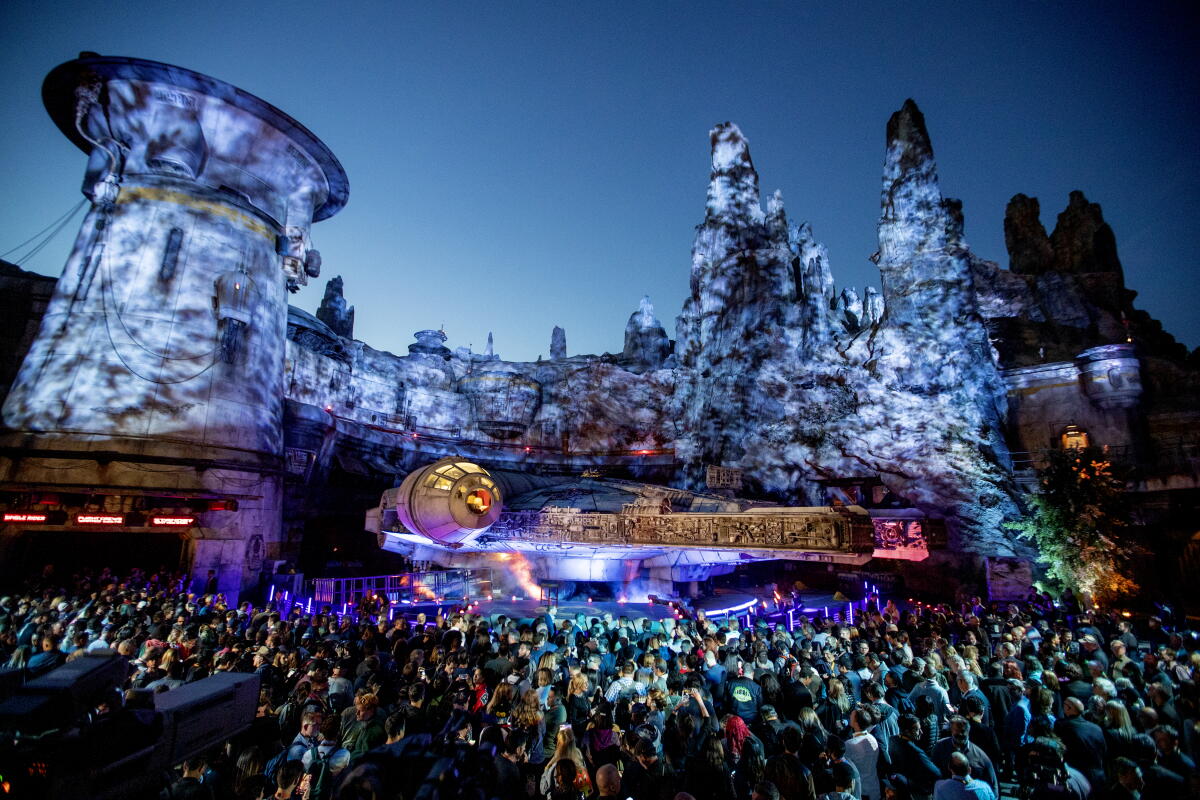
The centerpiece of Star Wars: Galaxy’s Edge is the Millennium Falcon.
(Allen J. Schaben / Los Angeles Times)
If I’m being honest, I am aware that Galaxy’s Edge seldom lived up to this promise. Imagineers teased many characters — a bounty hunter, for instance, who would hang in the cantina — who never appeared. In order to play, we need people to play with, and this playland often felt empty. Droids, for instance, would show up, but often only for a limited time. Teased features, such as Bluetooth technology that would allow the land to track a guest’s reputation, courtesy of missions they completed in the Play Disney Parks mobile app, never reached their fruition. That game itself, which is still available, thus lacks any meaningful payoff.
Galaxy’s Edge was a theme park risk, asking how deeply guests would want to engage in physical spaces. But it came with challenges, namely that as these lands grow, the level of activity needed to maintain the illusion increases. A promised dinner theater was never built, and a stage for a special effects-laden stunt show has largely sat barren. Disney also relied not on actors but its retail staff — cast members, in park parlance — to do the heavy lifting when it came to performing.
Many on social media are musing that Disney is now fixing Galaxy’s Edge. Let’s be clear, Galaxy’s Edge was never broken. It just needed Disney to be a better steward and to fully support the ambitions of its Imagineers.
Last week at Disneyland, when Darth Vader walked on a Galaxy’s Edge stage through a smattering of smoke, the crowd erupted as if at a sporting event. It was fun, and clearly something some fans had been craving.
So bring on Darth Vader and the rousing music of Williams, I reluctantly say. Disney should do what it does well, and that is to create memorable character experiences. Operationally, the park had abandoned the initial goals of Galaxy’s Edge long ago, and the presence of Han, Luke and Leia will excite guests and at last give attendees more characters to interact with. It will be a busy, bustling place, and that I do applaud.
The week in SoCal theme parks
Changes have been reported at Roger Rabbit’s Car Toon Spin.
(Christian Thompson / Disneyland Resort)
You can now get a “Star Wars” ID card in Downtown Disney. Located inside the Star Wars Trading Post shop is a plastic ID-making machine (similar to the fake driver’s license one can get in the queue for Autopia) that will take your photo and allow you to pick a role in the “Star Wars” universe (bounty hunter, fighter pilot, etc.). It looks neat. I want one, even though I don’t know what I would do with it, but so far, lines have averaged 90 minutes to two hours or more.
Roger Rabbit’s Car Toon Spin has lost its spin. Disneyland removed the ability for guests to twist and turn their cars, an operational-driven-tweak, as the ride now allows for lap seating for younger guests and will allow for more to experience the attraction. While I can see how some may miss the spinning feature, I often tried to keep the car steady to soak up the environment, so my initial reaction leans positive, especially if it improves a family’s Disneyland day.
Celebrate the 25th anniversary of the first “Harry Potter” film in an all-encompassing environment. Inglewood’s Cosm isn’t a theme park, but its dome-like screen offers a theme park-like experience (think the golden days of Circle-Vision). Opening Thursday is a re-imagined “Harry Potter and the Sorcerer’s Stone” with newly added environmental effects. The core film remains untouched, but the screen surrounding you aims to come alive with enchanting movement.
Magic Bands will soon disappear from Disneyland shelves. Disney reporter Scott Gustin, a friend of Mr. Todd’s Wild Ride, recently noted that Disneyland will not be replenishing its stock of the Magic Band+ once it sells through the remaining inventory. Those who have them (hand raised) needn’t worry, according to Disneyland officials, as Magic Band+ functionality, including the game Batuu Bounty Hunters in Galaxy’s Edge, won’t cease. But Magic Band+ has limited use cases at Disneyland, and never quite caught on here in the same way the wristbands have at Walt Disney World.
Happy birthday to the Great American Revolution. Magic Mountain’s classic coaster turns 50 this week, having opened on May 8, 1976. As part of the anniversary festivities, the park has restored its original name of the Great American Revolution (it was recently operating as the New Revolution). The ride is known for being the first modern looping coaster with a tubular steel track, earning it landmark status from American Coaster Enthusiasts.
The best thing I ate at the parks
A scallop appetizer at Carthay Circle. Go easy on me, I’m not a food photographer.
(Todd Martens / Los Angeles Times)
No churros or treats for me this week. I hadn’t had a chance yet to check out the spring menu at the lounge at Carthay Circle, Disney California Adventure’s fine dining restaurant, so I made my way there Friday afternoon. Carthay Circle is always a welcome respite, a calming, relaxing environment where the theme park day tends to slow down.
I was after the scallops appetizer. Now, priced at $16, I knew this wouldn’t be a large portion, but I was longing for something light and breezy and this plate of six small scallops in a sea shell delivered. Drizzled with macadamia nuts, the citrus-forward dish is designed to bring out contrasts in texture. Overall, it’s a little zesty, a little nutty, and as a seafood person I’m happy an affordable, delicate dish exists at the resort. If you’re really hungry, though, you’ll need a second item.
Ride report
Space Mountain has begun its yearly, temporary overlay as Hyperspace Mountain.
(Todd Martens / Los Angeles Times)
It’s “Star Wars” season at the Disneyland Resort, which means Space Mountain has been remade into Hyperspace Mountain. Now, generally speaking, this is my rule when it comes to ride overlays: The original is almost always better. That’s the case for Space Mountain as well, as the 1977 classic still thrills, its near pitch-blackness keeping you guessing while its uplifting score seems to capture the exhilaration and optimism of space flight.
But Hyperspace Mountain has its charms. The projections of lasers and X-wings look great in the darkness, and the sudden dips and turns work well for the dogfight atmosphere. The John Williams score brings the energy, and there’s the right amount of chaos and shifts in direction to make us feel as if we’re in a “Star Wars” battle. I’m just relieved, however, it doesn’t stick around too long, as the original is such a magnificent coaster.
Tell us your stories. Ask us your questions.
Have a theme park tale to share? Whether it was a good day or less-than-perfect day, I would love to hear about it. Have a question? A tip? A fun photo from the parks to share? Email me at todd.martens@latimes.com. I may feature your note in an upcoming newsletter.
Ride on,
Todd Martens
P.S.
Love Soarin’ Over California? Then I point you to this piece from former Times staffer Sammy Roth, an environmental reporter who also appreciates Disney theme parks. Here, Roth goes scene-by-scene, looking at how Soarin’ represents a snapshot in time and analyzing how its locations have been touched by climate change.
Normally his public persona is somebody who does not give much away but during the quarter-final win against Zebre in Italy, you saw a rare public image of him leading the celebrations.
“The huddle is a personal thing and it was great it was captured on screen, I was so proud of the players,” said Tiatia.
Former Wales fly-half James Hook played with Tiatia at Ospreys. Hook described him as “an animal on the field and your nan’s favourite off it”.
“You don’t see everything of me, maybe you see some of the little bits,” said Tiatia.
“What I give you is what I give you. When I’m watching the game I’m not overly emotional but people who know me, know the true me.”
Tiatia is in his first full season as head coach and believes getting to know the players has been a key component of any turnaround.
“One of the biggest things is around care for one another,” said Tiatia.
“Players and staff understanding each other on a deeper level, not just surface level, actually bone-deep.
“Understanding it’s people first and then understanding the player. That’s been a big shift, not just trying to get the best out of them but also having players take responsibility.”
Tiatia was asked what he meant by bone-deep. His answer was illuminating.
“Surface level is knowing people by face and respectfully saying hello,” said Tiatia.
“On a deeper level, I will introduce myself to you and tell you where I’m from.
“I’m from Wellington. I’m Samoan. My first language is English, it was Samoan, I speak Japanese. I speak a little Italian.
“I’m a learner, I’m an introvert, I’m a trained extrovert. When I’m stressed I’ll be quiet.
“When I will be quiet, I’m thinking about my family first and foremost.
“I was taught from my parents very early on that gratitude is one of the biggest strengths. You understand what you have and you’re grateful for it.
“Those are things I would share at a bone-deep level. We then have a deeper understanding about each other, about our morals and values.
“Also the mistakes I’ve made as a young person is something I can now relate to with the group.
“I don’t want the players to make the same mistakes and they’re becoming the best version of themselves. So it’s not just coaching. It’s holistic growth.”
Todd Martens’ newsletter delivers news and commentary on the past, present and future of theme parks, right from the theme park capital of the world — Southern California.
By continuing, you agree to our Terms of Service, which include arbitration and a class action waiver. You agree that we and our third-party vendors may collect and use your information, including through cookies, pixels and similar technologies, for the purposes set forth in our Privacy Policy such as personalizing your experience and ads.
And here at The Times, I have been writing about theme parks for more than a decade. As a journalist but also as a fan, even attempting to analyze my own love for these spaces and why I keep going back.
My entry to theme parks were trips to Florida’s Walt Disney World. These vacations were the highlight of my youth, helping a shy, awkward kid get out of his shell and discover a safe world of play. As I’ve gotten older, I’ve come to see parks as places that reflect our popular myths back to us, allowing us to live inside them and define a role for ourselves. I still insist on riding Pirates of the Caribbean each Disneyland visit, just as my father used to. It’s the second-greatest ride at the park, after all.
Take on a character and quest at Universal Studios
I am standing in front of a makeshift cemetery. On the paths between gravestones are colored footprints, as if left by cartoon characters. These are the trails of a suspect. Purple imprints are what I’m seeking.
I am on the case, and the Scooby-Doo gang is here to help: Velma, Daphne, Fred, Shaggy and, of course, Scooby-Doo himself. Left in the thorny bushes of the graveyard is a clue. Once the latter is discovered, I am one step closer to solving the mystery, one that has unleashed a host of Universal’s classic movie monsters on the ol’ Europe section of the studio’s backlot.
A mash-up of Universal’s classic monsters and “Scooby-Doo!” characters is featured in a game-like experience at Fan Fest Nights.
(Christina House / Los Angeles Times)
Can I and a few hundred strangers restore order and save the day?
Universal’s Fan Fest Nights is in its second year, and after a mixed debut last spring, the after-hours, specially-ticketed event has hit its stride. The centerpiece of the fest, which runs on select nights through May 16 with tickets starting at $74, is a mash-up of “Scooby-Doo!” and Universal’s Monsters, a lengthy game-focused quest with escape room-worthy puzzles.
Share via
The experience, as well as those focused on the worlds of “Harry Potter,” “Dungeons & Dragons” and anime sensation “One Piece,” are hefty, limited-time installations that would be worthy of including in a theme park’s daily operations, as the best of them experiment with character interactions and role play.
While exploring these pop-up worlds, I couldn’t help but think about how stagnant Disney’s own specially-ticketed events have become. Fan Fest and Universal’s Halloween Horror Nights change yearly, yet Disneyland’s popular Oogie Boogie Bash has become repetitive and its other themed nights are too reliant on photo ops and traditional character meet-and-greets.
Taken as a whole, Fan Fest resets expectations for what an after-hours, theme park event should be.
Here there are photo ops and limited-run food, sure (and I highly recommend the graham cracker-like Scooby Snack cookies), but Universal’s live theatrical team has placed the emphasis on exploratory attractions. Actors abound, allowing guests to lean in and take on an active role.
A “Harry Potter” experience at Fan Fest Nights is a walk through a fantastical forest looking for a magical creature.
(Christina House / Los Angeles Times)
In the Potter-focused “Forbidden Forest: Search for the Hippogriff,” we are amateur wizards on the prowl for a magical creature, in this case a majestic, oversized puppet. It reminded me of being a young Boy Scout and going on evening hikes into the woods with a guide regaling us with mysterious tales. In “Dungeons & Dragons: Secrets of Waterdeep,” a returning experience from last season, we are alternately adventurers and thieves.
And in the Scooby gang’s “The Case of the Phantom Director,” we are cast as extras in a film production. The Scooby Doo quest, the heart of the night, comes complete with a 14-page manual full of character bios, clues and missions. You’ll have to read, but it’s a bet that today’s guests are craving personal and interactive attractions that pull as much from immersive theater as they do classic theme parks. I applaud this sort of tinkering with the formula, even as I wonder how attendees will take to having to complete actual brain-teasers in a theme park. At least there is a payoff with a mini show (you do not need to complete the challenges to see the finale).
It took my friend and me more than an hour to solve the Scooby game, and, I confess, we didn’t complete one of the four mini-puzzles. While none of the head-scratchers individually are all that stressful, they are more complex than typical theme park fare and require guests to get out of a mindset of rushing from event to event. (Another friend of mine declared herself too “stupid” to complete the missions, but Scooby fans may simply enjoy living in the make-believe world and playing with the actors).
More of this kind of playful inventiveness, please. Magic isn’t always a fancy animatronic. Sometimes it’s just personalization.
A “One Piece”-inspired stunt show is a popular offering at Universal’s Fan Fest Nights.
(Christina House / Los Angeles Times)
The week in SoCal theme parks
Star Wars: Galaxy’s Edge will roll out some major changes on Wednesday. Out with Kylo Ren and in with Darth Vader (and Luke, Han and Leia). I’ll have more on this next week.
It’s your last chance to meet a Wall-E and Eve robotic figure at the Pixar Place Hotel. Wednesday is the final day currently on the schedule. This has been a popular meet and greet at the Disneyland Resort, so give yourself at least an hour, maybe more, to stand in line if it’s a priority for you.
Looking for a Disneyland deal? If you can get there midweek, single-day, single-park tickets can be had for $104 on Wednesday and Thursday. The friendlier price is also available next week, on May 5-6.
Universal Fan Fest Nights returns Friday through Sunday and while I clearly had a positive experience, if you’re considering going, be prepared for lines. The “Harry Potter” walk-through was a two-hour wait most of the evening. Queue up early, too, for the crowd-pleasing “One Piece” stunt show, as there were only three performances on opening night.
Disneyland has announced a host of new food options coming to the park this week, including blueberry cobbler doughnuts at Lamplight Lounge and a Philly cheesesteak at Pym Test Kitchen.
Facial recognition is now being used widely at Disneyland entrance gates. Disney isn’t the first theme park or major SoCal venue to utilize such technology, but Times news writer Hannah Fry spoke to guests about its implementation and delved into the ethical concerns surrounding it.
The best thing I ate at the parks
Universal Studios’ Scooby Snacks cookies are a delightful treat.
(Todd Martens / Los Angeles Times)
I mention this above, but as part of Fan Fest, Universal Studios has released a box of “Scooby Snacks.” They come in bundles of four, packaged in cute purple and green Girl Scout-inspired boxes. They are a delight, and only about $10. The honey & cinnamon dog tags also make a fine coffee accompaniment with breakfast as these are slightly oversize, graham cracker-style cookies. The only negative is you’ll need a Fan Fest ticket to snare them.
Ride report
There was recently a tweak to Universal Studios’ tram tour.
(Genaro Molina / Los Angeles Times)
The past couple weeks I’ve spent a significant amount of time at Universal Studios, partly in prep for Fan Fest and the arrival of the Fast & Furious coaster this summer, but I also wanted to take in its studio tram tour (officially designed as the World Famous Studio Tour). Aside from being a historic attraction, there was recently a change to its “King Kong” section. Namely, 3-D glasses are no longer required. As someone prone to motion sickness, this is a welcome change and I’m pleased to report it looks spiffy. Now if we could just do something about that stomach-churning “The Simpsons” ride.
Tell us your stories. Ask us your questions.
Have a theme park tale to share? Whether it was a good day or less-than-perfect day, I would love to hear about it. Have a question? A tip? A fun photo from the parks to share? Email me at todd.martens@latimes.com. I may feature your note in an upcoming newsletter.
Ride on,
Todd Martens
P.S.
I often work remotely from theme parks — find me on my laptop at Flo’s V8 Cafe at Disney California Adventure, near the Calico Saloon at Knott’s or out in back of the Three Broomsticks at Universal Studios. But even when I’m in a normal office, I still like to write with a bit of theme park optimism. So I turn to music.
My favorite bands (Wilco, the Clash, Sleater-Kinney) will distract, so lately I’ve been seeking instrumental fare. And Disneyland Paris has just released a gem of a work soundtrack. It re-imagined its second park as Disney Adventure World, and while I’m confused as to why my editor didn’t send me to Paris to review it (nudge, nudge), I’ve been consoling myself with the “Adventure Way Symphonic Suite” from the London Symphony Orchestra and French composer Philippe Rombi. It’s calming, a bit majestic, and reminds me of early days music at Florida’s Epcot. That is, it’s music that aims to conjure wonder.