Elderly Palestinians determined to stay in Gaza despite terrible conditions | Israel-Palestine conflict
The Rafah crossing between Gaza and Egypt has finally partially opened this week after two years of Israeli-mandated closure. The news offers relief for many – particularly those Palestinians in urgent need of treatment abroad.
But for many elderly Palestinians in Gaza, staying in the enclave is an act of survival, resistance, and historical memory. Rafah may be open, but they are not planning to go anywhere.
Recommended Stories
list of 3 itemsend of list
In Kefaya al-Assar’s mind, that decision to stay is an effort to correct what she perceives to have been a historical mistake made by her parents – fleeing their village of Julis, which was depopulated in the 1948 Nakba, and is now within Israel.
“We blamed [our parents] a lot for leaving our home there,” said the 73-year-old Kefaya.
Kefaya has faced displacement during Israel’s genocidal war on Gaza five times. Originally from Jabalia in northern Gaza, she now shelters in a classroom at a school in central Gaza’s Nuseirat.
Widowed in early 2023 and without children, she said displacement revives the trauma she inherited from her parents.
“History repeats itself now,” she said. “My parents lost all their money when they were forced to flee. We also used to have money, but now we are displaced and have lost everything.”
When Kefaya was a child, her family lived in tents in Gaza’s refugee camps, before they became more permanent structures in later decades. Now, she says that she is reliving that same fate.
“I don’t want to repeat history, I want to die in my own country,” she said. “Even here, being in Nuseirat, I feel like a stranger. I wish I could go back to Jabalia.”
Her home in Jabalia was destroyed during the war, meaning that, for now, she is staying in Nuseirat. But she is still adamant that it will not mean her departure from Gaza.
“I will not leave for medical treatment outside … I choose to die on my own land rather than be treated outside,” she said.
That’s despite her own medical issues – Kefaya suffers from high blood pressure, and has not been able to receive adequate medical care because of the war.
Hidden crisis
The Rafah crossing partially opened on Monday after being largely closed by Israel since May 2024.
The opening of the crossing is part of the second phase of the Gaza “ceasefire”, even as Israel continues to violate the agreement by regularly attacking the Palestinian enclave, killing hundreds.
Only a few dozen Palestinians have been allowed to leave so far, all patients needing treatments accompanied by family members.
Other Palestinians have also put their names on the list, some hoping to go abroad for education or simply to escape life in Gaza, where Israel has killed more than 70,000 since the war began, and destroyed the majority of buildings, meaning reconstruction will likely be a years-long process, even if Israel cooperates.
“Israel is creating unlivable conditions in Gaza, denying Palestinians all essentials of life,” said Talal Abu Rukba, a political science professor at al-Azhar University in Gaza. “When people resist and stay in their homeland, they ruin the Israeli project of creating an Israeli state on a land ‘without a people’”.
Members of the Israeli right-wing, including members of the government, have repeatedly called for illegal settlements to be established in Gaza, and for Palestinians to be forced out.
The desire to stay in Gaza on the part of elderly Palestinians is despite a largely overlooked humanitarian crisis facing the demographic.
Research by Amnesty International and HelpAge International found that Israel’s blockade of aid and medicines to Gaza had contributed to a “physical and mental health crisis”.
“During armed conflict, older people’s needs are often overlooked. In Gaza, older people are enduring an unprecedented physical and mental health collapse as a direct result of Israel’s deliberate infliction of conditions of life calculated to bring about the physical destruction of Palestinians in Gaza,” Erika Guevara-Rosas, Amnesty International’s senior director of research, advocacy, policy and campaigns, said after the publication of the report.
The two organisations found that 76 percent of the elderly people interviewed live in tents, with 84 percent saying that their living conditions harmed their health and privacy. In addition, 68 percent of respondents had been forced to stop or reduce medication because of a lack of availability. Nearly half reported skipping meals so that others could eat.
Many are also suffering from mental health problems, with 77 percent reporting that sadness, anxiety, loneliness, or insomnia had reduced their appetite and impacted their wellbeing.
![Nazmeya Radwan, 85, refugee since 1948, from the Jerusalem district, displaced in Deir al-Balah [Ola al-Asi/Al Jazeera]](https://i0.wp.com/www.aljazeera.com/wp-content/uploads/2026/02/image00004-1770323728.jpeg?w=640&ssl=1)
Tired and lonely
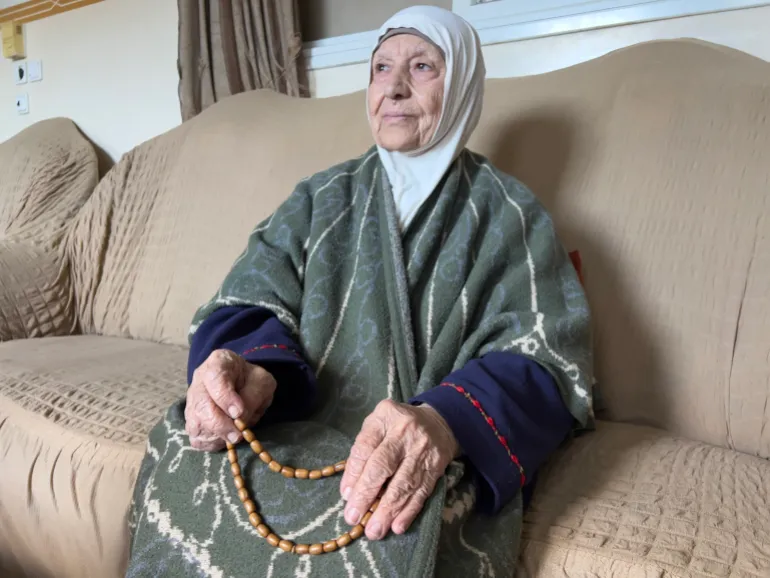
Nazmeya Radwan, 85, is one of those struggling.
Ill, underweight and unable to access medication, she still refuses to leave Gaza.
Nazmeya has her own previous experience of displacement at the hands of Israel – like Kefaya’s parents, she was forced to flee her home in the 1948 Nakba, along with about 750,000 other Palestinians.
Originally from Jerusalem, her family was displaced to Deir el-Balah, in central Gaza, after 1948.
“All my life was displacement and wars since the Nakba,” Nazmeya said. “I am 85, and tired, lonely, ill and displaced, but I would never leave Gaza. I would live as a beggar and homeless and never leave Gaza.”