david ellison

Why the FCC is unlikely to pull TV licenses over Iran news coverage

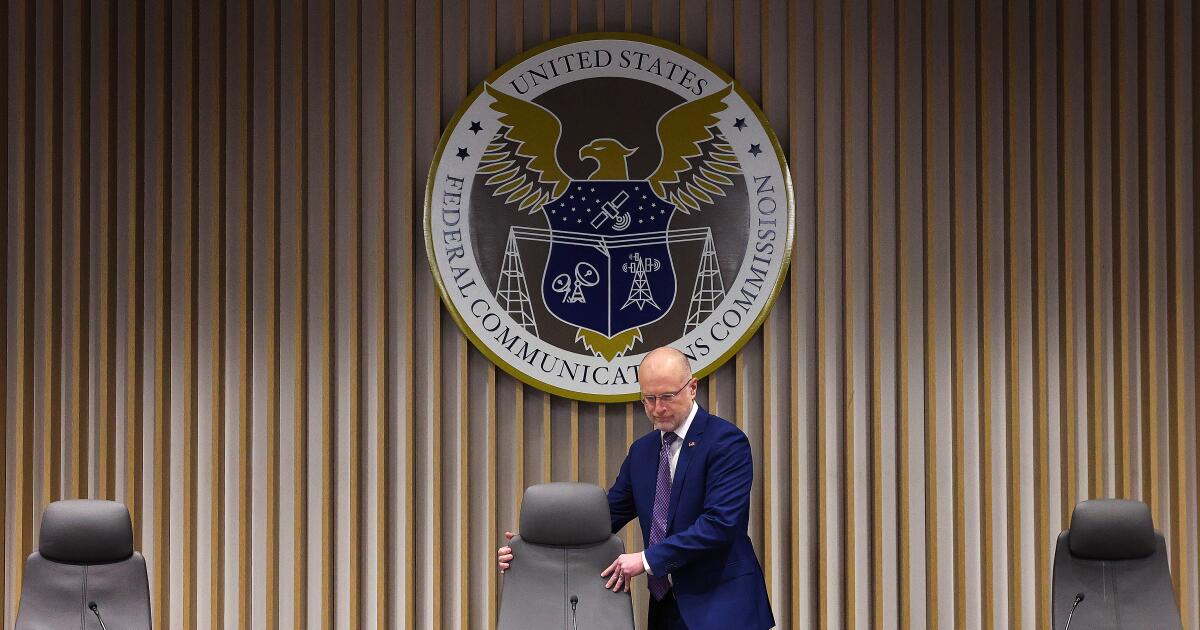
Federal Communications Commission Chairman Brendan Carr is using his bully pulpit to push back against coverage of the U.S. military action in Iran that his boss President Trump doesn’t like, marking an extraordinary escalation in his clashes with the media.

On Saturday, Carr posted a message on X suggesting TV stations could lose their government licenses to use the public airwaves if they “don’t operate in the public interest.”

Underneath his statement, Carr shared a social media post from Trump, who complained about the New York Times and Wall Street Journal stories on the five refueling tankers were hit during an Iranian missile strike on the Prince Sultan Air Base in Saudi Arabia.

Carr seized on Trump’s missive to issue a warning to TV outlets, which are frequently threatened by the president when he is angry at their coverage.

It’s the latest attempt by the FCC chair to apply pressure on media companies that irritate Trump with critical coverage of his administration.

Since becoming FCC chairman last year, Carr has repeatedly threatened to use the levers of power he has to punish TV and radio stations when they get in Trump’s crosshairs. His behavior has alarmed free speech advocates.

“Broadcasters that are running hoaxes and news distortions — also known as the fake news — have a chance now to correct course before their license renewals come up,” Carr wrote, without providing evidence to back up his claims. “The law is clear. Broadcasters must operate in the public interest, and they will lose their licenses if they do not.”

Carr’s threats are based on his assertions that said he wants to enforce the FCC’s public interest obligation for broadcasters that use the airwaves. He made similar remarks in the fall, which prompted two major TV station groups to keep ABC’s “Jimmy Kimmel Live!” off the air for a week due to remarks the host made regarding slain right-wing activist Charlie Kirk.

Trump and Defense Secretary Pete Hegseth have repeatedly attacked news organizations for any reporting that doesn’t say the war in Iran is anything but a rousing success.

On Friday, Hegseth said took aim at CNN and said “the sooner David Ellison takes over that network the better.”

Ellison, the chief executive of Paramount who, along with his father, has forged strong ties to the White House, will have control over CNN in addition to CBS if the company’s deal to acquire the news outlet’s parent Warner Bros. Discovery is completed.

Carr made the appointment of an ombudsman for CBS News a condition to approve Ellison’s Skydance Partners deal to acquire Paramount last year. Paramount also drew scrutiny over its controversial decision to pay $16 million to settle Trump’s legal salvo against “60 Minutes” over the editing of an interview with his 2024 opponent, then-Vice President Kamala Harris. Most legal analysts viewed the case as frivolous.

The FCC has no jurisdiction over CNN, which is why most of Carr’s barbs are aimed at ABC, CBS and NBC, which air on local TV stations. He once wrote on X, “More Americans trust gas station sushi than the legacy national media.”

Trump said in a social media post Sunday that he was “thrilled” with Carr’s remarks and would support his efforts to go after what he called “Highly Unpatriotic ‘News’ Organizations.”

“They get Billions of Dollars of FREE American Airwaves, and use it to perpetuate LIES, both in News and almost all of their Shows, including the Late Night Morons, who get gigantic Salaries for horrible ratings,” Trump wrote.

Andrew Jay Schwartzman, a Washington-based public interest communications attorney, believes Carr’s conduct and threats violate the 1st Amendment, adding that any serious attempt to revoke licenses would be tied up in legal challenges.

“Even if he started to try to deny a license renewal as quickly as he could, Brendan Carr would be long gone before that case would be over,” Schwartzman said. “The law intentionally sets out a very steep burden for the FCC to deny a license renewal; the process takes many years, during which time the licensee continues to operate normally under ‘continuing operating authority.’”

Carr’s remarks Saturday drew immediate blowback from Democrats and 1st Amendment advocates, noting the FCC’s role does not include policing the free press.

“Once again, this FCC pretends it has the power to control news coverage,” FCC Commissioner Anna Gomez said Monday in a statement. “In reality, the FCC has vanishingly little power over national news networks. It licenses local broadcast stations, not networks, and no licenses are up for renewal until 2028.”

Calif. Gov. Gavin Newsom weighed in as well, posting, “If Trump doesn’t like your coverage of the war, his FCC will pull your broadcast license. That is flagrantly unconstitutional.”

Sen. Ron Johnson (R-Wis.), usually a reliable voice of support for the Trump administration, expressed his concerns over Carr’s remarks.

“I’m a big supporter of the 1st Amendment,” Johnson told Fox News on Sunday. “I do not like the heavy hand of government no matter who’s wielding it. I’d rather the federal government stay out of the private sector as much as possible.”

Gomez added that while attempts to pull licenses border on folly, Carr’s threats and attacks on the media can create a chilling effect and erode the public’s confidence in the press.

“Over the past year, this FCC has attacked the media as part of a years-long campaign by this Administration and its allies to discredit factual, independent coverage while blaming the press for growing public distrust,” Gomez said. “Meanwhile, it is the FCC’s own credibility and public trust that are rapidly eroding.”

Trump is not the first president to target TV station licenses in response to negative news coverage. At the height of the Watergate scandal in the 1970s, Richard Nixon’s allies attempted to challenge the TV licenses for three stations owned at the time by the Washington Post.

The effort didn’t get far.

The last Los Angeles outlet to lose its broadcast license was KHJ in 1987, when the station was part of RKO General, a media company owned by the General Tire and Rubber Co. The case was related to corporate malfeasance and not broadcast content on the stations.

The process to revoke the RKO licenses took seven years from the moment the FCC voted in favor of the move.

“Since then, only small mom-and-pop radio stations have been litigated,” Schwartzman said. “The cases nearly always involve lying to the government, felony convictions or failure to pay regulatory fees. In one recent case, a small owner convicted of tax evasion still kept his license.”

There would be other logistical hurdles to the FCC making good on Carr’s threats.

As Gomez noted, Carr’s FCC only has regulatory control over the TV stations that carry the network signals. If stations were drop network programming for any reason, they could violate their affiliation contracts and lose the right to carry NFL football and other content that delivers big ratings and revenue.

Sinclair Broadcast Group wanted Kimmel to apologize to Kirk‘s family and contribute to his organization Turning Point USA before putting the host’s late night show on the air.

That did not happen and “Jimmy Kimmel Live!” returned to Sinclair’s stations anyway.
Source link

How ties with Vegas gambler could topple Jeff Shell’s career

It’s a mystery that has transfixed Hollywood:

How did Jeff Shell, who is seven months into his tenure as president of Paramount Skydance, get entangled with a professional gambler with a penchant for controversy?

Shell looked to be on his way to a high-profile comeback after losing his job as NBCUniversal chief executive three years ago over an inappropriate relationship with an underling.

Now he’s facing new scrutiny after his Paramount bosses hired a law firm to investigate his surreptitious dealings with a Las Vegas high-roller and self-styled “fixer.” Investigators are reviewing whether Shell leaked sensitive corporate secrets, according to two people familiar with the matter who were not authorized to comment.

The real-life drama features accusations of betrayal, vengeance and an alleged promise of a TV show deal.

Paramount declined to comment. An attorney for Shell also declined to comment, citing the ongoing review.

How this plays out for Shell remains to be seen, but the ongoing tempest has created a headache for Paramount’s leaders, coming just as David Ellison’s company was clinching its nearly six-month pursuit of Warner Bros. Discovery.

Last week, Paramount toppled Netflix with its $110-billion deal to claim HBO, CNN, Food Network and the storied Warner Bros. movie and TV studios, a key piece of Ellison’s ambitions to create a Hollywood behemoth by combining two century-old firms.

“The timing is terrible,” said Stephen Galloway, dean of Chapman University’s Dodge College of Film and Media Arts. “The last thing Paramount wants when closing this deal is for one of its [corporate] officers to be faced with allegations, true or false, from a professional gambler who calls himself Robin Hood.”

An unusual meeting in 2024

This account is based on interviews with nearly a dozen industry insiders who are familiar with the players and details of the increasingly ugly dispute. The Times granted anonymity to the sources, most of whom were not authorized to speak publicly.

According to these people, Shell’s dealings with the blackjack player began with an odd meeting in August 2024.

At the time, Shell was just joining Ellison’s team as the technology scion was preparing to build a new Hollywood empire.

But Shell was facing a serious problem. Someone was trying to plant unfavorable stories about him from his NBC days just as he was poised to stage his second act, two of the sources said.

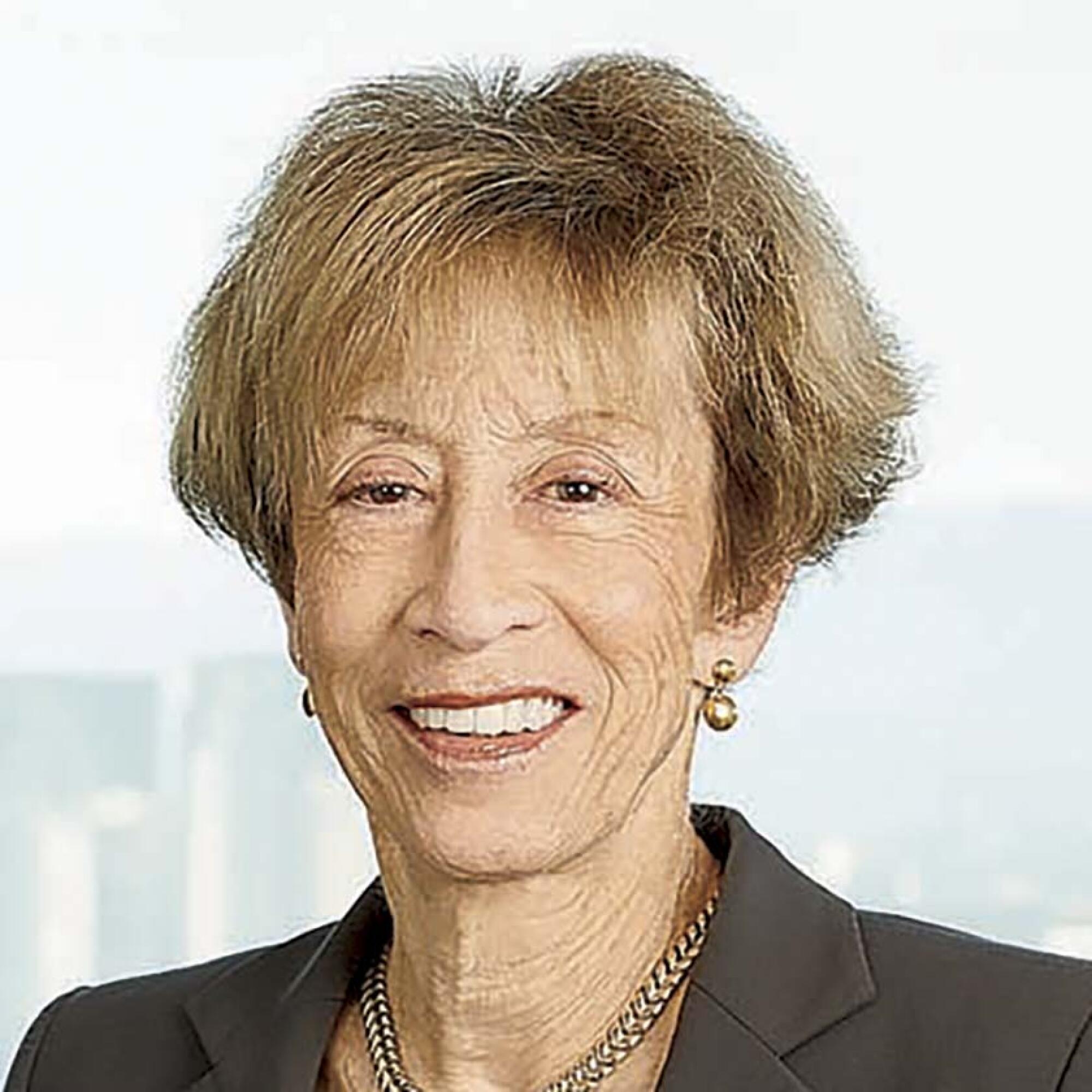
Enter Patty Glaser, the high-powered entertainment litigator who represents Shell, and, as it happens, the person they suspected was behind the whisper campaign: Robert James “R.J.” Cipriani.

Litigator Patty Glaser

Patty Glaser wanted to defuse the tensions between R.J. Cipriani and Jeff Shell.

To defuse the tensions, Glaser convened a meeting at her Century City offices between Shell and her other client, Cipriani, who is a self-professed whistleblower and high-stakes gambler who goes by the handle RobinHood702 (the Las Vegas area code). Shell attended the meeting at Glaser’s recommendation.

Cipriani wanted to meet the executive. He had been angry ever since Shell sacked his friend Ron Meyer, former vice chairman of NBCUniversal, in 2020.

One of the founders of talent giant CAA, Meyer filled a unique role at NBCUniversal as the self-deprecating and beloved sage in a wool vest who was often called on to finesse frayed relationships with producers, agents and talent.

But Meyer was bounced by NBCUniversal, then led by Shell, after he made a secret settlement to keep a lid on a nearly decade-old tryst with British actor Charlotte Kirk.

Former Vice Chairman of NBCUniversal Ron Meyer in 2020.

Ron Meyer, former vice chairman of NBCUniversal, remains beloved in Hollywood.

(Kevin Winter / Getty Images for AFI)

Kirk had an affair with another studio boss, Kevin Tsujihara, who resigned as Warner Bros. chairman in 2019 after it was revealed that he tried to help her get parts in movies and TV shows.

Meyer had said that after the payment was made, associates of Kirk allegedly demanded more money to keep the affair quiet.

Kirk’s associates denied any wrongdoing, but those dealings ended Meyer’s 25-year tenure at Universal.

Cipriani, according to a source familiar with the situation, was galled that Meyer had been unceremoniously dumped, particularly after it was revealed that Shell also had been engaged in an improper relationship — with a CNBC anchor.

Other Hollywood friends shared the sentiment — a form of schadenfreude — after Shell got his comeuppance nearly three years later.

Jeff Shell in 2015.

Jeff Shell in 2015.

(Rick Loomis / Los Angeles Times)

During the meeting at Glaser’s office, the two men discussed their families. Cipriani appeared to have a change of heart.

He told Shell that he would be his friend and personal “crisis PR” agent helping him with damage control, one of the sources said.

It was an unlikely pairing; the two men came from entirely different worlds.

Shell, 60, is a Los Angeles native — a relentlessly driven son of a Cedars-Sinai cardiologist and a teacher turned stay-at-home mom. Although only about 5-foot-9, Shell secured a spot on the University High varsity basketball team after spending long hours perfecting his jump shot.

He earned a degree in economics and applied mathematics from UC Berkeley, then an MBA from Harvard University.

“He’s often the smartest guy in the room,” a former high-level NBCUniversal executive said.

Comcast NBCUniversal building in 2025.

Jeff Shell previously ran NBCUniversal.

(Myung J. Chun / Los Angeles Times)

Shell has worked in the entertainment business more than 30 years, first at Walt Disney Co., then Rupert Murdoch’s Fox, where he briefly ran its cable networks. The TV executive moved to Philadelphia in 2004 to join Comcast, when its business was selling cable channels to subscribers.

When Comcast bought NBCUniversal in 2011, Shell’s stock was on the rise. He ran NBC’s international operations in London, then moved his family back home to Los Angeles when he became chairman of Universal’s prestigious film unit.

Meyer, who previously ran the studio, was tasked with showing Shell the movie business ropes.

Cipriani, 64, knew Meyer from gambling circles. The two men are friends, the sources said, although Meyer was not involved in the current dust-up, according to several of the people.

Cipriani grew up in Philadelphia, where his dad had worked for the Uniroyal tire company, according to an obituary.

It’s unclear when Cipriani came to L.A., but eventually he became a whistleblower who frequently made contact with journalists. He’s married to a former Brazilian model and actor/musical artist, Greice Santo, who had a small role in the CW’s “Jane the Virgin.”

Cipriani’s name went from the Vegas casinos to the headlines in 2017 when he was a key player in the arrest and conviction of a USC quarterback-turned global drug kingpin, Owen Hanson, who was sentenced to 21 years in federal prison.

Robert James "R.J." Cipriani in Amazon Prime Video's 2025 series, "Cocaine Quarterback."

Robert James “R.J.” Cipriani in Amazon Prime Video’s 2025 series, “Cocaine Quarterback.”

(Courtesy of Prime Video)

Cipriani tipped off the FBI in the case. Hanson allegedly gave Cipriani $2.5 million to launder but instead Cipriani lost the money in a blackjack game. In a YouTube interview, Cipriani claimed Hanson threatened him.

Cipriani has publicly taken issue with his portrayal as a money launderer in the popular Amazon Prime Video series “Cocaine Quarterback,” which brought the scandal to the screen. It’s a production of Mark Wahlberg and others.

Although Cipriani is often referred to as an “FBI informant,” the moniker rankles him. He prefers being called a “confidential human source for the feds,” who “goes after the bad guys,” according to those familiar with his thinking.

And Cipriani is not afraid to tangle with powerful people.

“Jeff Shell may have [gone to] Harvard Business School but R.J. Cipriani comes from the hardscrabble streets of Philly,” Cipriani’s attorney Steven Aaronoff told The Times. “Who’s going to win that war?”

Cipriani was arrested in 2021 on the casino floor of Resorts World Las Vegas, allegedly for snatching the cellphone of another gambler who Cipriani said was recording his movements.

The charge was dropped, but Cipriani has since brought a RICO lawsuit against Resorts World that alleges the firm allowed “known criminals involved in illegal gambling” and “money laundering” while also spearheading his ban from Vegas casinos.

Cipriani alleged his arrest and subsequent treatment was in retaliation for raising his concerns with casino management and law enforcement. A former president of the casino called the claims “ridiculous,” according to the Las Vegas Review-Journal.

Cipriani and Shell texted on-and-off for about 18 months, according to the knowledgeable people.

In the first half of last year, as Ellison and his team were waiting for the blessing of President Trump and the Federal Communications Commission to finalize the Paramount takeover, the group was bedeviled by press leaks.

Some were reported by Hollywood newsletters, including a scoop that Matt and Ross Duffer, who created the blockbuster horror series “Stranger Things” for Netflix, were decamping to Ellison’s Paramount. Shell was not aware of the Duffers’ deal before it was announced, said a person close to the executive.

Fallout over a TV show

But Shell and Cipriani had a major falling out when Cipriani began angling for a television show.

According to people familiar with the dispute, Cipriani worked for months without compensation but, at one point, Shell had thanked him for his efforts and offered to help him out. That’s when Cipriani asked Shell to greenlight an English version of a Spanish-language music show that streams on Roku TV, “Serenata De Las Estrellas.”

The TV project, like the Spanish-language version, would be co-executive produced by Cipriani and his wife, Santo.

But Shell failed to deliver, and Cipriani became furious.

“Mr. Shell promised to give my client, to produce the English language version of the show that was already a Spanish language hit,” Aaronoff said. “It was not something that was risky … It was not some crazy idea,” adding that Shell “did not keep his word to my client.”

Cipriani — who also has producer credits on the 2020 documentary about Vegas, “Money Machine: Behind the Lies,” and the 2015 movie, “Wild Card” — had intended to make “Serenata” as a homage to his late mother, Regina.

It was inspired by a song that Cipriani used to sing to her when he was growing up.

Paramount Pictures on Melrose Ave.  (Brian van der Brug / Los Angeles Times)

Jeff Shell became president of Paramount Skydance last summer.

(Brian van der Brug/Los Angeles Times)

Cipriani has threatened to file a lawsuit that makes a range of allegations, including that Shell had been slipping Cipriani sensitive corporate information, according to sources who have seen a copy of Cipriani’s draft complaint.

Shell, who officially joined Paramount in August with the Ellison takeover, immediately disclosed Cipriani’s legal threat to Paramount’s top lawyer and his previous employer RedBird Capital Partners, a Paramount investor partner.

According to the Hollywood Reporter, Cipriani also filed a whistleblower complaint with the Securities and Exchange Commission, alleging Shell alerted him to a then-pending $7.7-billion deal for the rights to UFC fights. But deal details did not leak in advance of Paramount’s announcement.

“We were presented with a draft complaint riddled with clear errors of fact and law,” attorney Glaser said in a statement last week. “We will strongly respond.”

The lawsuit hasn’t been filed, but Paramount hired Gibson Dunn lawyers to investigate Shell’s conduct and allegations contained in the draft, which was sent to Paramount.

On Friday, Cipriani wrote on X that he’d had “a great chat” the previous day with Gibson Dunn lawyers.

Source link

Power, politics and a $2.8-billion exit: How Paramount won Warners

The morning after Netflix clinched its deal to buy Warner Bros., Paramount Skydance Chairman David Ellison assembled a war room of trusted advisors, including his billionaire father, Larry Ellison.

Furious at Warner Bros. Discovery Chief David Zaslav for ending the auction, the Ellisons and their team began plotting their comeback on that crisp December day.

To rattle Warner Bros. Discovery and its investors, they launched a three-front campaign: a lawsuit, a hostile takeover bid and direct lobbying of the Trump administration and Republicans in Congress.

“There was a master battle plan — and it was extremely disciplined,” said one auction insider who was not authorized to comment publicly.

Netflix stunned the industry late Thursday by pulling out of the bidding, clearing the way for Paramount to claim the company that owns HBO, HBO Max, CNN, TBS, Food Network and the Warner Bros. film and television studios in Burbank. The deal was valued at more than $111 billion.

The streaming giant’s reversal came just hours after co-Chief Executive Ted Sarandos met with Atty Gen. Pam Bondi and a deputy at the White House. It was a cordial session, but the Trump officials told Sarandos that his deal was facing significant hurdles in Washington, according to a person close to the administration who was not authorized to comment publicly.

Even before that meeting, the tide had turned for Paramount in a swell of power, politics and brinkmanship.

“Netflix played their cards well; however, Paramount played their cards perfectly,” said Jonathan Miller, chief executive of Integrated Media Co. “They did exactly what they had to do and when they had to do it — which was at the very last moment.”

Key to victory was Larry Ellison, his $200-billion fortune and his connections to President Trump and congressional Republicans.

Paramount also hired Trump’s former antitrust chief, attorney Makan Delrahim, to quarterback the firm’s legal and regulatory action.

Republicans during a Senate hearing this month piled onto Sarandos with complaints about potential monopolistic practices and “woke” programming.

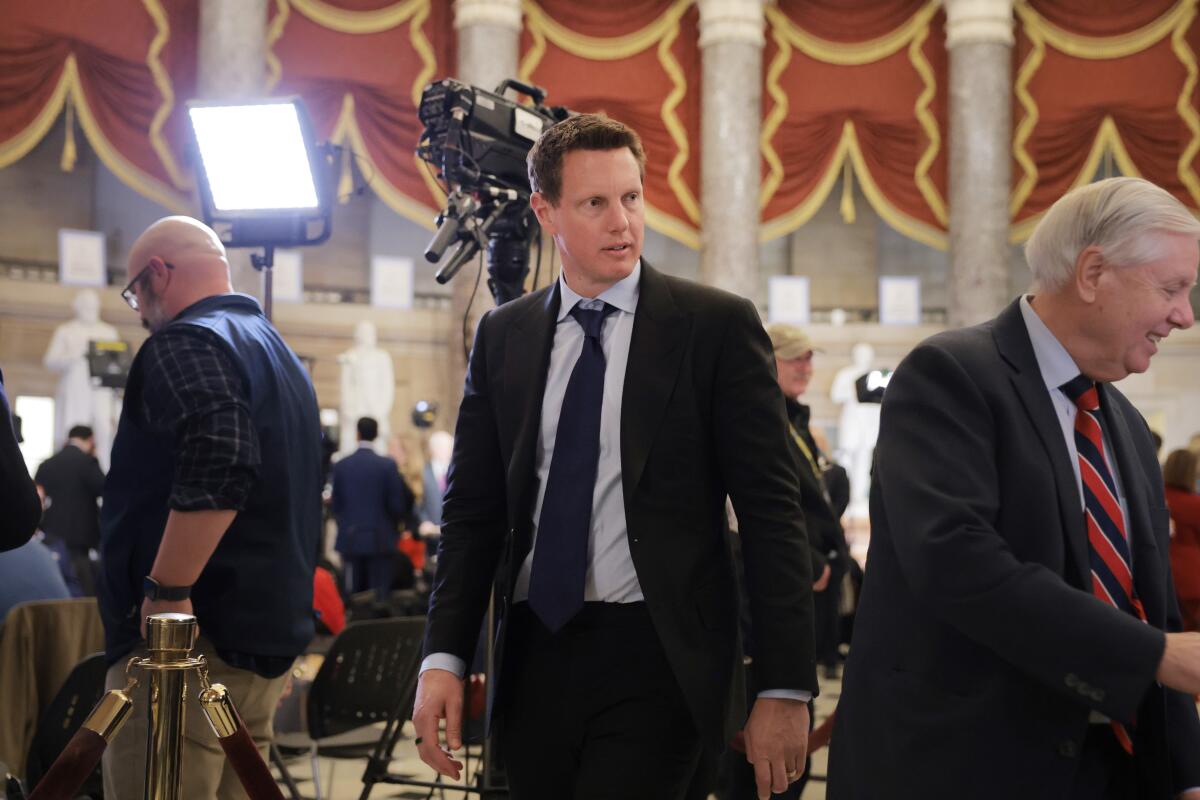
David Ellison skipped that hearing. This week, however, he attended Trump’s State of the Union address in the Capitol chambers, a guest of Sen. Lindsey Graham (R-S.C.). The two men posed, grinning and giving a thumbs-up, for a photo that was posted to Graham’s X account.

David Ellison, the chairman of Paramount Skydance Corp. walks through Statuary Hall to the State of the Union address

David Ellison, the chairman and chief executive of Paramount Skydance Corp., walks through Statuary Hall to the State of the Union address at the U.S. Capitol on Feb. 24, 2026.

(Anna Moneymaker / Getty Images)

On Friday, Netflix said it had received a $2.8-billion payment — a termination fee Paramount agreed to pay to send Netflix on its way.

Long before David Ellison and his family acquired Paramount and CBS last summer, the 43-year-old tech scion and aircraft pilot already had his sights set on Warner Bros. Discovery.

Paramount’s assets, including MTV, Nickelodeon and the Melrose Avenue movie studio, have been fading. Ellison recognized he needed the more robust company — Warner Bros. Discovery — to achieve his ambitions.

“From the very beginning, our pursuit of Warner Bros. Discovery has been guided by a clear purpose: to honor the legacy of two iconic companies while accelerating our vision of building a next-generation media and entertainment company,” David Ellison said in a Friday statement. “We couldn’t be more excited for what’s ahead.”

Warner’s chief, Zaslav, who had initially opposed the Paramount bid, added: “We look forward to working with Paramount to complete this historic transaction.”

Netflix, in a separate statement, said it was unwilling to go beyond its $82.7-billion proposal that Warner board members accepted Dec. 4.

“We believe we would have been strong stewards of Warner Bros.’ iconic brands, and that our deal would have strengthened the entertainment industry and preserved and created more production jobs,” Sarandos and co-Chief Executive Greg Peters said in a statement.

“But this transaction was always a ‘nice to have’ at the right price, not a ‘must have’ at any price,” the Netflix chiefs said.

Netflix may have miscalculated the Ellison family’s determination when it agreed Feb. 16 to allow Paramount back into the bidding.

The Los Gatos, Calif.-based company already had prevailed in the auction, and had an agreement in hand. Its next step was a shareholder vote.

“They didn’t need to let Paramount back in, but there was a lot of pressure on them to make sure the process wouldn’t be challenged,” Miller said.

In addition, Netflix’s stock had also been pummeled — the company had lost a quarter of its value — since investors learned the company was making a Warner run.

Upon news that Netflix had withdrawn, its shares soared Friday nearly 14% to $96.24.

Netflix Co-CEO Ted Sarandos arrives at the White House

Netflix Chief Executive Ted Sarandos arrives at the White House on Feb. 26, 2026.

(Andrew Leyden / Getty Images)

Invited back into the auction room, Paramount unveiled a much stronger proposal than the one it submitted in December.

The elder Ellison had pledged to personally guarantee the deal, including $45.7 billion in equity required to close the transaction. And if bankers became worried that Paramount was too leveraged, the tech mogul agreed to put in more money in order to secure the bank financing.

That promise assuaged Warner Bros. Discovery board members who had fretted for weeks that they weren’t sure Ellison would sign on the dotted line, according to two people close to the auction who were not authorized to comment.

Paramount’s pressure campaign had been relentless, first winning over theater owners, who expressed alarm over Netflix’s business model that encourages consumers to watch movies in their homes.

During the last two weeks, Sarandos got dragged into two ugly controversies.

First, famed filmmaker James Cameron endorsed Paramount, saying a Netflix takeover would lead to massive job losses in the entertainment industry, which is already reeling from a production slowdown in Southern California that has disrupted the lives of thousands of film industry workers.

Then, a week ago, Trump took aim at Netflix board member Susan Rice, a former high-level Obama and Biden administration official. In a social media post, Trump called Rice a “no talent … political hack,” and said that Netflix must fire her or “pay the consequences.”

The threat underscored the dicey environment for Netflix.

Additionally, Paramount had sowed doubts about Netflix among lawmakers, regulators, Warner investors and ultimately the Warner board.

Paramount assured Warner board members that it had a clear path to win regulatory approval so the deal would quickly be finalized. In a show of confidence, Delrahim filed to win the Justice Department’s blessing in December — even though Paramount didn’t have a deal.

This month, a deadline for the Justice Department to raise issues with Paramount’s proposed Warner takeover passed without comment from the Trump regulators.

“Analysts believe the deal is likely to close,” TD Cowen analysts said in a Friday report. “While Paramount-WBD does present material antitrust risks (higher pay TV prices, lower pay for TV/movie workers), analysts also see a key pro-competitive effect: improved competition in streaming, with Paramount+ and HBO Max representing a materially stronger counterweight to #1 Netflix.”

Throughout the battle, David Ellison relied on support from his father, attorney Delrahim, and three key board members: Oracle Executive Vice Chair Safra A. Catz; RedBird Capital Partners founder Gerry Cardinale; and Justin Hamill, managing director of tech investment firm Silver Lake.

In the final days, David Ellison led an effort to flip Warner board members who had firmly supported Netflix. With Paramount’s improved offer, several began leaning toward the Paramount deal.

On Tuesday, Warner announced that Paramount’s deal was promising.

On Thursday, Warner’s board determined Paramount’s deal had topped Netflix. That’s when Netflix surrendered.

“Paramount had a fulsome, 360-degree approach,” Miller said. “They approached it financially. … They understood the regulatory environment here and abroad in the EU. And they had a game plan for every aspect.”

On Friday, Paramount shares rose 21% to $13.51.

It was a reversal of fortunes for David Ellison, who appeared on CNBC just three days after that war room meeting in December.

“We put the company in play,” David Ellison told the CNBC anchor that day. “We’re really here to finish what we started.”

Times staff writer Ana Cabellos and Business Editor Richard Verrier contributed to this report.

Source link