[UPDATED] Venezuela: US Court Rules Against Maduro, State Officials, Awards Damages to Former Prisoners
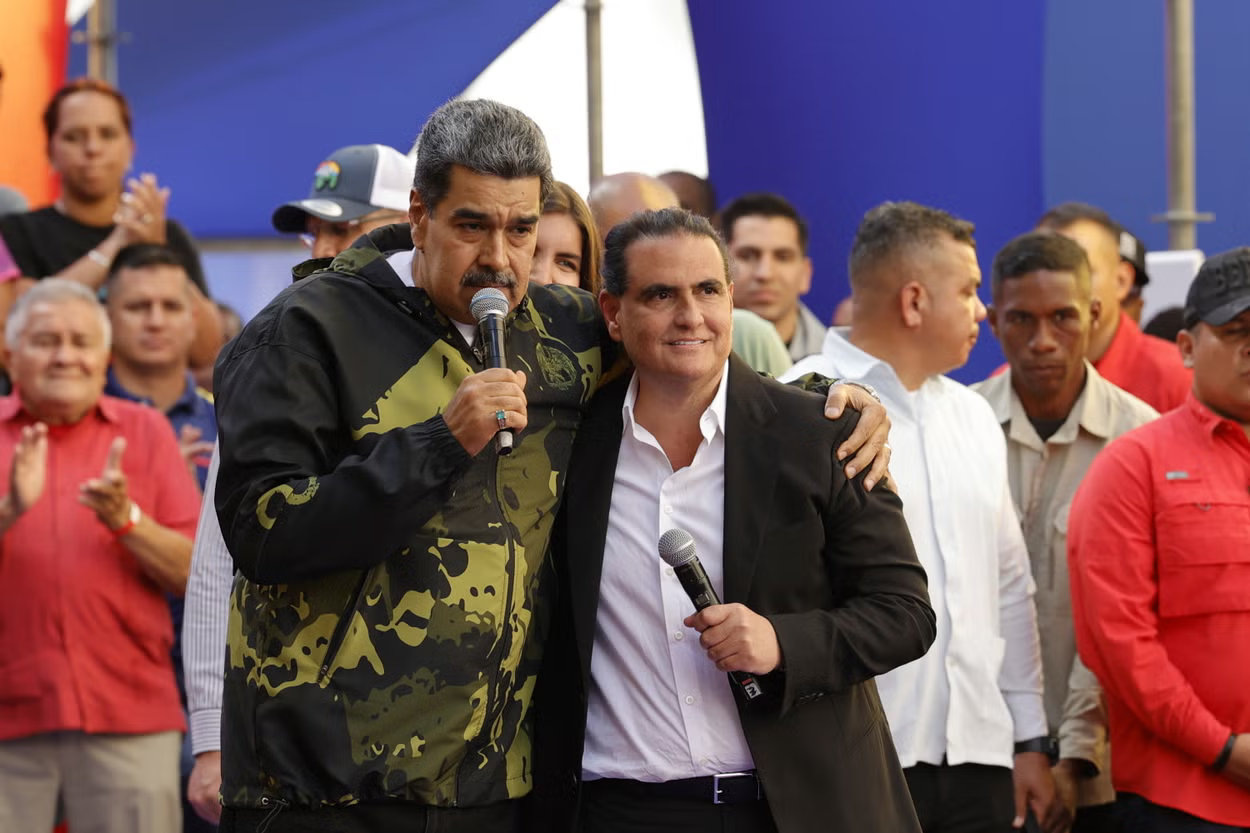
President Maduro and former minister Saab were among those targeted by the civil lawsuit. (AP)
Caracas, July 20, 2026 (venezuelanalysis.com) – A US federal judge has issued a default ruling against Venezuelan President Nicolás Maduro and several current and former state officials. US $314 million in damages was awarded to three US citizens who spent time imprisoned in Venezuela.
Venezuelan authorities have yet to comment on the case. Legal proceedings against Acting President Delcy Rodríguez continue. However, on Monday, the Trump administration sent a letter to the court arguing that, as a sitting head of state recognized by Washington, Rodríguez should be “entitled to immunity.”
Judge Darrin P. Gayles from the District Court for the Southern District of Florida published the verdict on July 14. US nationals Jerrel Kenemore, Jason Saad, and Edgar José Marval brought a civil lawsuit in August 2025 under Florida’s Anti-Terrorism Act (ATA) and the federal RICO statute against organized crime.
The three US citizens were released from Venezuela in December 2023 as part of a prisoner swap agreement with the Biden administration that saw former Venezuelan government envoy Alex Saab returned to the South American country.
The plaintiffs sought damages after claiming to have suffered “physical and psychological torture” while imprisoned in Venezuela and to have been used as part of “hostage diplomacy” to secure Saab’s release. The judge claimed that Maduro and other officials were a “criminal enterprise” that acted against US interests.
“The Maduro Criminal Enterprise committed myriad predicate offenses through its drug trafficking and kidnapping actions in and against the United States and its citizens,” he wrote in the verdict. The court estimated compensation for “kidnapping and torture” and “solatium, pain and suffering” under ATA that totaled $312.5 million and added $1.5 million in RICO damages.
Gayles entered the default ruling against Maduro after he failed to enter a defense or plea before the court. The court clerk entered similar defaults against Interior Minister Diosdado Cabello, former Defense and current Agriculture Minister Vladimir Padrino López, former Interior Minister Néstor Reverol, former Attorney General Tarek William Saab, former Supreme Court President Maikel Moreno, and former Industry Minister Alex Saab.
Maduro and First Lady Cilia Flores were kidnapped by US forces on January 3 and are facing charges including “narcoterrorism” and drug trafficking conspiracy. Both have pleaded not guilty, with the next hearing scheduled for July 22.
The Florida judge also included the so-called Cartel de los Soles, an alleged drug trafficking outfit run by high-ranking Venezuelan officials, as a defaulting defendant. Crime researchers have cast doubt on the existence of the cartel, while the US Justice Department dropped all references to it in the formal indictment against Maduro and Flores.
Similarly, Gayles claimed that “for at least twenty years, Maduro intentionally inundated the United States with tons of cocaine.” However, US officials have never presented evidence tying Maduro to narcotics activities, while reports from the DEA have consistently found that a very small percentage of US-bound drugs flow through Venezuela.
The US Justice Department has since 2020 introduced $25 million and $15 million bounties, respectively, for the arrest of Cabello and Padrino in connection with alleged “narcoterrorism.”
According to the Associated Press, Saab’s legal representatives declined to comment on the case. The acting Rodríguez government turned over the Colombian-born businessman, who served as industry minister after his 2023 release, to US authorities in May. He is being held at the Federal Detention Center in Miami while facing trial on renewed money laundering charges.
In contrast to Maduro, Cabello, and others, Acting President Rodríguez responded to the lawsuit in April, with lawyers contending that, as Venezuelan head of state, she should be immune from civil action. Rodríguez received the backing of the Trump administration via a July 20 letter “suggesting” to the court that the acting president should enjoy immunity,
“The United States respectfully submits to the Court that President Delcy Rodríguez is immune in this action and all claims against her should be dismissed without prejudice,” the letter concluded. The US State Department also intervened in June, requesting that the Justice Department communicate Rodríguez’s immunity to the Florida district court in order to secure a “prompt dismissal of the proceedings.”
Rodríguez’s brother, National Assembly President Jorge Rodríguez, filed a similar motion to set aside the lawsuit via a different legal team. The plaintiffs opposed the moves in another motion at the end of April.
The civil lawsuit likewise targeted state-owned companies Petróleos de Venezuela, SA (PDVSA) and Corporación Venezolana de Petróleo (CVP). The two firms have claimed immunity from civil litigation under the Foreign Sovereign Immunities Act.
The plaintiffs have not disclosed any strategy to collect the awarded damages. None of the defaulting defendants has any publicly known assets under US jurisdiction.
Edited by Lucas Koerner in Caracas.
[Updated on July 21 to include the Trump administration and State Department letters to the court endorsing immunity for Venezuelan Acting President Delcy Rodríguez.]