Sundance 2026: ‘American Pachuco: The Legend of Luis Valdez’ Q&A
A “brujo,” a “magician,” “a social arsonist” and the “father of Chicano Theater” — these are just a few of the monikers that have been bestowed upon Luis Valdez over the course of his decades-long career. The 85-year-old filmmaker and playwright is responsible for “La Bamba” and “Zoot Suit,” films that raised a generation of Latinos and are now upheld as classics — both were inducted to the National Film Registry of the U.S. Library of Congress.
Valdez awakened a movement, bringing Chicanos from the California fields he grew up working in to stages and screens all over the world. His stories shifted the frame, placing us at the forefront of the American story, allowing us to see our dreams, anxieties and struggles reflected back at us. In David Alvarado’s upcoming documentary, “American Pachuco: The Legend of Luis Valdez,” it’s the celebrated storyteller’s turn to be on the other side of the lens.
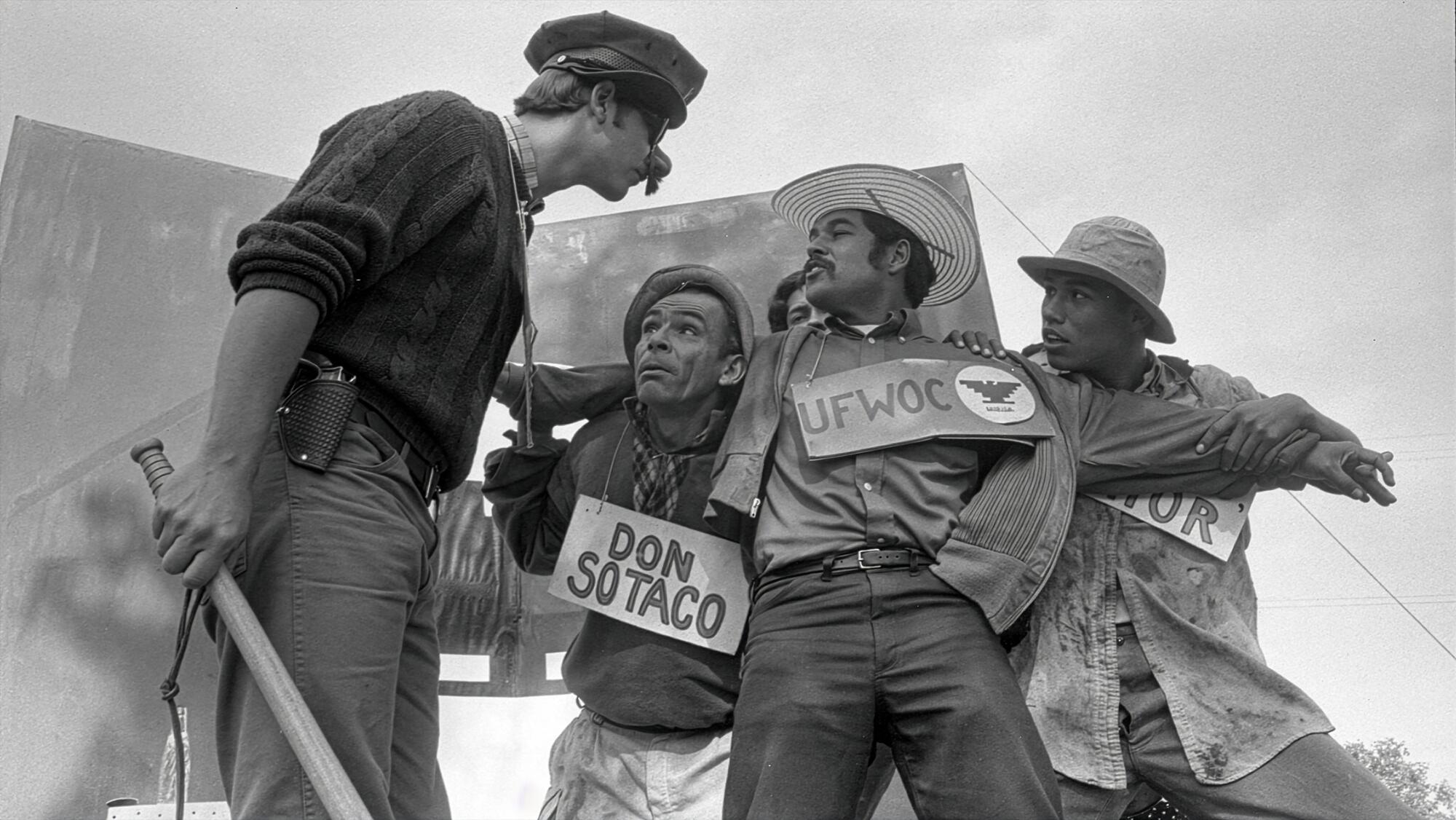
The film traces Valdez’s beginnings as the son of migrant farmworkers in Delano, Calif., to his early days in theater helming El Teatro Campesino — a traveling performance troupe who worked alongside Cesar Chavez to mobilize farmworking communities, raising awareness about strikes and unions through skits and plays. Incorporating folk humor, satire and Mexican history, their work later evolved to include commentary on the Vietnam War, racism, inequality and Chicano culture more broadly.
Narrated by Edward James Olmos, who broke out as the enigmatic pachuco with killer style and a silver tongue in 1981’s “Zoot Suit,” the documentary was awarded the Library of Congress Lavine/Ken Burns Prize for Film last year.
De Los spoke with Olmos and Alvarado ahead of the film’s world premiere on Thursday at the 2026 Sundance Film Festival.
This interview has been lightly edited for clarity.
David, what was your introduction to Luis’ work? And how did it influence you as a filmmaker?
David Alvarado: I grew up watching things like “La Bamba” with my dad, and it made a huge impression on me, but at the time, as a kid, I didn’t really know the name Luis Valdez. Then in 2006, I was an undergrad at the University of North Texas, and I got a Hispanic Scholarship Award. At the celebration, Luis gave a speech and I was just blown away. I was a young wannabe filmmaker trying to learn how to make movies, and somebody like me was up there onstage telling a story about how he got there. I felt really inspired and I always carried that with me. Then in 2021, I was at a juncture in my career where I had told these science and technology stories, and I loved it, but I wanted to do something more personal. I thought back to Luis Valdez. Where was his story? So I reached out to him and that’s where this all started.
Mr. Olmos, your breakthrough came from playing El Pachuco in “Zoot Suit,” first in the play and then the film. What was your first impression of the story?
Edward James Olmos: I remember I had been doing theater for years, and I was walking out of an audition for another play at the Mark Taper Forum when I heard someone say, “Hey, do you want to try out for a play?” And I said, “Excuse me?” And she said, “Well, do you or don’t you?” And I said, “OK, what do you want me to do?” I didn’t know who she was, or what the play was about, but the next day, I was standing there with 300 other guys getting handed a little piece of paper with the opening monologue [for “Zoot Suit.”] I knew from reading it that this was serious, really serious, so I just became the character immediately.
I remember when they called me and asked me to do the role, it was on a Friday night, around 8 o’clock, and they were going to start rehearsals on Monday morning. I hadn’t gotten any phone calls, so I thought [the part] was gone. Then all of a sudden, the phone rang and they asked me if I wanted the role of El Pachuco. I said it would be my honor, my privilege. I hung up the phone and I slid down the side of the wall crying. I just completely lost it.
DA: Eddie really stole the show. I mean, it’s just undeniable. What he brought [to the production] was exactly what Luis was looking for, and I think it’s what Chicanos wanted to see and hear at the time. He really struck a nerve, and that was a huge part of the success of “Zoot Suit.” What Luis tapped into with this collaboration with Eddie, with the Teatro Campesino, or later with “La Bamba,” that was his gift: finding people who could represent the true nature of what it means to be Chicano.

(Elizabeth Sunflower / Retro Photo Archive / Sundance Institute )
There’s so much incredible archival footage here from the Teatro Campesino. What was your reaction to seeing some of that early work?
EJO: That footage is priceless, and that’s one of the reasons this movie is really important, because Luis is truly someone that has given our culture a voice. He gave me my voice. When you want to learn about a culture, you try to study what’s been written about them, any documentation or books, but nothing compares to their art. Right now, I’m working on a piece with Luis called “Valley of the Heart,” a play that he wrote over the last 12 years. It’s a never-been-told love story between a Mexican American and a Japanese American in an internment camp during World War II. It’s been difficult to make, but once people see it, they’re going to be thankful because it doesn’t matter what culture you are, the humanity of it comes through. That’s how people will feel after seeing David’s documentary, too. It’s inspiring.
DA: I think people are ready for the real story of America. I mean, the documentary and “Valley of the Heart” are part of American history, they talk about a real American experience, and it’s not the kind that people hear anymore. People are thirsty for that kind of authenticity, and to re-evaluate what the American story really is.
One of the core themes within the documentary is how we as Chicanos view the American Dream: Can we achieve it by being ourselves, or do we have to assimilate? We see that identity struggle play out as Luis and his brother, Frank, take different approaches in their lives, and it’s later paralleled in the story of “La Bamba.”
DA: That’s such a core pillar of the film. We all want the American Dream, but what that dream is confusing to a lot of people. The quest to get there through assimilation is something that Chicanos, Latinos and other immigrants have tried at the expense of their own heritage and identity. They give it all up and lay it at the altar of the American Dream. They try to fit in, and be this other thing, and so often, that doesn’t work. In his own life, Luis’ answer to that was if America is supposed to be this multicultural beacon of democracy, then let’s have a space for Chicanos to play a role there. I’ll retain my culture and be an American.
He and his brother tried to make it together, but they weren’t taking the same approach. In Frank’s story, that caused him a lot of pain, and he never quite made it that way. Luis, in very important ways, did make it. The fact that his work speaks to those themes, and was part of his personal life, I couldn’t leave that on the editing room floor.
In the documentary, we see the triumph of “Zoot Suit” being the first Chicano production on Broadway, and then the crush of it being panned by critics who didn’t seem to get it. Mr. Olmos, you say that the reaction wasn’t a loss for you all, it was a loss for America. What did you mean by that?
EJO: Well, because it wasn’t going to be spread around the country and understood. To me, the theater is magic. When it really works, it’s amazing. But [those negative reviews] stopped us from that growth process. There was one critic from the New York Times, Richard Eder, who said it was street theater on the wrong street.
I have to tell you, though, the people who were given the opportunity to see that play in New York, even after the critics panned it, always gave us a cheering standing ovation at the end. They burned the house down every single night. Even in L.A., that play was monumental. But that criticism hurt Luis badly, it hurt us all. I think if we’d gone through Arizona, Texas, Chicago, Miami before hitting New York, we would’ve been a powerhouse that would still be running today. It’s one of those stories that deserves to be revived over and over again.
The story of “Zoot Suit” is set in the 1940s, during a time of intense scrutiny and discrimination for Mexican Americans. How did the story resonate in the 1980s, and what do you think it has to tell us now?
EJO: People came from all over the world to watch the play, but Latinos kept coming back. Some of them had never been to a theater before in their lives, and they were bringing in family, friends to come and see it every weekend. It was a beautiful experience, one that was like giving a glass of water to somebody in the middle of the desert. They cherished us for giving them the opportunity. Now, we’re needed more today than we were even then. Today’s time is uglier than almost any time.
DA: It’s ugly, and it’s crass. We’ve had so long to try to figure out racism and get the American experiment back on track, and yet it just feels so depressing. Like when is the cycle going to end? At the same time, I hope that there’s a little bit of optimism in the film that the community can come together, and that we can find a way through this.
The documentary does a great job of showcasing the power of art. The performances from the Teatro de Campesinos allowed the farmworkers to really see themselves in a way that helped build a movement and made for a successful collective action. What do you hope this documentary can teach a new generation of Latinos today?
DA: For me, it’s to understand who you are, and to do what it takes to make it work here in America. When Luis spoke to me from that lectern, the thing that really got me going was that he said, “Whatever it is that you’re trying to do, whatever your project is, just stop doubting yourself and do it.” I remember thinking, “Oh my God. Maybe I can be a filmmaker. Maybe I could tell stories for a living.” So I hope that that’s clear in the film: that if you believe in yourself, you can fit into America, you can make a place for yourself.
But also, know that creation is an act of joy, and that the whole point of life is to find happiness and share it with other people. Despite all the heavy things we’ve talked about so far, I do want to point out the film is a joyful one of exploration. Luis has his moments when the world pushes back on him so hard, and it’s painful, but he just has so much love to give, and that’s the point of making art. I want people to walk away thinking that they can do it too.
EJO: David nailed it. That’s it exactly.