communications

KC-135 Tanker Spotted With New Satellite Communications Antenna

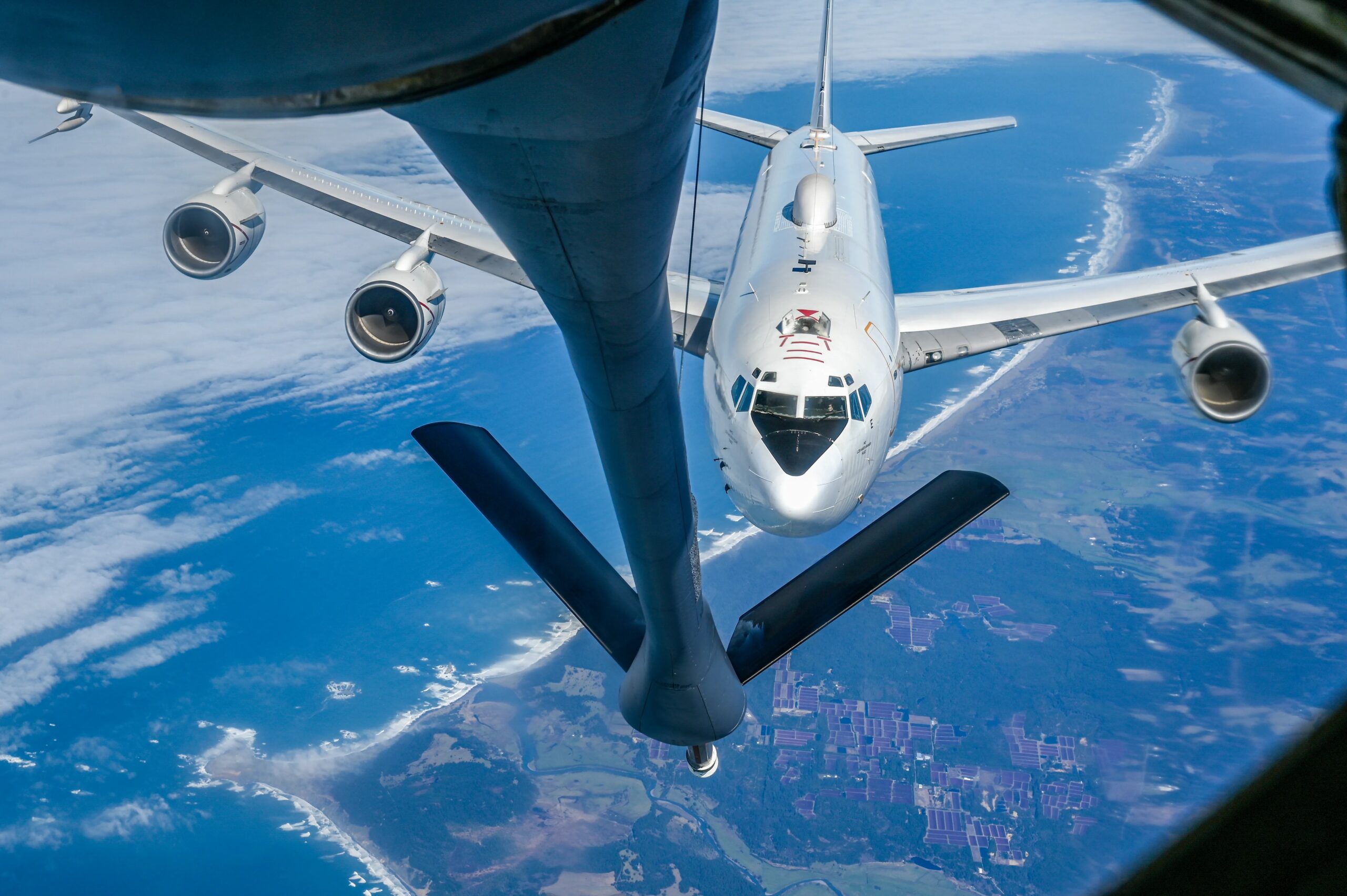
A U.S. Air Force KC-135 tanker appeared in the United Kingdom this weekend with a new antenna on top of the rear of the fuselage. The service has several efforts underway to improve the communications networking capabilities of all of its tankers and cargo planes, including ones that leverage Starshield, the government-focused cousin of SpaceX’s Starlink. This has become an especially critical priority for future survivability and effectiveness of the aging KC-135 fleet.

Aviation photographer Alessandro Ledda, who goes by Aerographist on Instagram, caught the KC-135 in question at RAF Mildenhall yesterday. The base is a major hub for U.S. Air Force operations in the United Kingdom. It has been utilized to support recent operations against Iran, as have other RAF facilities.

A stock picture of a KC-135 tanker taking off from RAF Mildenhall in 2025. USAF/Staff Sgt. Kevin Long

Ledda told TWZ that online flight tracking data says this particular KC-135 is serial number 63-7976, but that this might not be correct. The plane is largely devoid of markings, preventing easy confirmation. Two years ago, the Air Force’s Air Mobility Command (AMC) began removing serial numbers and other unique identifying markings from tankers and other aircraft as an operational security measure, as you can read more about here.

Ledda also told us that this is the first time he has seen a KC-135 with the new dorsal antenna, despite regularly photographing tankers of this type at Mildenhall. The base is home to the Air Force’s 100th Air Refueling Wing, which flies the KC-135, but is also a regular staging point for temporary deployments and a stop-over for aircraft just passing through.

A picture of the same antenna on top of a KC-135 had emerged online in April, but where and when it was taken are unclear. This may or may not be the same aircraft seen at Mildenhall this weekend. It is unknown how many Air Force KC-135s may have received this modification so far, and TWZ has reached out to the Air Force for more information. At the beginning of Fiscal Year 2026, the Air Force had 368 KC-135s in inventory, in total. At least a portion of that fleet is set to remain in service through 2050.

A close-up look at the dorsal antenna on the KC-135 seen this weekend at RAF Mildenhall. Alessandro Ledda

The antenna has a very roughly trapezoidal shape with a mostly flat top. There is a single small blade that sticks up at the rear, as well. The size and shape are broadly reflective of ‘hump’ style antennas associated with high-bandwidth satellite communications (SATCOM) suites seen on large military and commercial aircraft. In both pictures we have seen of this installation on the KC-135 so far, the new antenna is also mounted right behind a much smaller existing platter-shaped type typically used to support ultra-high-frequency SATCOM links.

Back in April, the possibility was raised that the new antenna for the KC-135 could be tied to Airlift/Tanker Open Mission Systems (ATOMS) and/or its successor, MAF NEXUS, both developed by the Sierra Nevada Corporation (SNC). MAF here stands for Mobility Air Forces, a collective term for the Air Force’s tanker and airlifter fleets, and the personnel that support them.

ATOMS is “a Starshield-based BLOS [beyond line of sight] satcom system SNC has been installing on a handful of [KC]-135s, [C]-17s, [KC]-46s, [C]-130s. Saw a C-17 getting it last week in Dayton,” Aviation Week‘s Brian Everstine wrote on X, speaking generally, in a thread discussing the first picture of the new antenna for the KC-135 that had emerged. ATOMS is “now transforming to Air Mobility Commands [sic] ‘MAF Nexus.’”

Elements of at least one iteration of ATOMS are seen, at center, inside a C-17 cargo plane during a briefing for senior officials in 2025. USAF/Staff Sgt. Joshua T. Crossman

As noted, Starshield is a more secure, government-centric offshoot of SpaceX’s Starlink space-based network. Starshield and Starlink have been in increasing use across the U.S. military on aircraft, as well as warships and in various contexts on the ground, for years now, as TWZ has explored on several occasions in the past.

The size and shape of the antenna on the KC-135 at Mildenhall is, broadly speaking, in line with commercial Starlink antennas used on airliners and other civilian aircraft.

An example of a commercial Starlink antenna for use on aircraft, in this case integrated onto a Beechcraft King Air turboprop. AeroMech Incorporated

“The SNC solution for ATOMS, originally provided as a Quick Reaction Capability (QRC) in just six months, delivers enhanced situational awareness through multidomain networking and datalink,” SNC had explained in a press release in August 2025. “The system’s ability to provide a Common Operating Picture improves data interpretation and bolsters decision advantage, strengthening AMC’s effectiveness by leveraging multiple communications paths and sensors to seamlessly share data.”

That release followed the conclusion of the Air Force’s Mobility Guardian 2025 exercise, in which ATOMS “played a pivotal role” by “demonstrating its ability to provide seamless data management and communications solutions on multiple aircraft platforms, including the C-17, KC-135, KC-46 and C-130, as well as numerous ground nodes.”

The Air Force’s 2027 Fiscal Year budget request highlights at least two other potentially relevant communications upgrade efforts for the service’s KC-135, specifically, which could also make use of Starlink/Starshield.

A row of US Air Force KC-135 tankers. USAF

There is the “Hybrid SATCOM capability,” which involves “the employment of Multi-Band, Multi-Orbit SATCOM terminals to switch between different government and commercial constellations,” according to official budget documents. This is tied to another project called MAF Connectivity focused on developing a “path forward as the tanker needs to be able to connect to the Joint fight to close kill chains and logistics chains.”

For MAF Connectivity, “possible capabilities include, but are not limited to, intelligent gateways, antennas, radios, software updates, crew displays, and multiple aperture array housings,” the budget documents also note. An “increment 1 first prototype installation” was also scheduled to be completed in the second quarter of Fiscal Year 2026, which began on January 1 and ended on March 31.

The antenna could be part of a different effort, as well. The Air Force has fielded a number of roll-on/roll-off communications and networking suites for the KC-135 over the years, but in an ad hoc manner and on a relatively limited scale. Last year, the Air National Guard also announced the demonstration of a new communications and data-sharing node packaged inside a heavily modified underwing Multipoint Refueling System (MPRS) pod, but the extent to which that capability may now be available for operational use is unclear. KC-135 and KC-46 tankers use unmodified MPRS pods to transfer fuel to receivers via the probe-and-drogue method.

A repurposed Multipoint Refueling System (MPRS) pod containing a communications and data-sharing package, seen under the wing of a Utah Air National Guard KC-135. MSgt Nicholas Perez/Utah Air National Guard

As an aside, a Boeing 757 called Trailblazer (N-number N473AP), which defense contractor L3Harris uses as a testbed, also recently emerged with a new elongated dorsal fairing. Trailblazer’s new addition is similar in some broad strokes, but also distinctly different from the antenna seen on the KC-135 at Mildenhall this weekend. One of L3Harris’ major business areas is satellite communications systems, including for the U.S. Air Force. TWZ has reached out to the company for more information about this development.

For years now, the Air Force has been trying to more deeply integrate new communications and networking capabilities onto the KC-135, as well as other tankers and aircraft across the MAF. Senior service officials have also described this as a gateway to enabling other new capabilities down the road, including ones to help better protect tankers and airlifters from future threats. TWZ has previously highlighted this as a path to airborne control for “loyal wingman” type drones and other uncrewed aerial systems, something the Air Force has already been experimenting with to differing degrees.

“I gotta keep modernizing the tanker force,” Air Force Lt. Gen. Rebecca Sonkiss told TWZ and others at a roundtable at the Air & Space Forces Association’s annual warfare symposium in February. “If I was going to parcel out the things we care about in that, though, it’s connectivity and survivability. So those are the things that we really care about in that effort.”

“There’s various ways to get after survivability,” she continued. “It starts with being connected so that you have battlespace awareness, and then it continues on to how do we protect those assets.”

Sonkiss’ official title is Deputy Commander of AMC. However, she has been serving as the interim head of the command since her predecessor, Gen. John Lamontagne, became Vice Chief of Staff of the Air Force in January.

Air Force Lt. Gen. Rebecca Sonkiss speaks at the 2026 AFA Warfare Symposium. USAF/Capt. Christian Little

“The single biggest contributor to survivability in a big airplane is connectivity. The biggest contributor is not having a 12-hour-old Intel brief that you’re relying on to get you through the mission,” retired Air Force Gen. Michael “Mini” Minihan, who led AMC from October 2021 to November 2024, told TWZ in an interview in February, as well. “So real-world updates, real-time updates, just like our fighters and our bombers enjoy. Battle management that gets after maneuver and not just kill chain. Those things matter.”

“The reality is that the car I rented right now, driving from the airport to my hotel room, has more connectivity in it than the overwhelming majority of the mobility fleet. So connectivity matters,” he also told us at that time.

New communications and networking suites could enable AMC’s KC-135, as well as the rest of the command’s fleets, to serve as essential ‘translators’ between disparate networks and waveforms in the future. Providing a link between low probability of interception/low probability of detection (LPI/LPD) datalinks that stealthy aircraft use, such as the Multifunction Advanced Data Link (MADL) and Intra-Fighter Data Link (IFDL), and more general-purpose ones, would be especially valuable. IFDL is currently only found on the F-22 Raptor, while all variants of the F-35 fighter (and future B-21 Raider bombers) use MADL, and the two cannot ‘talk’ to each other directly, which has long created challenges. Upgraded tankers could serve as important parts of a beyond-line-of-sight mesh-like network that incorporates other kinds of line-of-sight links like Link16. In this way, they could help relay data to and from forward battle management and other command and control nodes, including ones in the air.

An F-22, in front, flies together with an F-35A, at rear. USAF

In addition, improved connectivity stands to provide additional operational and safety benefits across the MAF.

“According to the Air Force, the tankers’ ability to access tactical data links could increase mission success in contested environments by improving survivability, agility, and situational awareness for command-and-control elements and aircrews,” the Congressional Research Service (CRS) wrote in a report published in January. “The connectivity could provide aircrews with such information as potential threats, fuel availability, and safer landing sites. In addition, tanker aircraft could serve as a backup information conduit for other aircraft in a degraded communications environment.”

The points here have become a broader topic of discussion after two KC-135s collided over Iraq in March during the opening weeks of Operation Epic Fury against Iran. One of the aircraft crashed, killing all six onboard. The other tanker involved was able to land in Israel despite suffering severe damage. At the time of writing, the Air Force has not yet shared any official determinations as to the chain of events that led to that fatal incident.

“We should never put mobility crews, especially tanker crews, in a position during combat operations where they have to choose between being seen by everyone, including the enemy, or being seen by no one, including the joint force and civil aviation,” Minihan subsequently wrote in a post on LinkedIn. “Mobility force connectivity now. Write the damn check.”

“Most KC-135s [sic] communications networks are ‘not the type of battle space awareness that shows you where the red is, where the blue is, and the actions that are being taken in real time in a conflict,’”Defense One reported in March, citing an interview with retired Air Force Gen. Jacqueline Van Ovost, who previously served as head of U.S. Transportation Command (TRANSCOM). “All you have is the intelligence you took off with when you got the brief two hours prior to take off.”

All this being said, the Air Force is still years away from integrating more robust communications and networking capabilities onto the entire KC-135 fleet.

“Over the course of about the next six years, you’ll see the full fleet of KC-135s fully connected,” Lt. Gen. David Tabor, Deputy Chief of Staff for Plans and Programs, told members of Congress at a hearing last month.

The appearance of the KC-135 with the added antenna at Mildenhall does point to new progress on key connectivity upgrades for Air Force tankers and airlifters. At the same time, improved communications and networking capabilities are increasingly critical now, and it remains to be seen when they become more commonplace across the KC-135 fleet.

Special thanks again to Alessandro Ledda for sharing the picture of the KC-135 seen at Mildenhall this weekend with us.

Contact the author: joe@twz.com

Joseph has been a member of The War Zone team since early 2017. Prior to that, he was an Associate Editor at War Is Boring, and his byline has appeared in other publications, including Small Arms Review, Small Arms Defense Journal, Reuters, We Are the Mighty, and Task & Purpose.


Howard is a Senior Staff Writer for The War Zone, and a former Senior Managing Editor for Military Times. Prior to this, he covered military affairs for the Tampa Bay Times as a Senior Writer. Howard’s work has appeared in various publications including Yahoo News, RealClearDefense, and Air Force Times.


Source link

Air Force Wants To Axe Its E-11A BACN Communications Jets

The U.S. Air Force plans to fully retire its fleet of E-11A Battlefield Airborne Communications Node (BACN) aircraft in Fiscal Year 2028. The BACN jets provide highly specialized communications capabilities that allow for the rapid transfer of data between various aerial platforms, as well as forces on land and at sea, which you can read more about here. The Air Force more than doubled its fleet size in recent years, but now wants the mission to be taken over by space-based systems.

In their Posture Statement for Fiscal Year 2027, the Secretary of the Air Force Troy Meink, Air Force Chief of Staff Gen. Kenneth S. Wilsbach, and Space Force Chief of Space Operations Gen. B. Chance Saltzman state that the E-11A “will be fully divested” in FY2028.

In our previous coverage of the E-11A, we described the basic capabilities of the platform as follows:

The BACN payload is an extremely robust communications gateway that can rapidly send and receive data transmitted through various waveforms to and from a wide array of aerial platforms, as well as forces on the ground. In addition to being able to “translate” between various communications and data sharing systems, these aircraft have been vital communications relay nodes in Afghanistan, where the country’s mountainous terrain limits the reach of line-of-sight links.

A 430th Expeditionary Electronic Combat Squadron E-11A aircraft outfitted with a Battlefield Airborne Communications Node sits on the runway at Kandahar Airfield, Afghanistan, April 4, 2019. The 430th EECS is the only unit that operates these aircraft with the BACN payload. (U.S. Air Force photo by Capt. Anna-Marie Wyant)
A 430th Expeditionary Electronic Combat Squadron E-11A aircraft outfitted with a Battlefield Airborne Communications Node sits on the runway at Kandahar Airfield, Afghanistan, April 4, 2019. U.S. Air Force photo by Capt. Anna-Marie Wyant Capt. Anna-Marie Wyant

In the short term, the capabilities provided by BACN will be bridged by the Hybrid SATCOM Terminal program. In a 2024 demonstration by Northrop Grumman, this type of satellite communications solution made use of commercial space Internet providers to establish a resilient multi-orbit, multi-constellation network.

A schematic artwork of Northrop Grumman’s hybrid SATCOM solutions. Northrop Grumman

The Posture Statement further adds that the Air Force is “executing a deliberate and balanced strategy for Intelligence, Surveillance, and Reconnaissance (ISR), Battle Management Command and Control (BMC2), and Airborne Moving Target Indicator (AMTI) capabilities to meet the intent of the National Defense Strategy.”

This strategy includes “a generational shift away from legacy systems” like the E-11A and “towards next-generation capabilities in both air and space.” This also calls for continued investment in the DAF Battle Network, which is described as “a key capability to fuse sensor data and remain resilient against all adversaries.”

Lt. Col. Chris and Maj. Matt, 430th Expeditionary Electronic Combat Squadron, prepare to fly the Battlefield Airborne Communications Node’s 10,000th mission in the E-11A aircraft, Feb. 24, 2017. The BACN weapons system was developed to fulfill an urgent need in Afghanistan where the mountainous terrain makes communication difficult. (U.S. Air Force photo by Staff Sgt. Katherine Spessa)
Lt. Col. Chris and Maj. Matt, 430th Expeditionary Electronic Combat Squadron, prepare to fly the Battlefield Airborne Communications Node’s 10,000th mission in the E-11A aircraft, Feb. 24, 2017. U.S. Air Force photo by Staff Sgt. Katherine Spessa Katherine Spessa

The Air Force has previously described the DAF Battle Network as an “integrated system-of-systems connecting sensor, effector, and logistics systems enabling better situational awareness, faster operational decisions, and decisive direction to the force.”

Another option could be BACN-like solutions provided in podded form to various aircraft. Examples of these include the Smart Node Pod from Northrop Grumman, which is already in production.

Until recently, the Air Force seemed very much committed to its BACN fleet.

Back in 2021, the service confirmed it planned to acquire six more E-11As over the next five years; this would provide a total of nine BACN jets. This reflected the high demand for the fleet, which meant all of the existing operational examples had historically been forward deployed in Afghanistan, where one of them crashed after suffering an engine failure in 2020.

The BACN fleet has also conducted extensive operations in the Persian Gulf region, Central and South America, and elsewhere.

The E-11A has remained active in combat operations up to this day, including being deployed in support of Operation Epic Fury against Iran. It was also involved in the operation to capture Venezuelan dictator Nicolas Maduro, an effort known as Absolute Resolve.

Another driver behind the force expansion was the Air Force’s retirement of four EQ-4B Global Hawk drones that were also equipped with the BACN communications package. These were later converted into the RangeHawk configuration to support hypersonic testing.

In 2022, the Air Force confirmed that the first of the additional six E-11As was now operating in the Middle East, having formally joined the 430th Expeditionary Electronic Combat Squadron at Prince Sultan Air Base in Saudi Arabia.

A U.S. Air Force E-11A Battlefield Airborne Communications Node aircraft, assigned to the 430th Expeditionary Electronic Combat Squadron, takes off in support of a joint, multi-national exercise at Al Dhafra Air Base (ADAB), United Arab Emirates, June 30, 2021. During the exercises, multiple platforms worked together to execute and refine tactics, techniques and procedures to counter Unmanned Aerial System threats. Conducting consistent training with partner nations ensures interoperability and the ability to defend ourselves, and reinforces security and stability in the region. (U.S. Air Force photo by Master Sgt. Wolfram M. Stumpf)
A U.S. Air Force E-11A BACN aircraft, assigned to the 430th Expeditionary Electronic Combat Squadron, takes off in support of a joint, multinational exercise at Al Dhafra Air Base, United Arab Emirates, June 30, 2021. U.S. Air Force photo by Master Sgt. Wolfram M. Stumpf Master Sgt. Wolfram Stumpf

It’s worth noting that the Air Force’s three oldest E-11As are based on older Bombardier BD-700 and Global 6000 business jets, while the newer airframes are based on the Global 6500 bizjet.

The aircraft has also taken on additional functions, such as in 2021, when at least one E-11A was involved in a combined U.S.-UAE exercise focused on employing “multiple platforms… together to execute and refine tactics, techniques and procedures to counter Unmanned Aerial System threats,” according to the Air Force.

A U.S. Air Force E-11A Battlefield Airborne Communications Node (BACN) takes off from Prince Sultan Air Base, Kingdom of Saudi Arabia, Jan. 4, 2022, in support of complex joint training with aircraft from across the region, to include U.S. Air Force F-16 Fighting Falcons and U.S. Marine Corps F/A-18 Hornets. Airspace across U.S. Central Command’s area of responsibility is among the most dynamic in the world and regular training ensures U.S. and coalition aircrew operate safely and professionally. (U.S. Air Force photo by Senior Airman Jacob B. Wrightsman)
A U.S. Air Force E-11A BACN takes off from Prince Sultan Air Base, Kingdom of Saudi Arabia, Jan. 4, 2022. U.S. Air Force photo by Senior Airman Jacob B. Wrightsman Senior Airman Jacob Wrightsman

In the past, we’ve also noted how the value of the BACN platform extends beyond Afghanistan and the Middle East.

Its capabilities would be equally useful for supporting operations over the vast expanses of the Pacific, where the U.S. military is increasingly focused on preparing for a potential future high-end conflict with China. It would also be suited to working on NATO’s eastern flank, where U.S. allies have been expanding their force posture in recent years to help deter Russian aggression.

More generally, as a fixed-wing bizjet platform, the E-11A lacks the low-observability characteristics to survive in highly contested airspace, so it would need to operate from considerable standoff distances when confronted by the kinds of peer- and near-peer adversaries that they are intended to help defeat. This is undoubtedly part of the reason for the Air Force deciding to discard the BACN fleet. In the same way, it also gave up its E-8C Joint STARS without any direct replacement, driven by the concern that platforms of this kind will simply be too vulnerable in the future.

A U.S. Air Force E-8C JSTARS. U.S. Air Force/Senior Airman Jared Lovett

After all, both China and Russia are developing very long-range anti-air missiles expected to be optimized for high-value targets such as BACN. In addition, airborne ISR platforms will increasingly face sophisticated anti-access/area-denial (A2/AD) networks before they even get to their operating areas. 

Furthermore, pushing the E-11A further away from the warfighter is a fundamental problem for its mission, especially when it comes to connecting to forces on the ground. BACN works as a bridge between forces using disparate radios and even the same radios, and is particularly valuable since units on the ground that are trying to communicate with other units or aircraft can be blocked by line of sight, especially in terrain. Regardless, the farther the E-11A flies away from its target area, the less it is capable of providing meaningful connectivity to the forces operating there, just due to the horizon.

Ultimately, the E-11A’s high-demand, low-density status may also have counted against it. Even after the Air Force decided to increase the fleet numbers, it remains a highly niche capability and one that comes at a lot of cost, with an extensive training, maintenance, and logistics burden needed to support it.

A new U.S. Air Force E-11A BACN aircraft taxis through a "bird bath" at Prince Sultan Air Base, Kingdom of Saudi Arabia, Dec. 16, 2022. This E-11A is the newest addition to 430th Expeditionary Electronic Communications Squadron's fleet. Commonly known as Battlefield Airborne Communications Node, or BACN, this aircraft extends the range of communications channels and enables better communication amongst units. (U.S. Air Force photo by Staff Sgt. Shannon Bowman)
A new U.S. Air Force E-11A BACN aircraft arrives at Prince Sultan Air Base, Kingdom of Saudi Arabia, Dec. 16, 2022. U.S. Air Force photo by Staff Sgt. Shannon Bowman Staff Sgt. Shannon Bowman

The Air Force’s ambition to migrate the BACN’s capabilities to space-based assets parallels, to some degree, its aim for its future airborne early warning and control (AEW&C) architecture. However, the service does at least still see a need for traditional crewed AEW&C aircraft, too. Partly this is due to the fact that the Air Force does not expect new space-based capabilities to be operational before, at best, the early 2030s. The service is seeing a similar shift with its ground moving-target indicator (GMTI) capabilities, which are being transferred from the now-retired E-8C JSTARS to a distributed network of space-based sensors to keep tabs on targets on land and at sea.

At this stage, it’s far from clear whether the terminals required for BACN’s successor have already been installed on aircraft, ships, and issued to ground units, and whether the system will be able to translate Link 16 and other waveforms.

Time will tell if space-based assets can take over the BACN’s role in what is a notably abbreviated timeframe.

Contact the author: thomas@thewarzone.com

Thomas is a defense writer and editor with over 20 years of experience covering military aerospace topics and conflicts. He’s written a number of books, edited many more, and has contributed to many of the world’s leading aviation publications. Before joining The War Zone in 2020, he was the editor of AirForces Monthly.


Source link

Former Fauci adviser indicted for allegedly concealing communications related to COVID-19 research

A former senior adviser to Dr. Anthony Fauci was indicted on federal charges alleging he conspired to hide his communications related to COVID-19 research as the pandemic raged across the country, the Justice Department said Tuesday.

Dr. David Morens, 78, is accused of using his private email account to intentionally circumvent public records laws while employed at the National Institutes of Health. The Justice Department alleges that he concealed or destroyed records of discussions related to COVID-19 research grants, including an effort to revive a controversial coronavirus grant.

“These allegations represent a profound abuse of trust at a time when the American people needed it most — during the height of a global pandemic,” acting Atty. Gen. Todd Blanche said in a statement Tuesday. “Government officials have a solemn duty to provide honest, well-grounded facts and advice in service of the public interest — not to advance their own personal or ideological agendas.”

Morens faces charges of conspiracy against the United States; destruction, alteration or falsification of records in federal investigations; concealment, removal or mutilation of records; and aiding and abetting, according to a Justice Department news release. If convicted, he could face decades in prison. An attorney for Morens declined to comment.

The indictment reflects Republicans’ long-held belief that the federal government covered up key information about COVID-19 as the pandemic unfolded. Despite numerous probes, the origins of COVID have never been proven. Scientists are unsure whether the virus jumped from an animal, as many other viruses have, or came from a laboratory accident. A U.S. intelligence analysis released in 2023 said there is insufficient evidence to prove either theory.

Blanche said Morens’ alleged conduct was part of an effort to “suppress alternative theories” about COVID-19’s origins. The Justice Department also accused Morens of having an improper relationship with a collaborator, including allegedly accepting a gift of wine and discussing COVID-19 research and potential publications in a prominent medical journal.

The indictment follows a probe by House Republicans into the origins of the COVID-19 pandemic that scrutinized Morens’ email communications and accused him of intentionally concealing records. In congressional testimony, Morens denied attempting to evade federal transparency laws by using his personal email.

Source link