Commanders

Veteran KC-135 Base Commander’s View Of Epic Fury’s Strain On The Tanker Force

Operation Epic Fury will hit a month old by the weekend. It and the massive military build-up to it were made possible by a global logistics chain that only the Pentagon can supply. At the heart of it is the aerial refueling fleet. These aircraft have flown thousands of sorties to get materiel where it needs to be and fast. These have included stuffing the fuel tanks of C-17s with cargo holds full of Patriot missiles to dragging stealth fighters across the globe. Epic Fury has been one of many operations to heavily tax the tanker fleet in recent years. To get a much better insight into the tanker portion of the war and its impacts, we talked to one man with an extreme level of experience behind the controls of USAF tankers.

For more than 20 years, Troy Pananon, a retired Air Force colonel, served in the aerial refueling community. He flew KC-10 Extender and KC-135 Stratotanker refueling jets and served as deputy commander of the 6th Air Mobility Wing at MacDill Air Force Base in Tampa, Florida (now 6th Air Refueling Wing), and later as commander of the 100th Air Refueling Wing at RAF Mildenhall in England. Both of these installations and their KC-135s are instrumental in the ongoing war in Iran.

In a two-hour, wide-ranging exclusive interview, Pananon offered insights into the strain of the war on the jets and personnel and the challenges of keeping the aging KC-135s flying as they perform hundreds of sorties gassing up fighters, airlifters and other aircraft. One of those missions resulted in the deaths of six airmen after a suspected midair collision over Iraq. Pananon also addressed a whole host of other issues, including how Epic Fury is affecting readiness for a fight against China, the scourge of drone incursions and much more, which will be addressed in future installments.

Pananon, who began his career as an enlisted Marine, retired from the Air Force in 2023 and is now a 737 first officer with United Airlines. The first installment of our conversation focuses on Epic Fury and the toll on the tankers, crews and maintainers. Some of the questions and answers have been lightly edited for clarity.

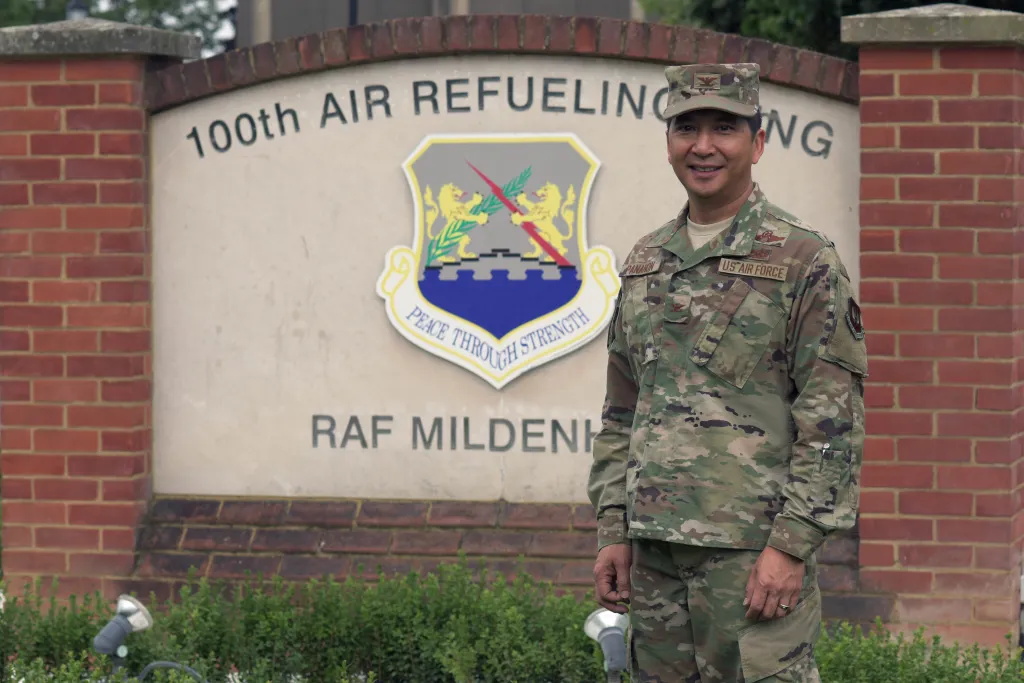
U.S. Air Force Col. Troy Pananon, 100th Air Refueling Wing commander, poses for a photo at RAF Mildenhall, England, July 9, 2019. Pananon served five years as an enlisted Marine prior to receiving his commission from Embry-Riddle Aeronautical University, Daytona Beach, Fla., in 1996. He was initially assigned as a maintenance officer at Hurlburt Field, Fla., and then attended Undergraduate Pilot Training at Columbus Air Force Base, Miss. (U.S. Air Force photo by Senior Airman Benjamin Cooper)
U.S. Air Force Col. Troy Pananon, 100th Air Refueling Wing commander, poses for a photo at RAF Mildenhall, England, July 9, 2019. Pananon served five years as an enlisted Marine prior to receiving his commission from Embry-Riddle Aeronautical University, Daytona Beach, Fla., in 1996. He was initially assigned as a maintenance officer at Hurlburt Field, Fla., and then attended Undergraduate Pilot Training at Columbus Air Force Base, Miss. (U.S. Air Force photo by Senior Airman Benjamin Cooper) Tech. Sgt. Benjamin Cooper

Q: The Air Force tanker fleet has come under extremely heavy use in recent years, being widely utilized in the evacuation of Afghanistan, the massive deliveries to Ukraine, the constant crisis in the Middle East and the campaign against the Venezuelan dictator Nicolas Maduro. Now, the war in Iran. Talk about the strain this is putting on it, on the aircrews, the maintainers and the airframes, some of which rolled out during the Eisenhower era.

A: I would categorically say that there’s a huge strain on the entire ecosystem. The KC-135s were rolling off the assembly line in the 50s and 60s. Some of the technology, and we called it technology back then, was graduated from the Wright brothers technology. Parts on that aircraft are still reminiscent of some of the things that were invented by the Wright brothers. So it’s amazing to me that the KC-135 is able to operate, and it’s due in large part to the maintainers and the relentless effort that they follow through to keep those aircraft air worthy. 

KC-135 AI Copilot testing
KC-135 Stratotanker aerial refueling tankers have flown hundreds of sorties supporting Epic Fury. (Tech. Sgt. Joshua Smoot) Tech. Sgt. Joshua Smoot

If you think about the [airmen], how they’re operating in places you mentioned all over the world, they’re there. We’ve broken their normal routine. They’re away from home, away from their family and friends. So that’s a mental and physical stressor, because they’re in environments that they’re not accustomed to. 

We don’t know how long this conflict could last. We’re approaching a high heat of summer in that region, and so depending on where some of these personnel are based or stationed, they’re certainly out of their normal circadian rhythm, their normal environmental routines. It is a huge strain on those maintainers and the airframes that we’re placing in different parts of the world, exposed to different elements than they may have been exposed to at their normal pace. Maintaining these aging aircraft is a strain on the entire ecosystem, and we are operating them at a high operations tempo, and surely that puts a lot of a significant strain on the KC-135.

We do have the KC-46 that is helping to fill some of that void, but we just retired the KC-10, which was a tremendous workhorse. And so I would say that there’s a significant strain on the ecosystem.

U.S. Air Force 100th Maintenance Squadron, aircraft maintainers conduct maintenance on the KC-135 Stratotanker at RAF Mildenhall, England, Dec. 10, 2025. Aircraft maintainers play a critical role in ensuring the KC-135 fleet remains mission-ready to support air refueling operations across the European theater. (U.S. Air Force photo by Airman 1st Class Iris Carpenter)
U.S. Air Force 100th Maintenance Squadron, aircraft maintainers conduct maintenance on the KC-135 Stratotanker at RAF Mildenhall, England, Dec. 10, 2025. (U.S. Air Force photo by Airman 1st Class Iris Carpenter) Airman 1st Class Iris Carpenter

Q: What are the biggest challenges in keeping these Cold War-era jets like the KC-135 flying? How difficult is it to find parts, and what do you do when you can’t?

A: That’s 100% accurate. There have been some breakthroughs in technology. I know that they’ve used 3D printing to help source some parts. They’ve even gone back to the boneyard and pulled parts off of older KC-135s. So resources will always be a great puzzle for our entire team to source. 

There’s no new assembly line. They shut that assembly line down back in the ’50s and ’60s. Some of the parts for those aircraft in general were from the ’60s, ’70s and ’80s. And then, you have to take those back and refurbish those certain parts. There’s not a lot of new technology that’s going on to these core platforms. The avionics, for sure, is newer. But everything that you add to this aircraft, I call it the Frankenstein effort – taking bolt-on technology to try and help modernize the fleet. And by modernizing that means that you’re also helping with the parts availability. But going back to the age of these aircraft, some of these parts were developed back in the ’40s and machined back in the ’50s and ’60s. Our teams have to get creative with the acquisition. And that’s a huge, huge challenge. But they currently have done a great job of putting new engines on the aircraft. And so that means that the parts availability is better in some cases, but it’s not a solution. 

Davis Monthan AMARG Boneyard tour with KC-135s and Boeing 707s


Q: What are some of the old parts you’re talking about that go back to the ’40s, or to the Wright brothers era?

A: Just think about the flight controls. If you, for whatever reason, need to replace certain pulleys or elements within the flight control system, those parts were thought-up and developed way back in the ’40s. Machined maybe back in the ’50s and ’60s. It’s still not a fly-by-wire aircraft like some of the modern aircraft that we have nowadays. And so you have to go back and machine some of these parts if they get wear and tear.

Two Guardsmen from the 171st Maintenance Group, 171st Air Refueling Wing, Pennsylvania Air National Guard, work on top of a KC-135 Stratotanker aircraft while it undergoes an isochronal inspection Aug. 17, 2021, in Pittsburgh, Pennsylvania. (U.S. Air National Guard photo by Staff Sgt. Zoe M. Wockenfuss)
Two guardsmen from the 171st Maintenance Group, 171st Air Refueling Wing, Pennsylvania Air National Guard, work on top of a KC-135 Stratotanker aircraft while it undergoes an isochronal inspection, Aug. 17, 2021, in Pittsburgh, Pennsylvania. (U.S. Air National Guard photo by Staff Sgt. Zoe M. Wockenfuss) Tech. Sgt. Zoe Wockenfuss

Q: What are the complexities of supporting such a high tempo operation like the war against Iran with aerial refueling? We’ve heard that the airspace over Iraq is chaotic and that the lack of onboard situational awareness is a major issue with tanker crews and receivers. What have you heard about this?

A: Obviously I haven’t operated over there in a number of years, but I do go back to the times when I was operating aircraft in that theater. That puts me back into the Enduring Freedom, Iraqi Freedom timeframe. We have deconfliction procedures. We have airspace procedures that we study and that we follow. We have aircraft in there that help us deconflict the airspace and ensure that we have safe separation. And it goes to training, it goes to situational awareness.

Back then, we didn’t have some of the avionics and software suites that we have available to us today, so our situational awareness wasn’t as high, but yet we had good, solid procedures and processes that ensured clear deconfliction and separation in the airspace that they’re operating in. Now, I would assume that it’s congested and it’s contested, and so having the ability to have higher situational awareness with onboard avionics suites that are connected is probably more and more essential as we go forward.

A view from inside the cockpit of a Block 45 KC-135R during a land approach. The wide-area digital multi-function display in the center of the cockpit is another key feature of the upgrade package. (USAF)

Q: But have you heard anything about the chaotic nature of the current airspace and lack of onboard situational awareness? Is it a major issue right now with the tanker crews and receivers?

A:  I really can’t comment on it, because I don’t have firsthand knowledge. What I can say is that it’s in a contested environment, and our crews are definitely trained to operate in these kinds of environments. And you know, it’s just like anything there. There are elements that we have little control over, and I call it the fog and friction of warfare. But I have 100% absolute trust in the personnel. They’ve been trained. They are equipped. Could they be equipped better? Could they be resourced better? Sure. But again, it still goes back to the fact that even if we resource them with the newest technology, they then have to go back and be trained to understand how to integrate it and how to use it effectively. 

There is still an opportunity here. You can’t solve it overnight, but it does need to happen so it would help. I’m certain that if we ever get into conflict with a near peer, it’s going to be even more challenging.

A U.S. Navy F/A-18F Super Hornet aircraft refuels from a U.S. Air Force KC-135 Stratotanker aircraft during a mission in support of Operation Epic Fury over the U.S. Central Command area of responsibility, March 8, 2026. (U.S. Air Force photo)
A U.S. Navy F/A-18F Super Hornet aircraft refuels from a U.S. Air Force KC-135 Stratotanker aircraft during a mission in support of Operation Epic Fury over the U.S. Central Command area of responsibility, March 8, 2026. (U.S. Air Force photo) U.S. Central Command Public Affa

Q: When was the last time tanker crews flew in contested airspace against adversaries with more robust air defenses than we have seen in past conflicts?

A: I would like to say that any time that you’re operating within a conflict zone, that’s considered contested airspace, right? The tankers are considered a high-value, low-density. We don’t have an infinite number of tankers, so they’re going to tend to operate outside the reach of the adversary’s missiles, or fighter aircraft that would try to reach and take down one of these tankers. So they’re really going to try and operate within a safe, safe zone. I would frankly say that in a conflict, tankers operate in contested airspace all the time, and it’s really contingent on the ability of our joint force to clear that airspace and to allow our tankers to move closer to the tip of the spear, but generally speaking, it is really sacrosanct to keep tankers an arm’s reach away from an adversary’s ability to take them down.

U.S. Air Force Airmen prepare for aerial refueling on a KC-135 Stratotanker aircraft during Operation Epic Fury over the U.S. Central Command area of responsibility, March 20, 2026. (U.S. Air Force photo)
U.S. Air Force airmen prepare for aerial refueling on a KC-135 Stratotanker aircraft during Operation Epic Fury over the U.S. Central Command area of responsibility, March 20, 2026. (U.S. Air Force photo) U.S. Central Command Public Affa

Q: Do you have any sense of what happened in the fatal March 12 KC-135 crash in Iraq that led to the deaths of Maj. John “Alex” Klinner, 33, of Auburn, Alabama; Capt. Ariana G. Savino, 31, of Covington, Washington; Tech. Sgt. Ashley B. Pruitt, 34, of Bardstown, Kentucky; Capt. Seth R. Koval, 38, of Mooresville, Indiana; Capt. Curtis J. Angst, 30, of Wilmington, Ohio; and Tech. Sgt. Tyler H. Simmons, 28, of Columbus, Ohio?

A: There’s an investigation taking place and it’d be wrong of me to comment on what I think took place. These crews are highly trained. They have a process. They have procedures. I don’t know what was taking place on the flight decks of both of those aircraft. There was probably some confusion as to who and where each aircraft was supposed to be, but I don’t know what led to that. There’s a lot of speculation out there. It’d be hard for me to really say what I think actually did happen.

Q: The cause of the tanker crash is suspected to be a collision with another KC-135. How many close calls have you experienced in your career?

A: Well, I have a deep background in the KC-10, and that also gives gas and takes gas. So I’ve been within 10 feet of another aircraft, operating at close to 350 miles an hour. It’s an inherently dangerous occupation when you’re trying to receive fuel from another aircraft. I don’t think that was the case in this particular incident over Iraq. But at all times, everything we do is inherently dangerous because we operate within safe operating margins, but they’re tight. So, a simple split-second decision or maybe error puts you in a precarious position. But we have procedures that, if we make a mistake and we come close to another aircraft – there is a term that we use, which is ‘breakaway.’ And that tells both aircraft, ‘hey, we’re in a situation where we need to create some space between our aircraft,’ and we follow our procedures. It’s a safe maneuver, but probably makes the hair on the back of your neck stand up a little bit. I’ve been in this, I’ve been in situations where I’ve had to rapidly escape from another aircraft. 

But again, we get trained for this. We are highly trained. And I think because of the training, when a situation like that occurs, your instinct kicks in and you know what to do. And so, I don’t recall instances where two KC-135s had a midair collision, but certainly, we have had air-to-air collisions, just none in my recent memory.

A KC-135 refueling tanker crashed in Iraq, according to CENTCOM.
Aerial refueling missions, which require close contact between aircraft traveling at high speeds, are inherently dangerous. (USAF) (USAF)

Q: The air refueling tanker community is tight. You served at MacDill Air Force Base in Tampa, Florida, with Tech. Sgt. Pruitt, one of the airmen who was killed in the crash. Tell me about how the crash affected the community. Tell me a little bit about Pruitt.

A: From my time at MacDill, I do remember her family. In general, losing anyone is just a shock to the system. And especially somebody that you may have worked with in the past, and you know. I just feel for their families. And we have a community. The tanker community – it’s just a system, a brotherhood and sisterhood. We are just one big family. Anytime we have a tragedy that strikes our community, especially like this, it’s tough. 

I know that there are teams of people out there that are remorseful for the loss and that are doing anything in their power to support the families of these airmen. And I know there’s a lot of effort right now within our tanker community and outside of our tanker community with Go-Fund-Me pages. This is critical, because the families that have been affected by this lost a parent, right? A brother or sister or a spouse. I really do feel for these families, and I applaud the efforts of the supporters out there that are contributing to help with some of the things that are going to end up financially costing these families; but emotionally, you know that they will need support, probably for the rest of their lives. And so it’s a huge, huge loss.

U.S. Air Force Airmen attend a vigil held by the 909th Air Refueling Squadron at Kadena Air Base, Japan, March 20, 2026. The vigil brought Airmen together in remembrance of six Airmen who died in a KC-135 Stratotanker crash while supporting Operation Epic Fury. (U.S. Air Force photo by Senior Airman James Johnson)
U.S. Air Force airmen attend a vigil held by the 909th Air Refueling Squadron at Kadena Air Base, Japan, March 20, 2026. The vigil brought airmen together in remembrance of six airmen who died in a KC-135 Stratotanker crash while supporting Operation Epic Fury. (U.S. Air Force photo by Senior Airman James Johnson) Senior Airman James Johnson

Q: What can you tell me about Tech. Sgt. Pruitt?

A: Ashley was full of energy and was extremely bright, tenacious, and had an unmatched work ethic. She was a real, genuine people person. When you walked into a room, you knew she was there. But she was incredibly talented and someone that you could rely upon to help others, and she was absolutely an incredible boom operator and highly skilled and her death is this huge, huge loss. For her legacy, she impacted so many people and so many of these airmen and their families were certainly enriched by her being in their lives. At the time, I was the vice commander of the [then-6th Air Mobility Wing] at MacDill. And on occasion, I would go out and go fly with the KC-135 crews. I didn’t have a daily interaction with her, but everybody knew her, and everybody knew of her. And that’s the important part. There are many other airmen that are in our ranks right now that have benefited from being introduced to her and being taught by her and being mentored by her. So she’s surely missed.

An undated photo of Tech. Sgt. Ashley B. Pruitt, 34, of Bardstown, Ky., assigned to the 6th Air Refueling Wing at MacDill Air Force Base, Fla. Pruitt was one of six airmen who died March 12, 2026, when a KC-135 aircraft crashed in western Iraq while supporting Operation Epic Fury. (Courtesy photo)

Q: Give me a sense of how RAF Mildenhall and other bases in Europe and elsewhere keep these aircraft flying to generate sorties and deploy to combat zones like the Middle East.

A: The best part about having a forward operating base like Mildenhall is that you have all the resources in place, and in this particular case, they’re closer to where the conflict is. You don’t have as much of a long logistical chain, but you still have a logistics chain that you have to support. And so operating at a place like Mildenhall, a round the clock operation every day of the year, you do have weather to contend with on occasion, and you do have airspace constraints that you do have to contend with. But again, all of these crews are highly trained and so I would say that the operations tempo at a place like Mildenhall is extremely high. 

Just being able to have the support of the government there and the host nation that there is, and the local community is a big deal. I enjoyed my time there. Of course, we were there during COVID, during the global pandemic, and the lengths and support that we received from the host nation to ensure the safety of our community and our airmen was incredible.

Seven U.S. Air Force KC-135 Stratotanker aircraft line up on the flight line for a training mission at Royal Air Force Station Mildenhall, United Kingdom, on March 13, 2006. (DoD photo by Staff Sgt. Jeanette Copeland, U.S. Air Force. (Released))
Seven U.S. Air Force KC-135 Stratotanker aircraft line up on the flight line at Royal Air Force Station Mildenhall, United Kingdom, on March 13, 2006. (DoD photo by Staff Sgt. Jeanette Copeland, U.S. Air Force. (Released)) Staff Sgt. Jeanette Copeland

Q: The 100th Air Refueling Wing has 15 tankers and more transit through. What are the concerns and checklists of objectives for a Mildenhall commander during a major contingency operation like Epic Fury?

A: It’s just our ability to support, right? You mentioned there are 15 tankers, but the airfield itself was able to surge to support twice as many. I currently don’t know how many aircraft that we’re currently supporting out of Mildenhall, but the ability to support that means that you have to be able to flex to the surge of the operation that you’re encountering. You have personnel that are helping to fuel the aircraft. You need personnel to maintain and sustain the aircraft. And so I would assume that we are getting support from bases in the United States. And they’re deployed there from all parts of our country and major units. The tanker fleet is a total force effort. Nearly half of the force resides in the [Air Reserve Component] ARC, and so personnel from Reserve, Guard, active duty, I’m sure, have been sent to help support operations like that. 

In our next installment, Pananon talks about the KC-46’s lack of a boom pod, how Epic Fury is affecting the ability to potentially fight China and the dangers of flying long distances over the Pacific against an adversary with robust and plentiful modern air defenses.

Contact the author: howard@thewarzone.com
Howard is a Senior Staff Writer for The War Zone, and a former Senior Managing Editor for Military Times. Prior to this, he covered military affairs for the Tampa Bay Times as a Senior Writer. Howard’s work has appeared in various publications including Yahoo News, RealClearDefense, and Air Force Times.


Source link

Former CENTCOM Commander’s Candid Take On The Situation In The Strait Of Hormuz

Few people know the Middle East as well as Joseph Votel. From March 2016 to March 2019, the retired Army general served as the commander of U.S. Central Command, overseeing American military operations in the region. A big part of that job was planning for contingencies like what would become Operation Epic Fury, and especially how they would affect the massively strategic waterway that joins the Persian Gulf and the Gulf of Oman — the tumultuous Strait of Hormuz. This waterway, in which about 20% of the world’s oil passes, is currently shutdown by Iran.

In the first part of our wide-ranging exclusive interview with Votel, we focus on what is happening in the Strait. The author transited the Strait with Votel, now a Distinguished Military Fellow at the Middle East Institute, in 2016 and got a first-hand look as Iranian ships shadowed the USS New Orleans.

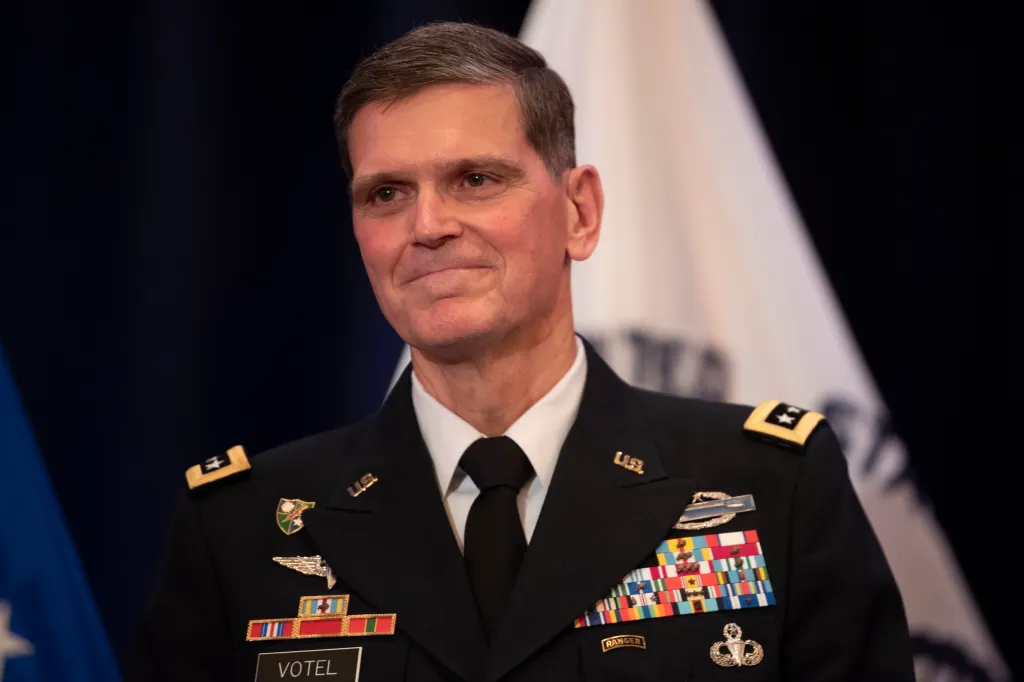
The outgoing commander of U.S. Central Command, U.S. Army Gen. Joseph L. Votel, is seen at his retirement ceremony, Tampa, Florida, March 28, 2019. Votel retired after 39 years of military service. U.S. Army Chief of Staff Gen. Mark A. Milley hosted the event; attendees included U.S. Acting Secretary of Defense Patrick M. Shanahan. (DoD photo by Lisa Ferdinando)
The outgoing commander of U.S. Central Command, U.S. Army Gen. Joseph L. Votel, is seen at his retirement ceremony, Tampa, Florida, March 28, 2019. (DoD photo by Lisa Ferdinando) Chief Petty Officer Lisa Ferdinando

Some of the questions and answers have been lightly edited for clarity.

Q: How surprised were you that the Iranians closed the Strait of Hormuz, attacked shipping and Arab nations?

A: I’m not particularly surprised. I expected that they would attack some of the Gulf partners, but I did not think they would go after civilian targets. I thought they would go after military installations, particularly our military installations in most countries, but going after things like hotels and civilian airports, things like that, I think was, was not expected. I was a little surprised that they would do that. I think we certainly expected them to respond to it and of course, trying to shut down the Strait of Hormuz, I think was very expected.

Q: Did you expect that?

A: Oh yeah.

Q: Why?

A: Because it’s their principal advantage. They control that terrain. They have the advantage over the Strait of Hormuz. They know it’s a critical choke point. They know it’s a pain point for many, and they knew it would cause the discussion that it’s causing right now.

Strait of Hormuz (Google Earth)

Q: How much pain do you think the Arab allies can sustain during this fight?

A: Well, I think they’re actually proving pretty resilient right now and they’re doing a good job defending themselves. Some of [the missiles and drones] are getting through, but it hasn’t been catastrophic in terms of that. Obviously, some damage… That’s not good. But they’re doing a pretty good job of defending themselves. 

And I think as you have seen from some of the open source reporting today, some of the Arab countries are beginning to run out of patience here, Saudi Arabia, the Emirates, of course, and we may see them lash back out. But they are also watching very carefully what the United States is doing, along with the Israelis, and they see that we are striking back very, very hard at the Iranians. So I think that that helps them to be a little bit more patient. We haven’t stepped away from this. We’re still very, very engaged, and I think that allows them to be a little bit more patient as we work through this.

TOPSHOT - Smoke rises from the direction of an energy installation in the Gulf emirate of Fujairah on March 14, 2026. Smoke could be seen rising from the direction of a major UAE energy installation on March 14, in what appeared to be the latest strike targeting the Gulf's petroleum facilities hours after the US struck Iran's Kharg Island. (Photo by AFP via Getty Images) /
Smoke rises from the direction of an energy installation in the Gulf emirate of Fujairah on March 14, 2026. Smoke could be seen rising from the direction of a major UAE energy installation on March 14, in what appeared to be the latest strike targeting the Gulf’s petroleum facilities hours after the US struck Iran’s Kharg Island. (Photo by AFP) –

Q: How feasible or not is a mission to escort ships in the Strait and de-mine it? What are the challenges and dangers of that?

A: Well, first of all, it’s very feasible. The United States Navy has a history of doing this kind of stuff, and they have, for the most part, all the resources that are required for this. 

I think the most important thing to appreciate before we really kind of get into the Strait of Hormuz here, is to appreciate what’s preparatory to doing all that. We really have to kind of finish this campaign that’s already been started. That is focused on reducing the Iranian capabilities to a very significant degree. And that’s what’s happening right now.

I think we need to appreciate that CENTCOM is executing a war plan here that’s going to take some weeks to destroy the military capability, and then they will be in a position – they’ll set the condition, so to speak – so they can actually go and reopen the Strait of Hormuz, and then direct and escort tankers through there. 

Then Gen. Joseph Votel, commander of U.S. Central Command, addressing sailors aboard the San Antonio class amphibious transport dock ship USS New Orleans transiting the Strait of Hormuz in 2016. (Howard Altman photo)

For the most part, we have all the resources that we need for that. As I mentioned, it might be helpful to get some additional resources from our international partners. And I’m not sure that’s going to happen based on some of the politics around all that and how we engaged and not engaged them in the lead up to this. But the United States Navy and Marine Corps and other joint services are, I think, are fully prepared to do that.

Q: Have the engagements we’ve had with foreign nations been helpful or hurtful or the ability to draw in assistance for any escort effort?

A: Well, we’ve had a pretty adversarial discussion going on, particularly with our European allies for at least the last 12 to 14 months with them. We haven’t really sent a positive signal. And the whole thing about Greenland and getting everybody fired up over that, and pushing that kind of thing, I think really gave some pause to them. 

And of course, you know, there’s continuous rhetoric coming from across the administration towards this, and in the lead up to this, we apparently didn’t do any kind of consultation with any of our partners that we expected would be impacted by this, or whose resources we thought we would need.

WATCH: German Defence Minister Boris Pistorius:

We did not start this war.

What does the world expect, what does Donald Trump expect from a handful or two handfuls of European frigates to achieve there in the Strait of Hormuz, which the powerful American Navy cannot manage… https://t.co/lO4WR2zly3 pic.twitter.com/MWwu3U4xyS

— Clash Report (@clashreport) March 16, 2026

Now, coming back after things have been joined and they haven’t been consulted, I think makes it really, really hard for us to get them involved. And I think it makes it hard for those international partners to sign on with this readily, very, very readily, without a lot of debate and understanding what they’re getting into. So we really didn’t set the conditions very well for if we thought we needed international support on this. 

And we usually do. I mean, that’s a normal thing that we do. We generally always try to fight as a coalition, because it gives us credibility. It gives us additional resources. And it kind of helps share the burden a little bit, and it makes everybody feel like they’re part of the solution to this. But in this case – with the exception of Israel – we pretty much chose to go it alone.

Q: We talked about the importance of keeping the Strait open while we were transiting it when you commanded CENTCOM. What’s your worst case scenario for the Strait now, given the current situation?

A: I think the worst case now would be if we’ve found positive evidence of the Strait being mined… That would really extend out the time [for opening the Strait]. We probably have to assume that there are mines in there right now. But a serious mining effort by Iran could really complicate and slow things down. 

Mine clearing is very deliberate. It’s very slow. It’s very frustrating. It’s that way if you’re doing it on land, and it’s that certainly if you’re doing it at sea. So to me, I think that kind of represents the most challenging thing that we would have to deal with. I mean, we can get [combat air patrols] Air CAPs up over this. We seem to be doing a good job going after missiles and drones and shore-based systems. We’ve destroyed a lot of the Iranian Navy and the IRGC Navy, and we can continue to ping on [Fast Attack Craft] FACs and [Fast Inshore Attack Craft ] FIACS – things like that that they might send in there. 

U.S. Navy MH-53E Sea Dragon pilots with Helicopter Mine Countermeasures Squadron (HM) 15 conduct deck landing qualifications on the flight deck of the USS Lewis B. Puller (ESB 3) in the Arabian Gulf, May 11, 2019. The Lewis B. Puller is an afloat forward staging-base variant of the mobile landing platform and is designed to provide dedicated support for air-mine countermeasures and special warfare missions around the globe. (U.S. Marine Corps photo by Sgt. Desiree King/Released) 

But the mines, I think, are a really, really hard issue. And when we think about one of these big tankers, so they are just really vulnerable, they’re thin-hulled, getting into this very narrow traffic scheme that’s there – two miles wide, right in the middle of the Strait and then hitting a mine and being disabled on the spot. Not only will we have a mine problem, we have a disabled ship problem and an ecological disaster, and a whole bunch of other things there. So in my view, I think the worst case situation kind of looks like a deliberate mining effort by the Iranians.

Q: Can the Gulf allies protect the Strait on their own? Some have expressed fear that the U.S. could end Epic Fury before the Strait is secured.

A: I don’t know. I don’t think so. They are a little dated in some of their capabilities. There hasn’t been a huge investment in the resources that would be necessary for keeping the Strait open in an armed conflict scenario. You need destroyers. You need a bunch of them. You need to be able to maintain several air CAPS up over it. You need to have extensive ISR. You need to have boarding parties. You need to have all the other stuff, like mine sweepers.

In a follow-up to our recent story about a pair of U.S. Navy Independence class Littoral Combat Ships (LCS) configured for minesweeping appearing in the Pacific, those vessels have now moved further east from Malaysia to Singapore.
A stock picture of the Independence class LCS USS Tulsa, which is configured for minesweeping duties, sailing in the Strait of Malacca in 2021. USN

And I don’t know that they have that. They may have all the pieces and parts of it across some of the Gulf countries, although I doubt they have the number of frigates that would be needed. But then bringing that together, they don’t necessarily have a great history of coming together for these kinds of things and combining these capabilities under a unified command other than the United States. I think it would be a challenge for the Gulf partners to be able to do that.

In our next segment, Votel talks about the highly strategic Kharg Island and how recovering uranium in Iran would be a more massive effort than most people think, among other topics.

Contact the author: howard@thewarzone.com

Howard is a Senior Staff Writer for The War Zone, and a former Senior Managing Editor for Military Times. Prior to this, he covered military affairs for the Tampa Bay Times as a Senior Writer. Howard’s work has appeared in various publications including Yahoo News, RealClearDefense, and Air Force Times.


Source link