cocaine

Global cocaine market expands, U.N. report says

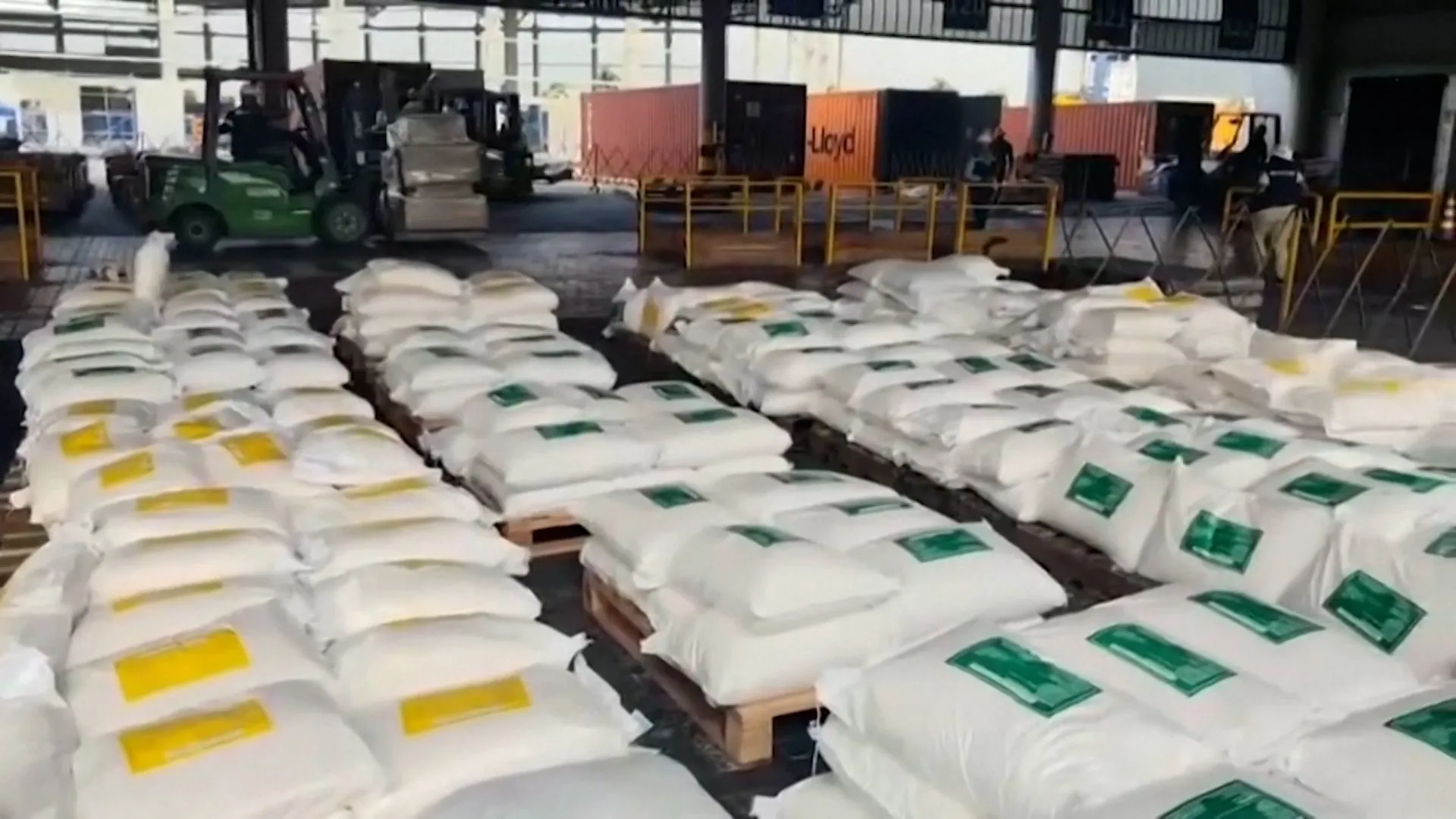
Members of the National Institute of Forensic Sciences organize packages of confiscated cocaine in Santo Domingo, Dominican Republic, on February 26 before incinerating 5,038 pounds of the drug after seizures made under the U.S.-led Operation Southern Spear, an international initiative to combat drug trafficking in Latin America. Photo by Orlando Barria/EPA

Feb. 27 (UPI) — The global cocaine market is the fastest-growing segment of the illicit drug trade, driven by rising production in South America and increasing demand in Africa and Asia, according to a United Nations report released this week.

Ecuador, meanwhile, has become one of the countries most affected by violence and the expansion of drug trafficking routes, the report said.

The findings appear in the 2025 report of the International Narcotics Control Board, the U.N. body responsible for monitoring compliance with international drug control treaties. It was published Thursday.

Global cocaine production exceeded 3,700 metric tons in 2023, a 34% increase compared with 2022, according to the control board.

The expansion is largely attributed to Colombia, where both the area under illicit coca cultivation and the production capacity of clandestine laboratories increased.

“The global cocaine market continues to expand and diversify,” the board said, warning that trafficking routes now reach “all regions of the world.”

While Western and Central Europe and North America remain the main destination markets, the report highlights rising consumption and seizures in Africa and parts of Asia.

In Africa, seizures rose 48% in 2023 compared with the previous year, which the report said reflects an expanding market rather than merely a transit region.

Between 2013 and 2023, the number of cocaine users worldwide increased from 17 million to 25 million, according to U.N. data.

Against this backdrop, Ecuador has emerged as a critical hub.

“In South America, the impact of increased cocaine trafficking has been felt particularly in Ecuador, which in recent years has experienced a wave of lethal violence caused by both local and transnational criminal groups,” the control board said.

Ecuadorian authorities seized more than 290 metric tons of cocaine in 2024, an unprecedented figure and approximately 30% higher than in 2023.

The surge in trafficking has coincided with a deterioration in security. The country recorded 6,964 violent deaths in 2024, with a homicide rate of 38.76 per 100,000 inhabitants, meaning the rate has quintupled over five years.

The report notes that Ecuador has become a major maritime export hub for cocaine shipments bound for the European Union.

In March 2025, Ecuadorian and European authorities dismantled an intercontinental criminal network that shipped tons of cocaine in maritime containers from South America to Europe.

In that operation, 73 metric tons of cocaine were seized in Ecuador and several European Union countries. Authorities arrested 14 people in Germany and Spain and 36 in the port city of Guayaquil, according to the report.

The control board also warned that traffickers are using increasingly sophisticated concealment methods to evade controls, including chemically altering cocaine to hinder detection during routine inspections, embedding the drug in plastics and textiles and using double-bottom compartments in legitimate goods.

Offshore deliveries coordinated through geolocation systems have also been seen.

As an example, the report cited the 2024 seizure of 13 metric tons of cocaine at the port of Algeciras in Spain, hidden in a shipment of bananas from Ecuador and described as the largest cocaine seizure in the country’s history.

The report further warns that sustained increases in production and the diversification of routes reflect a structural transformation of the global cocaine market, with criminal networks operating in an increasingly transnational manner and with greater logistical capacity.

The board stressed that the phenomenon is no longer limited to traditional production or consumption regions but now involves multiple continents at different stages of the drug trafficking chain.

Source link

Trump and Petro clash over how best to uproot Colombia’s cocaine crops | Donald Trump News

All about the numbers

The Petro administration has also continued to target criminal networks that traffic in cocaine through arrests and the seizure of shipments.

In November, Petro announced the Colombian government had made its largest drug bust in a decade, with law enforcement nabbing nearly 14 tonnes of cocaine.

Gloria Miranda was appointed by Petro in 2024 to lead Colombia’s Directorate for the Substitution of Illicit Crops, the agency overseeing the voluntary eradication efforts.

She believes that the Petro administration’s efforts have been mischaracterised as ineffective.

“There’s been a narrative that Colombia isn’t doing anything in the fight against drug trafficking,” she told Al Jazeera.

“But we’ve seized 276,000 kilogrammes [608,500 pounds] of cocaine, destroyed 18,000 laboratories, arrested 164,000 people, and are replacing more than 30,000 hectares [about 74,100 acres] of illicit crops.”

But critics — including Trump — argue Petro’s measures have yet to translate into results. Coca cultivation and cocaine production remain stubbornly at record levels.

According to the latest United Nations figures, coca cultivation rose in Colombia by about 10 percent in 2023. Potential cocaine output also jumped 53 percent to about 2,600 tonnes.

Gloria Miranda stands next to Gustavo Petro at an event
Gloria Miranda, second from right, stands next to President Gustavo Petro at a government event [Catherine Ellis/Al Jazeera]

Petro has questioned the accuracy of those numbers, though. Last week, ahead of Petro’s meeting with Trump, his government announced it would no longer use the United Nations figures, arguing that they rely on an “obscure statistical method”.

Michael Weintraub, the director of the Center for the Study of Security and Drugs (CESED) at the University of the Andes, told Al Jazeera that some of Petro’s pushback is political.

But he added that there is a genuine basis for questioning the UN’s methodology.

“The ‘potential cocaine production’ measure has a lot of baked-in assumptions that make it very difficult to trust,” Weintraub said.

It predicts coca production from selected plots, but yields vary by region and season. The UN itself has admitted there are limitations in its method.

Despite these concerns, coca cultivation in Colombia has trended upward for decades.

Analysts note one overriding factor: demand. Consumption in North America and Europe remains strong, and new markets have emerged in Asia, Africa and South America.

“Coca can only grow in limited places due to climate, soil and elevation,” Weintraub said. “So Colombia is likely to remain a major producer for the foreseeable future.”

Source link