closures

More flights cancelled with hundreds of thousands still stranded abroad in fourth day of airspace closures

FLIGHTS are continuing to be cancelled as the travel chaos caused by the Middle East conflict enters a fourth day.

Limited flights were permitted to take off last night, which included an Etihad flight from Abu Dhabi to London.

Flights are continuing to be cancelled today across the Middle EastCredit: AFP
Airlines are warning passengers not to travel to the airport unless contactedCredit: Reuters

However the majority of airlines have confirmed that most flights remain cancelled.

According to data from aviation analytics firm Cirium, around 73 flights are scheduled from the UK to the Middle East, working out to nearly 25,000 passengers affected today.

Emirates, which operates out of Dubai, confirmed that “limited flights” took off yesterday.

However, this was only for passengers with earlier bookings, and only those who are being contacted by Emirates.

HOL NO

EVERYTHING you need to know about holidays and flights affected by Iran crisis


GROUNDED

Thousands more flights and holidays cancelled as all travel to UAE banned

They warned: “Please do not go to the airport unless you have been notified.

“All other flights remain suspended until further notice.”

Etihad also operated limited flights yesterday across Asia and Europe, which included a flight to London.

However, most scheduled flights to and from Abu Dhabi are suspended until at least 2pm tomorrow.

In a statement, it confirmed: “Passengers should not travel to the airport unless they have been contacted directly by Etihad Airways and advised to do so.”

Qatar Airways confirmed this morning that flight operations were “still suspended due to the closure of the Qatari airspace”.

It added: “Qatar Airways will resume operations once the Qatar Civil Aviation Authority announces the safe reopening of Qatari airspace.

“A further update will be provided on March 4 by 9am Doha time.”

Virgin Atlantic has cancelled its Dubai to London flight today but has not yet confirmed any cancellations tomorrow.

And British Airways said they have “cancelled a number of our flights to the Middle East”.

Most airlines are allowing passengers to ask for a full refund, or can move their flights to a later date without any additiona charge.

Yesterday, the General Civil Aviation Authority in the UAE – in a very rare move – confirmed that the state would cover all accommodation and hosting costs for stranded passengers.

Most airports remain closed in the UAE and Qatar due to the airspace closuresCredit: Reuters

The Sun’s Head of Travel explains your rights if affected by the cancellations

Lisa Minot, Head of Travel, said:

For passengers meant to be flying in or out of the region, your rights depend on whether you were flying directly in or out of the UK or EU or if you are flying with an UK or EU airline.

Those who are will not get compensation as it is not the fault of the airline but they do have a duty of care to look after impacted passengers – depending on the length of the delay that could include food and drink, a means of communicating and if necessary, overnight accommodation.

Those flying on non-UK or EU carriers may find their rights are slightly different if they are not on a direct flight to the UK as different rules apply and you may not be provided with the same assistance.

They are, however, expected to offer you the right to a refund or another flight in the case of cancellations.

As well as those directly impacted by cancelled flights, the closure of so much of the Middle Eastern airspace will mean even more congestion on alternative routes that could impact flights across the globe.

For those due to travel in the coming days, staying in contact with your airline and checking before travelling to the airport is essential as schedules may change at short notice.

This means anyone still stuck in Dubai or Abu Dhabi will be able to stay at hotels free of charge, as well as not pay for any additional costs like food and drink.

The Sun’s Head of Travel Lisa Minot explains everything to do know about travelling to the Middle East right now.

Emirates and Etihad operated limited flights yesterday but the majority have been suspendedCredit: Getty

Source link

‘Not again’: Gaza rushes to stockpile amid Iran war, crossing closures | Israel-Palestine conflict

Deir el-Balah/Gaza City – When Hani Abu Issa headed to the Deir el-Balah market on Saturday morning, he was not carrying a long shopping list. He had only intended to buy ingredients for his family’s Ramadan iftar meal, nothing more.

But the sight of crowds gathered in front of grocery shops caught him by surprise and prompted him to ask what was happening.

Recommended Stories

list of 4 itemsend of list

A passer-by told him that Israel had struck Iran and war had broken out.

Hani was shocked as he watched people around him leaving one after another, carrying sacks of flour on their shoulders, and buying whatever food supplies and goods they could manage.

That was how the first hours of the military confrontation between Israel, joined by the United States, and Iran unfolded in Gaza.

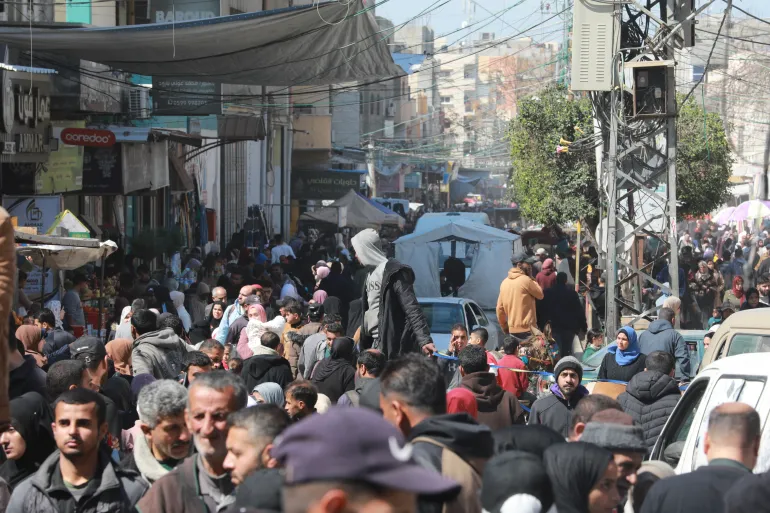
The scene in the enclave changed completely as people everywhere rushed to the market to buy sugar, flour, cooking oil and yeast.

Shelves began to empty, and the price of essential goods increased.

A father of five children, 51-year-old Hani told Al Jazeera that he believes the Israel-US war with Iran “will not directly affect Gaza”. But he admits that people in Gaza are no longer able to react calmly to any military development in the region.

“People have become afraid of everything. Since the morning, everyone rushed to the markets to stockpile, and that led to shortages of many goods and rising prices,” he said, while standing in front of food stalls in the Deir el-Balah market, in central Gaza.

Anxiety among residents intensified after COGAT, the Israeli body managing the Palestinian territory, released a statement on its Facebook page on Saturday evening announcing the closure of crossings leading to Gaza and the occupied West Bank “until further notice”, in light of security developments related to the war with Iran.

Hani said the possibility of crossings remaining closed deeply worried him.

“Flour, sugar, cooking oil, and yeast… those were the first things to disappear from the market because of the heavy demand,” he said.

“I lived through famine [during Israel’s genocidal war on Gaza] like everyone else. The worst days were when I had to buy a sack of flour for more than 1,000 shekels [$319]. I don’t want to relive that experience.”

He said that stockpiling while the crossings remained closed was not a viable solution.

“Goods run out quickly, and the conditions we live in may spoil whatever we store. All we need is for someone to reassure us that the closure of the crossings will not last.

“For someone to tell us that we will not be affected.”

Crowds filled Gaza’s markets as residents rushed to stockpile food after news of the Iran war and the closure of Gaza and West Bank crossings [Abdelhakim Abu Riash/ Al Jazeera]
Crowds filled Gaza’s markets as residents rushed to stockpile food after news of the war with Iran and the closure of Gaza and West Bank crossings [Abdelhakim Abu Riash/ Al Jazeera]

Local sources reported that the crossing closures were linked to the Jewish holiday of Purim, which created confusion over how long they would last.

“We cannot be certain or confirm anything. Israel’s word cannot be relied upon, and no specific duration was given,” Hani added in frustration.

“Gaza has not recovered from two years of war and famine. All I think about now is traveling and leaving with my two daughters to live in another country. That is enough.”

At around the same time last year, during Ramadan last March, Palestinians in Gaza endured one of the harshest phases of the war after crossings were closed and goods were prevented from entering for extended periods, leading to shortages of food supplies and price hikes that resulted in the spread of famine.

Israel’s policy of starvation at the time faced widespread condemnation. Markets turned into empty spaces, flour prices soared to record highs, and people died due to severe malnutrition.

Omar Al-Ghazali sells groceries from his food stall in Nuseirat market in central Gaza [Abdelhakim Abu Riash/ Al Jazeera]
Omar Al-Ghazali sells groceries at his food stall in the Nuseirat market in central Gaza [Abdelhakim Abu Riash/ Al Jazeera]

Justified fear

In the Nuseirat market, where people are still frantically buying groceries, 28-year-old seller Omar Al-Ghazali told Al Jazeera that the famine experience has left a deep psychological impact.

“People’s fear is completely justified. They were shocked and frightened and want to secure themselves. They learned from the previous famine experience and from fears of trader hoarding,” the father of four said.

“Today, although the war is not taking place on Gaza’s land, the fear of repeating the famine scenario appears stronger than any logical analysis of the regional situation,” he added.

“We cannot tell people not to buy. What they went through was extremely difficult. We try to convince ourselves that things are fine and that no one will be affected, but fear is stronger.”

‘Where would we even store it?’

Not everyone can afford to stockpile.

Asmaa Abu Al-Khair, 38, was wandering through the Gaza City market on Sunday,  visibly confused. A mother of eight, she wants to stock up, but lacks both the financial ability and the space.

“Where would we store it? And what would I even store? We need everything, and we can barely provide our daily food during Ramadan,” she told Al Jazeera as she walked empty-handed through the market.

“I feel great anxiety. Everyone is talking about it – about Iran’s strike and the closure of the crossings – and I cannot afford to buy what I need, while at the same time, I am afraid of famine returning. I have young children,” she said sorrowfully.

Asmaa said many displaced families living in nearby tents were facing the same reality as they “do not have the money to buy supplies, nor the space to store them inside the tents”.

“We endured so much hardship during the war, and it barely ended with the announcement of a ceasefire. So why close the crossing now? What do we have to do with what is happening? Is what we witnessed not enough? Why play with people’s nerves?”

Until yesterday evening, Asmaa had hoped the crossings would not be closed and that things would continue as they were. Then, the announcement came.

“It felt like a stab in my heart. I went to sleep with deep frustration,” she said bitterly.

Mohammed Daher chose not to stockpile, saying he is exhausted by the repeated Israeli crossing closures, particularly those that coincided with Ramadan last year [Abdelhakim Abu Riash/ Al Jazeera]

Mohammed Daher, 46, from Jabalia, who is now displaced and living in Deir el-Balah, said he had been living the spirit of Ramadan “calmly and peacefully”, without war or gunfire for the first time in two years, until the news of war with Iran.

“I found myself lost again. But I decided not to stockpile anything,” he told Al Jazeera while looking around the market.

“We are exhausted. I reached a point where I have grown used to all scenarios,” he said despairingly. “Israel is looking for any pretext to starve Gaza’s residents again and deepen their humanitarian crisis.”

Daher said he had spent most of his money during the previous famine buying basic food items at inflated prices.

“Everything was priced like gold… if you could even find it. Today, I have no energy left to endure that torment again. Let whatever happens, happen.”

Deepening Gaza’s humanitarian crisis

There were widespread reactions to the Israeli closure decision on social media, as Palestinians questioned whether they were on the brink of an even harsher phase of Israel’s treatment. Many people accused Israel of closing the crossings to push Palestinians towards further starvation and collective suffering.

Some wondered whether Israel was using the moment to create more suffering for Palestinians in Gaza while the world was distracted by the war with Iran.

Ali al-Hayek, a member of the Palestinian Businessmen Association in Gaza, warned that closing the crossings could halt aid distribution to struggling families and put a pause on charitable kitchens. It would also obstruct urgent medical travel abroad, particularly for those who are wounded, in critical condition or living with chronic diseases, such as cancer.

He pointed out that Gaza’s economy has already contracted by more than 85 percent because of Israel’s genocidal war, with the majority of the population pushed below the poverty line, unemployment reaching nearly 80 percent, and more than 97 percent of industrial facilities ceasing operations.

Al-Hayek called on the international community to intervene immediately and pressure the Israeli side to reopen the crossings and restore their normal operations, while ensuring freedom of movement for individuals and goods.

But he also said it is important that traders not use the shortage to increase prices. It’s Ramadan time, he emphasised, and Palestinians should demonstrate solidarity now more than ever.

Source link

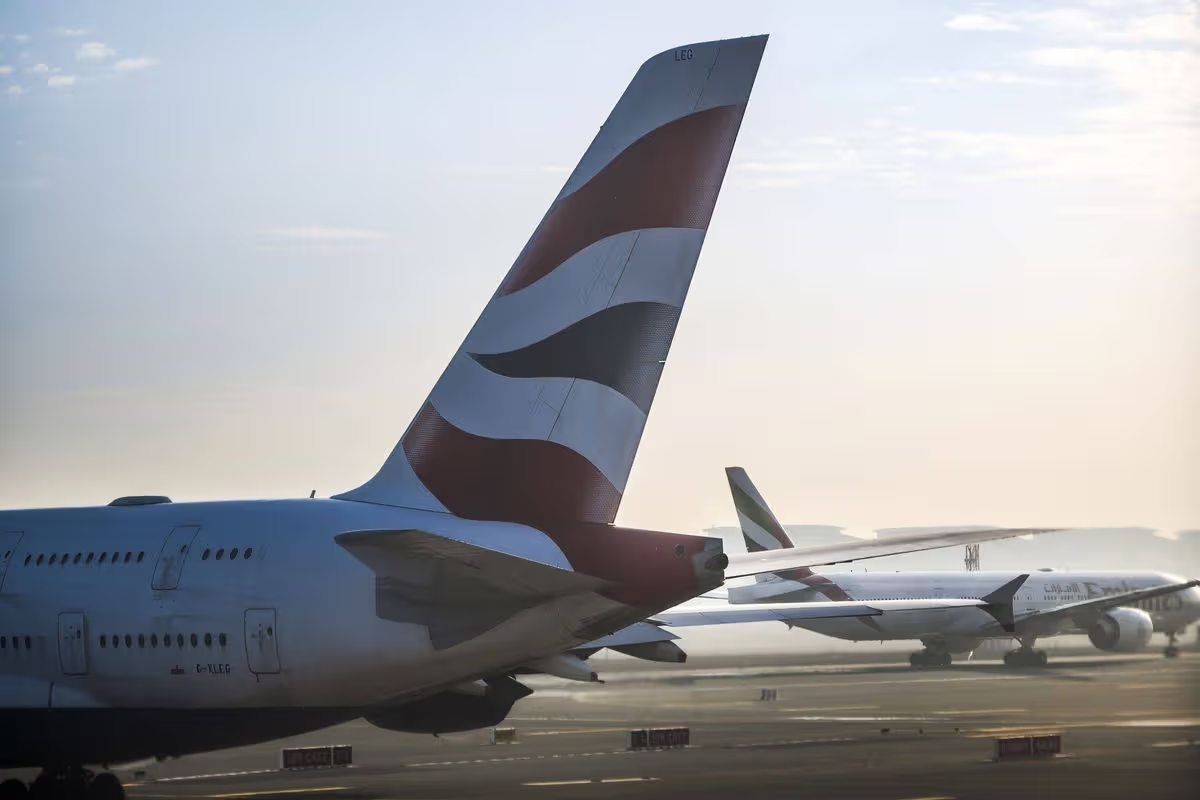
Dubai airport chaos: British Airways cancels Middle East flights amid airspace closures

British Airways has cancelled flights to Tel Aviv, Bahrain and Amman with passengers offered free changes or refunds – as travellers are warned they may need to ‘get creative’ amid mass disruption

Travellers will need to “get creative” if they want to fly in the coming days, an expert has cautioned, with hundreds of thousands of people stranded or rerouted to alternative airports following widespread airspace closures throughout the Middle East.

Israel, Qatar, Syria, Iran, Iraq, Kuwait and Bahrain have all closed their airspaces. Flight tracking website FlightRadar24 recorded no flight activity over the United Arab Emirates, with the UAE government announcing a “temporary and partial closure” of its airspace.

British Airways has confirmed flights to Tel Aviv and Bahrain will remain suspended until next week, whilst flights to Amman, Jordan, were scrapped on Saturday.

READ MORE: Donald Trump tells Iran ‘better not’ strike after Ayatollah Khamenei killedREAD MORE: Dubai airport chaos: Emirates confirms when flights will resume as Brits scramble to flee

Ensure our latest headlines always appear at the top of your Google Search by making us a Preferred Source. Click here to activate or add us as your Preferred Source in your Google search settings.

This resulted in the shutdown of crucial hub airports in Dubai, Abu Dhabi and Doha, and the scrapping of over 1,000 flights by leading Middle Eastern carriers, reports the Express.

The three principal airlines operating from those airports – Emirates, Qatar Airways and Etihad – typically handle approximately 90,000 passengers daily through those hubs, with even greater numbers of travellers bound for Middle Eastern destinations, according to aviation analytics firm Cirium. Dubai international airport ranks as the world’s busiest airport for international flights.

Aviation industry analyst and president of Atmosphere Research Group Henry Harteveldt said, via AP: “For travellers, there’s no way to sugarcoat this… you should prepare for delays or cancellations for the next few days as these attacks evolve and hopefully end.

“Travellers should anticipate that there will be a lot of disruptions,” he said, before adding: “To be honest, if you haven’t left home, chances are you won’t be leaving home if you’re supposed to travel to or through these destinations for at least several days, if not longer. And if you are returning home, you will have to be very creative about how you get home.”

BRITISH AIRWAYS: FULL STATEMENT ON FLIGHTS TO AND FROM THE MIDDLE EAST.

BA released an official statement on its website late on Saturday (February 28) for passengers who may be affected by the rapidly developing situation in the Middle East.

Here is the statement in full:. “We are closely monitoring the situation and have cancelled a number of our flights to the Middle East. Safety is always our top priority and we would never operate a flight unless it was safe to do so.

“If you are due to fly between London Heathrow and Abu Dhabi, Amman, Bahrain, Doha, Dubai or Tel Aviv you can change your flight free of charge up to and including 6 March. Customers travelling up to and including 4 March may also request a full refund.

“Should you wish to do so, please ring our contact centres on 0800 727 800 within the UK or 020 3250 0145 where a member of our team will be happy to assist. You can also find useful information, including details of your consumer rights, at ba.com/helpme..

“Thank you for your understanding and we look forward to welcoming you on board soon.”

BA’s statement comes as airlines serving the Middle East cancelled or diverted flights en masse on Saturday in the wake of US and Israeli airstrikes against on Iran.

Iran hit back by launching a wave of attacks, targeting Israel and four Gulf Arab nations hosting US military bases – Bahrain, Kuwait, Qatar and the UAE.

British Airways, Virgin Atlantic and Wizz Air were amongst the carriers to reduce their schedules to Middle Eastern destinations, citing safety concerns. The UK Foreign Office urged British nationals in Bahrain, Qatar, Kuwait and the United Arab Emirates (UAE) to immediately shelter in place following explosions.

UK Foreign Office issues advice for Britons trapped in Dubai.

For any Britons currently in the UAE, the Foreign Office released new guidance overnight.

All citizens already present in the UAE are strongly encouraged to notify the UK government by registering their presence to receive further updates as the situation continues to develop across the Middle East. “Due to reported missile attacks, British nationals in the UAE should immediately shelter in place. Remain indoors in a secure location, avoid all travel and follow instructions from the local authorities.”

The FDCO also advised British nationals in the UAE to take sensible precautions, taking into account their own personal circumstances.

  • – Read the UK Government’s fact sheet If you’re affected by a crisis abroad. This includes guidance on how to prepare for a crisis with suggestions on what you might include in your emergency supplies and what to do in a crisis.
  • – Follow advice from the local authorities and sign up to receive information and alerts. Read the FDCO fact sheet: National Emergency Crisis and Disaster Management Authority’s guidance across numerous emergencies.
  • – Sign up to FCDO Travel Advice to get email notifications on updates as they happen.

Follow our live blog for the latest travel updates by clicking here.

Source link