ceremony

Oscars to leave Hollywood’s Dolby Theatre in 2029

• The Academy Awards will move from the Dolby Theatre to L.A. Live in downtown Los Angeles beginning in 2029 under a new agreement with AEG that runs through 2039.

• The shift to L.A. Live will place the ceremony within a larger, campus-style complex, allowing the red carpet, show, press operations and post-show events to be staged in a more centralized footprint with increased capacity.

• The move will coincide with the Oscars’ shift to YouTube, part of a broader reset for the ceremony as it looks to expand its global reach after years of declining television viewership.

The Oscars are leaving Hollywood — or at least Hollywood Boulevard.

Beginning in 2029, the Academy Awards will move from the Dolby Theatre, their home for nearly a quarter century, to L.A. Live in downtown Los Angeles, the Academy of Motion Picture Arts and Sciences and AEG announced on Thursday. The ceremony will be held in the theater currently known as the Peacock Theater, which is expected to be renamed before the Oscars arrive as part of a new naming rights deal.

The new agreement runs through 2039. Discussions about the move have been underway for the last couple of years, according to people familiar with the planning who were not authorized to speak publicly.

The change in venue comes as the Oscars are also moving away from their traditional home on broadcast television. Earlier this year, the Academy announced that the ceremony will begin streaming live worldwide on YouTube in 2029, ending a five-decade run on ABC.

Since 2002, the show has been closely associated with Hollywood Boulevard, where the red carpet runs alongside the Walk of Fame and, for one night a year, the area becomes the symbolic center of the film industry. The Dolby Theatre sits at the corner of Hollywood and Highland, inside a retail and entertainment center near the TCL Chinese Theatre and the El Capitan.

L.A. Live offers a more centralized, campus-style setting, with venues and event spaces clustered together. The complex is adjacent to Crypto.com Arena and the Los Angeles Convention Center and is part of a larger sports and entertainment district developed and operated by AEG that regularly hosts concerts, sporting events and awards shows, including the Emmys and the Grammys. AEG has recently proposed adding a new hotel, residences and additional entertainment space to the complex, part of a longer-term expansion of the site.

In some ways, the move out of the Dolby is less a break than a return: The ceremony was staged for years in downtown L.A. at the Dorothy Chandler Pavilion and at the Shrine Auditorium before settling at the Dolby.

At the Oscars’ new home, the red carpet, ceremony, press operations and post-show events can all be staged within a compact footprint that includes the adjacent JW Marriott hotel and its ballroom. The theater itself is expected to undergo upgrades to its stage, sound and lighting systems, allowing it to be configured more specifically around the show. The move is also expected to increase capacity, a growing consideration as the academy’s ranks have expanded significantly in recent years, now numbering more than 11,000 members.

At the Dolby, space has long been tight. Each year, multiple blocks of Hollywood Boulevard are shut down for days at a time, rerouting traffic and turning the area into a heavily secured zone — conditions that were even more restrictive this year with security tightened further amid the war in Iran, including a one-mile police buffer around the theater.

The Academy had been looking for a venue that offered greater control over how the show is staged, including how the audience is arranged and how the room is used for both the broadcast and the live event. The new venue is expected to provide more room for press areas, green rooms and backstage operations, along with upgraded technical infrastructure for staging the ceremony.

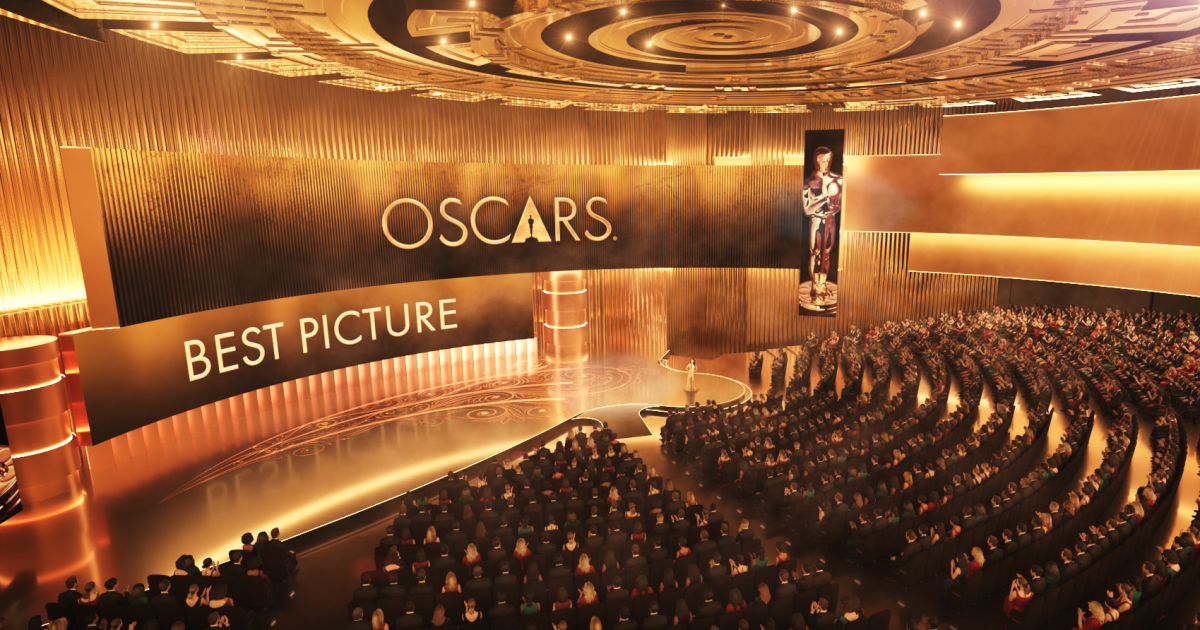
Early design renderings released by the academy suggest that, for viewers at home, the Oscars may not look all that different. The stage retains the sweeping, curved proscenium that has defined the Dolby Theatre era, suggesting a similar visual approach at a larger scale, with expanded screen space and a more immersive ceiling design.

For both the academy and AEG, which owns and operates the complex, the appeal is in keeping everything in one place — arrivals, ceremony, the Governors Ball and afterparties — rather than spreading events across multiple locations. The setup also creates new opportunities for hospitality and sponsorship tied to the broader campus.

“L.A. Live was built to host the moments that define culture and there is no greater global stage than the Oscars,” said Todd Goldstein, AEG’s chief revenue officer. “Together, we will create an environment that celebrates creativity, honors excellence and delivers an unforgettable experience for movie fans everywhere.”

Taken together, the changes amount to a significant reset for the Oscars, which have seen their audience decline from more than 40 million viewers in the late 1990s to 17.9 million this year, down 9% from the previous year. Moving to YouTube offers a way to reach a broader, more global audience at a time when traditional television viewership has declined.

The Oscars will remain at the Dolby through the 100th ceremony in 2028 before making the transition the following year.

“For the 101st Oscars and beyond, the Academy looks forward to closely collaborating with AEG to make L.A. Live the perfect backdrop for our global celebration of cinema,” Academy Chief Executive Bill Kramer and President Lynette Howell Taylor said in a statement.
Source link

2026 Oscars telecast scores 17.9 million viewers, down 9% from last year

ABC’s Sunday telecast of the 98th Oscars averaged 17.9 million viewers, ending a four-year streak of audience increases.

The figure from Nielsen is down 9% from the 19.7 million viewers who watched the telecast on ABC and Hulu in 2025.

After ratings for the Oscars cratered to an all-time low of 10.5 million viewers in 2021, the event’s audience levels ticked back up in recent years.

But the show has not topped 20 million viewers since 2019, as younger viewers are content to watch highlights of the ceremony on social media, rather than sit through a three-hour-plus telecast on traditional TV.

The awards held at the Dolby Theatre in Hollywood honored “One Battle After Another” for best picture, Michael B. Jordan for lead actor in “Sinners,” and Jessie Buckley for lead actress in “Hamnet.” Conan O’Brien was the host for the second straight year.

Critics said the ceremony was light on political statements about President Trump, whose name was not mentioned during the telecast. The show’s highlight was an extended “In Memoriam” segment that gave extra tribute to legendary actor and filmmaker Robert Redford and slain actor, director and producer Rob Reiner.

ABC had success in selling out the commercials for the Oscars, which is perennially the most watched non-sports telecast of the year. But the network will only have the event for two more years as the Academy of Motion Picture Arts and Sciences chose to take a better financial offer from YouTube for the rights to the telecast starting in 2029.

O’Brien poked fun at the YouTube move. He closed with a video that shows him being appointed Oscars “host for life.” As he takes in the honor, poison gas seeps into the office he is given. After O’Brien’s lifeless body is wheeled out, a name plaque with a new host is put on the door. His successor is YouTube star Mr. Beast.

Source link

Oscars: ‘Voice of Hind Rajab’ star to miss ceremony due to travel ban

“The Voice of Hind Rajab,” a heartbreaking retelling of the efforts to save a 6-year-old Palestinian girl amid Israel’s attacks on Gaza, will be honored at the 98th Academy Awards on Sunday — without one of its star players.

Actor Motaz Malhees, who stars in the film as Red Crescent dispatcher Omar, confirmed Thursday that he will be absent from the festivities because of President Trump’s travel ban against Palestinians. “I had the honor of playing one of the lead roles in a story the world needed to hear,” Malhees said on Instagram, “but I will not be there.”

“I am not allowed to enter the United States because of my Palestinian citizenship,” he added.

Trump announced his widened travel ban in December, noting his decision to “fully restrict and limit the entry of individuals using travel documents issued or endorsed by the Palestinian Authority,” along with people from countries including South Sudan and Syria. The president issued the order months after he presented his 20-point peace plan for the Gaza strip — efforts that some Palestinians feel have been now brushed aside amid U.S. and Israeli attacks against Iran.

Malhees said in his post that the restriction “hurts” but offered his followers and supporters a kernel of truth: “You can block a passport. You cannot block a voice.”

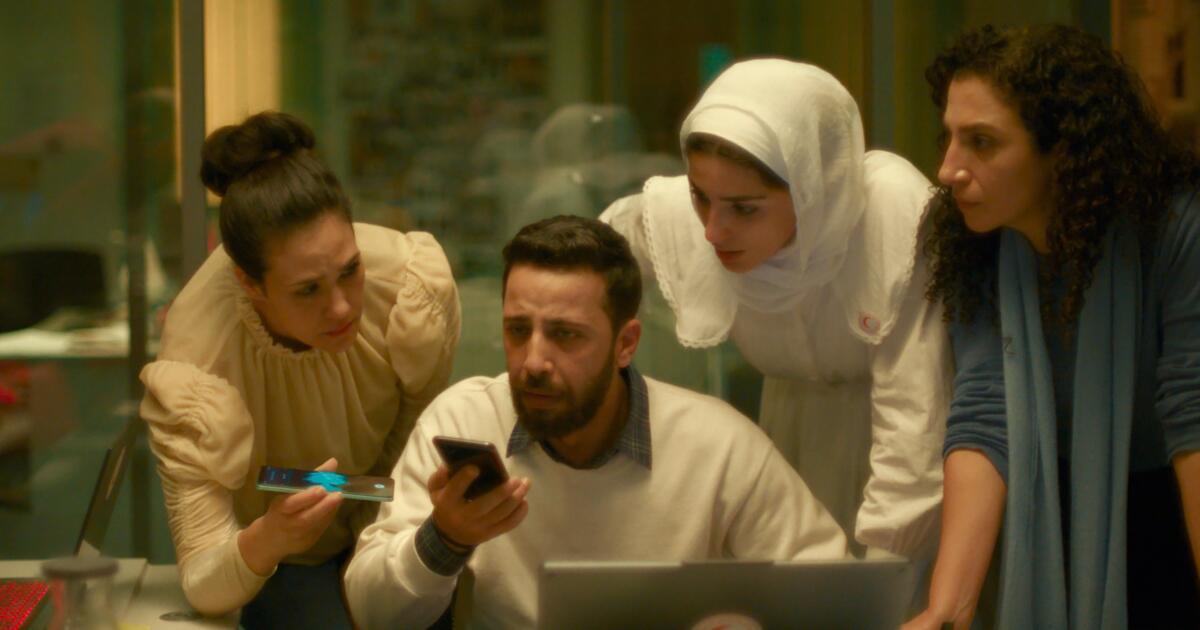
“The Voice of Hind Rajab,” directed by Tunisian filmmaker Kaouther Ben Hania, is nominated in the international feature category. The film is set in a Red Crescent call center in Ramallah and centers the 70-minute phone recording of Hind’s pleas for help as she waits with her family in a trapped car for emergency responders. She and two medics dispatched to her location were killed in February 2024 in Israeli attacks in Gaza.

The film earned the grand jury prize at the Venice Film Festival.

Though unable to celebrate the film at the Oscars on Sunday, Malhees said he stands “with pride and dignity” and that his “spirit will be with the Voice of Hind Rajab that night.”

“Our story is bigger than any barrier, and it will be heard,” he said.

A representative for the Academy of Motion Picture Arts and Sciences did not immediately respond to a request for comment.

As Malhees publicized his absence, fellow stars including Oscar winner Riz Ahmed and Emmy-nominated “Succession” star Arian Moayed rallied in support.

“Your work in the film and the film itself are both incredible and will live on forever,” Ahmed commented.

“You are brilliant, azizam,” Moayed replied to Malhees. “And this is heartbreaking and unjust.”


Source link

Conan O’Brien says addressing politics at Oscars is a ‘dance’

The big question surrounding last year’s Academy Awards was whether the show would address the L.A. wildfires, which had rattled the city mere months prior.

This year, the elephant in the room is the ongoing Iran war, which like last year’s wildfires, puts a celebration like the Oscars in sharp relief. But for Conan O’Brien, balancing gravity and levity is part of his job description as host.

“My job is to always try and hit this very, very thin line between entertaining people and also acknowledging some of the realities,” O’Brien said during a Wednesday news conference with the Oscars creative team.

“It’s a dance that goes on up until the show begins,” the former talk show host said, adding that he and his team of writers are still revising material ahead of the show to ensure their content is as relevant as possible.

“Between us,” he said, referencing Oscars telecast executive producers Katy Mullan and Raj Kapoor, “we will find the right tone.”

O’Brien also during the news conference recalled Johnny Carson’s turn hosting the Oscars during the Iran hostage crisis, when 52 Americans, including diplomats and other personnel, were held hostage at the U.S. embassy in Tehran from 1979 to 1981. The comedian remembered the television host parodying ABC’s “Nightline” with his joke, “It’s day 444 of the Oscars.”

“It was such a funny, topical joke that touched on something everyone was thinking about, and at the same time, got a big laugh and was unifying,” O’Brien said. “That was meaningful to me.”

Kapoor said during the news conference that the production team is putting systems in place to alleviate attendees’ safety concerns amid the tense global situation and reported threats to California.

“Every year, we monitor what’s going on in the world,” the showrunner said, adding that the ceremony has the support of the FBI and LAPD. “This show has to run like clockwork.”

He added, “Everybody that is coming to this show, that is witnessing this show, that is even a fan of the show when they’re standing outside the barricades — we want everybody to feel safe and protected and welcome.”

As for the telecast’s creative direction, the team cited “human touch” as a unifying theme — a not-so-subtle slight to AI.

“We’re celebrating human touch, human connection and what I like to call actual intelligence, as opposed to artificial,” said music director Michael Bearden. “We want to get back to the communal … and so the music will reflect that.”

That spirit of celebration will be especially tangible in the “KPop Demon Hunters” performance, Kapoor said. That performance will be complemented by a “Sinners” moment featuring Miles Caton and Raphael Saadiq as well as guests Misty Copeland, Eric Gales, Buddy Guy, Brittany Howard, Christone “Kingfish” Ingram, Jayme Lawson, Li Jun Li, Bobby Rush, Shaboozey and Alice Smith.

“We have this lovely story celebrating Korean culture with authentic Korean drummers and singers and even choreography,” the producer said. “So again, we’ve expanded our reach, and we’re telling these global stories, celebrating international films that have had a global impact and doing things in a really different way.”

Mullan and Kapoor closed the news conference by teasing a pair of reunions featuring cast members from “Bridesmaids” and the Marvel Cinematic Universe. “Bridesmaids” alum Rose Byrne is nominated for a lead actress Oscar for her role in “If I Had Legs I’d Kick You,” which marked O’Brien’s dramatic acting debut. (If Byrne wins, he said, “half that Oscar’s mine.”)

“We’re gonna have superstars, superheroes, and there is also going to be an extraterrestrial on the stage, so you can figure that one out,” Mullan said.

The 2026 Oscars will air live Sunday on ABC, with streaming available on Hulu, YouTube TV, AT&T TV and FuboTV.

Source link