Who’s Funding the Asian Century?
Hong Kong listing reforms and surging deposits show regional markets funding Asia’s future.
This article appears in the October issue of Global Finance Magazine.
When the International Monetary Fund and World Bank convene their annual meetings in Bangkok this October, it will be the first time the joint gathering has returned to the city in 35 years. IMF officials have taken to calling Asia the “driving force” of the global economy — shorthand for a region that accounts for one-third of global gross domestic product, 29% of global public equity market capitalization, 56% of listed companies and 52% of global venture capital activity, according to the Organization for Economic Cooperation and Development’s Asia Capital Markets Report
The question for chief financial officers isn’t whether Asia is growing — it’s whether the region can finance that growth on its own terms, or whether it still depends on capital, listings, and liquidity from the West. The answer, based on bank data, exchange records, and conversations with practitioners and economists on the ground, turns out to be both.
Alex Ibrahim, until recently corporate CFO of Yanolja, the Seoul-headquartered travel technology company, said Asia is a picture of change. Its financial sector has matured in the decades since the 1960s to 1990s, when headlines proclaimed the rise of the Asian Tigers and countries became synonymous with rapid, export-driven industrialization funded largely from abroad.
“Back then, the economies were growing very fast, and a lot of the money was coming from the U.S. to invest,” said Ibrahim, who before joining Yanolja spent nearly a decade running international capital markets at the New York Stock Exchange. “If you look now, capital has developed locally and the financial infrastructure in Asia is much more robust.”
Marc Iyeki, a board advisor who formerly led the NYSE’s Asia-Pacific listing sector and shepherded about 100 companies to market, said the shift reflects a change in decision-making. “Decades ago, the money was in New York. Decisions were made in New York,” he said. Since then, regional private equity and venture firms have placed people on the ground in Asia who understand the home market and make the calls themselves, often after training at global firms and bringing that experience back. The region has also produced homegrown standouts such as PAG, Hillhouse Investment, MBK Partners, and Peak XV Partners.
That evolution is seen in how Asia’s own exchanges are performing. Over the past ten years, Hong Kong’s equity market has moved through cycles in liquidity and new issuance, but 2025 marked a rebound from the post-pandemic slowdown. Average daily turnover on the Hong Kong stock exchange rose from HK$66 billion in 2016 to HK$248 billion in 2025, nearly 3.7 times the level a decade earlier. Initial public offering proceeds were more volatile: HK$194 billion was raised in 2016, followed by several weak years before rebounding to HK$285 billion in 2025.
Japan’s exchange has risen more steadily. On the Tokyo Stock Exchange’s Prime Market, average daily trading value for domestic common stocks rose from 3.2 trillion yen in fiscal year 2022 to 4.3 trillion yen in fiscal year 2023, and 6.7 trillion yen in fiscal year 2025.
Iyeki recalled that when Alibaba first wanted to list in Hong Kong in 2013, the exchange turned it away over governance requirements — and New York landed the IPO. Losing a flagship company forced a reckoning. Some in Hong Kong worried that loosening listing rules would weaken protections for retail investors; others warned the market would be “hollowed out,” as local companies sought listings in New York and London. Hong Kong changed its rules, and years later Alibaba came back for a dual listing. The infrastructure now absorbing record IPO volumes and Alibaba-scale capital was built, in part, out of that earlier loss.
One of the people behind that financial infrastructure is Larry Li, a Hong Kong-based fintech founder who worked on Stock Connect, a market access program that links the stock markets of mainland China and Hong Kong. It has become a major cross-border equity trading tie between China and international investors. Its northbound turnover more than doubled to 345 billion yuan in the first half of 2026; southbound turnover hit a new high of $123 billion yuan. “It’s a closed loop, so capital cannot fly out of the system,” Li said.
Li, a director of Digital Asset Clearing Center, which aims to develop a financial settlement and clearing infrastructure that can integrate digital and tokenized assets into mainstream capital markets, argued that areas like Hong Kong, Singapore, and Shanghai have pockets of innovation in financial AI. Li said the region’s token economy “drives market infrastructure upgrades, attracts capital globally, and enjoys support from governments as a strategic force of growth.”
Fintech, Banking, and Innovation
Li pointed out that the region’s tokenized economy fosters “co-opetition” between the banking industry and fintech enterprises. Consumers across the region have largely turned to fintech-developed super apps like Alipay and WeChat Pay, while banks have doubled down on the regulated back end: cross-border settlement, know your customer, and other compliance rules.
Some of the same banks figuring out Asia’s patchwork of KYC and settlement rules are also among the world’s fastest-growing lenders. Banking data makes the same point in numbers. S&P Global Market Intelligence’s 2026 ranking of Asia-Pacific’s 50 largest lenders by assets found China’s big four — Industrial and Commercial Bank of China, Agricultural Bank of China, China Construction Bank, and Bank of China — grew assets about 16% year over year in US-dollar terms as of December 31, 2025. S&P also singled out Singapore’s three largest banks — DBS, Oversea-Chinese Banking Corp., and United Overseas Bank — for strong double-digit asset growth, driven by regional deposit inflows rather than capital raised abroad.
China’s financial system is bank-led and primarily state-directed, according to Standard & Poor’s. The country’s household savings, pensions, and corporate liquidity flow into banks rather than capital markets, giving lenders a large, stable funding base that the government then channels toward priority sectors. Beijing has supported that base with a 520 billion yuan capital injection into four state-owned banks in 2025, followed by plans announced in March 2026 to issue another 300 billion yuan in special bonds to recapitalize ICBC and Agricultural Bank of China.
“As the primary liquidity conduit for fiscal stimulus, state-owned banks increased their financial investments by 19% in 2025,” Iris Tan, a senior equity analyst at Morningstar, said in the S&P report. These financial investments were “fueled by a record 28% surge in government bond issuance,” according to Tan.

Vietnam as a Case Study
None of this means that Asia’s approximately 48 countries are growing equally. Sam Van, managing partner of SRO Partners and an advisor on Vietnamese capital markets, said the region is still layered by tier. Blue-chip regional companies can borrow cheaply from local banks at rates set by well-capitalized central banks — sometimes so cheaply, he said, that “it’s better to borrow money from the bank than actually issue a bond.” Midsize companies, those earning under $50 million in revenue, are a harder sell to credit officers weighing thin margins against career risk, which pushes some smaller businesses toward informal lenders. Van sees this gap as a reality in a still-maturing system rather than evidence that the system isn’t working.
Van, who recently co-authored a book that chronicles Vietnam’s economic rise, said the country illustrates how quickly a market can mature once the incentives align. Vietnam’s IMF-linked compliance upgrades — the product of what Van calls the government “consistently wanting to meet that standard” since joining the IMF in the 1990s — helped it earn an upgrade to FTSE Russell’s emerging-market status in September.
Critical Economic Views
Two economists watching from outside the deal room caution against overstating the region’s financial self-sufficiency. Bala Ramasamy, professor of economics at the China Europe International Business School in Shanghai, argued that “the driver in Asia, for Asia and by Asia is definitely China” — its outbound foreign direct investment to the Association of Southeast Asian Nations alone can match what comes from the EU or the US, and the reconfiguration of trade around geopolitical frictions is relocating supply chains in ways that are boosting growth across Southeast and South Asia. Japanese and Taiwanese capital, he noted, is increasingly heading toward the US to secure market access and stay aligned with Trump-era industrial policy, even as flows from Europe and the US slow elsewhere. “I don’t think Asia can do without it,” he said.
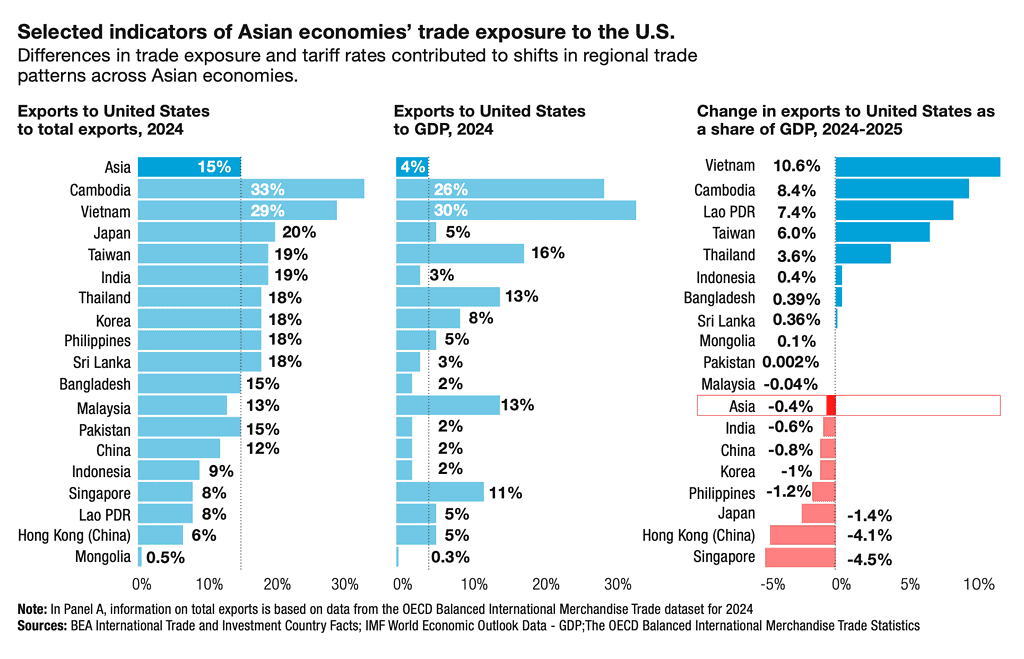
Prema-chandra Athukorala, emeritus professor of economics at the Australian National University, said Asia’s growth is substantial, but its export-driven economy still relies heavily on the rest of the world. Domestic savings rates across the region dwarf the emerging-market average of roughly 25% — Singapore’s is near 58%, China’s near 49.5%, India’s around 30% — and in most Asian economies, investment rates run below those savings rates, meaning the region is, on balance, a net exporter of capital rather than an importer of it. Intraregional FDI from China, Korea, Taiwan, and Singapore has grown substantially over the past two decades. However, Athukorala said that extra-regional FDI still accounts for the larger share of investment in Vietnam, Malaysia, Thailand, and Cambodia, where Western multinationals remain central to “China+1” supply-chain strategies, and even domestically financed activity depends heavily on global demand. “Over two-thirds of the regional exports are still destined to extra-regional markets,” he said.
Taken together, the practitioners and the professors describe a region that finances far more of its own growth than it used to, yet remains clearly reliant on the rest of the world.
Weld Royal is a contributing writer based in the U.S.







![National Geographic Explorer Paola Nogales Ascarrunz, who led the research that identified Leopardus tilcayo as a new species, observes the cat at the Senda Verde animal refuge in the Yungas region, in Bolivia, September 1, 2026 [Fernando Faciole/Handout via Reuters]](https://i0.wp.com/occasionaldigest.com/wp-content/uploads/2026/09/2026-09-17T154150Z_381273466_RC2N9NAU7NUJ_RTRMADP_3_SCIENCE-CAT-1789702964.jpg?w=640&ssl=1)