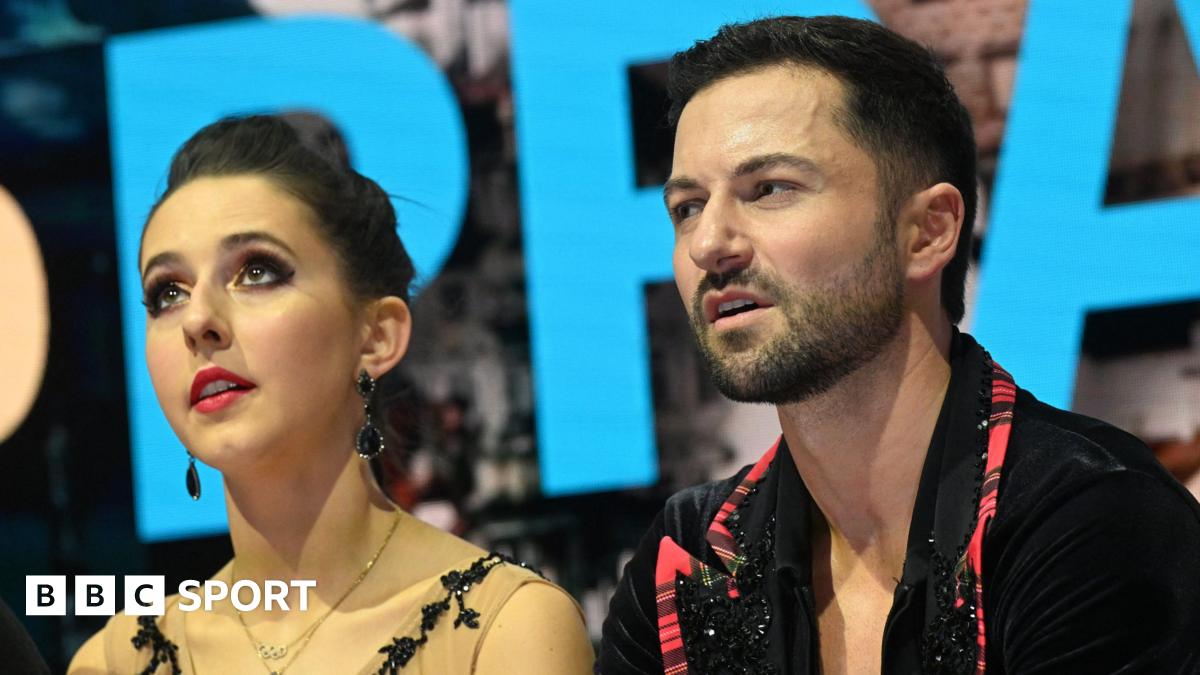
Atkin wins halfpipe bronze for Team GB's fifth medal
Freestyle skier Zoe Atkin wins bronze in the women’s halfpipe to secure Great Britain’s fifth medal at the 2026 Winter Olympics, equalling the team’s record-best haul.
Source link
Freestyle skier Zoe Atkin wins bronze in the women’s halfpipe to secure Great Britain’s fifth medal at the 2026 Winter Olympics, equalling the team’s record-best haul.
Source link
Alina Muller repeats history from Sochi in 2014, scoring an overtime winner as Switzerland beat Sweden 2-1 to claim bronze in the women’s ice hockey at the 2026 Winter Olympics.
Muller scored the winner 12 years ago as a 15-year-old against the same opponents in a 4-3 victory to win the bronze medal.
WATCH MORE: Winter Olympics Video
Available to UK users only.
CORTINA D’AMPEZZO, Italy — It’s all downhill after 40.
Downhill at screaming speeds, that is, fast enough to capture Olympic gold, which is precisely what 41-year-old Elana Meyers Taylor did Monday night in the women’s monobob.
America’s most successful female bobsledder finally got her gold medal. She was four one-hundredths of a second faster than Germany’s Laura Nolte — compiled over four heats — netting her sixth Olympic medal.
Those prizes — a gold, three silvers and two bronzes — tied Meyers Taylor with speedskater Bonnie Blair as the most decorated U.S. woman in Winter Olympic history.
“I still can’t even put into words what this means having the gold medal,” Meyers Taylor said. “It’s still surreal.”
She became the oldest American woman to win a gold medal at the Winter Games, having covered the winding course four times in two days in a total of 3 minutes, 57.93 seconds.
American gold medalist Elana Meyers Taylor and bronze medalist Kaillie Humphries pose for a photo during the medal ceremony for monbob bobsled in Cortina d’Ampezzo, Italy, on Monday.
(Julian Finney / Getty Images)
Monobob is a women’s event that made its debut at the Beijing Olympics four years ago. Only one person competes, pushing the sled at the start and piloting down the course at speeds of 70 to 80 mph. There were 20 competitors in the inaugural event, and American Kaillie Humphries — who claimed the bronze Monday — won the first gold medal in the event.
The triumph came after Meyers Taylor went a whole World Cup season without standing on a podium, finishing 10th in the standings.
“The season was miserable,” she said, noting she has suffered back problems for months.
Her husband and two young children were waiting for her at the finish line, and Meyers Taylor is about as down-to-earth as an elite athlete can get. Both of their children have special needs and are deaf.
American Elana Meyers Taylor celebrates after winning the monobob bobsled competition in Cortina d’Ampezzo, Italy, on Monday.
(Al Bello / Getty Images)
She taught them some new words in sign language in the days leading up to the race.
“We went over what ‘champion’ is,” she said, adding she also taught them to sign “bobsled race” and “gold.”
Asked about her pre-race assessment that a gold medal would mean everything and nothing to her, she smiled and said: “It still is everything, and it still is nothing. Because at the end of the day, in six days I’ve got school pickups and dropoffs in the middle of Texas.”
Humphries — who has three golds and two bronzes in her career — was tied with Meyers Taylor heading into the fourth and final heat. They are both mothers who split time between intense training and all the challenges of parenthood.
“I hope it inspires other people to go out and chase it, whatever it may be,” said Humphries, 40.
“I grew up in a sport where if you have kids once you get to 40, it’s all downhill and alumni … I get to be proof that that’s not true.”
American gold medalist Elana Meyers Taylor and bronze medalist Kaillie Humphries celebrate with Humphries’ son after the monobob competition at the Winter Olympics in Cortina d’Ampezzo, Italy, on Monday.
(Julian Finney / Getty Images)
Meyers Taylor, who was born Oct. 10, 1984, is eight days older than American ski racing legend Lindsey Vonn, who is recovering from a violent crash in the women’s downhill and has undergone multiple operations in the last week.
“I was at the Alpine race when she went down, and that was heartbreaking,” Meyers Taylor said.
“To do that at 41, she’s incredible.”
Humphries said staying atop the sport will be quite a challenge for the monobob medalists.
“These girls are young,” she said. “They’re putting up a good fight. I won’t lie, the starts are challenging, so we’ve got some work to do.”

With the Winter Olympic Games Milano Cortina 2026 in full swing, attention extends beyond the competition itself to a practical question: what is an Olympic medal actually worth?
The answer depends on how you define “worth.” There’s the literal value of the metal, the tax implications that could follow, and then the much bigger value that comes from status, visibility, and opportunity.
Despite the name, Olympic gold medals are not solid gold. Even though the tradition of a solid gold medal was established in 1904, forging the medals 100% out of gold didn’t last long, as it became too costly after World War I. As a result, the top medal hasn’t been made of solid gold since the 1912 Olympic games.
Today, gold medals are primarily made of silver, with a relatively thin coating of pure gold on the surface. The exact specifications vary slightly, but the general formula has remained consistent. A modern Olympic gold medal typically contains 523 grams of sterling silver, with approximately six grams of gold plated on top. This allows it to look like gold and feel substantial, while also carrying enormous symbolic weight.
Silver medals are indeed solid, made of 525 grams of sterling silver. Bronze medals meanwhile contain no precious metals at all, typically containing 90 percent copper and other alloys, such as tin and zinc.
As a result, the true value of each medal comes more from the prestige of being a medalist and the opportunities it may offer than from the raw materials that comprise each medal.
Metal prices fluctuate constantly, so any estimate is a snapshot in time. Using current pricing, gold is trading around $5,000 per troy ounce, and silver around $80 per troy ounce. Six grams of gold works out to be worth about $965 at current prices, while the silver portion of a gold medal, about 523 grams, is worth about $1,345. Added together, the raw metal value of a gold medal currently lands around $2,310.
Silver medals, made of 525 grams of sterling silver, would be worth around $1,350, while bronze medals are worth far less from a materials standpoint. With copper currently priced at about $0.37 per ounce and a bronze medal comprising 495 grams of copper, the third-place medal would be worth less than $7 at today’s prices.
Fortunately for U.S. athletes, the tax picture has changed over time. In the past, medals and associated prize money were treated as taxable income, meaning athletes could owe federal taxes on both the cash bonuses and the fair market value of the medal itself.
That shifted in 2016, when Congress passed the United States Appreciation for Olympians and Paralympians Act of 2016. The legislation allows most U.S. Olympic and Paralympic athletes to exclude medal-related prize money from federal income taxes if their overall income falls below a certain threshold. The intent was to prevent athletes, many of whom train for years with limited financial support, from being hit with tax bills simply for winning.
The exemption applies only to certain medal-related income and doesn’t extend to endorsement deals, appearance fees, or other earnings that often follow Olympic success.
If medals were only worth their metal content, they’d be impressive keepsakes, but not life-changing ones. The real value comes from what the medal represents and what it unlocks.
An Olympic medal can raise an athlete’s profile overnight, leading to endorsements, sponsorships, and paid appearances that weren’t on the table before. The impact often lasts well beyond competition, opening doors to coaching, leadership roles, and media opportunities long after the Games are over.
Those opportunities don’t look the same for every medalist—or arrive all at once. For some athletes, especially gold medalists, the exposure of winning on the sport’s biggest stage can translate quickly into major endorsement deals. For others, the payoff is more gradual, showing up as smaller sponsorships, speaking fees, or a clearer path into post-competition careers built on recognition and trust.
Winning multiple medals can also amplify the effect, creating a sustained spotlight that brands and audiences tend to value more than a single podium finish.
While the metal in an Olympic medal may only be worth a modest sum, the visibility it brings can reshape an athlete’s earning potential in ways that far outlast the Games themselves—making its true value less about what it’s made of, and more about what it makes possible.
For the first time in history, every U.S. Olympic athlete is getting something they’ve never had before: guaranteed financial support just for making a team. Thanks to a $100 million gift from financier Ross Stevens, every U.S. Olympian and Paralympian competing in the Milan-Cortina Games will be eligible for $200,000 in future benefits, whether they medal or not, providing a long-term boost for careers that often pay little during competition.
MILAN — Before the final competitors hit the last turn, Jordan Stolz’s coach was already unfolding a U.S. flag.
The 21-year-old speedskating star won his second Olympic medal of the Milan-Cortina Games, setting an Olympic record in the 500 meters on Saturday at 33.77 seconds. He edged out the Nedtherlands’ Jenning de Boo, who was paired with Stolz and finished 0.11 seconds behind the U.S. star. Canada’s Laurent Debreuril took bronze at 34.26 seconds, which also stood as the Olympic record for three pairs before Stolz blazed through Milano Speed Skating Stadium.
Stolz is attempting an ambitious four-event program at the Milan-Cortina Games and already won the 1,000-meter gold medal this week. He will also compete in the 1,500 meters and the team pursuit.
Stolz is the first U.S. man to win the 500 meter at the Olympics since Joey Cheek in 2006. He is the first U.S. man to win gold in the 500 and 1,000 at the same Olympics since Eric Heiden in 1980.
He took a victory lap around the arena as red, white and blue-clad fans chanted “U-S-A!” Even the Dutch fans, forming a wall of bright orange all around the racing oval, clapped in admiration as Stolz held the U.S. flag above his head.
Gold medalist Jordan Stolz of the United States, center, celebrates on the podium with silver medalist Jenning de Boo of the Netherlands, left, and bronze medalist Laurent Dubreuil of Canada after the men’s 500 meters in speedskating at Winter Games on Saturday.
(Robert Gauthier / Los Angeles Times)
In a game of fine margins, Mouat and Dodds were repeatedly an inch or two away from where they needed to be.
They started with the hammer – theoretically advantageous in allowing a team to control a match – and had a shot in the first end to take three points.
However, Dodds’ effort was fractionally out and the Italians stole one. It would be a recurring theme as Constantini and Amos Mosaner dictated the contest.
The British pair levelled, before the hosts edged back ahead in a cagey third end and pinched another in the third. Again, it was a near-miss from Dodds.
That had Italy 3-1 ahead at the interval and GB chasing.
One in the fifth was less than they wanted but a big mistake by Mosaner in the sixth opened the door. Was this going to be the moment the momentum shifted?
It wasn’t. Constantini – a picture of tranquility throughout – played a perfect shot to ensure the Italians edged two clear again with two to play.
GB needed a big score, and deployed their powerplay, but again could only take one and were left needing a steal to even force an extra end.
They couldn’t. And they were left to face the nightmare scenario of another Games in which they have finished in fourth place and without a mixed doubles medal.
“We spoke last night about how lucky we are to be playing at the Olympics as best mates,” Mouat added. “We are two people that grew up together and never really knew where we could go with curling. It has been pretty special with Jen.
“I’m obviously pretty gutted but I’m so proud of us for sticking at it.”
In Beijing, they responded the right way, with women’s gold and men’s silver. What will they do this time?

As the upcoming Winter Olympic Games Milano Cortina 2026 approaches, attention naturally shifts to records, rivalries, and the prestige of making it to the podium. But after the celebrations end, a practical question always resurfaces: What are those medals actually worth?
The answer depends on how you define “worth.” There’s the literal value of the metal, the tax implications that follow, and then the much bigger value that comes from status, visibility, and opportunity.
Despite the name, Olympic gold medals are not solid gold. Even though the tradition of a solid gold medal was established in 1904, forging the medals 100% out of gold didn’t last long, as it became too costly after World War I. As a result, the top medal hasn’t been made of solid gold since the 1912 Olympic games.
Today, gold medals are primarily made of silver, with a relatively thin coating of pure gold on the surface. The exact specifications vary slightly, but the general formula has remained consistent. A modern Olympic gold medal typically contains 523 grams of sterling silver, with approximately six grams of gold plated on top. This allows it to look like gold and feel substantial, while also carrying enormous symbolic weight.
Silver medals are indeed solid, made of 525 grams of sterling silver. Bronze medals meanwhile contain no precious metals at all, typically containing 90 percent copper and other alloys, such as tin and zinc.
As a result, the true value of each medal comes more from the prestige of being a medalist and the opportunities it may offer than from the raw materials that comprise each medal.
Metal prices fluctuate constantly, so any estimate is a snapshot in time. Using current pricing, gold is trading around $4,900 per troy ounce, and silver around $85 per troy ounce. Six grams of gold works out to be worth about $945 at current prices, while the silver portion of a gold medal, about 523 grams, is worth about $1,430. Added together, the raw metal value of a gold medal currently lands around $2,375.
Silver medals, made of 525 grams of sterling silver, would be worth around $1,435, while bronze medals are worth far less from a materials standpoint. With copper currently priced at about $0.38 per ounce and a bronze medal comprising 495 grams of copper, the third-place medal would be worth less than $7 at today’s prices.
Fortunately for U.S. athletes, the tax picture has changed over time. In the past, medals and associated prize money were treated as taxable income, meaning athletes could owe federal taxes on both the cash bonuses and the fair market value of the medal itself.
That shifted in 2016, when Congress passed the United States Appreciation for Olympians and Paralympians Act of 2016. The legislation allows most U.S. Olympic and Paralympic athletes to exclude medal-related prize money from federal income taxes if their overall income falls below a certain threshold. The intent was to prevent athletes, many of whom train for years with limited financial support, from being hit with tax bills simply for winning.
The exemption applies only to certain medal-related income and doesn’t extend to endorsement deals, appearance fees, or other earnings that often follow Olympic success.
If medals were only worth their metal content, they’d be impressive keepsakes, but not life-changing ones. The real value comes from what the medal represents and what it unlocks.
An Olympic medal can raise an athlete’s profile overnight, leading to endorsements, sponsorships, and paid appearances that weren’t on the table before. The impact often lasts well beyond competition, opening doors to coaching, leadership roles, and media opportunities long after the Games are over.
Those opportunities don’t look the same for every medalist—or arrive all at once. For some athletes, especially gold medalists, the exposure of winning on the sport’s biggest stage can translate quickly into major endorsement deals. For others, the payoff is more gradual, showing up as smaller sponsorships, speaking fees, or a clearer path into post-competition careers built on recognition and trust.
Winning multiple medals can also amplify the effect, creating a sustained spotlight that brands and audiences tend to value more than a single podium finish.
While the metal in an Olympic medal may only be worth a modest sum, the visibility it brings can reshape an athlete’s earning potential in ways that far outlast the Games themselves—making its true value less about what it’s made of, and more about what it makes possible.
For the first time in history, every U.S. Olympic athlete is getting something they’ve never had before: guaranteed financial support just for making a team. Thanks to a $100 million gift from financier Ross Stevens, every U.S. Olympian and Paralympian competing in the Milan-Cortina Games will be eligible for $200,000 in future benefits, whether they medal or not, providing a long-term boost for careers that often pay little during competition.