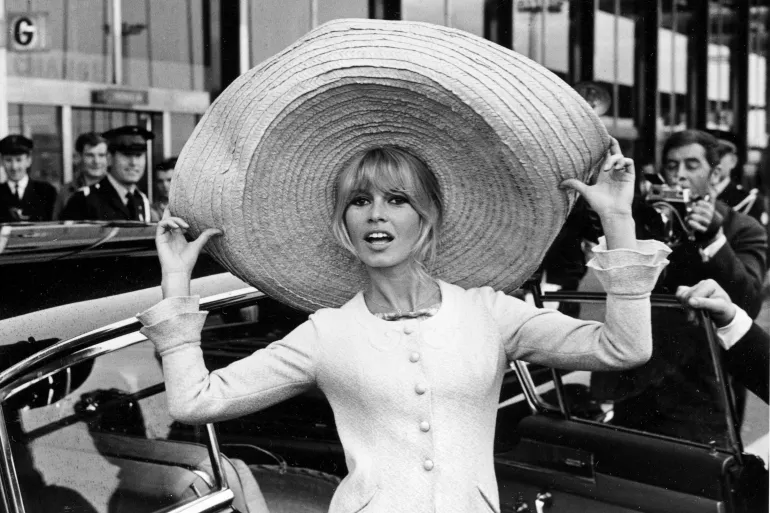
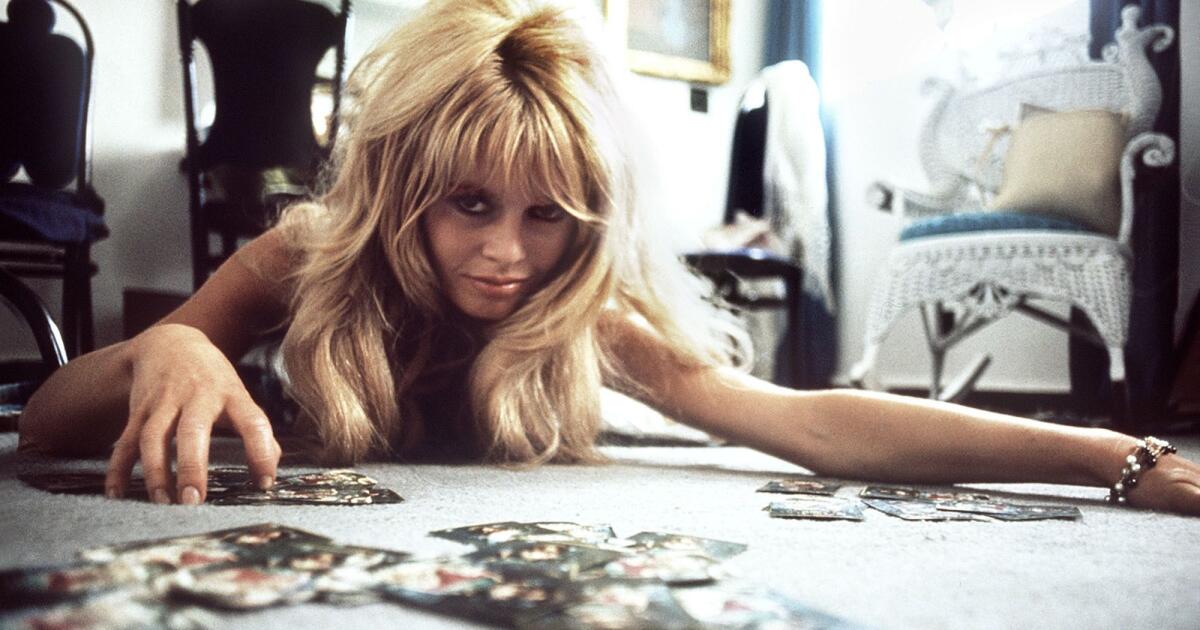
Brigitte Bardot, the French actor idealized for her beauty and heralded in the midcentury as the prototype of liberated female sexuality, has died at 91.
Long withdrawn from the entertainment industry, Bardot died at her home in southern France, Bruno Jacquelin of the Brigitte Bardot Foundation for the protection of animals confirmed to the Associated Press. He gave no cause of death. Bardot had dealt with infirm health in recent years, including hospitalization for a breathing issue in July 2023 and additional hospital stays in 2025.
Bardot was known for being mercurial, self-destructive and prone to reckless love affairs with men and women. She was a fashion icon and media darling who left acting at 39 and lived out the rest of her years in near seclusion, emerging periodically to champion animal rights, lecture about moral decay and espouse bigoted political views.
And, as if in protest of her famed beauty, Bardot happily allowed herself to age naturally.
“With me, life is made up only of the best and the worst, of love and hate,” she told the Guardian in 1996. “Everything that happened to me was excessive.”
In her prime, Bardot was considered a national treasure in France, received by President Charles de Gaulle at the Élysée Palace and analyzed exhaustively by existentialist philosopher Simone de Beauvoir. She was the girl whose poster adorned the bedroom of a teenage John Lennon.
While Marilyn Monroe was playing it coy, Bardot was forthright and free about her sexuality, sleeping with her leading men without apology, sweaty and writhing barefoot on a table in the controversial 1956 film “…And God Created Woman.” Though many of her films were largely forgettable, she projected a radical sense of self-empowerment for women that had a lasting cultural influence.
Born Sept. 28, 1934, in Paris, the daughter of a Parisian factory owner and his socialite wife, Bardot and her younger sister were raised in a religious Catholic home.
Bardot studied ballet at the Paris Conservatoire and, at her mother’s urging, pursued modeling. By 14, she was on the cover of Elle magazine. She caught the eye of filmmaker Marc Allegret, who sent his 20-year-old apprentice, Roger Vadim, to locate her.
Vadim and Bardot began a years-long affair during which he cultivated the sex-kitten persona that would seduce the world. But Bardot wasn’t one to be cultivated. As Vadim once said, “She doesn’t act. She exists.”
Bardot married Vadim at 18, and that same year he directed her in “…And God Created Woman,” as a woman who falls in love with her older husband’s younger brother. The film, which prompted moral outrage in the U.S. and was heavily edited before it reached theaters, made Bardot a star and an emblem of French modernity.
“I wanted to show a normal young girl whose only difference was that she behaved in the way a boy might, without any sense of guilt on a moral or sexual level,” Vadim said at the time.
In real life, Bardot left Vadim for her costar Jean-Louis Trintignant. She went on to master a comic-erotic persona in the popular 1957 comedy “Une Parisienne” and portrayed a young delinquent in the 1958 drama “Love Is My Profession.”
By 1959, she was pregnant with the child of French actor Jacques Charrier, whom she married as a result. Together they had a son, Nicolas.
In Bardot’s scathing 1996 memoir, “Initiales B.B: Mémoires,” she details her crude attempts to abort the child, asking doctors for morphine and punching herself in the stomach. Nine months after the baby was born, she said, she downed a bottle of sleeping pills and slit her wrists, the first of several apparent suicide attempts during her life. When Bardot recovered, she gave up custody of her son and divorced Charrier.
“I couldn’t be Nicolas’ roots because I was completely uprooted, unbalanced, lost in that crazy world,” she explained years later.
Bardot earned her greatest box-office success in the 1960 noir drama “The Truth,” playing a woman on trial for the murder of her lover. Her best performance likely came in Jean-Luc Godard’s acclaimed 1963 melancholy adaptation “Contempt,” as a wife who falls out of love with her husband. She was later nominated for a BAFTA award for her performance as a circus entertainer turned political operative in the 1965 comedy “Viva Maria!”
All the while, though, Bardot courted drama and lived large.
While she was married to German industrialist Gunter Sachs, she had an affair with French pop star Serge Gainsbourg. He wrote Bardot the erotic love song “Je t’aime … moi non plus,” which went on to become a hit by Donna Summer, altered and retitled “Love to Love You Baby.” By 1969, she had divorced Sachs and was romantically linked to everyone from Warren Beatty to Jimi Hendrix.
The celebrity life eventually exhausted Bardot, and she grew to fear that she’d end up dying young like Marilyn Monroe or withering away in public view like Rita Hayworth. Though she exuded confidence, she admitted in her memoir that she battled depression as she sought to juggle the many moving pieces of her chaotic life.
“The majority of great actresses met tragic ends,” she told the Guardian. “When I said goodbye to this job, to this life of opulence and glitter, images and adoration, the quest to be desired, I was saving my life.”
Nearing 40, she quit acting and spent the rest of her life bouncing between her Saint-Tropez beach house and a farm — complete with a chapel — outside Paris. She devoted herself to the Brigitte Bardot Foundation for the Welfare and Protection of Animals.
As an animal rights activist, her list of enemies was long: the Japanese for hunting whales, the Spanish for bullfighting, the Russians for killing seals, the furriers, hunters and circus operators.
At her home in Saint-Tropez, dozens of cats and dogs — along with goats, sheep and a horse — wandered freely. She chased away fishermen and was sued for sterilizing a neighbor’s goat.
“My chickens are the happiest in the world, because I have been a vegetarian for the past 20 years,” Bardot said.
In 1985 she was awarded the Legion d’Honneur, France’s highest civilian decoration, but refused to collect it until President François Mitterrand agreed to close the royal hunting grounds.
In 1992 she married Bernard d’Ormale, a former aide to Jean-Marie Le Pen, leader of France’s far-right National Front and frequent candidate for France’s presidency. Later, Bardot became an ardent supporter of Le Pen’s daughter Marine, leader of France’s anti-immigration far right.
Two French civil rights groups sued Bardot for the xenophobic and homophobic comments she made in her 2003 book, “A Cry in the Silence,” in which she rails against Muslims, gays, intellectuals, drug abusers, female politicians, illegal immigrants and the “professionally” unemployed. She was ultimately fined six times for inciting racial hatred, mostly while speaking out against Muslims and Jews. She was fined again in 2021 over a 2019 rant wherein she dubbed the residents of Réunion, a French Island in the Indian Ocean, “degenerate savages.”
“I never had trouble saying what I have to say,” Bardot wrote in a 2010 letter to The Times. “As for being a little bunny that never says a word, that is truly the opposite of me.”
Bardot stirred controversy again in 2018 when she dismissed the #MeToo movement as a campaign fueled by a “hatred of men.”
“I thought it was nice to be told that I was beautiful or that I had a nice little ass,” she told NBC. “This kind of compliment is nice.”
She remained firm in those views in the final year of her life, decrying the societal shaming of playwright-comedian-actor Nicolas Bedos and actor Gérard Depardieu, who were both convicted of sexual assault. “People with talent who grab a girl’s bottom are thrown into the bottom of the ditch,” she declared in a 2025 TV interview, her first in 11 years. “We could at least let them carry on living.”
As she aged, Bardot mostly kept to herself, content to do the crossword puzzle when the newspaper arrived, tend to her menagerie and mail off hotly written pleas to world leaders to halt their animal abuses. She was largely vague when asked if she was still married to D’Ormale.
“It depends what day it is,” she said, laughing gently.
Piccalo is a former Times staff writer. Former staff writer Steve Marble contributed to this report.