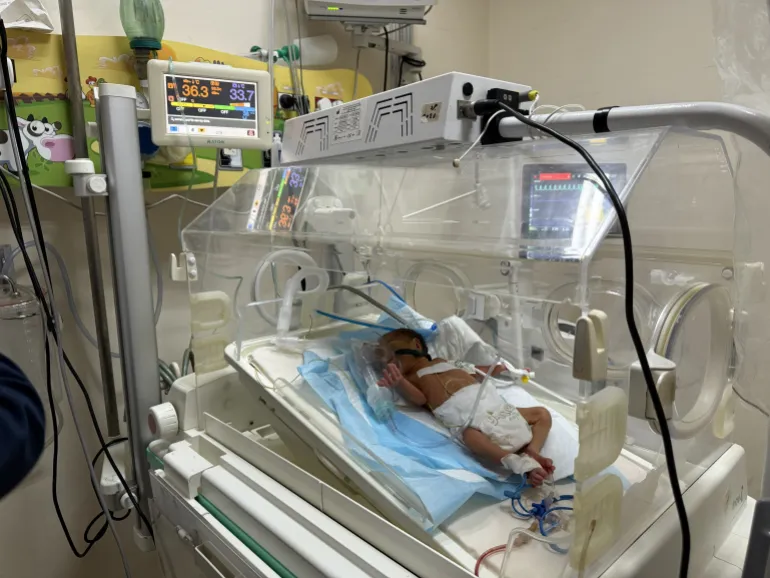
Noor Salem, 30, stands beside an incubator at a neonatal intensive care unit in central Gaza, where her baby, Yazan Al-Khalidi, lies attached to tubes and monitors.
She watches his tiny body behind a sheet of quartz glass, tracking his meagre breathing and the slightest movement he makes.
Yazan was born eight months into Noor’s pregnancy, his body appearing bluish in the first moments of life.
This required immediate transfer to the neonatal intensive care unit at Al-Aqsa Martyrs Hospital in Deir el-Balah, after it became apparent that Yazan was born with breathing issues.
Instead of being able to hold her baby in the first moments after his birth, Noor is now forced to sit by the incubator and wait for Yazan’s condition to improve.
During her pregnancy with Yazan, she endured shortages of basic necessities and a constant fear of losing another child.
Yazan Al-Khalidi, born in the eighth month of pregnancy. After birth, he experienced breathing difficulties [Eman Abu Zayed/Al Jazeera]
“I was afraid throughout my pregnancy because I had already lost my baby before. I was afraid I would go through the same pain again,” she said.
“When he was born, and I saw that he was not moving or crying like other babies, I felt terrified. I did not know what would happen to him. All I wanted was for him to survive.”
Noor waits for daily updates from doctors, hoping Yazan will overcome his health difficulties and return to her arms.
Rising premature births in Gaza
There has been a sharp increase in premature births and underweight newborns, as well as stillbirths and birth defects, since the genocide in Gaza began on October 7, 2023.
UNICEF has repeatedly warned about a crisis in premature births in Gaza, with one in every five newborns requiring intensive neonatal or thermal care. Maternal malnutrition, prolonged psychological stress and declining prenatal care services have all had an impact on both mother and child.
Dr Afnan Abu Hasaballah, an obstetrician and gynecologist working with UNRWA and Al-Awda Health Hospital in Nuseirat refugee camp, has personally witnessed the impact of this on the health of pregnant women and newborns.
She says many pregnant women arrive at hospitals suffering from severe stress and exhaustion after repeated displacement, deprivation of essential goods and bombings.
“Constant fear, repeated displacement, lack of food and clean water, and limited access to prenatal care all increased the risk of premature birth,” she says.
The Israeli siege on Gaza is also leading to severe malnutrition, and one of the main issues affecting both expectant mothers and their fetuses, leading to more premature births and low birthweights for newborns and requiring intensive care.
Inadequate nutrition also increases the risk of anemia, exhaustion for expectant mothers, pregnancy complications and restricted fetal growth.
“Many pregnant women during the war were unable to access sufficient or balanced food, and this directly affected the health of mothers and newborns,” Dr Abu Hasaballah says.
Pressure on Gaza health services
Al-Aqsa Martyrs Hospital is the only hospital with a neonatal unit in the whole of central Gaza, serving thousands of expectant mothers and causing immense pressure on overstretched health workers.
“We were working under enormous pressure, with shortages of incubators, ventilators, medications and basic supplies, in addition to repeated power and fuel shortages, which posed a direct threat to babies inside the incubators,” Dr Abu Hasaballah says.
Premature babies require continuous monitoring, oxygen, respiratory support, proper nutrition and treatment, something that health workers with their limited resources and time are not always able to provide.
“When these resources become unavailable, the risk of serious complications increases, including breathing difficulties, low body temperature, infections and low blood sugar,” Dr Abu Hasaballah says.
“Unfortunately, we may lose babies who could have survived if they had received basic care.”
The separation of mothers from their babies shortly after their birth is one of the hardest experiences for mothers to endure. This abrupt separation causes immense anxiety for both mothers and babies, with the most common question doctors at neonatal units are asked is whether their children will survive. Doctors and nurses do what they can to reassure the mothers and save the children.
“Instead of holding their baby and celebrating, mothers see them transferred directly to the incubator or intensive care unit. Their fear is doubled because the war has affected everything, from medical equipment and supplies to electricity shortages and overcrowding in hospitals,” says Dr Abu Hasaballah.
“We continued working day and night without sleep, and we did everything we could to save every child, but in many cases, the babies’ needs were greater than the resources available.”
Akram Abu Jiab, head of Qutoof Al-Khair Foundation, which supports pregnant women and newborns by providing vitamins and nutritional supplements for mothers, as well as medicines and medical supplies for children [Eman Abu Zayed/Al Jazeera]
New challenges for mothers
Once the parents and babies are discharged, a new struggle for families begins amid a landscape where a mother’s health has been impacted by deprivations and stresses of the war. Essential baby care items, such as sterilisation kits and baby formula, are absent or unaffordable.
“Many families have lost everything because of displacement, leaving mothers without baby clothes, diapers, blankets, formula or clean water,” Dr Abu Hasaballah says.
In Nuseirat refugee camp, central Gaza, Qutoof Al-Khair Foundation supports pregnant women and newborns by providing vitamins, nutritional supplements, medicines and essential medical supplies.
Akram Abu Jiab, head of the foundation, says his staff is dealing with growing demand for their services among pregnant women and new mothers who are unable to access enough food and healthcare to sustain their babies’ health.
“Premature babies require special care and continuous medical follow-up even after being discharged from incubators,” he says.
“However, many families are facing significant challenges in securing the basic medical and nutritional needs of their children.”
Despite the foundation’s efforts to reach as many mothers and children as possible, their efforts can only go so far.
“The scale of needs far exceeds the available resources. The gap between needs and support continues to grow every day,” he says.
“Behind every baby born in Gaza is a mother trying to protect her child under exceptional circumstances. Supporting mothers and children at this stage is not a luxury; it is a necessity to protect the lives of the next generation.”
For decades, neo-Nazis and far-right extremists flocked to the Austrian home where Adolf Hitler was born to glorify the Nazi leader. Now, the building has been transformed into a police station following a $22.8-million renovation.
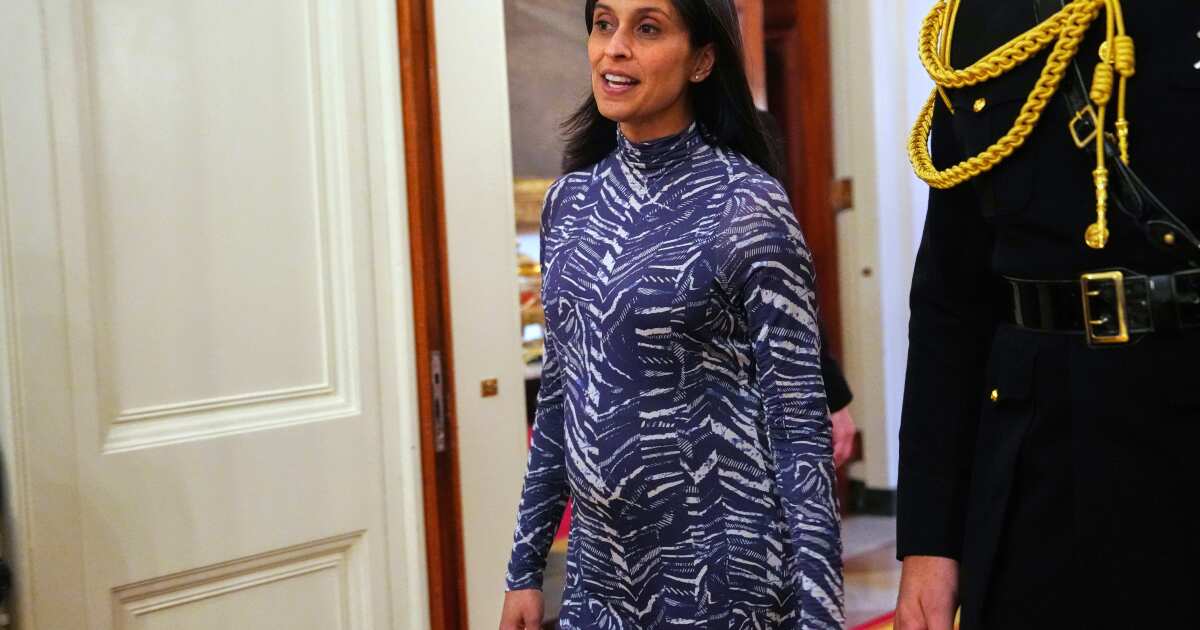
WASHINGTON — Vice President JD Vance and his wife, Second Lady Usha Vance, announced the birth of their fourth child, the first born to a sitting vice president in more than 150 years.
Born Sunday, Alec Neel Vance joins older siblings Ewan, 9; Vivek, 6; and Mirabel, 4.
Vance announced the birth Sunday on social media with a statement signed by him and his wife.
“We are excited to announce that our baby boy, Alec Neel Vance, was born this morning. Usha and the baby are happy and healthy, and our kids are overjoyed to meet their little brother,” the statement said.
They thanked doctors and staff at the Walter Reed National Military Medical Center and with the White House medical team.
The Republican vice president’s growing family is in keeping with his passionate advocacy for Americans to have more children. He has also suggested that the 2025 killing of conservative activist Charlie Kirk, who was his friend, factored into the decision to have another child.
Vance, a former U.S. Marine, repeatedly expressed alarm about declining birth rates in America as he launched his political career in 2021 with a bid for a U.S. Senate seat from Ohio. As vice president, he said in Washington at the 2025 March for Life anti-abortion rally, “I want more babies in the United States of America.”
The vice president, who’s 41, has been accompanied on overseas trips by Usha Vance, 40, and their children, with the kids often pajama-clad as they board Air Force Two for the overnight flights.
Usha Vance, the daughter of immigrants from India, had already been the subject of some public fascination because of her husband. Her pregnancy, which was announced in January, amplified that spotlight since it is rare for occupants of the United States’ highest public offices to add to their families while serving.
The last time a sitting vice president became a new father was in the 1800s.
Schuyler Colfax and his second wife, Ellen Wade, had a son, Schuyler Colfax III, in 1870 when Colfax was serving as vice president, according to the White House Historical Assn. Decades before that, John C. Calhoun and his wife, Floride Bonneau, had a son, William, in 1829 when Calhoun was vice president, the association said.
Usha Vance recently came under scrutiny after The New York Times’ fashion critic called attention to the stomach-hugging, coral maternity dress she wore for a Father’s Day episode of “Storytime with the Second Lady,” a video podcast she launched during the pregnancy.
The Times wrote that the attention that Vance, Miller and Leavitt had put on their pregnancies offered “an image of idealized womanhood that gives literal shape to the pronatalist movement,” which encourages couples to have as many children as possible to counter declining birth rates.
The second lady responded on social media, writing, “Now that we know the political significance of my $8.75 coral maternity dress from Old Navy, can’t wait to hear what the New York Times has to say about my elastic-waistband pants and compression socks! In the meantime, enjoy my pregnancy fashion (or lack thereof) and a good story with your kids on Storytime with the Second Lady.” She later shared the receipt for the dress, and her husband applauded her frugality.
“She bought a $50 dress for $8.75. America: meet your next director of the federal budget!” the vice president wrote on social media.
SEATTLE — If a pregnant Nigerian woman had been allowed to board a plane 25 years ago, the U.S. team’s path through this summer’s World Cup may have unfolded much differently. Instead, a gate agent turned her away, insisting it wasn’t safe for her to fly from New York to London.
So Florence Balogun returned to Brooklyn, where she had been visiting relatives, and waited for her second son to be born. And when Folarin arrived a few weeks later, entering the world just hours before Independence Day dawned, he did so as an American citizen.
It was that quirk of fate that allowed Balogun, who lived just two months in the U.S., to represent the country on soccer’s biggest stage.
“I’m extremely proud my individual journey will come full circle now,” he said before the tournament started. “Especially the World Cup being here, the opportunity to represent my nation. It’s going to be something special for me.”
The first game certainly was, with Balogun scoring twice in the first half of a dominant 4-1 win over Paraguay, becoming the first American with multiple goals in a World Cup game in 96 years while introducing himself to a country that may have known his name, but not his unique talent.
“If you don’t know the type of player he is, you could see it today,” midfielder Weston McKennie said. “It’s the World Cup, everyone steps up to their maximum. In the past a lot of people maybe have not made him out to be a player like that.
“He showed everyone he’s willing to do the dirty work as well.”
Balogun once had his pick of countries to represent. His birth in Brooklyn made him eligible to play for the U.S., his longterm residency in London made him eligible to play for England and his parents’ nationality qualified him to play for Nigeria.
He picked the U.S.
And he’s not the only one on the American team who had a choice. Half the men on the World Cup roster — including Christian Pulisic, Gio Reyna and Malik Tillman, who each had a goal or an assist against Paraguay — are dual nationals, meaning they’re playing for the U.S. because they want to, not because they have to.
“You’re more American if you were not born over there because you had the choice to choose and you chose America,” Kenneth Dest, the Surinamese-American father of Dutch-born defender Sergiño Dest, said in an HBO Max documentary.
If America is a nation of immigrants, it only seems right that it should be represented in the World Cup by a team of immigrants. Like Tillman and Dest, who were born and raised in Europe, the sons of U.S. soldiers. Or forwards Tim Weah, the Brooklyn-born son of the former president of Liberia, and Alejandro Zendejas, who was born in Mexico but became a U.S. citizen at 13 after his father was naturalized.
U.S. forward Folarin Balogun, right, celebrates his goal with Sergiño Dest (2) and Chris Richards (3) against Paraguay.
(Robert Gauthier / Los Angeles Times)
The paternal great-grandmother of goalie Matt Turner fled religious persecution in Lithuania, with his Jewish ancestors changing their family name from Turnovski to Turner when they arrived at Ellis Island. The parents of midfielder Cristian Roldan came to the U.S. to escape civil wars in Central America, his father from Guatemala and his mother from El Salvador.
They didn’t wind up wearing the same uniform by accident, however. The recruitment of dual nationals dates to the 1980s under Hungarian-born manager Bob Gansler, who qualified the U.S. for the World Cup for the first time in 40 years with a team that included players born in Uruguay, Greece, Germany and El Salvador.
It really began to scale up about 15 years ago under Bob Bradley and his successor Jurgen Klinsmann. Gregg Berhalter then took it to another level, recruiting more than a dozen dual nationals — including Dest, Tillman, Balogun and Turner — in his five years as coach.
The practice isn’t limited to the USMNT. When France won the World Cup in 2018, 16 of the 23 players on the team came from families that recently immigrated from places like Zaire, Cameroon, Morocco, Angola, Congo or Algeria. More than half the players on Algeria’s team in this summer’s tournament were born in Europe while only seven men on Morocco’s roster are from Morocco.
Even Japan, famously homogeneous, has a Black goalkeeper who was born in Arkansas to a father from Ghana.
“Inclusion always pulls sport forward,” said Ronen Dorfan, a journalist and sports historian based in Budapest.
Still, Balogun’s journey is unusual — and not just because of the way it started.
He was two months old when he and his mother finally made it to London and eight years later he was good enough to enter Arsenal’s academy system. He made his junior international debut with England at 17, then three months later was invited to play four games for the U.S. U18 team.
But Balogun’s future appeared to be with England, especially after he scored seven times in 13 appearances with the U21 team, then followed that up with a career-high 21 goals for Reims in France’s Ligue 1 in 2022-23.
Yet neither performance earned him a call-up to a senior national team that was deep at forward.
So the U.S., which desperately needed a fast, technical, two-footed No. 9, pounced, getting Balogun to withdraw from England’s U21 training camp to make a secret visit to Florida. Once there, U.S. Soccer arranged for him to sit courtside at an NBA game, receive VIP passes to Universal Orlando, attend spring training with the Yankees and meet with a number of U.S. national team players.
With a schedule like this, his visit didn’t stay secret for long. After studying pictures Balogun had posted on social media, some U.S. fans determined he was in Orlando and began peppering his feeds with American flag emojis. Others found him at his hotel and urged him to commit to the U.S., a plea his parents, citing a quirk in fate, had been making for years.
You’re American, they argued. You were born there.
Six weeks later he did commit, with FIFA approving his request to switch allegiances from England to the U.S. A month after that, he scored his first senior international goal in the 2023 Nations League Finals and he’s never looked back. Because if Balogun, 24, felt overlooked in England, he’s felt looked after in the colonies.
“When I committed and throughout this whole cycle and the whole journey to me being at this point, I’ve always said the fans gave me so much motivation, showed me so much support,” said Balogun, who speaks in a pronounced London accent. “The most important thing has been to repay that.
“I just want to continue to show the fans I made the right decision. I want to continue to make the fans proud as well.”
He made a great start on that in his World Cup debut.
Renfield, a movie based on characters from Bram Stoker’s novel Dracula, is airing tonight and fans have praised hailed the film “funny and deliciously entertaining’
Renfield was originally released in 2023 starring Nicolas Cage as Dracula(Image: AP)
A movie perfect for fans of Dracula is heading to the small screen.
American action comedy horror film Renfield was originally released in 2023 and Film4 is showing the film at 9pm on Wednesday (May 20) evening.
Inspired by characters from Bram Stoker’s 1897 novel Dracula and its 1931 feature film adaptation, the film features Nicholas Hoult as the titular character and co-stars Awkwafina, Ben Schwartz, Shohreh Aghdashloo, Brandon Scott Jones, Adrian Martinez and Nicolas Cage.
The story follows Renfield who, after decades as a grueling servant for Dracula, seeks a new purpose in life. Viewers who have already watch the movie have offered their review online.
One fan penned: “I came for Nicolas Cage and was not disappointed. He played an amazing Dracula in the modern world.” Nicolas Cage was born to play and he appropriately chews up the scenery whenever he is on screen. This movie is a lot of fun thematically and visually.”
A third person said: “Renfield hits all the right notes. The humour is dark, witty and at times profound. The film delivers plenty of gore and bloodshed to satisfy fans of the horror genre.”
A fourth agreed: “Funny, well-crafted, and deliciously entertaining, Renfield isn’t short of bite.”
According to reports, Cage prepared for his role as Dracula by observing the distinctive ways the character was portrayed on screen by Bela Lugosi, Frank Langella, and Gary Oldman.
“What can I bring that will be different?”, he said, “I want it to pop in a unique way. We’ve seen it played well, we’ve seen it play not so well, so what can we do?
“So I’m thinking to really focus on the movement of the character … and that perfect tone of comedy and horror.”
Cage mentioned An American Werewolf in London, Ring and Malignant as inspirations for the role.
The film is Cage’s first live-action film by a major studio since Ghost Rider: Spirit of Vengeance.
The film’s black-and-white opening scenes recreate the events of Dracula with Cage and Hoult respectively inserted in place of Bela Lugosi and Dwight Frye as Count Dracula and Renfield, with Helen Chandler and Edward Van Sloan appearing as Mina Seward and Abraham Van Helsing via archive footage.
![Yazan Al-Khalidi, born in the eighth month of pregnancy. After birth, he experienced breathing difficulties. [Eman Abu Zayed/Al Jazeera]](https://i0.wp.com/occasionaldigest.com/wp-content/uploads/2026/07/IMG_6439-1784903726.jpg?w=640&ssl=1)
![Akram Abu Jiab, head of Qutoof Al-Khair Foundation, which supports pregnant women and newborns by providing vitamins and nutritional supplements for mothers, as well as medicines and medical supplies for children. [Eman Abu Zayed/ Al Jazeera]](https://i0.wp.com/occasionaldigest.com/wp-content/uploads/2026/07/IMG_7404-1784903732.jpg?w=640&ssl=1)