
bomber

Judge denies pretrial release for alleged D.C. pipe bomber

Jan. 2 (UPI) — A Washington, D.C., federal magistrate judge ruled Friday that a man who allegedly set pipe bombs outside of political party headquarters on Jan. 5, 2021, must stay behind bars before his trial.

Brian Cole Jr., 30, faces charges of transporting an explosive device and attempted malicious destruction by means of explosive materials. The charges have a maximum sentence of 30 years.

He allegedly placed two bombs in front of the Democratic National Committee and Republican National Committee headquarters, though the bombs never detonated. He was arrested Dec. 4 and hasn’t entered a plea.

Assistant U.S. Attorney Charles Jones filed a request on Dec. 30 to keep Cole in jail while he awaits trial. Cole’s attorneys wanted him released into the custody of his grandmother.

Judge Matthew Sharbaugh wrote in his ruling filed on Friday: “Although home incarceration and a GPS monitor would provide some check against Mr. Cole’s ability to carry out any menacing or dangerous conduct in the community, the Court is simply not satisfied these conditions rise to the necessary level.

“This is particularly true based on the severity of the potential danger Mr. Cole is alleged to pose, given his alleged persistent acquisition and retention of so-called ‘bombmaking parts,’ and given his reported penchant and capacity to create explosive devices and deploy them in public settings.

“If the plan had succeeded, the results could have been devastating: creating a greater sense of terror on the eve of a high-security Congressional proceeding, causing serious property damage in the heart of Washington, D.C., grievously injuring DNC or RNC staff and other innocent bystanders, or worse,” Sharbaugh wrote.

Sharbaugh announced Dec. 30 that Cole was indicted on the two charges but that he has not yet accepted the indictment because the Justice Department’s move seeking federal charges from a local grand jury is part of an ongoing debate in the courts. That case is pending in the federal appeals court.

According to a court filing, Cole told investigators that he disliked both political parties and was “watching everything, just everything getting worse.”

He believed the allegation that the 2020 election was stolen.

“If people feel that their votes are like just being thrown away, then … at the very least someone should address it,” Cole said, according to the filing.

“According to the defendant, he was not really thinking about how people would react when the bombs detonated, although he hoped there would be news about it,” the filing said.

“The defendant stated that he had not tested the devices before planting them. He claimed that when he learned that the devices did not detonate, he was ‘pretty relieved,’ and asserted that he placed the devices at night because he did not want to kill people.

“The defendant denied that his actions were directed toward Congress or related to the proceedings scheduled to take place on January 6,” the filing said.

Cole is from Woodbridge, Va., where he lives with his mother and other family members.

The case baffled law enforcement for almost five years. The pipe bombs were made of 1-inch galvanized pipes, 8 inches long with end caps, homemade black powder, wires, metal clips and a kitchen timer. The FBI has said the bombs were viable and could have hurt people nearby if they had detonated. The bombs sat for 15 hours before being discovered.

Supporters of President Donald Trump riot against the Electoral College vote count on January 6, 2021, in protest of Trump’s loss to President-elect Joe Biden, prompting a lockdown of the Capitol Building. Photo by Leigh Vogel/UPI | License Photo

Source link

Ukraine Strikes Russia-Linked Tanker In The Mediterranean With ‘Bomber Drone’

In a significant escalation of the ‘tanker war’ between Russia and Ukraine, which has so far played out mainly in the Black Sea, Ukrainian aerial drones have struck a tanker belonging to Russia’s so-called ‘shadow fleet’ in the Mediterranean. The latest incident comes after a tit-for-tat series of attacks, and a warning earlier this month from Russian President Vladimir Putin that he would “cut Ukraine off from the sea” in response to Kyiv stepping up its campaign against Russian commercial shipping. 

A source from within the Security Service of Ukraine (SBU), the government’s main internal security agency, told TWZ that “a new, unprecedented special operation” was carried out “more than 2,000 kilometers” (1,243 miles) from Ukrainian territory.

A video appeared online allegedly showing a drone attack on a Russian shadow fleet tanker in the Mediterranean sea.

Reportedly, it was a QENDIL tanker that transports Russian oil that was empty at the moment of the strike. There are reports that the vessel was critically… pic.twitter.com/G50Sf579If

— Anton Gerashchenko (@Gerashchenko_en) December 19, 2025

The target was the Oman-flagged crude oil tanker Qendil, empty at the time of the attack and sailing from the Indian port of Jamnagar, where it had been unloaded on December 1.

“Accordingly, this attack did not pose any threat to the ecological situation in the region,” the SBU said.

Before unloading, the tanker had left Russia’s Black Sea port of Novorossiysk on November 4, sailing through the Bosphorus and Mediterranean, then passing the Suez Canal en route to India. The vessel was built in 2006 and has a capacity of 115,338 deadweight tonnes.

Russian tanker hit in Ukrainian drone strike

A Russian oil tanker tied to Moscow’s so-called shadow fleet has sustained critical damage after being struck by Ukrainian aerial drones in the Mediterranean Sea, according to reports. #MarineTraffic data shows the tanker Qendil… pic.twitter.com/jb82QT40S7

— MarineTraffic (@MarineTraffic) December 19, 2025

According to Lloyd’s List Intelligence vessel tracking, the attack likely occurred when the tanker was heading west in the Mediterranean between Malta and Crete, which would put it around 930 miles from Ukraine. According to AIS data, the vessel made a U-turn immediately before midnight and then turned toward the east, for unknown reasons, changing its destination to Port Said in Egypt.

The SBU explained that aerial drones were used as part of a “multi-stage” operation that was conducted by forces from its Special Group “Alpha.” The same group was responsible for yesterday’s aerial drone attack on Belbek Air Base in Crimea, which you can read more about here.

The SBU shared a video with us that purports to show the attack on the tanker. Here, munitions can be seen dropped onto the deck from a hexacopter-type aerial drone, indicating a short-range attack, with ‘bomber drones’ likely having been launched from a nearby vessel. The launch of these drones from a neighboring country would only be possible if the target was half a dozen or so miles off the coast.

The SBU claims that the tanker “suffered critical damage and cannot be used for its intended purpose.” The video evidence suggests that damage was inflicted on the tanker’s topside infrastructure, although it’s unclear how severe this was.

“Russia used this tanker to circumvent sanctions and earn money that went to the war against Ukraine,” the agency added in a statement. “Therefore, from the point of view of international law and the laws and customs of war, this is an absolutely legitimate target for the SBU. The enemy must understand that Ukraine will not stop and will strike it anywhere in the world, wherever it may be.”

In a statement, the security firm Vanguard said that the attack reflected “a stark expansion of Ukraine’s use of uncrewed aerial systems against maritime assets associated with Russia’s sanctioned oil export network.”

The EU and the United Kingdom sanction Qendil, since it is considered part of the shadow fleet, a term for vessels used by Russia (as well as by Iran and Venezuela) to evade sanctions with deceptive practices. These include changing flags and complex chains of ownership, often using shell companies.

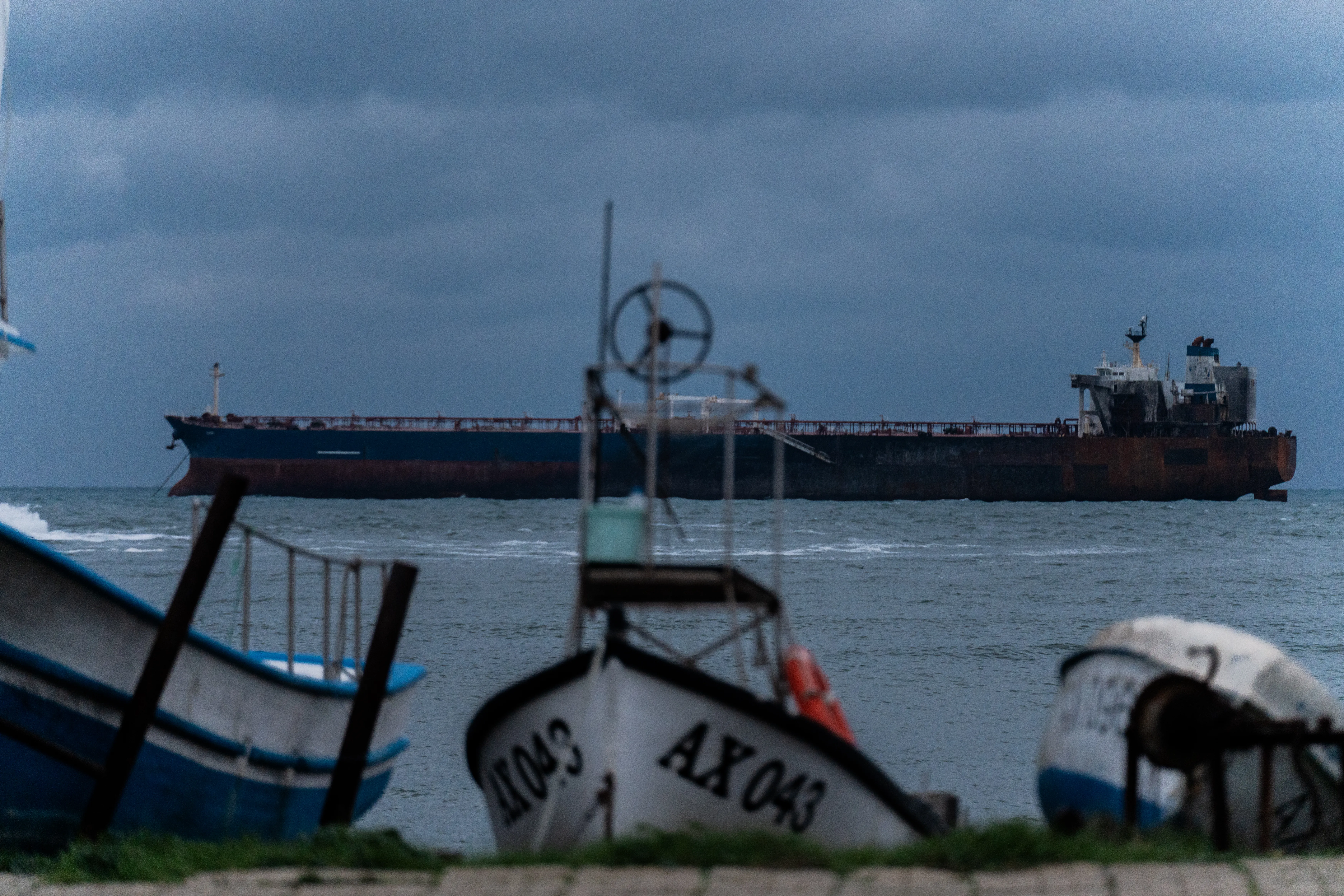
AHTOPOL, BULGARIA - DECEMBER 8: The Kairos oil tanker, a Gambian-flagged vessel believed to be part of Russia's shadow fleet, remains anchored on December 8, 2025 in Ahtopol, Bulgaria. Last week, the ship was sailing from Egypt toward the Russian port of Novorossiysk when it caught fire after an alleged attack by Ukrainian naval drones. Bulgarian maritime authorities are planning the evacuation of the remaining crew. The tanker was sanctioned by the European Union in July for its involvement in Russia's so-called shadow fleet, a clandestine network of vessels that help the country skirt price-capping sanctions on Russian oil sales, penalties that were imposed after the 2022 invasion of Ukraine. (Photo by Hristo Rusev/Getty Images)
The oil tanker Kairos, a Gambian-flagged vessel believed to be part of the Russian shadow fleet, remains anchored on December 8, 2025, in Ahtopol, Bulgaria. The ship was sailing from Egypt toward the Russian port of Novorossiysk when it caught fire after an alleged attack by Ukrainian naval drones. Photo by Hristo Rusev/Getty Images Hristo Rusev

It might not be a coincidence that the attack took place on the day of Russian President Vladimir Putin’s annual end-of-year press conference. During this, Putin said that Russia would respond to recent Ukrainian attacks on shadow fleet tankers.

Since the start of the full-scale invasion of Ukraine, Russia has relied heavily on the shadow fleet, estimated to number more than 1,000 ships, to circumvent sanctions and export crude oil, bringing much-needed revenue.

Putin said today that Russia would “definitely respond” to Ukraine’s campaign against its shadow fleet. “Ultimately, this will not lead to the expected result,” he said. “It will not disrupt any supplies, but will only create additional threats,” Putin added.

Ukraine has previously used drone strikes to target Russian shadow tankers in the Black Sea.

As we have previously reported, Ukraine carried out three attacks on Russian-connected oil tankers in the Black Sea in late November and early December. This campaign has drawn a response in kind from Russia, using a Shahed-type drone, as you can read about here.

Ukraine’s SBU security service says its Sea Baby naval drones today struck another Russian “shadow fleet” tanker in the Black Sea.

Video from an SBU source purports to show the oil tanker “Dashan” being hit by the attack drone and explosions in the stern area. “The vessel,… pic.twitter.com/mtfBqYe1gQ

— Christopher Miller (@ChristopherJM) December 10, 2025

However, the first confirmed Ukrainian strike on a Russian-linked vessel this far from the Black Sea theater is a significant development. It is highly likely that the clandestine anti-ship war waged between Iran and Israel — something we have reported on for years now —likely provided a template for this.

The ability to use short-range drones to prosecute attacks in the Mediterranean indicates that vessels could be under threat elsewhere in European waters or even beyond. Beyond that, we could see Ukraine start to use longer-range systems, including one-way attack drones equipped with Starlink terminals, in the future.

Regardless, this development not only makes it potentially harder for Russia to export oil but also means that other commercial shipping will have to be aware of the increasing risks and potentially take measures to enhance their protection.

While the attack on Qendil appears to be the first of its kind in the Mediterranean, a further geographical expansion of Kyiv’s campaign against the Russian shadow fleet should not be ruled out.

Contact the author: thomas@thewarzone.com

Thomas is a defense writer and editor with over 20 years of experience covering military aerospace topics and conflicts. He’s written a number of books, edited many more, and has contributed to many of the world’s leading aviation publications. Before joining The War Zone in 2020, he was the editor of AirForces Monthly.


Howard is a Senior Staff Writer for The War Zone, and a former Senior Managing Editor for Military Times. Prior to this, he covered military affairs for the Tampa Bay Times as a Senior Writer. Howard’s work has appeared in various publications including Yahoo News, RealClearDefense, and Air Force Times.


Source link