Why the best UCLA women’s basketball team ever might not win a title
Absolutely, this is the best team in UCLA women’s basketball history.
Not the best team in the country this year, but truly a testament to teamwork and hard work and talent retention.
Whether UCLA wins it all this season or not, the Bruins are the envy of teams everywhere, including Oklahoma State, whose season they ended with an 87-68 second-round victory Monday. Afterward, UCLA’s six seniors joined their teammates in one last victory lap around the court, waving to fans, soaking in the adoration, on their way to the Sweet 16 for the fourth consecutive season.
“Seeing a team who gets to host, a team who has stayed together, for the most part, they get to experience all the things that all of us want, and that is so incredibly rare and hard and special,” Oklahoma State coach Jacie Hoyt said.
But how much further those things will take these Bruins in the NCAA tournament after they fought off Oklahoma State?
Maybe all the way, but maybe not.
The road ahead is treacherous. And the Bruins aren’t barreling toward it with the same momentum as the teams they’re likely to face. This deep UCLA team will need to dig even deeper.
They will have Lauren Betts, though, and no one else will. UCLA’s great 6-foot-7 center and cheat code saved the day Monday, scoring 21 of her career-high 35 points in the second half, when the Bruins got tight and the Cowgirls got closer.
Not close, but closer. Much closer than UCLA’s fellow top seeds’ opponents did.
UConn beat ninth-seeded Syracuse 98-45 in a second-round game that featured a killer 31-0 run by the defending champion Huskies.
South Carolina dismissed ninth-seeded USC, 101-61.
Texas blew out eighth-seeded Oregon like a candle, 100-58, on Sunday.
Even the second-seeded Louisiana State Tigers — likely UCLA’s Elite Eight date if both teams win their way to a third consecutive NCAA tournament meeting — got in on the demolition derby Sunday. They routed seventh-seeded Texas Tech 101-47 while setting an NCAA record by scoring 100 points in their 16th game this season.
But this is not a tournament that takes into account point differential. So no harm and no foul when it comes to the scores of the Bruins’ first two wins — and the first round against California Baptist turned into a rout, 96-43, after the Bruins woke up and outscored their guests 52-9 in the second half.
What might matter is that while UConn and South Carolina, Texas and LSU delivered their best spirit- and soul- and confidence-crushing blowouts, the Lancers and the Cowgirls left Pauley Pavilion feeling good about themselves.
The 16th-seeded Lancers can tout that they trailed a top seed by just 10 at halftime. The eighth-seeded Cowgirls (24-10) can crow about outscoring the Bruins 42-41 in the second half.
“UCLA has lost one game all season, right? The majority of those wins were blowouts, like, real blowouts, and it would have been really easy for us to fold after that first quarter,” said Hoyt, referencing the fact that UCLA beat teams by an average of 28.9 points per game this season, fourth-best in the nation.
“But we never did. They were tough and had a resilience and a grit to them that I was really proud to coach.”
That the Bruins (33-1) couldn’t put more significant distance between themselves and a physical Cowgirls team posed some questions about why adjustments didn’t come quick enough, UCLA coach Cori Close said, taking accountability for her part of that. She also saw her players start to let calls and miscommunications frustrate them: “I didn’t think our next-play speed was as good as it has been, and it affects you,” she said.

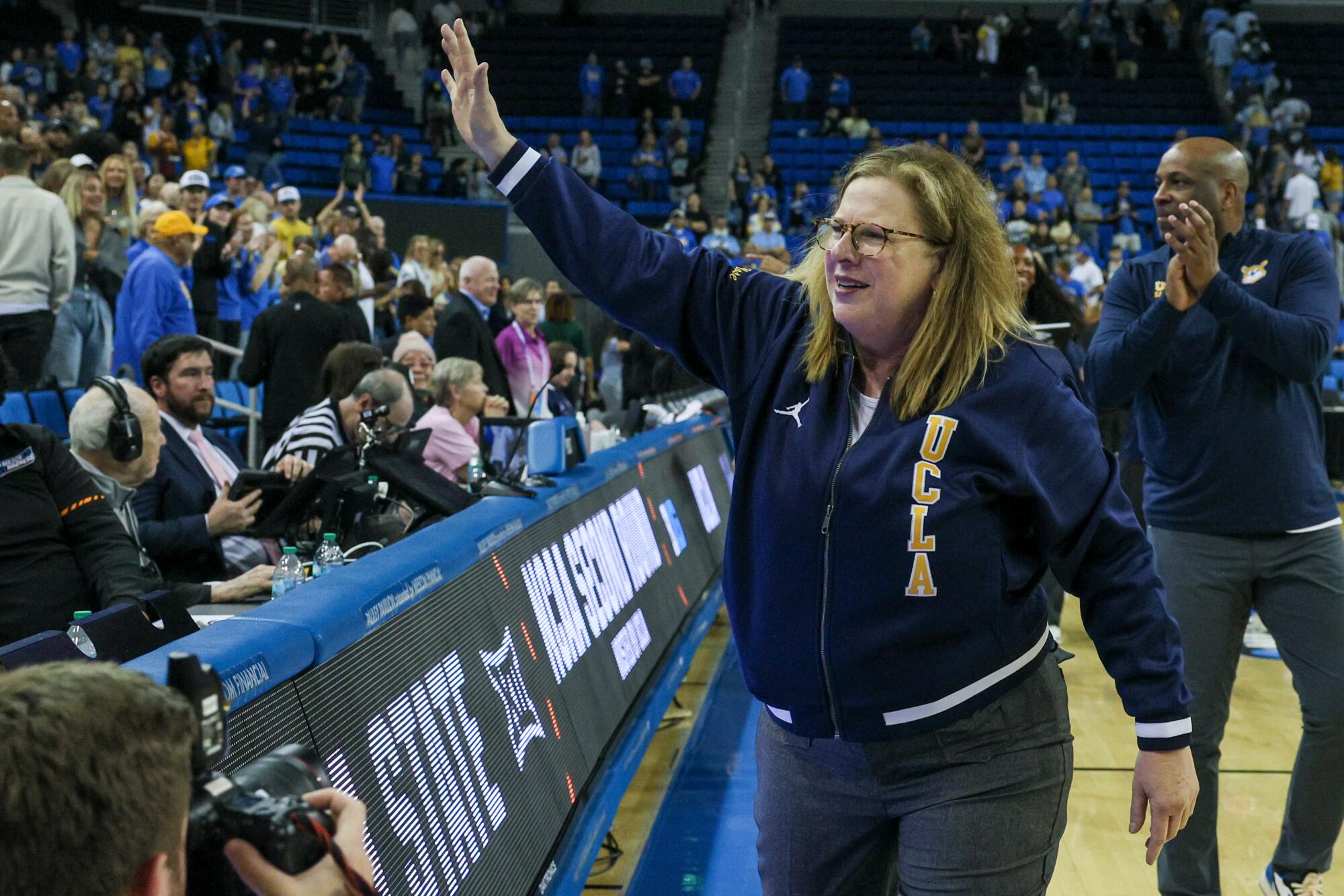
UCLA coach Cori Close waves to the crowd after Monday’s win over Oklahoma State in the second round of the NCAA tournament.
(Ronaldo Bolanos / Los Angeles Times)
That doesn’t inspire additional confidence in the Bruins’ path forward. It’s a thorny gauntlet created by seeding rules that bar conference opponents from playing in the Elite Eight — and that could require UCLA, as the No. 2 overall seed, to beat three of the top-five seeded teams if it’s going to win a national championship for the first time since the Bruins won the AIAW title in 1978.
Close hasn’t quibbled with her team’s seeding despite its impressive 31-1 regular-season record against a loaded schedule. But she said Monday she doesn’t like the route that’s been drawn up for her team.
In Sacramento on Friday, the Bruins will play Minnesota, a familiar foe from the Big Ten — one of a dozen conference teams that earned NCAA tournament bids — whom they defeated 76-58 on Jan. 14.
But after that, to reach the championship game the No. 2 team in the nation could meet LSU (the fifth overall seed in the tournament), followed possibly by Texas (No. 3 overall). And then, of course, they’d likely meet No. 1, undefeated UConn in the final, where the Huskies would be trying to win a second consecutive title.
An unenviable assignment, even for a team that seems to have it all.
“You know what does bother me?” Close said. “That the No. 1 and No. 2 overall seeds are not being rewarded because of a guideline that you can’t play a person in your conference in the regional finals. That is an antiquated, poor rule that advantages the wrong teams and the people who haven’t done the work.”
But on Monday, while saying a victorious goodbye to Pauley Pavilion, the Bruins were still mostly unbothered.
“I told ‘em in the locker room,” Close said, “we can talk about your wins and losses all day, but that will always pale in comparison to the way that you’ve affected this community, the way that you’ve touched people’s hearts, the way that you’ve grown as young women.”