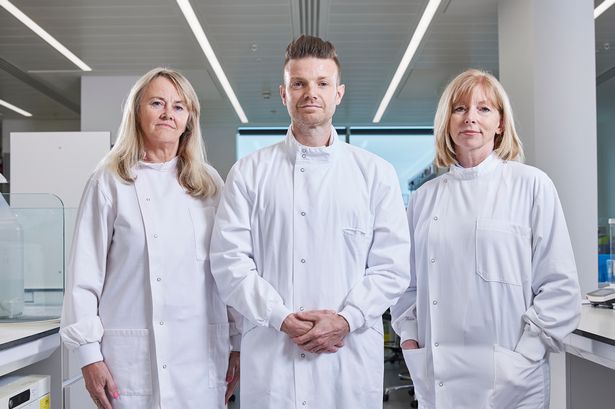
The three-part documentary follows experts developing a lung cancer prevention vaccine, blood tests to detect cancer early, and new brain cancer treatments

Researchers featured in a new Channel 4 series have revealed further details about their “groundbreaking” work towards curing and managing cancer. The three-part programme Cancer Detectives: Finding the Cures examines the future landscape of cancer identification, therapy and immunisation.
The experts highlighted that “progress” in this field has already been achieved, even proposing that cancer may one day be viewed as a “manageable, long-term condition”. So far, the television programme has tracked the work of Professor Sarah Blagden, who is creating a lung cancer prevention jab in what she describes as a “once in a generation opportunity” and brain surgeon Richard Mair, who assists those with difficult-to-treat brain tumours.
In its concluding instalment, broadcasting on Thursday, December 4, it will showcase Professor Caroline Dive, who is developing blood screening methods to identify cancer prior to it appearing on imaging. Additionally, the programme will document patients receiving potentially life-saving interventions.
Discussing his research, Associate Professor Richard Mair, from the University of Cambridge and Addenbrookes Hospital Cambridge, said: “What makes this trial different is that we are constantly learning and adapting how we deliver medicines. Right now, we currently look at specific faulty genes to decide if a treatment might be successful.
“There are several exciting possibilities, from early detection and faster treatments to shifting cancer into a manageable, long-term condition. Much like high blood pressure, we could monitor and adjust treatment regularly based on how the treatment is benefiting the individual at that moment in time.
“The ability to monitor and treat people dynamically, rather than giving a couple of treatments and hoping for the best would be a paradigm shift for brain cancer care. What excites me most is the potential of harnessing the immune system more effectively.
“It already plays a key role in finding and attacking cancer cells, but if we can empower it to do even more, that could be a game-changing approach across many cancer types but especially brain cancer where current immune-based treatments have been disappointing.”
Prof Sarah Blagden, featured in the opening episode of the series, discussed how her research into cancer vaccines. She explained: “When someone has just been diagnosed with cancer, they tend to think it has taken a year or two to develop in their bodies but we now realise it can take much longer than that, even decades in some cases.
“It actually starts as a precancer, a very small cluster of abnormal cells that look cancerous but don’t have all of the features of a cancer. An example is a bowel polyp.
“We know that some but not all polyps eventually turn into colorectal cancer but, biologically-speaking, polyps are quite different from a tumour. It is wrong to imagine that they are miniature versions of colorectal cancer.”
She added: “That’s why I liken precancers to a cocoon that is very different from the fully grown moth. This helps explain why many cancer blood tests (like the colorectal cancer CEA test or the prostate cancer PSA test for example) – that reliably detect advanced cancers – aren’t so good at detecting them at the early, cocoon stage.
“When we are thinking of prevention vaccines, we need to design them to teach the immune system to recognise the earliest changes in precancers (the cocoon stage) so we can really nip cancer in the bud.”
Thursday evening’s instalment will spotlight the work of Prof Caroline Dive, affiliated with the Cancer Research UK National Biomarker Centre and the University of Manchester. The broadcast will showcase her development of highly sophisticated liquid blood tests capable of identifying cancer before it becomes visible through conventional scanning methods.
Her pioneering research holds the potential to transform early diagnosis and treatment for countless individuals. Prof Dive explained: “Detecting cancers early through a blood test, before they’d appear on a scan, is a huge global ambition.
“While progress is being made, it remains a considerable challenge, with some cancer types proving much harder to detect than others. We look for many different types of molecules in the blood but we typically study fragments of DNA shed by dying cancer cells, called circulating tumour DNA.
“These DNA fragments can be analysed using different scientific techniques to spot signs ofcancer, such as sequencing for cancer-associated mutations or assessing DNA fragment lengths that distinguish cancer cells from normal ones. Some new technologies are sensitive enough to detect signs of cancer that are present in really low amounts in the blood.”
However, she further stated: “But creating a test that is sensitive and specific enough to reliably detect all early cancers is a huge challenge and should not be underestimated.” In this episode, viewers will also get acquainted with Lee, a 58 year old mechanic who is considered a medical mystery.
Medical professionals have been unable to determine the origin of his cancer; could Caroline’s innovative blood tests provide the answer?And another patient featured in the show, Damian, 49, hopes to join a trial to test if his recent skin cancer will come back so he can move on with family life.
Jonah Weston, commissioning editor at Channel 4, commented: “Cancer Detectives: Finding the Cures shines a light on the groundbreaking scientific research currently taking place to detect, prevent and treat cancer. It has been great to partner with Dragonfly and Cancer Research UK on this series and see these amazing scientists at work, as they make amazing breakthroughs already benefitting patients in ways that would have been unthinkable only a few years ago.”
Viewers can catch the third instalment of Cancer Detectives: Finding the Cures on Channel 4 this Thursday, 4th December at 10pm. Alternatively, the complete three-part series is accessible for streaming via channel4.com.