The Dodgers need an outfielder. Is a Cody Bellinger reunion possible?
The Dodgers need an outfielder. Cody Bellinger is available.
So, eight years removed from his Rookie of the Year arrival, six years since his 2019 MVP campaign, and three years after an unceremonious end to his Dodgers tenure, could the team and its once-beloved homegrown slugger actually reunite this winter?
It’s not impossible, with the Dodgers believed to have Bellinger on their radar as they evaluate their options in free agency.
In an offseason of wide possibilities, but thus far tempered expectations from the Dodgers’ front office, Bellinger represents something of a wild card in the team’s potential winter plans.
He is not the top outfielder on this year’s market, which is headlined by former Chicago Cubs slugger Kyle Tucker and the $400 million-plus bidding war he is expected to trigger.
But, for a team like the Dodgers, Bellinger could be a better (and more familiar) fit, providing the kind of positional versatility and financial flexibility someone like Tucker wouldn’t.
Granted, the seriousness of the Dodgers’ interest in Bellinger, which was first reported by ESPN, remains unclear. But the mere possibility will make it one of the more intriguing early subplots of the winter, representing one potentially splashier option for the club to consider in pursuit of 2026 roster upgrades.
To this point of the offseason, of course, the Dodgers have signaled a reluctance to add more lucrative, long-term, free-agent contracts to their steadily aging core. It’s shown up in their pursuit of relievers, with their preference seemingly being a shorter-term deal after being burned by big bullpen spending last year. It has also influenced the way they’ve viewed the outfield market, cooling summer-long expectations that they would be leading contenders in the Kyle Tucker sweepstakes.
After all, the Dodgers have two starting outfielders currently on their roster in Teoscar Hernández (who is entering the second of his three-year, $66 million deal) and Andy Pages (who is coming off a 27-homer campaign in his second MLB season). They have plenty of depth options at the position, from Alex Call to Ryan Ward to the versatility provided by utility players Tommy Edman and Hyeseong Kim (and maybe even backup catcher Dalton Rushing, who could experiment in the outfield again in 2026).

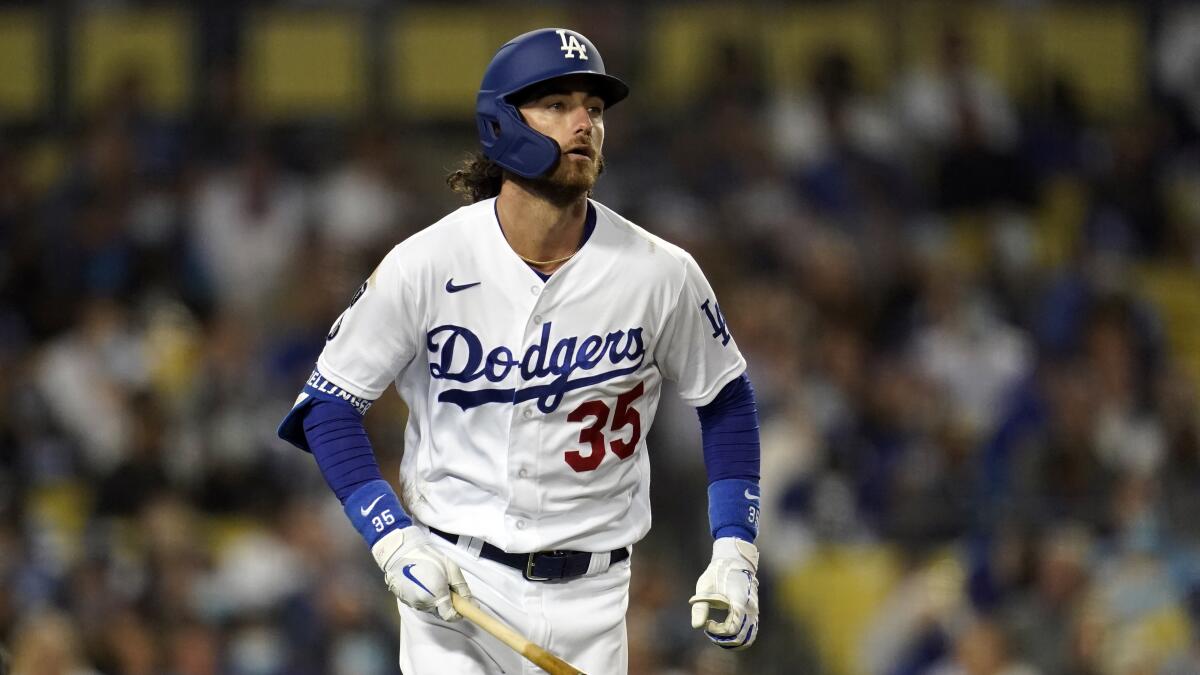
Cody Bellinger was the NL Rookie of the Year in 2017 and the NL MVP in 2019, but struggled in his last few seasons with the Dodgers.
(ASSOCIATED PRESS)
They also, importantly, have a promising wave of outfield prospects expected to reach the majors in the next 2-3 years, a group headlined by Josue De Paula (the top prospect in their farm system); Eduardo Quintero (their 2025 minor-league hitter of the year); Zyhir Hope, Mike Sirota, James Tibbs III and Zach Ehrhard (promising talents acquired in trades over the last two years); and Charles Davalan and Kendall George (recent first-round draft picks).
The team would still like to add another outfielder, likely of the left-handed-hitting variety, to the mix in 2026. It is hopeful of finding an improved replacement for Michael Conforto, after his woeful performance on a one-year, $17 million deal last season.
At the same time, though, the Dodgers want to preserve their longer-term flexibility at the position — making their odds of giving someone like Tucker the 10-year contract he is expected to receive appear dubious at best.
Bellinger, however, provides a different free-agent proposition.
He is a couple of years older than Tucker, set to turn 31 next season, but is also likely to receive a contract of roughly half the length and much less guaranteed money; pegged by most projections to be in the 5-6 year and $150-$175 million range (though he could reasonably surpass those figures if his market materializes well).
Crucially, Bellinger also offers positional flexibility. At present, he can play all three outfield spots, and remains a plus-defender in the corners. Down the line, he could eventually shift to first base, making him (for a team like the Dodgers) a potential future successor to Freddie Freeman.
Another key factor: Bellinger is a much different player than he was when the Dodgers declined to tender him a contract at the end of the 2022 season.
Back then, Bellinger was coming off two straight years of subpar performance in the wake of a shoulder surgery following the 2020 World Series. Between 2021 and 2022, he hit .193, struck out more than 27% of the time, and had an OPS+ of 66 (an advanced metric in which 100 is considered league average).
The last three years, on the other hand, have seen the former MVP winner stage a mid-career revival. While playing for the Chicago Cubs (who signed Bellinger ahead of the 2023 season) and New York Yankees (who traded for him last offseason), he hit .281, struck out just 15% of the time, and had an OPS+ of 125. Last season, he also hit 29 home runs, his most since collecting 47 in his 2019 MVP season.
Granted, Bellinger did benefit from the hitter-friendly environment at Yankee Stadium, where he had 18 of his long balls last year. He also does not hit the ball as routinely hard as in his peak years with the Dodgers. Yet, he has improved his approach, honed more consistent swing mechanics, and balanced out his platoon splits, batting .353 against left-handed pitching in 2025.
Those strides served as a reminder of Bellinger’s tantalizing talent, as well as a sign of his growing maturation as he enters his 10th year in the majors.
The question now: Whether it will all be enough for the Dodgers to make a legitimate run at bringing him back.
The nature of free agency, of course, means Bellinger is still likely to land elsewhere this winter. He is expected to field wide interest on the open market, starting with the incumbent Yankees (especially if their other free-agent outfielder, Trent Grisham, turns down a qualifying offer). The Dodgers, meanwhile, remain better positioned to explore the trade market for an outfield addition, possessing the kind of highly-rated farm system that could make them a factor for everyone from Steven Kwan to Brandon Donovan to Jarren Duran.
If Bellinger were to attract his own bidding war, the Dodgers would likely be reluctant to overpay (at least in their view) for his services.
But for now, the possibility of a reunion does at least seemingly exist — thanks to Bellinger’s versatile fit, recent resurgence and lingering familiarity with the franchise.
Years removed from his breakout, then flame-out, during his first tenure with the Dodgers, he could wind up in their winter plans again this offseason.