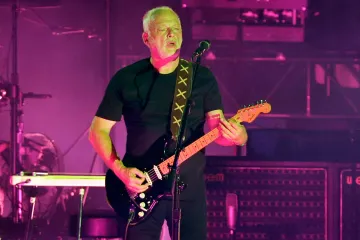
It’s been eight years since The xx performed together as a band, but it sure didn’t feel like it when the U.K. trio took the Main stage on Friday.
For one, the members haven’t exactly disappeared. Producer/drummer Jamie xx is a festival mainstay and one of the most sophisticated, exultant DJ’s working. Romy Madley Croft became a sapphic-nightlife sovereign in 2023 with the clubby “Mid Air,” after Sim’s own minimalist, horror-streaked “Hideous Bastard.”
The band’s songs are among the most timeless of their generation of indie rock. Forward-thinking enough to reinvent the guitar-bass-drums palette for the EDM boom; yet stark and lovelorn enough to pass for Motown in another era.
Yet their return was among the most buzzed-about sets of the festival this year, a credit to how well their catalog has stood up on the merits. At their debut, they almost singlehandedly inaugurated a shift towards hyper-intimate headphone pop – it’s hard to imagine Billie Eilish sounding quite the same without them.
Yet on Friday, they bolstered that purity with the confidence, swagger and precision of the veteran rock act they’ve become.
Dressed in their typical all-black palette, their faces carrying a little more gravity and composure with age, the set slipped between the ships-in-the-night duets of “Shelter” and “VCR” to the after-hours whomp of Romy’s “Enjoy Your Life.” “On Hold” best married the band’s two worlds, sample-soaked yet rock driven; “Angels” remained a peerless devotional ballad.
There was a sweet irony watching them close the set with “Intro,” a modest instrumental jam from their debut that has, through well-paying commercial placements, become their calling card to mainstream pop. It still rips. They even wrapped it up with into a noise-staggered breakdown that felt like actual stadium rock. Leave it to these three to drift into the murk of a warehouse club for a near decade, and come back bigger rock stars and more powerful a band than ever.
A CLASSIC British rock band’s touring plans have been put on hold until one member gets a bill of clean health.
The band YES was due to embark on an 11-date European tour this month, launching in Glasgow on April 22nd – but the group’s guitarist Steve Howe has to undergo essential surgery, forcing the band to announce a change in plans.
Sign up for the Showbiz newsletter
Thank you!
YES was due to embark on an 11-date European tour this month – but the group’s guitarist Steve Howe has to undergo essential surgery, forcing the band to announce a change in plansCredit: GettyThe band formed in 1969, with many members coming and going over the years. The line-up of Anderson, Howe, Bruford and Wakeman is pictured in 1989Credit: GettyYES were set to play their much-loved 1971 album Fragile in full, after the success of their North American tour in 2025Credit: GettyHowe is the only remaining member of his eraCredit: Getty
YES was set to play their much-loved 1971 album Fragile in full, after the success of their North American tour in 2025.
But taking to Instagram, the group have issued a statement explaining the need to postpone.
“The upcoming YES ‘Fragile’ UK and EU Tour has had to be postponed as guitarist Steve Howe requires an essential operation that requires recovery time,” read the statement on social media.
“This decision has been made to ensure that Steve can return to the stage in full health and deliver the performances that fans deserve.
“We are working hard to reschedule the UK and EU shows to a later date, with full details to be announced after Easter.
“Steve Howe and YES would like to thank their UK fans and hope for their continued support at this time.”
The post explained that tickets would be valid for the rescheduled dates and that the concerts would take place later in 2026.
Fans took to the comments underneath the post to express concern for Steve, wishing him well.
One wrote: “The most important thing is Steve’s health… wishing a full and speedy recovery to one of rock’s greats!”
YES released Fragile as their fourth album – and it’s widely considered their best among fans and critics alike.
The group formed in 1969, but Steve didn’t join until a year later, replacing original guitarist Peter Banks.
The group gained considerable recognition with their third and fourth albums – The Yes Album and Fragile – which were both released in 1971.
The latter included famed single Roundabout.
Over the decades, 20 different members have been part of YES, including founding members Jon Anderson, Chris Squire, Bill Bruford and Tony Kaye.
Steve is the only remaining member of his era, now joined by lead singer Jon Davison, drummer Jay Schellan, keyboard player Geoff Downes, and Billy Sherwood on bass.
In 2017, the group had to cut another tour short due to personal circumstances when Steve’s 41-year-old son tragically died from a heart attack.
YES are considered the pioneers of progressive rock by many music fans, known also for their impressive live performances, and are members of the Rock & Roll Hall of Fame.
The band originally split in 1980, with some members attempting to launch spin-off groups, which mostly failed to take off.
One of these groups ended up comprising mostly of ex-YES members, and in 1983 the band was re-launched.
More incarnations of the group followed, with Steve eventually leaving in the early 1990s, returning later that decade, before the group split again in the early 2000s.
They reformed again in 2009 and have recorded new material and toured on-and-off ever since, marking their 50th anniversary in the process.
In 2024, former keyboardist Rick Wakeman left the group, saying he felt it was “time to call it a day”.
Steve and the other current line-up have continued with the group without Rick over the past two years.
The band explained in a statement that the decision had been made to postpone so that “Steve can return to the stage in full health and deliver the performances that fans deserve”Credit: Getty“We are working hard to reschedule the UK and EU shows to a later date, with full details to be announced after Easter,” the band said on InstagramCredit: Getty
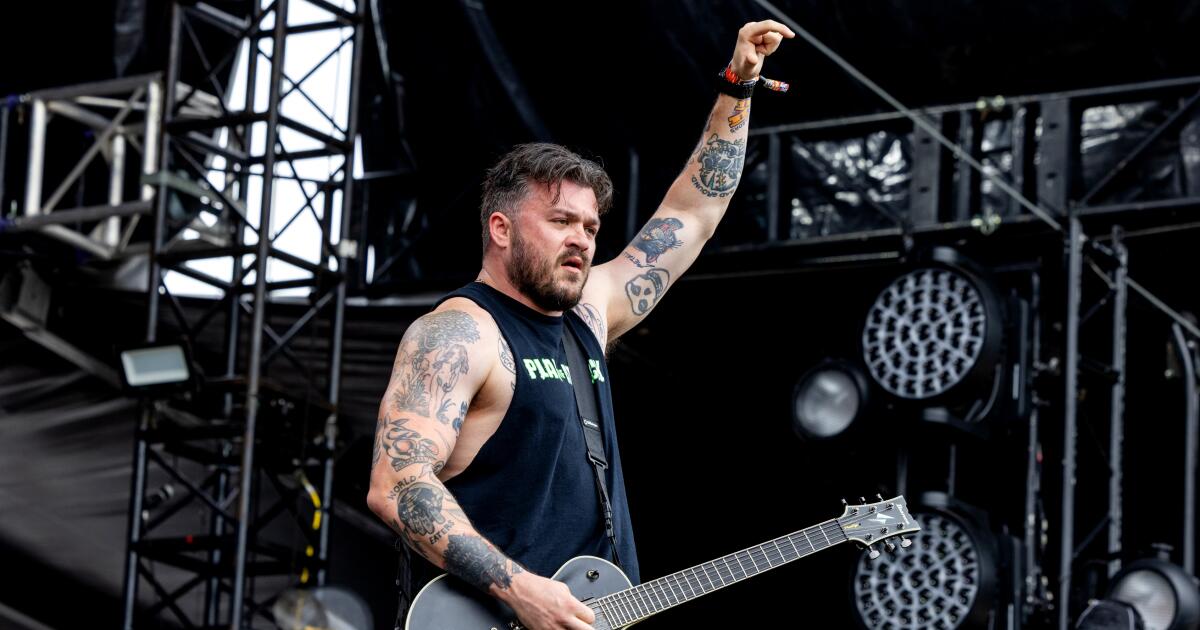
Bo Lueders, guitarist and co-founder of the Chicago-based hardcore metal band Harm’s Way, has died, his bandmates announced “with heavy, broken hearts” Thursday on social media. He was 38.
Lueders “will be remembered for his unwavering empathy and compassion for his friends & family and his magnetic, inimitable presence on & off the stage,” Harm’s Way wrote on Instagram, asking for “grace and privacy” during a difficult time.
No cause of death was provided, but the band offered up the 988 suicide and crisis lifeline to anyone “struggling with depression or urges to self-harm.”
Born Bohan Daniel Lueders in November 1987, the musician co-founded Harm’s Way in 2006 as a side project of the punk band Few and the Proud. It turned into a full-time band that has released five studio albums and five EPs in the years since, with songs including “Human Carrying Capacity,” “Become a Machine” and “Call My Name.”
In a bio posted by the band on Spotify, Lueders took a shot at describing the music on Harm’s Way’s 2018 album, “Posthuman,” which was followed by its fifth album, “Common Suffering,” in 2023.
“To a Harm’s Way fan, I would describe ‘Posthuman’ as a blend of ‘Isolation’ (2011) and ‘Rust’ (2015), but it’s sonically way more insane,” he said. “To anyone else, I would simply say it’s like full on aggression.”
Lueders began the “HardLore” podcast in 2022 with Twitching Tongues frontman Colin Young to chronicle life on the road in the hardcore/punk/metal scene. A new episode — the second part of a two-part interview with Madball singer Freddie Crician — was posted Wednesday.
But on March 19, before that two-parter was done, Young and Lueders posted a “HardLore” episode that broke from format, instead answering listener questions for an hour and a half. One listener asked the hosts what piece of music they wanted to hear last before they died. Young picked “My Way” by Frank Sinatra. His buddy chose another track that was distinctly non-metal and non-punk.
“Mine would be some Björk song, probably. Either ‘Unravel’ or ‘Aurora.’ I just wanna drift and go peacefully,” Lueders said, rubbing both eyes before making a drifting gesture with both hands.
“I think ‘Unravel’ is one of the most beautiful songs ever written.”
A GoFundMe campaign was launched Friday by Young on behalf of Lueders’ “mother Wendy and girlfriend Taylor to help cover the costs of both afterlife & memorial services in Chicago.” The campaign had reached nearly $140,000 by midday.
After a major national debacle on live TV when she was only 20 years old, Ashlee Simpson Ross finally found a way to win back a small-screen audience’s love: She put a galaxy mask over her head and let the vocals rip.
Forget that 2004 incident where she got caught singing over a backing track in an appearance on “Saturday Night Live.” Sure, she did a weird little dance, then fled the set. Sure, her dad made excuses. But that’s in the past.
“I feel like I became Galaxy Girl and I had the best team ever,” Simpson told People. “So I mean, it felt great to do it. It felt great to perform, not being able to see where I’m going. You can hardly see where you’re going. I think just becoming that character of Galaxy Girl and people not knowing who I was, it was just a different way of performing that. I enjoyed that. It was definitely a moment of discovery.”
Back in fall 2004, Simpson, who’s now 41, was about to do her second song as the musical guest on “SNL.” Following in her famous sister’s footsteps as Jessica Simpson’s newlyweds reality show with then-husband Nick Lachey was hitting its stride, she had just released what would become the year’s top-selling album by a female singer.
Lorne Michaels would confirm later that it had been a first for the sketch show.
“What can I say? Live TV,” host Jude Law told the audience during the show’s goodbye sequence that night. Simpson, standing at his side, jumped in with a rapid-fire explanation of what had just happened, throwing her band under the bus and not making much sense at all.
“I feel so bad. My band started playing the wrong song and I didn’t know what to do, so I thought I’d do a hoedown. I’m sorry!” she said.
This was a year after her sister had asked, with cameras rolling, whether a can of Chicken of the Sea contained tuna or chicken, and whether Buffalo wings were made out of buffalo. So what stuck in people’s minds were those lyrics playing out of the ether. Ashlee Simpson, it was clear, intended to lip sync, which sort of implied to casual observers that she couldn’t sing. She became, to many, a laughingstock.
Her dad said afterward that acid reflux had made her vocal cords swell, necessitating the last-minute switch from live to Memorex. He called it a learning experience and said she would prove herself in future shows.
“Unfortunately, that happened to us on Saturday, so just like every other artist in America she has backing tracks … so you don’t have to hear her croaking through a song on national television,” Joe Simpson told Ryan Seacrest in a radio interview.
“She never used them before,” he said of the vocal tracks, but “you have to do what you have to do.”
A few months later, she was booed on national TV when she did the halftime show at the 2005 Orange Bowl. Folks joked that it was worse than what happened on “SNL.”
So, yes, her career continued, but it hasn’t been 100% smooth. After a couple more albums, she took a role in a Broadway musical and eventually she returned to acting. She said over and over that she was going to get back into music, but life kept getting in the way.
Then in 2025, after celebrating the 20-year anniversary of her breakout album release with a short gig at a WeHo nightclub the year prior, she announced a residency at the Venetian in Las Vegas. The gig proved popular enough that it was extended into 2026.
And over the course of “The Masked Singer” season, Simpson finally proved to those casual observers that she has a voice and knows how to use it. She even bested her husband, who competed this season as Stingray and was cast out in Episode 10.
“Performing is my happy place, and to be doing that again just feels so nice,” she told People. “I’m inspired to keep playing shows and creating new music. And moments like ‘Masked Singer’ and Vegas, and I’m looking forward to Pride and Stagecoach — those moments just make me realize, ‘Oh, this is what I love to do.’
The ex-guitarist of Turnstile has been arrested for allegedly intentionally hitting the lead singer’s father with a car.
Brady Ebert, a founding member of the Baltimore hardcore punk band, was arrested Tuesday in Silver Spring, Md., on charges of attempted murder in the second degree and first-degree assault.
Montgomery County Police responded to a call Sunday saying a pedestrian had been struck by a car. Upon arrival at the front yard of a home, officers discovered William Yates, the 79-year-old father of Turnstile frontman Brendan Yates, with “trauma to his lower extremities,” the Baltimore Banner reported.
William Yates and his family told police that Ebert first drove up to their house “honking his horn and yelling obscenities,” per Fox 5 in Washington, D.C. Ebert then allegedly returned and hit the elder Yates with his car.
According to the Banner, police obtained surveillance video of the incident that shows Yates moving out of the way and throwing a rock at Ebert’s vehicle and Ebert then accelerating up the driveway before swerving and striking Yates with his car. Yates told police that before first responders arrived, Ebert returned once again to yell that he “deserved it.”
Turnstile told Pitchfork in a statement that Yates underwent surgery for the “severe physical trauma” he sustained during the altercation and that the band’s members are “hoping for the best possible outcome in his recovery.”
“Turnstile cut ties with Brady Ebert in 2022 in response to a consistent pattern of harmful behavior affecting himself, the band, and the community,” the “Never Enough” band said in the statement. “After exhausting every available resource to support his access to help and recovery, a boundary ultimately had to be set when healthy communication was no longer possible and he began threatening violence.”
“We have no language left for Brady,” the band added.
Formed in 2010, Turnstile broke into the mainstream with the 2021 album “Glow On,” which earned the band its first Grammy nominations. The band’s first Grammys came in February 2026 for metal performance (“Birds”) and rock album (“Never Enough”). Turnstile is scheduled to perform at both weekends of the Coachella Valley Music and Arts Festival later this month.
Is there room in corridos tumbados for a little bit of R&B soul? Linea Personal is betting on it.
For three years, the música Mexicana band Linea from Stockton has been perfecting its sophomore album, “Todo ø Nada,” a 13-track project that incorporates elements of melodic trap, R&B, blues and corridos tumbados.
“It’s slow music, the lyrics transmit good feeling and it’s moody,” said frontman Gustavo Raya Garcia following the album’s release on March 26. “Our R&B style is a lot different from these [corrido] artists.”
At its core “Todo ø Nada” is a sad sierreño escapade that heavily has boisterous elements of corrido tumbados — often through wailing high-pitch strumming from a requinto and thunderous tololoche plucks, most notable in tracks like “Motorola” and “Tarot.”
But most distinct from the LP is the blues-infused “Caperuzita,” which kicks off the album with an ethereal, pitch-shifting cry that wades through the backdrop as an omniscient spirit — an interpolation inspired by Future’s “Wait for U” (featuring Drake and Tems) — while sounds of a banjo speckle about. The band also isn’t afraid to tap into other genres by infusing a drunken, jazzy trumpet into the sex positive “Ülala” — whose infatuating lyrics were partially inspired by the chorus line in Luther Vandross’ ”Never Too Much.”
“R&B is our original sound and we wanted to bring that back to this album but a little different,” said Raya Garcia “We wanted it to have a little bit more feeling to it. That’s why we added new instruments.”
For the group — which includes frontman Raya Garcia, his brother and secondary voice Aidan Raya Garcia, requinto player Jorge Ontiveros Zúñiga and guitarist Edgar Lozoya Verduzco — bringing “Todo ø Nada” to fruition was a total slow burn.
The band — who gained traction through their 2024 hustler melodies “Holanda” and the melancholic “Hennessy” — was often stuck in lengthy creative meetings at Street Mob Records, the record label founded by Fuerza Regida’s Jesús “JOP” Ortiz Paz, who signed the band in 2021.
“It taught us a lot of patience and a lot of faith in God’s timing,” said Raya Garcia. “We really wanted this album to come out a year ago, but things happened for a reason.”
To help fuel their creative flow, the group went down to a beach retreat in San Carlos, Sonora, right Mexico’s Gulf of California. They compiled a total of 50 songs, then narrowed it down to the 13-track list.
“What we look at is the lyrics,” said Edgar Lozoya Verduzco, the group’s producer. “The one we were not too sure about was ‘P— Alcohol’ because it was too explicit.”
But at the end of the day, Lozoya Verduzco wanted to push against the grain with the obscenity-laced track whose lyrics’ double meaning are reminiscent of those in Lil Wayne’s 2008 “Lollipop.”
“We’re not scared to try something new,” said Lozoya Verduzco.
(Cat Cardenas / For De Los)
With the release of “Todo ø Nada,” Linea Personal hopes it can continue to build on the momentum achieved by many of its Mexican American contemporaries — including corrido tumbado forefather Natanael Cano and its mentor, Fuerza Regida. According to Spotify, corridos accounted for 77% of all música Mexicana streaming in 2023.
“We are inspired a lot [by these acts], we see their mentality,” said Lozoya Verduzco. “We need need to be exactly like that or work 10 times harder.”
Erasure have split up and won’t be performing againCredit: Getty Images – GettyVince Clarke, part of the iconic 80s duo, revealed the news in an interviewCredit: Getty – Contributor
Erasure were responsible for some utterly iconic tunes back in their day, many of which have stood the test of time.
But now they’ve revealed that they have already performed their final gig.
Speaking to The New Cue newsletter, Erasure’s Vince Clarke spoke about the decision to stop touring and how it wasn’t an easy choice.
Vince was asked: “What’s the bravest career decision you’ve ever made?,” in an interview with the outlet.
He then continued to explain the reasoning behind the decision in more depth.
Vince elaborated: “What happened was [Erasure singer] Andy Bell and myself, we did these fan shows before Christmas and they were great but…
“It’s difficult to explain… the simple answer would be is I just don’t want to be really old and going onstage!
“I just don’t want to do it anymore.”
The pair released their first album together in 1985Credit: Getty – Contributor
Vince and Andy sent fans rushing to conclusions of a reunion years ago after posting a vague post online with the caption: “plotting and planning.”
The news thrilled fans on X, who immediately started speculating what they had up their sleeves.
“Let’s GO! Gotta see Erasure again live soon, it’s been way too long!” wrote one fan.
“So thrilled you two are still working together all these years later,” said a second.
A third noted: “New album? Would kill for a follow up to Erasure”
Erasure released their debut album Wonderland in 1985, and in the following year they broke into the UK charts with their single, Sometimes.
Since that time, they have released a staggering 19 albums, with their last being 2022’s Day-Glo.
They won Best British Group at the 1989 Brit Awards, with other hit tracks including A Little Respect, Always, Chains of Love and Breath of Life.
Andy went on to have a successful solo career, whileVince Clarkehad previously been a founding member of two more iconic bands, Depeche Mode and Yazoo.
Vince was candid about just not wanting to do it anymoreCredit: GettyTheir biggest song together was called A Little RespectCredit: Rex
A FOUNDING member of Seventies glam rock band Showaddywaddy, guitarist Trevor Oakes, has died the group announced today.
Former lead singer Dave Bartram who is now manager, said the 79-year-old musician passed away peacefully on February 18 after “a long illness”.
Sign up for the Showbiz newsletter
Thank you!
The musician was a founding member of Seventies glam rock band ShowaddywaddyCredit: GettyGuitarist Trevor Oakes died aged 79Credit: GettyNo further details have been released about Oakes’ illness or cause of deathCredit: Instagram
The band specialised in Fifties and Sixties classics including their only UK No1 single Under the Moon of Love in 1976 and still tours but with only drummer Romeo Challenger from the original line-up.
It enjoyed 15 Top Twenty hits during their peak from 1974 to 1979.
Bartram, also the group’s manager, said: “Trevor was a unique character and a dedicated professional, without whom the band would never have quite scaled the dizzy heights we seemed destined to achieve.
“He was also a caring and affectionate family man, with a mischievous sense of humour, which will be sadly missed by all those dear to him.
“ I could write a book about the incredible memories we’ve shared over the past fifty-seven years, but most of all I thank him from the bottom of my heart for his unwavering friendship. Your true friend Dave.”
A source claimed to The Sun that Bartram died in a Leicester care home and that his funeral has already taken place.
No further details have been released about Oakes’ illness or cause of death.
The musician was born in Leicester and worked as press knife maker before becoming a professional musician.
Oakes quit the band when he was aged 62 in May 2009 after suffering ill health, according to his biography on its website.
He has two ex-footballer sons, Stefan Oakes who played for Leicester City in the Premier League, and Scott Oakes, whoi had a spell at Luton Town.
The band specialised in Fifties and Sixties classicsCredit: InstagramThe band enjoyed 15 Top Twenty hits during their peak from 1974 to 1979Credit: GettyOakes quit the band when he was aged 62 in May 2009 after suffering ill health, according to his biography on its websiteCredit: Instagram
“I want to lick your stink … I want to taste your foulness … I want to shower in your rot … I want to feast in your fetid funk.”
Have more romantic sweet nothings ever graced the screen? Scripted by Grace Glowicki and Ben Petrie (partners in life and in filmmaking), these words of seduction are music to the ears of a lonely Gravedigger (Glowicki), who has been formulating a perfume to cover up her corpse-like stench. What she discovers is that the right one will love her exactly the way she smells, learning that she’s not so pheromonally challenged after all.
Glowicki’s sophomore feature “Dead Lover,” sometimes presented in “Stink-O-Vision,” is one of those entirely singular freakouts that we can thank Telefilm Canada for subsidizing (see also: the Cronenberg family oeuvre, Matt Johnson’s current “Nirvanna the Band the Show the Movie” and many more).
She co-writes, directs and stars in this highly stylized, wonderfully DIY handmade project, beautifully designed with gruesomely gothic sets by production designer Becca Morrin and art director Ashley Devereux. The blend of intentional artifice paired with deep emotion calls to mind other Canadian auteurs like Guy Maddin and Matthew Rankin (“The Twentieth Century”), but Glowicki’s film also exists within another lineage: the feminist Frankenstein film.
The film opens with a quote from Mary Shelley: “There is something at work in my soul which I do not understand.” Her 1818 novel “Frankenstein: or, the Modern Prometheus” has always been a feminist text (despite Guillermo del Toro’s more bro-ey adaptation), grappling with the terrifying power of creating life — and how close that is to death. Feminist filmmakers have drawn out these inherent themes from the book, the most recent and loudest example being Maggie Gyllenhaal’s “The Bride!” But “Dead Lover” hews closer to Laura Moss’ modern medical take, “birth/rebirth,” and even more closely to Zelda Williams’ cute, poppy “Lisa Frankenstein,” in which a young seamstress stitches up a reanimated boyfriend.
Our Gravedigger speaks to us, and to the moon, about her heart’s desire in charming cockney rhyming slang. Her hopes are rather simple and conventional: one true lifelong love and a family. After much rejection, she finally finds her Lover (Petrie) in the cemetery, saving him from a ferocious beast while he mourns his late opera-singer sister (Leah Doz). After the pair consummate their fragrant lust, the Gravedigger is ready to settle down right away.
In order to make her dreams come true, Lover travels to Europe for fertility treatments, where he drowns on a ship, the only thing left of him a finger, delivered to her by fishermen. Our enterprising Gravedigger, a true woman of science, engineers a lizard elixir and regenerates the finger into a long tentacle that eventually demands a body. What better choice than his own sister? But when her wild new Creature (Doz) comes to life, all hell breaks loose, summoning the sister’s jealous, grief-stricken Widower (Lowen Morrow) into an unfortunate love triangle (or square?).
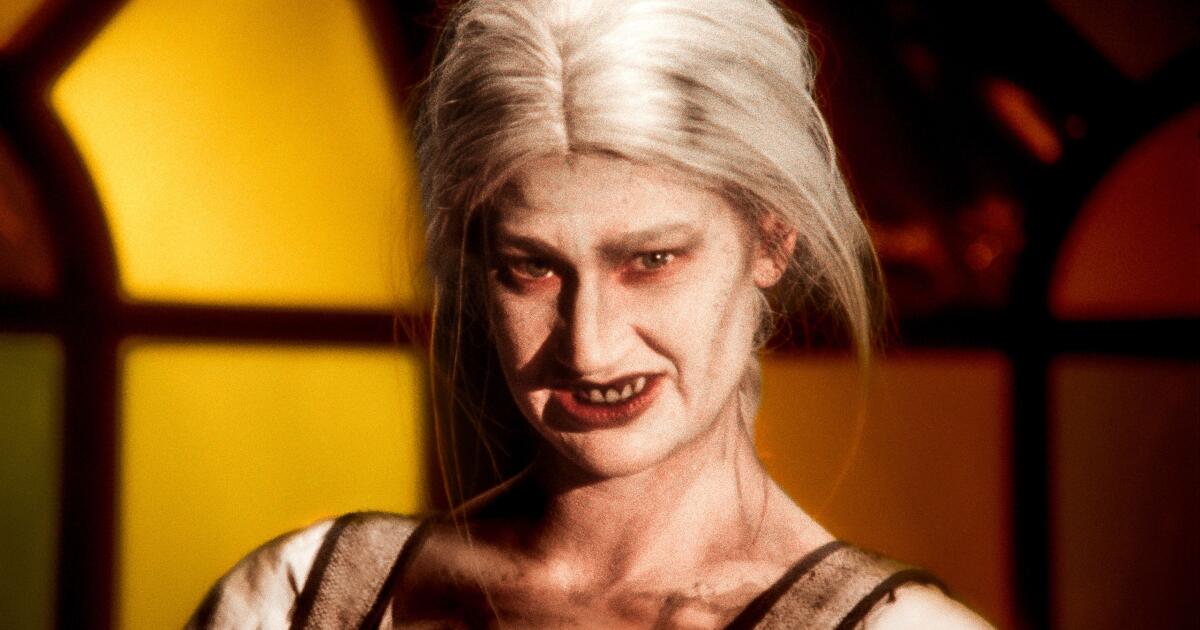
Glowicki is a terrific filmmaker, marshaling her tiny troupe to execute this unique project. Petrie, Doz and Morrow play multiple roles, including a gossipy Greek chorus and the band of merry fisherman (truly an astonishing array of Canadian accent work on display). Her commitment to her singular vision never wavers, but as an actor, Glowicki is truly astonishing. Caked in Halloween makeup and lit with an array of colored gels, Glowicki summons something primal, pure and deeply moving about the lengths one will go to for love, a screech from the depths of her gut.
With a dream-pop soundtrack by U.S. Girls that would be at home in an episode of “Twin Peaks,” “Dead Lover,” in all its stinky, sexy, queer and grotesque glory, is one of the grossest and loveliest films about love I’ve ever seen. This one’s for the horny, hopeless goth inside all of us.
‘Dead Lover’
Not rated
Running time: 1 hour, 25 minutes
Playing: Opens Friday, March 27 at Laemmle Glendale
Poverty can be and often is crushing. For Hermanos Espinoza — who are in the midst of promoting their debut studio album “Linaje,” released Friday — growing up in a family that struggled financially after a string of failed restaurants turned out to be the greatest motivator.
Since 2021, the quintet led by the sibling duo of Joel and Leonel Espinoza have steadily built an audience with their brand of new wave norteño, pairing the prominent sounds of the accordion and the bajo quinto with lyrics about making it big thanks to a combination of unrelenting working-class grit, familial love and faith.
Hermanos Espinoza were one of the most buzzed about bands at the 40th South by Southwest music festival, which took place earlier this month in Austin, Texas. At the De Los showcase — one of three appearances the band made during SXSW — the rooftop of the Mala Fama nightclub was at capacity well before the brothers set foot on stage, and a line to get in extended past the door.
“Y que c— su madre la pobreza,” lead vocalist and accordionist Joel Espinoza, 24, belted out from the stage, opening their set with their 2024 hit “Dios Por Delante.” The popular Mexicanism translates to “F— poverty.”
The crowd cheered and danced, letting loose on a late Sunday night.
“I saw my family go through so much because of money, because of poverty. They didn’t deserve it but I understand the world works in a certain way,” he would later tell De Los in a video call. “I just hated it.”
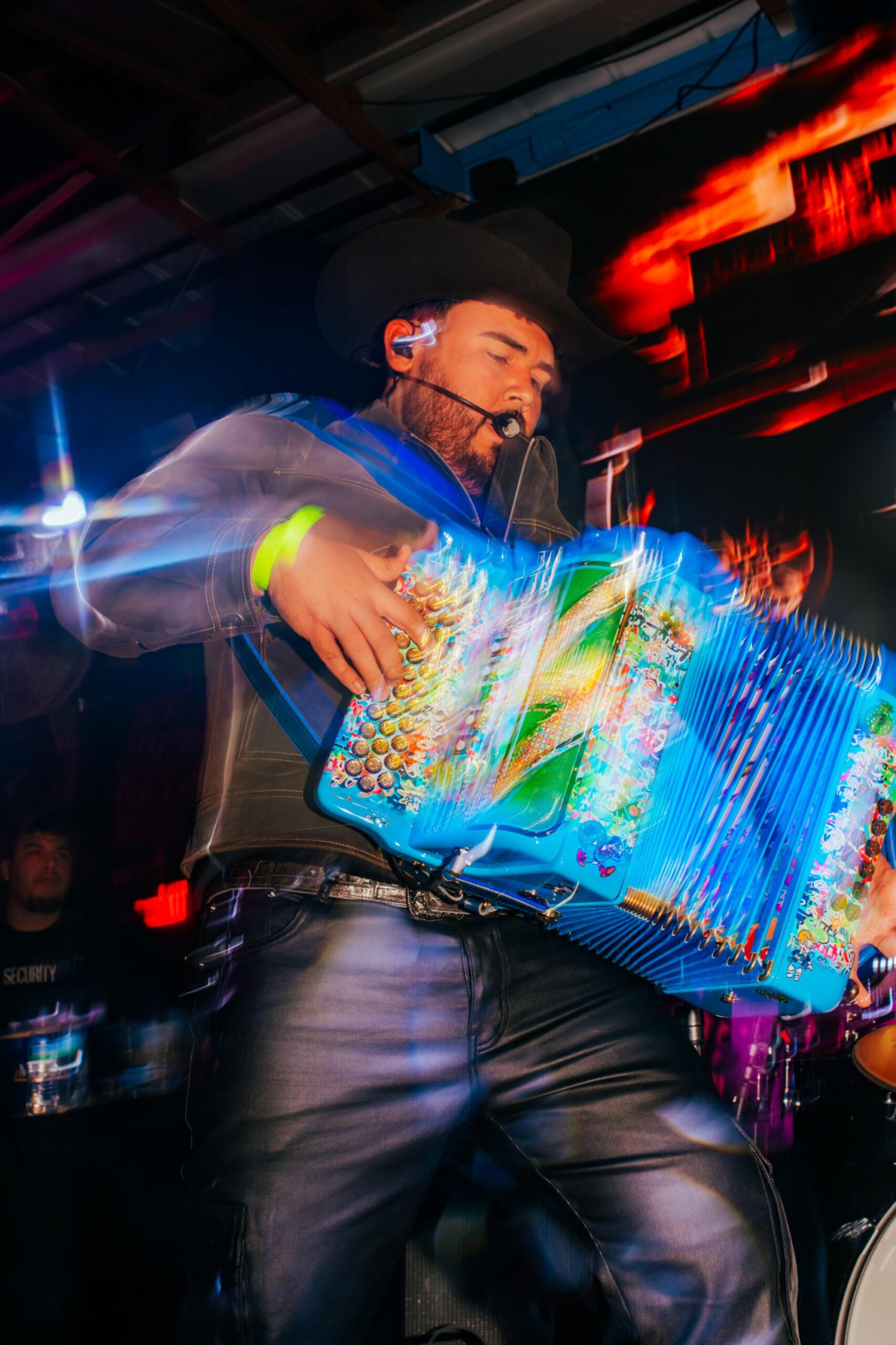
The dynamic singer delivered every lyric with his whole body as he frenetically tapped the buttons of his brightly colored accordion, doing his best to make the squeezebox sound like an electric guitar. The drum set and bajo quinto kept pace, making the set feel more like a rock show than a backyard kickback.
(Cat Cardenas / For De Los)
With “Linaje” — it translates to lineage, a term often associated with nobility and pedigree — the brothers are intent on sharing their hard-earned success with those they love most.
“Some people refer to ‘Linaje’ as royalty, or people who come from money, but for us, it’s the complete opposite,” said Joel. “Our family is hardworking and we wanted to give them credit too. To us, that’s royalty.”
The Espinoza brothers grew up in the South Texas city of McAllen, in the Rio Grande Valley, helping out at their family’s Mexican restaurants. They can still recall prepping food from the early morning hours to late at night. They say it was tedious work that made them disciplined, punctual and appreciative of the value of a hard-earned dollar.
“You see life through a different perspective,” said Leonel, who is 20 years-old.
(Cat Cardenas / For De Los)
The brothers say they brought that same work ethic in their pursuit of music; both were heavily involved in their school’s marching band as part of the drum line, which helped them master rhythmic timing, coordination and motor skills. In high school, Joel picked up the accordion — he describes playing the 49-key instrument as a “love-hate” situation — and Leonel the bajo quinto.
Their mother helped book their first gigs singing serenade covers. But by 2021, house party gigs had slowed down.
“I used to work with my dad back at his restaurant and one of those days I was just feeling really down, ready to give up on my dream of music, but he held me down,” said Joel.
It wouldn’t be long before all that hard work paid off. Hermanos Espinoza gained traction on YouTube and TikTok with their self-released tracks, “Prueba De Fuego” (2022) and the aforementioned “Dios Por Delante,” which describe leaving behind the treachery of poverty for a better life.
“People started tattooing ‘Dios Por Delante’ on their forearms and neck and that’s when we realized that this was more than music, it’s a movement,” Joel said of the impact of the latter song.
Resilience and faith remain at the core of “Linaje,” which was mixed and produced by Ernesto “Neto” Fernández, who has worked with the likes of Peso Pluma and Xavi.
The 15-track LP, a solid representative of the ever-evolving norteño sound coming from the Texas borderlands, begins with a blessing, “29:11.” The title refers to a Bible verse in the Book of Jeremiah: “‘For I know the plans I have for you,’ declares the Lord, ‘plans to prosper you and not to harm you, plans to give you hope and a future.’”
“A big part of this album was just letting go of trying to control everything,” said Joel. “I put it into [God’s] hands and we just let things flow.”
Money is the focus in the tracks like “La Moneda,” with Joel’s voice echoing through the backdrop as he proclaims that cash might change some tacky, incompetent chumps, but not him. Almost halfway through the set list is a hazy track, “No Puedo Amarte,” where the singer sours over an unresolved love; the crooning track is reminiscent of a twinkling sad sierreño genre, with an accordion alternating volumes between a bold tremolando and a silky legato.
Still, at its core, “Linaje” fundamentally underscores their grit in tracks like “Modelo V,” the first single under Double P Management that celebrates the journey that led them to success, which honors the lessons taught by their father.
“No matter all the adversities we face, the thing about my dad is that he’s always stayed true to himself and who he is,” says Joel. “That’s how we were raised and how we live day to day.”