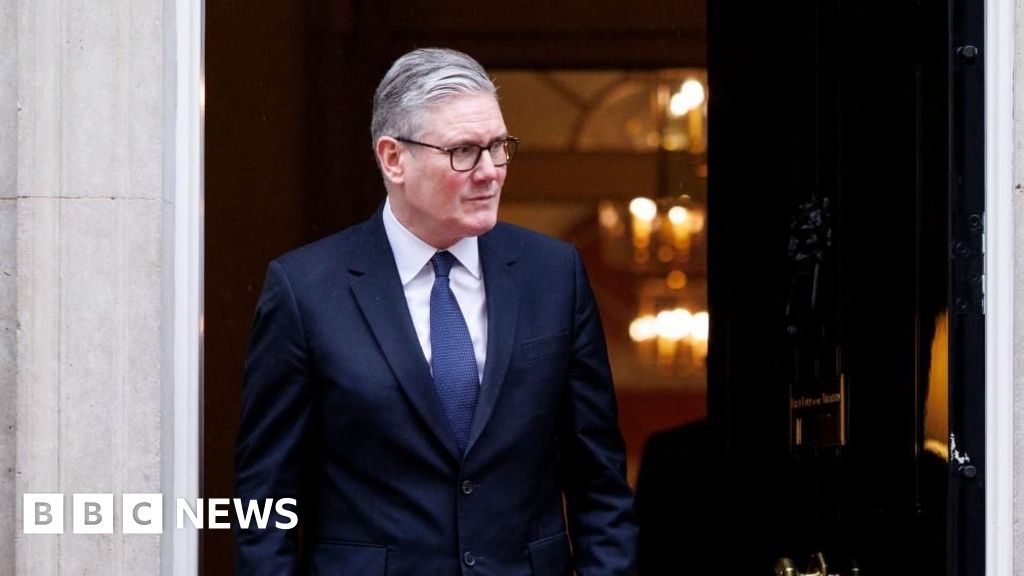
Starmer’s change of heart another ‘almighty backtracking’
Ditching his plans to make digital ID mandatory for workers in the UK is an almighty backtracking and dilution of one of the prime minister’s flagship policy ideas of the autumn.
I remember the first time Sir Keir Starmer talked publicly about his plans, because he was talking to me when he did so.
It was September, and we were sheltering from the pouring rain, in an outside metal stairwell next to a giant ship being built by BAE Systems on the banks of the Clyde in Glasgow.
What he had to say that day was rather overshadowed by the swirling storm around his then Deputy Prime Minister Angela Rayner, who 24 hours later was out of a job.
What those around him were describing as “phase 2” of his government was already off to a bumpy start, but digital ID was seen as a defining idea of the parliament that the prime minister could own and then lean into the arguments it provokes with his opponents, within his party and beyond it.
The thing is it provoked a lot of arguments, perhaps more than he had anticipated, including among some Labour MPs.
It was the mandatory element that became the magnet for the stickiest criticisms.
The idea cratered in popularity. It revived so many of the arguments that nuked the last Labour government’s plans for ID cards about two decades ago.
The sense from critics of an overbearing state, a ‘show us your papers’ society.
So what have ministers done? They have junked the mandatory element of it.
People will still have to digitally prove they have the right to work – but could use other things to do it.
This new government digital ID will not be essential.
The argument I hear within government is they are ditching the bit that is unpopular, but keeping something people might choose to use themselves because it could make accessing public services easier, for instance.
In short, the whole initial public pitch for why digital ID was a good idea – cracking down on illegal migration and illegal working – has been shelved.
The emphasis now is on digital ID being an aide to consumers.
“Let’s remove the whole culture war thing entirely and focus on the pragmatic element plenty of people will like and will choose to use,” is how one government figure put it to me.
Others say if the prime minister really is going to focus on the cost of living when he is addressing domestic policies, he needed to junk unpopular stuff that was getting in the way of that.
The opposition parties have piled in with their criticisms, while welcoming the government’s change of heart.
Here is the political challenge for Downing Street: the climbdowns, dilutions, U turns, about turns, call them what you will, are mounting up.
In just the last couple of weeks, there has been the issue of business rates on pubs in England and inheritance on farmers.
Before that, among others, income tax, benefits cuts and winter fuel payments.
Sir Keir Starmer’s critics, external and internal, are taking note.
Just hours before this latest backtracking, the Health Secretary Wes Streeting – who’d quite fancy being prime minister himself one day – said it was important the government “gets it right first time”.
That, to put it very politely, is a work in progress for Sir Keir Starmer.