appears

RQ-180 Secret Stealth Drone Appears To Have Made An Emergency Landing At A Greek Air Base

Spotters in Greece have caught an especially good look at what very much appears to be a stealthy, long-range, high-altitude (HALE) intelligence, surveillance, and reconnaissance drone commonly referred to as the RQ-180, or an evolution of that design.

Pictures of the dark-colored, flying-wing type aircraft landing at Larissa National Airport, also known as Larissa Air Base, situated in the Greek city of the same name, were published earlier today by local news outlet onlarissa.gr.

This aircraft seen over Larissa, Greece is not a B-2 like the local Greek news reported or an RQ-170, but is in fact best imagery ever published of the RQ-180, an undisclosed low observable drone used by the USAF. Location suggests use in the Iran conflict https://t.co/Pa9whNlQSV pic.twitter.com/UsDxy9Tc4n

— IntelWalrus (@IntelWalrus) March 18, 2026

“Those who were in the area near the 110th Fighter Wing [technically the 110th Combat Wing] in Larissa at the end of last week were left speechless when they saw an impressive plane in the sky, completely different in shape and appearance from everything we see daily in politics and the military air force,” according to a machine translation of onlarissa.gr’s piece, which misidentifies the aircraft as a B-2 bomber. “According to more recent information from military sources, this [aircraft] … reportedly parked at the Larissa military airport due to a breakdown and will remain there until it is repaired.”

TWZ cannot immediately confirm any of these latter details, but we have reached out to U.S. Air Forces in Europe (USAFE) and the Pentagon for more information.

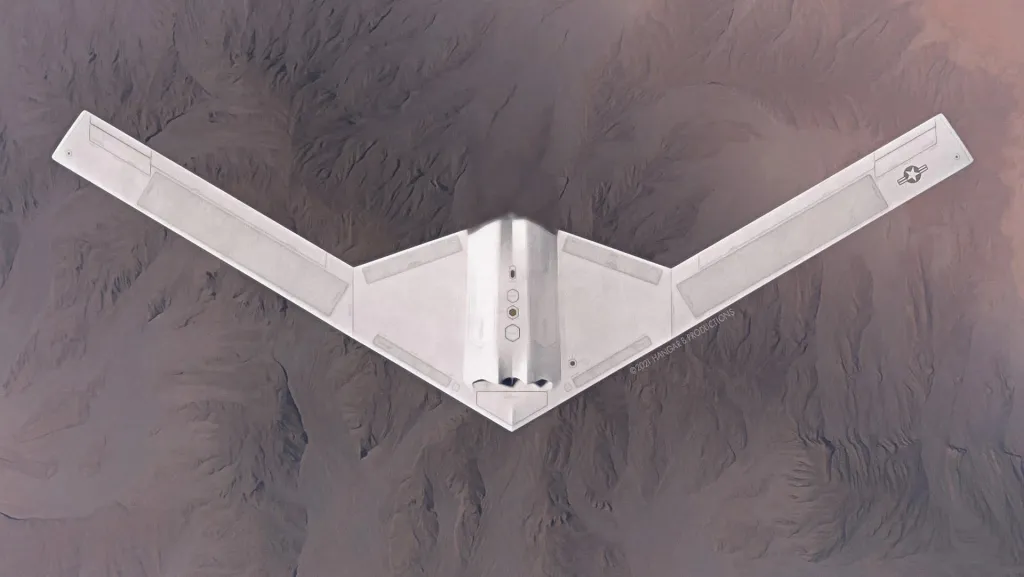
What is clear is that this is not a B-2, which has a very distinctive saw-tooth trailing edge that is not visible here, among other features. In fact, the overall planform is highly reminiscent of the new B-21 Raider stealth bomber from Northrop Grumman, as well as past sightings of aircraft believed to be RQ-180s or progenitors of that design. The RQ-180 is widely understood to be a Northrop Grumman product, as well, and very likely played a significant role in risk reduction efforts as part of the development of the B-21, as we have posited for years.

A notional rendering of what the Northrop Grumman drone, commonly referred to as the RQ-180, may look like based on previous sightings. Hangar B Productions

There are also some very rough similarities to sightings of what is believed to be an Israeli drone called the RA-01, but with some distinct differences. The RA-01 shares a similar planform, but is a more svelte design that would be significantly smaller than what we are seeing here. Furthermore, it makes very little sense that an Israeli drone would be flying that far west for any reason. The American aircraft in question is likely quite large, sitting below the size of a B-21, but maybe by 25 percent, as a guess. It would be designed for extremely long-endurance, high altitude strategic reconnaissance missions.

B-21 Takeoff and Landing


The pictures from Larissa also offer a good look at the aircraft’s landing gear, which is very widely positioned. A gear configuration of that kind allows for the maximization of volume in between and underscores the sheer wingspan of the aircraft.

Whether the aircraft in question has been operating from Larissa, or simply diverted there due to an issue, is unknown. It is possible that it has been forward-deployed to the base, but still had to return to base unexpectedly, leading to it being spotted during the day rather than coming in discreetly at night.

Larissa is a Hellenic Air Force base, home to the 110th Combat Wing, which operates Block 52+ F-16C/D Viper fighters, as well as various types of drones. Since the late 2010s, the U.S. Air Force has also publicly used the base for MQ-9 Reaper drone operations over areas of Europe and Africa. That, in turn, has led to upgrades to Larissa’s infrastructure, especially along the south side of the base, where there are now hangars that could accommodate larger flying wing aircraft and that do not appear to be used to house MQ-9s.

By what we can surmise about the RQ-180 program, aircraft that are part of its lineage have likely been flying for roughly over a decade and a half. Yet in recent years, just as this platform was thought to be coming online in a grander operational sense, we have not seen the infrastructure that would be indicative of that. It’s even possible its scale has been reduced as the Pentagon looks to push its surveillance capabilities to space, and especially some of the kinds an ‘RQ-180’ could do.

Still, given that this aircraft is now likely a component of the Long Range Strike (LRS) family of systems, and will work in concert with and even possibly have some commonality with the B-21, it could share that same infrastructure and come online fully alongside the Raider in the next couple of years. That is if the program is still intended to be scaled-up as opposed to diverting funds to on-orbit surveillance capabilities.

B-21 Raider. (USAF)

Regardless, the aircraft has been spotted flying over secretive locales in America’s Southwest for many years now, with sightings over Area 51, and reports of it flying out of Palmdale and Edwards Air Force Base. A conflict with Iran would be a relevant fit for what it was designed to do, so it should be of no surprise that it is flying missions over the country, even if it still remains in something of a late developmental state.

In all of the years of the RQ-180’s rumored existence, multiple stealthy HALE drone designs have emerged in China, at least undergoing testing, and these are just the ones we know about.

We will have more analysis on all this in the near future.

Already, if nothing else, there are very strong signs that we’ve now gotten our best look ever at the drone referred to as the RQ-180 or a directly related design.

Contact the author: joe@twz.com

Joseph has been a member of The War Zone team since early 2017. Prior to that, he was an Associate Editor at War Is Boring, and his byline has appeared in other publications, including Small Arms Review, Small Arms Defense Journal, Reuters, We Are the Mighty, and Task & Purpose.


Source link

Serbian MiG-29 Appears Armed With Chinese Supersonic Standoff Missiles

In a surprising development, Serbia has emerged as an operator of the Chinese-made CM-400 air-launched supersonic standoff missile. The weapon has been integrated into Serbia’s Soviet-era MiG-29 Fulcrums, which have undergone various upgrades. As it stands, the Balkan state, which has had a turbulent recent history, likely fields a missile capability otherwise unmatched in Europe (outside of Russia, at least).

A photo recently emerged showing a Serbian Air Force and Air Defense MiG-29 carrying a pair of CM-400 missiles on its inboard underwing hardpoints.

As we reported yesterday, Serbian Air Force showcased, for the first time, that they are in possession of Chinese made CM-400 supersonic air-ground missiles, with a reported range of up to 400 km.

This makes Serbia the second foreign customer, after Pakistan.

Pair of missiles… pic.twitter.com/Yo2Utzf8DV

— Peter Voinovich (@PeterVoinovich) March 10, 2026

There had also been previous clues that Serbia might be poised to introduce a powerful new weapon of some kind.

According to Belgrade-based defense journalist Petar Vojinović, the chief of the General Staff of the Serbian Armed Forces, Gen. Milan Mojsilović, stated last month that “in the air component, we have weapons of a similar maximum range and lethality [to the PULS rocket artillery system].”

Mojsilović was referencing the Israeli-made PULS (Precise and Universal Launching System) since this has been recently introduced by the Serbian Army. You can read more about this ground-launched artillery rocket here.

Serbia’s Acquisition of PULS Systems and Hermes 900 UAVs from Israel

Serbia ordered 1,000 kamikaze drones from Iran in 2023. In 2025, it made significant purchases from Israel’s Elbit Systems: a $335 million rocket and drone deal in January, and a $1.6 billion PULS (Precise and… pic.twitter.com/IiHPqyo5BZ

— Clash Report (@clashreport) October 8, 2025

Furthermore, Serbian President Aleksandar Vučić recently alluded to recently introduced military capabilities, stating: “…people couldn’t dream about everything we have, everything we are acquiring, they couldn’t dream.”

As for the CM-400, this weapon was developed and is manufactured by the China Aerospace Science and Industry Corporation (CASIC), apparently primarily for export. So far, it is not known to be in Chinese military service.

Unveiled in 2012, the CM-400 has a length of around 17 feet, a diameter of 16 inches, and weighs roughly 2,000 pounds. This includes one of two types of warheads, either a high-explosive charge weighing 330 pounds or an armor-piercing warhead weighing 440 pounds.

The CM-400 is a supersonic weapon, and CASIC claims it can reach a speed of Mach 4.5 in the terminal phase of flight. It has often been described as a hypersonic missile, but this is likely not the case: Mach 5 is typically considered to be the boundary between high-supersonic and hypersonic speed.

Nevertheless, it is clearly a very fast missile.

The missile’s range remains unclear, with varying accounts of this aspect of its performance.

At the very least, it is reported to have a range of 155 miles, while some sources claim it can hit targets at a range of 186 miles or even 250 miles.

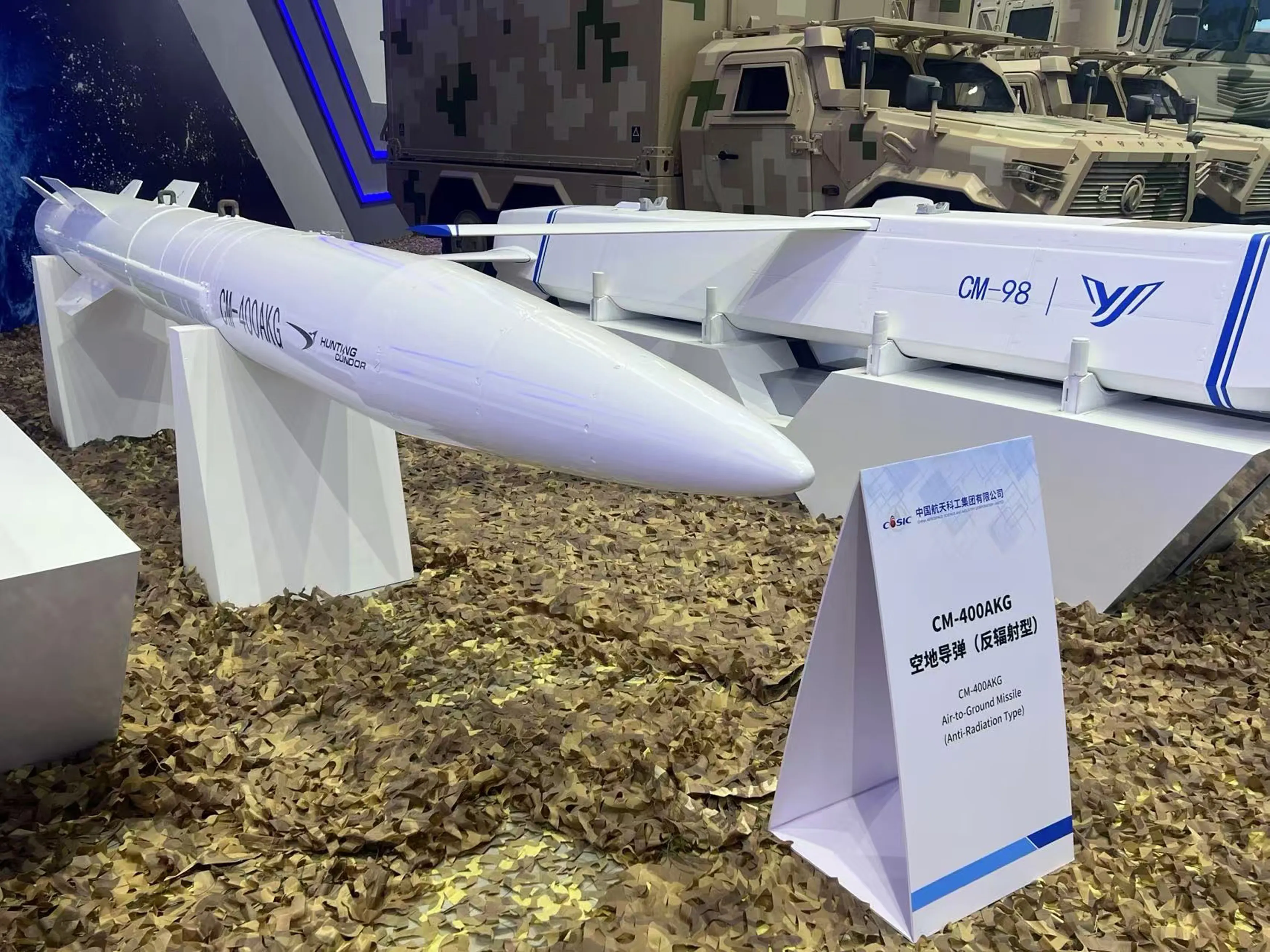
ZHUHAI, CHINA - NOVEMBER 12: CM-400AKG Air-to-Ground Missile (Anti-Radiation Type) is on static display during the 15th China International Aviation and Aerospace Exhibition, or Airshow China 2024, on November 12, 2024 in Zhuhai, Guangdong Province of China. The Airshow China kicks off on November 12 in Zhuhai. (Photo by Shen Ling/VCG via Getty Images)
The CM-400AKG anti-radiation missile on display during Airshow China 2024. Photo by Shen Ling/VCG via Getty Images VCG

The CM-400 has also been described as a quasi-ballistic missile, though this is also probably not entirely accurate.

Generally speaking, a quasi-ballistic missile is capable of being used on a depressed trajectory. This makes the missile more capable of significant maneuvering in flight, presenting greater challenges even for opponents with more robust missile defense capabilities.

In the case of the CM-400, the missile reportedly flies on a relatively high ballistic trajectory, powered by its solid rocket motor. It then careens toward its target at a steep angle of descent. While it may also be able to maneuver dynamically during its terminal attack phase, to attack moving ships, it doesn’t fly on a depressed trajectory, as far as we know.

In terms of target sets, the missile has been widely described as an anti-ship missile, specifically even as a ‘carrier-killer’. In fact, the basic weapon can also be configured as an anti-radiation missile, and it is presumed to also have the capability to attack non-emitting ground targets.

Depending on the different targets, the CM-400 can have different seeker heads fitted. All of the versions have an inertial guidance system with Global Navigation Satellite System (GNSS) correction. For the terminal phase, it relies on an infrared/optoelectronic seeker for attacking naval targets, or a passive radar seeker to take out electromagnetic emitters. The circular error probable (CEP) for the anti-radiation version is claimed to be 16-33, reduced to 16 feet or less for the anti-ship version.

Previously, the only confirmed export operator of the CM-400 was Pakistan, which uses it on its JF-17 Thunder multirole fighters. Pakistani officials claimed that the missile saw successful combat use against Indian S-400 air defense systems during the conflict between the countries in May last year. However, this remains unconfirmed.

A JF-17 Thunder of the Pakistan Air Force armed with CM-400 missiles. via Chinese internet

Pakistan shows footage of its JF-17 Thunder jet taking off to hit Indian S-400 air defence system with Chinese-origin CM-400AKG hypersonic missiles in anti-radiation variant.

The missile features a passive radar guidance mode, allowing it to home in on radar emissions, making it… pic.twitter.com/DUQTOQciDk

— Clash Report (@clashreport) May 10, 2025

In Serbian service, the CM-400 is carried by the MiG-29 fighter. These aircraft were first acquired by the then Yugoslavia in the 1980s. Survivors of Operation Allied Force in 1999 were later supplemented by secondhand MiG-29s from Russian and Belarusian stocks. The aircraft have also been moderately upgraded and are now known as MiG-29SM+. Fourteen examples are currently in active Serbian service.

19 July 2024, Serbia, Belgrad: A MIG-29 jet of the Serbian Air Force accompanies the Airbus of Federal Chancellor Scholz (SPD) after a visit to the President of Serbia Vucic and a summit meeting on critical raw materials. Photo: Michael Kappeler/dpa (Photo by Michael Kappeler/picture alliance via Getty Images)
A Serbian MiG-29 accompanies the Airbus of the German chancellor after a visit to Serbia in 2024. Photo by Michael Kappeler/picture alliance via Getty Images picture alliance

The long-term plan for the Serbian MiG-29s is somewhat unclear, since the country ordered 12 Dassault Rafale multirole fighters, in a deal that you can read more about here.

For the time being, however, in the CM-400, Serbia looks to have secured a capability that is very likely unique in the wider region.

With its combination of very high speed, long range, and ‘fire and forget’ guidance, the missile is ideal for deep standoff strikes. It is optimized for striking hardened strategic targets, day and night, and in all weather.

Thanks to CATIC’s Standalone Weapon Fire Control System (SWFCS), also designated as WZHK-1 by China, the CM-400 (and other Chinese missiles) areis designed to allow foreign models of aircraft to operate Chinese missiles and bombs.

Speaking to Janes during the exhibition, a CATIC official said that the system is designed to equip a range of Chinese air-launched weapons and can be installed on existing weapon hardpoints.

“The system gives air forces around the world the ability to easily integrate Chinese-made weapons with their aircraft without requiring them to make software or hardware changes to the host aircraft,” a CATIC official told Janes about the SWFCS back in 2024.

CATIC’s Standalone Weapon Fire Control System (SWFCS). Petar Vojinović

“The [SWFCS] uses a wireless data system that connects to a tablet in the cockpit that can be worn by the pilot. The tablet acts as a portable wireless controller that the pilot can use to launch the missiles,” the official added. Similar tablet-based soluiions have also been used by Ukraine to rapidly integrate Western weapons on Soviet-era jets, as you can read about here.

Ukrainian Air Force Su-27 Flanker Wild Weasel operations, seen here conducting multiple low level standoff strikes against Russian radars with US-supplied AGM-88 HARMs. pic.twitter.com/7CosjXFNkO

— OSINTtechnical (@Osinttechnical) April 21, 2024

The same SWFCS interface is also being used to carry another Chinese air-to-ground weapon, the LS-6 precision-guided munition. This is a 1,100-pound-class weapon that combines a general-purpose bomb with a strap-on upgrade package to provide range extension and precision strike capabilities.

Meanwhile, weapons in the CM-400 class are a response to the growing threat posed by ground-based air defense systems, which are pushing combat aircraft ever further from the targets they are assigned to destroy.

With its very high maximum speed, the CM-400 is also well suited to attacking time-sensitive targets, which could also include mobile air defense systems or mobile ballistic missiles, provided their coordinates can be established in the required timeframe.

For Serbia, the new missile would appear to offer a relatively easy way to expand its air-launched, precision standoff strike capability. With a high degree of flexibility, fast reaction time, and the ability to penetrate most enemy air defenses, it is a notably hard-hitting weapon for what is otherwise a fairly modest air force.

It is also interesting that Serbia is looking to China to fulfil its missile needs, rather than Russia.

A pilot of the standby unit of the fighter aviation gets ready for take-off aboard a Mikoyan MiG-29 twin-engine fighter aircraft during a military excercise at the "Colonel-Pilot Milenko Pavlovic" military airport in Batajnica on March 31, 2024. The President of the Republic and the Supreme Commander of the Serbian Armed Forces, Aleksandar Vucic, visited on March 31, 2024 the standby unit of the fighter aviation for the control and protection of the airspace of the Republic of Serbia, at the "Colonel-Pilot Milenko Pavlovic" military airport in Batajnica. (Photo by Andrej ISAKOVIC / AFP) (Photo by ANDREJ ISAKOVIC/AFP via Getty Images)
A Serbian pilot gets ready for takeoff aboard a MiG-29 at Batajnica Air Base in 2024. Photo by Andrej ISAKOVIC / AFP ANDREJ ISAKOVIC

While Belgrade and Moscow have traditionally had good relations, acquiring Russian arms has become far harder since the West imposed sanctions in response to the full-scale invasion of Ukraine.

Even before this, however, there were signs that Serbia was looking to move away from Russia as its main arms supplier. As such, it has increasingly moved into a more Western-oriented orbit, with acquisitions from Airbus, for example, but it is also buying weapons from China and Israel.

A U.S. Air Force HH-60G Pave Hawk and a Serbian Mi-17 Hip during CSAR maneuvers conducted over Serbia in 2023. U.S. Air Force photo by Airman 1st Class Edgar Grimaldo

At the same time, the Serbian military is increasingly switching to more NATO-style doctrine, as well as equipment, including exercises alongside the U.S. Air Force, as you can read about here.

Bearing in mind the fact that it can be integrated on non-Chinese platforms, it will be interesting to see if other nations also adopt the CM-400.

Contact the author: thomas@thewarzone.com

Thomas is a defense writer and editor with over 20 years of experience covering military aerospace topics and conflicts. He’s written a number of books, edited many more, and has contributed to many of the world’s leading aviation publications. Before joining The War Zone in 2020, he was the editor of AirForces Monthly.


Source link

Israeli F-16 Appears Carrying A Mysterious Precision Bomb

Less than a week into Operation Epic Fury, we have seen a wide variety of munitions used by the U.S. and Israeli militaries and have previously looked at how their employment evolved as the conflict has progressed. We have also gotten a look at an apparently mysterious version of the widely used Joint Direct Attack Munition (JDAM) in Israeli Air Force (IAF) service.

The imagery in question, showing two unusually marked 2,000-pound GBU-31 series JDAMs under the wing of an F-16C/D Barak jet, was posted on the IAF’s official X account earlier this week. It appears some of the photos may have been subsequently taken down. The photos were presented alongside an account of missions flown deep into Iranian territory and over its capital city, Tehran, in the form of a statement from the commander of Ramat David Air Base, identified only as “Col. A.” However, no explanation of the bomb appears to have been given.

״אנו טסים לעומק שטח האויב ומעל עיר הבירה שלו, טהרן, בנחישות ועם תחושת שליחות עמוקה. לא נעצור.
צוותי האוויר מבצעים את משימתם הרחק מישראל, בסיכון גבוה, גם כשמערך ההגנה האווירי של האויב שיגר עליהם עשרות טילי קרקע-אוויר.

צוותי הקרקע, הטייסים, והנווטים בבסיס פועלים סביב השעון, באומץ… pic.twitter.com/BMFGFL8X7a

— Israeli Air Force (@IAFsite) March 3, 2026

The standout feature of the JDAM seen in the photos is its markings. These include a red band around the nose of the weapon, as well as a red-painted nose plug. There is also a more familiar yellow band, which on U.S.-standard munitions indicates that they contain high explosives, around the nose.

Another view of the unusual JDAM under the wing of an F-16. IAF

A red band, however, is far more unusual and rarely — if ever — seen on a JDAM.

Based on U.S.-standard munitions markings, a red band can indicate an incendiary payload, while dark red on a gray panel “indicates the ammunition contains an irritant (riot control) agent.” There is a good chance that the JDAM might be an incendiary type.

The OSMP has added Israeli 2,000-pound-class air-delivered bombs with distinct red and yellow markings.

This suggests the munitions likely contain an incendiary and high-explosive payload. The best known of these is the BLU-119/B CrashPAD which contains white phosphorous. pic.twitter.com/MWkudRFKlb

— Open Source Munitions Portal (@MunitionsPortal) March 5, 2026

One of the few fielded examples of a JDAM with an incendiary payload that we are readily aware of is the 2,000-pound BLU-119/B Crash PAD (Prompt Agent Defeat), a weapon that doesn’t seem to have been shown before.

Crash PAD was intended to be used exclusively with the JDAM guidance package. Before looking at this weapon in more detail, the basic JDAM kit consists of the guidance package and control section, tailfins for steering, and strakes attached to the bomb for stability and a limited gliding capability. This kit is then mated to an existing bomb body, normally a variant or derivative of the ubiquitous Mk 80 series of weapons.

A standard 2,000-pound JDAM arming an Israeli F-16. IAF

The Crash PAD was developed in 2002 as a quick reaction capability for use in Operation Iraqi Freedom in 2003. It was designed to attack chemical and biological weapon stockpiles. It does this by using a combined payload of approximately 145 pounds of PBX-109 high explosive and 420 pounds of white phosphorus.

A poor-quality but rare diagram showing the contents of the BLU-119/B Crash PAD. DoD

In this way, the high-explosive blast-fragmentation warhead penetrates the weapon containers, and the white phosphorus warhead defeats the agents by literally incinerating them. This is intended to minimize effects on the civilians and the environment.

OPERATION IRAQI FREEDOM -- A weapons load crew from the 22nd Expeditionary Fighter Squadron loads a GBU-31 precision-guided bomb on an F-16 Fighting Falcon on March 24 at a forward-deployed Operation Iraqi Freedom air base. (U.S. Air Force photo by Staff Sgt. Derrick C. Goode)
Weapons load crew loads a standard 2,000-pound GBU-31 JDAM on an F-16CJ of the 22nd Expeditionary Fighter Squadron at a forward-deployed air base during Operation Iraqi Freedom. U.S. Air Force photo by Staff Sgt. DERRICK C. GOODE/RELEASED Staff Sgt. Derrick C. Goode

There was also a similar type of weapon named Shredder, which was based on the bunker-busting BLU-109 bomb body, as used in the GBU-31 JDAM, for deeper penetration, and also with WP content, but it does not seem to have been produced. There could be other such weapons, too, also based on the JDAM, that we don’t know about.

As for white phosphorus, this remains a controversial and misunderstood weapon.

White phosphorus is not a chemical weapon, as sometimes described, since it is primarily an incendiary weapon, although it’s also regularly used for making smokescreens and for target marking. Burning at around 1,500 degrees Fahrenheit, white phosphorus can obviously inflict terrible injuries, and its use in densely populated areas violates international law.

The warhead for Crash PAD was developed by Alliant Techsystems (ATK), which received a $4-million contract in October 2003 from the U.S. Air Force Research Laboratory (AFRL) at Eglin Air Force Base, Florida. Sled-track testing took place in late January 2003, and flight test occurred in late February 2003, just ahead of the invasion of Iraq.

Details of the use of Crash PAD in Iraq are very scarce, but the weapon seems to have been retained in the U.S. Air Force inventory and, in Fiscal Year 2011, the Defense Threat Reduction Agency initiated concept studies for a BLU-119/B conversion that would use a safer, lower- cost payload fill.

Interestingly, during the Gaza-Israel conflict, the IAF released a photo of one of its AH-64D Apache attack helicopters armed with a mysterious version of the Hellfire air-to-ground missile with a prominent red stripe painted around the middle of its body, all the more intriguing.

An Israeli AH-64 with one of the Hellfire missiles carried in a four-round cluster on the outer station of the right-hand stub wing, marked with a red-colored band. This is in obvious contrast to the more usual (three) yellow bands seen on live Hellfire missiles, including the others loaded onto this helicopter. IAF

As we discussed at the time, this may well have been a version of the Hellfire with a thermobaric warhead, another type of incendiary, designed for destroying enclosed targets.

As internet chatter about the possible meaning behind the red-banded Hellfire spiked, the IAF quietly deleted the post in question, replacing it with a similar photo, this time showing a different AH-64D taking off with standard-looking Hellfires fitted.

Perhaps the red-banded JDAM was another social media slip-up, although at least one of the images is still found on the IAF’s X account.

Two of the unusual JDAMs under the wings of an F-16 Barak in its shelter, apparently at Ramat David Air Base. IAF

Since the Israel Defense Forces (IDF) has generally been extremely discriminating about the kinds of photos and videos that it releases for public consumption, the red stripes on the JDAM might also indicate something different altogether.

Israel has a long history of adapting U.S.-made and other weapons to its very particular needs, and the marking in question may be entirely specific to the IDF, pointing to a different, novel version of the JDAM.

Regardless, there could certainly be a role in the current conflict for Crash PAD or another agent-defeating munition.

Iran was developing chemical weapons at least as long ago as the early 1980s, and allegedly used them in the Iran-Iraq War, although not on a comparable scale to its adversary.

Iranian soldiers wearing gas masks sit in foxholes during Operation Badr, in the Iran-Iraq War, in March 1985. Iranian state media www.mehrnews.com

In 2025, the U.S. Department of State reported unresolved questions surrounding Iran’s chemical and biological activities, including around experiments with pharmaceutical-based agents, and stated that Iran “has not abandoned its intention to conduct research and development of biological agents and toxins for offensive purposes.”

There could be other reasons to use a weapon like Crash PAD in Iran, possibly tied to targets that produce volatile rocket fuel and other dangerous compounds.

In a report last month, the U.K.-based International Institute for Strategic Studies (IISS) think tank assessed that “Iran’s nuclear facilities hold a range of chemical and toxic hazards.” This includes certain nuclear materials that are also highly toxic.

In the course of time, and despite the secrecy surrounding the details of Israeli combat operations, we might still learn more about what is, for now, something of a mystery munition.

Contact the author: thomas@thewarzone.com

Thomas is a defense writer and editor with over 20 years of experience covering military aerospace topics and conflicts. He’s written a number of books, edited many more, and has contributed to many of the world’s leading aviation publications. Before joining The War Zone in 2020, he was the editor of AirForces Monthly.


Source link

Voter ID appears headed for California’s November ballot. What you should know

A proposed initiative to require Californians to show identification every time they vote, and election officials to verify registered voters are U.S. citizens, appears to have enough support to qualify for the November ballot.

Proponents say they have collected more than 1.3 million voter signatures on petitions supporting the ballot measure, far more than required under California law, and plan to submit them to county elections officials Monday for verification.

The Republican-led push for the voter ID initiative comes at a time of growing distrust in the integrity of the electoral process nationwide, a wariness intensified by President Trump’s baseless claims that the 2020 election was stolen from him and false assertions that droves of undocumented immigrants are swaying elections with illegal votes.

Proponents of voter ID contend that such laws prevent election fraud and, along with proof of citizenship mandates, prevent noncitizens from voting. Opponents say ID mandates threaten the fundamental constitutional rights of Americans who do not have the mandated documentation readily available, and that the restrictions are unnecessary given that voting by noncitizens is rare and already outlawed in the U.S.

The partisan divide over whether voters must provide proof of U.S. citizenship when registering to vote, one of Trump’s top priorities, continues to consume Washington. House Republicans passed the mandate in early February but the legislation — known as the SAVE Act — has bogged down in the Senate.

Democrats say that under the SAVE Act, many state driver’s licenses would not be adequate documentation to prove U.S. citizenship, forcing people to produce a passport or birth certificate — which many voters do not have. According to a 2023 survey by the Brennan Center for Justice and others, 9% of U.S. adult citizens do not have proof of their citizenship that’s readily available. The survey found that 11% of adult citizens of color were unable to readily access those documents, compared with 8% for white American adults. They accused Republicans of trying to prevent millions of Americans from voting in the next election in order to keep Congress under GOP control.

UC Berkeley Law School Dean Erwin Chemerinsky said that both the SAVE Act and proposed ballot measure in California are not only unnecessary, but harmful to democracy.

“Both are aimed at solving problems that don’t exist,” Chemerinsky said. “There is no evidence of a problem of non-citizens voting. Nor is there evidence of significant fraud with voters casting votes under false names. But both would limit who can vote. As for the SAVE Act, many people don’t have a birth certificate or passport.”

 U.S. House Speaker Mike Johnson (R-La.) speaks during a news conference.

U.S. House Speaker Mike Johnson (R-La.) speaks during a news conference on Feb. 11 at the U.S. Capitol. Johnson was joined by Republicans to speak about the passage of the SAVE America Act, an election bill backed by President Donald Trump that would require proof of citizenship to register to vote and require photo identification at the ballot box.

(Michael M. Santiago / Getty Images)

Rep. Ken Calvert (R-Corona), who supports and voted for the SAVE Act, said it is a simple way to restore voter confidence in elections. But he said the bill’s fate appears grim.

“I don’t think they have the votes,” Calvert said Friday.

Which is why, Calvert says, California must join other states and enact commonsense voter ID and citizenship requirements that can attract bipartisan support. The longtime Republican congressman said he does not believe there has been widespread voter fraud in the U.S., or a that a flood of noncitizens has been voting, but that does not mean those have not happened to some degree and would sway both tightly contested local elections and congressional races.

“I’ve always said it’s probably a small amount, but it’s enough to change an outcome of elections, and could change the numbers we have in Congress,” Calvert said.

The California ballot measure

The petitions being submitted for the California Voter ID Initiative will be reviewed by county election officials, who must verify that the people who signed are registered voters in the state and that the proponents collected at least the 874,641 valid signatures required to qualify for the November ballot.

The ballot measure will make significant changes to how Californians vote, and enact new mandates on county elections officials. Among the top changes being proposed:

  • Every time a voter casts a ballot in person in any election in California, they must present government-issued identification.
  • Californians voting by mail will be required to list on the ballot envelope the last four digits of a “unique identifying number from a government issued identification” — essentially a pin number like people use at an ATM — that matches the one the voter designated when they registered to vote.
  • The California secretary of state and county election officials will be required to verify that registered voters are U.S. citizens by “using government data,” which according to supporters could include information in the federal Social Security Administration database, jury summons information and other government records.
  • The secretary of state and county election officials must maintain accurate voter registration lists.
  • If requested, the state would be required to a provide eligible voters with free voter identification cards for use during elections.

“We’re creating the legal obligation that in California, when we do voting, we want our election officers to actually give a damn about whether someone’s a citizen,” said Assemblymember Carl DeMaio (R-San Diego), one of the main forces behind the proposed ballot measure. “That’s what we’re asking. That’s why voters support this, because it’s not a burden on the voter. It really is a burden on the election officers to do their job.”

Republican Assemblymember Carl DeMaio speaks at a press conference.

Republican Assemblymember Carl DeMaio of San Diego speaks at a press conference in July to announce a campaign to require voter identification in California.

(Tran Nguyen / Associated Press)

But Jenny Farrell, executive director of the League of Women Voters of California, called the proposed ballot measure an underhanded attempt by Trump and Republicans to make it even harder for people in the state to vote — which they see as a political advantage. The Californians who will suffer the most are “communities of color, people with disabilities, elderly folks, folks who move around a lot, folks who have recently experienced a name change.”

“California elections are already secure. This initiative isn’t really about election integrity. It’s part of this broader national playbook from President Trump and the current federal administration to make voting harder and to create doubts in the minds of the public and to really sow chaos on election day,” Farrell said. “The measure would create new strict barriers for eligible voters. It could wrongfully flag naturalized citizens, and it will create new ways to challenge results.”

Noncitizens who vote in California risk being charged with a felony and deported, she said.

Farrell’s organization has joined with the ACLU of Northern and Southern California, Common Cause, Disability Rights California and other groups to oppose the proposed measure.

The nonpartisan Legislative Analysts Office estimates the new requirements under the proposed ballot measure could potentially cost state and local governments “tens of millions of dollars to the low hundreds of millions of dollars” annually.

What’s the law now in California?

Currently, 36 states require or request that voters provide identification at the time they cast a ballot, and 10 states have strict laws requiring people to produce government-issued photo IDs, according to the National Conference of State Legislatures.

Under current law, Californians are not required to show or provide identification when casting a ballot in person or by mail. They are required to provide identification when registering to vote, and must swear under penalty of perjury, a felony, that they are eligible to vote and a U.S. citizen.

To register to vote, Californians must provide their driver’s license number or state identification card number and the last four digits of their Social Security number, along with other information. The state is required to validate the information using relevant databases, including records at the state Department of Motor Vehicles and Social Security Administration.

Along with a driver’s license, U.S. passport or state identification card, acceptable identification also can include photo identification cards issued by a school, a credit card company, a gym, an insurance company, an employer or a public housing agency. Californians have the option of providing certain other documents, as long as they contain the person’s name and address, including: utility bills, bank statements, government checks, rental statements or government-issued bus passes.

First-time voters who did not present identification when they registered to vote must present ID the first time they cast a ballot in a federal election.

When ballots are sent by mail, election officials are required to verify a voter’s signature on the ballot by comparing it with the signature on the official voter registration records on file.

Source link

A new wedge issue appears in L.A. City Council races

Good morning, and welcome to L.A. on the Record — our City Hall newsletter. It’s Noah Goldberg, with an assist from David Zahniser and Sandra McDonald, giving you the latest on city and county government.

There was a brief discussion on the L.A. City Council floor, with hardly any disagreement, before a motion brought by Councilmember Monica Rodriguez passed on Tuesday.

Rodriguez wants to allow city officials to enter hillside properties in “Very High Fire Hazard Severity Zones,” even without an owner’s permission, to clear hazardous materials and homeless encampments. The goal is to stop encampment fires that could grow into wildfires.

Councilmembers Hugo Soto-Martínez and Ysabel Jurado voted against the proposed change to the city’s municipal code, citing details they wanted addressed, but said they agreed with its spirit.

A third councilmember, Eunisses Hernandez, also voted against the measure, though she did not speak during the meeting.

The political implications of the seemingly routine vote could play out more bitterly over the next several months as Soto-Martínez and Hernandez, both members of the council’s four-person “progressive bloc,” run for reelection in their districts, which include fire-prone hillsides.

The proposal could become another wedge issue on homelessness for the two members, just as the city’s controversial anti-encampment law, Municipal Code section 41.18, was in the 2022 election.

That year, it was Soto-Martínez and Hernandez who were running against incumbents and took a progressive stance against 41.18, which allows council members to designate areas near schools, libraries, senior centers and other sensitive areas as no-camping zones. The two said they believed the law was ineffective at solving homelessness, merely shuffling people around without addressing the root issues.

Now, as the two council members defend their seats, Rodriguez’s proposal has already spurred similar attacks from would-be incumbent-busters.

Maria Lou Calanche, a nonprofit leader seeking to unseat Hernandez in District 1, lives in a “Very High Fire Hazard Severity Zone” at the bottom of a hill by Debs Park. The area is full of dry brush, and Calanche said in an interview that parts of the park catch fire every summer.

“The council district has a lot of hillside property and open space. Debs Park has encampments in it that have not been cleared and that’s public property,” said Calanche, who formerly served on the city Police Commission. “I’m concerned that the current council member puts ideology over the safety of the citizens and residents.”

Calanche said she would consider highlighting Hernandez’s “no” vote on campaign mailers.

“This is such a simple way to make a difference,” Calanche said. “It just seems incredible they would not be supportive.”

Hernandez said she is open to supporting Rodriguez’s proposal but that it fails to define the type of hazard that would allow city officials to enter private property without permission.

“When you expand government authority without tight definitions and guardrails, you end up with inconsistent enforcement and expensive lawsuits,” she said in a statement.

She said she hopes to work with the city attorney’s office, Fire Department and others to make sure the policy is “precise, intentional, legally sound and actually focused on reducing fire risk.”

In District 13, Dylan Kendall, a nonprofit founder and entrepreneur who is running against Soto-Martínez, said she supports the “common-sense” proposal and that her opponent’s vote was “irresponsible.”

The district, which stretches from Hollywood to Atwater Village, includes high fire-risk areas like Elysian Heights and parts of Silver Lake.

“We know what [firefighters are] seeing on the ground: encampments on or adjacent to private property with exposed wiring, pressurized fuel canisters and dense vegetation, and a maze of legal questions about who controls the site when they respond to a call,” she said in a statement. “If a private owner cannot or will not remove combustible materials and encampments that clearly increase wildfire risk, the city should be able to step in, clear the danger.”

Before Tuesday’s vote, Soto-Martínez said he would have supported the proposal had it included a definition of what exactly a fire hazard is, making the same point that Hernandez later did.

Soto-Martínez had supported Rodriguez’s initial proposal at the council’s Public Safety Committee, which was to ask for a report on what municipal code changes would be needed.

But on Tuesday, Rodriguez amended her motion to go straight to the city attorney’s office to change the municipal code. She said she wanted to accelerate the change because of the importance of preventing encampment fires.

Soto-Martínez also expressed an underlying concern that echoed his earlier statements about 41.18, which he fiercely opposed.

“What I don’t want to see is this being used as a tool to push homeless folks from one side of the street to the other side of the street,” he said.

Notably, Councilmember Nithya Raman, who is running for mayor against incumbent Karen Bass, voted in favor of Rodriguez’s motion.

“The problem that this motion is identifying — gaining permission to access private property in Very High Fire Severity Zones — is one that needs to be resolved to ensure that we are mitigating the risk for a serious fire to our fullest capacity,” Raman, who opposed 41.18 and is a member of the council’s progressive bloc along with Jurado, said in a statement.

Former Councilmember Mike Bonin, who runs the Pat Brown Institute for Public Affairs at Cal State LA, said the hillside encampment issue is less clear-cut than 41.18 but could still prove to be divisive.

“This is the kind of thing political consultants salivate over,” he said. “It’s an example of taking an issue that even from the council debate seemed to appreciate the shades of gray and making it black and white.”

You’re reading the L.A. on the Record newsletter

State of play

— KARATE KAREN: Bass said at a rally in Leimert Park on Sunday that she is ready to fight off a challenge from Raman, invoking her training in karate to remind Angelenos that she is not too nice to battle. “I was trained to fight physically,” she said, stooping into a bow. “But if you know the martial arts, you know to bow before you kill somebody. You know to smile to throw them off.”

The mayor said she was joking, adding, “But seriously, we know how to fight and we know how to organize.”

— SCHOOL LAYOFFS: The Los Angeles Unified School District board — confronted with deficit spending and a forecast of insolvency in three years — narrowly voted to send out 3,200 notices of possible layoffs. The move, which is ultimately expected to result in 657 job cuts, is strongly opposed by labor unions as unnecessary and harmful to students.

— UCLA AX: UCLA fired its chief financial officer, Stephen Agostini, saying he inaccurately described the school’s budget deficit. The termination comes after Agostini told the school newspaper, the Daily Bruin, that “financial management flaws and failures” predating his arrival led to a $425-million deficit. The school claimed his comments were inaccurate.

— PRESSURE ON WASSERMAN: Casey Wasserman faced more calls to step down as chair of the 2028 Los Angeles Olympics over racy emails with convicted sex Ghislaine Maxwell from decades ago. Bass, along with some gubernatorial candidates, was among those joining the chorus.

“My opinion is that he should step down,” Bass said in a CNN interview.

STRICTLY BUSINESS: A coalition of business and hotel industry leaders submitted more than 79,000 signatures in support of a measure to repeal the gross receipts tax on L.A. businesses. The measure, proposed for the November ballot, would punch an $800-million hole in the city budget if approved by voters.

— WRITE IT RIGHT: Angelenos hoping to write arguments for or against three city ballot measures — dealing with cannabis and hotel taxes — can apply by Friday with the office of Council President Marqueece Harris-Dawson. The arguments will be published in the Voter Information Pamphlet mailed out before the June 2 election.

— PUSHING FOR PARK: The union that represents rank-and-file police officers is putting $278,000 into efforts to reelect Councilmember Traci Park, according to a filing submitted to the city’s Ethics Commission. The money from the Los Angeles Police Protective League will go toward polling and canvassers in Park’s coastal district.

— SLAP ON THE WRIST: City Council candidate Jose Ugarte, who is running to replace his boss Curren Price in District 9, has agreed to pay $25,000 for committing a city ethics violation. Ugarte admitted that on his financial interest forms, he failed to disclose a consulting firm he owns and income he made. He has called it a “clerical reporting error.

QUICK HITS

  • Where is Inside Safe? The mayor’s signature program was in Skid Row in Councilmember Ysabel Jurado’s district providing assistance to homeless people during the heavy rains this week.
  • On the docket next week: The Charter Reform Commission will meet Thursday to address City Council expansion, ranked choice voting, mayoral powers and more.

Stay in touch

That’s it for this week! Send your questions, comments and gossip to LAontheRecord@latimes.com. Did a friend forward you this email? Sign up here to get it in your inbox every Saturday morning.

Source link