aide

Trump attacks Newsom again for having dyslexia, says it disqualifies him from being president

President Trump has once again mocked Gov. Gavin Newsom’s dyslexia as “disqualifying” for leadership, marking at least the fourth time in a week that the president has targeted the California Democrat for being open about his diagnosis.

In remarks Monday in the Oval Office, Trump said Newsom was “dumb” and should never be allowed to be president because he has “admitted that he has learning disabilities, dyslexia.”

“That’s how crazy it’s gotten with a low-IQ person,” Trump said. “Honestly, I’m all for people with learning disabilities but not for my president. … And I know it’s highly controversial to say such a horrible thing.”

But in the course of his needling, Trump mistakenly elevated his political rival to the rank of commander in chief — repeatedly referring to Newsom as “the president of the United States.” Newsom took the opportunity to turn the tables on the president.

“I, GAVIN C. NEWSOM, AM OFFICIALLY PRESIDENT OF THE UNITED STATES (THANK YOU DONALD!)” he wrote on X Monday.

The clash is the latest in a storied contest of chest-beating between Trump and Newsom, who have made sport of bad-mouthing one another across campaign rallies, interviews and social media.

A model stealth bomber in front of US President Donald Trump during an executive order signing

A model stealth bomber sits in front of President Trump during an executive order signing in the Oval Office Monday.

(Aaron Schwartz / Bloomberg via Getty Images)

The president has frequently cast Newsom as a symbol of the liberal governance he opposes, while the governor has leaned into the confrontations, often using them to elevate his national profile and position himself as a leading Democratic counterweight. His sparring with the president appears to be part of an aggressive strategy to amplify his own messaging as he weighs a potential run for president in 2028. This time, Newsom used the spotlight to support young people with dyslexia.

“To every kid with a learning disability: don’t let anyone — not even the President of the United States — bully you,” Newsom wrote on X. “Dyslexia isn’t a weakness. It’s your strength.”

The insults first materialized when a video went viral of Newsom speaking at a book tour appearance with Atlanta Mayor Andre Dickens during which he discussed his lifelong struggle with the learning disability. Since then, the president has repeatedly poked at the vulnerability.

Trump has brought up the governor’s dyslexia at least four times in the last week. He mentioned it at a political rally in Kentucky last week, where he equated dyslexia with a “mental lack of ability,” and again during a Fox News Radio interview on Friday, in which he reiterated that “presidents can’t have a learning disability.” In a post on Truth Social, Trump labeled Newsom’s admission a “politically suicidal act,” calling him “dumb” and “A Cognitive Mess!”

After the Kentucky rally, Newsom responded to Trump.

“I spoke about my dyslexia, I know that’s hard for a brain-dead moron who bombs children and protects pedophiles to understand,” he said.

Dyslexia affects as much as 20% of the population, according to the Yale Center for Dyslexia and Creativity. Despite affecting a such a wide portion of the population, the condition is widely misunderstood, according to dyslexia researcher Dr. Helen Taylor of the University of Cambridge.

“In some ways, Trump’s awful comments are just a cruder version of assumptions that already run through our culture,” she said. “If anything, [it’s] the opposite. There is evidence of an overrepresentation of people with dyslexia in business leadership roles.”

According to Taylor, there is a link between dyslexia and “enhanced abilities” in areas such as discovery, invention and creativity.

“The same cognitive trade-offs that can make routine tasks like reading more difficult support strengths in navigating complexity and guiding groups toward better future outcomes,” she said.

Newsom often describes his early experiences with dyslexia as a source of insecurity when he was growing up. In his memoir, the governor writes about his mother, Tessa Newsom, attempting to help him with homework. The lessons ended with him “running out of the room screaming that I didn’t know what was wrong with my brain.”

Back when Newsom was a boy in the 1970s, dyslexia was recognized but still not fully understood. He recalls a day when his mother grew so concerned that she took a deep breath and told him, “It’s OK to be average, Gavin.”

“I understood even back then that this, too, came from her deep reservoir of love for me,” Newsom writes in his book “Young Man in a Hurry.” “But I don’t recall crueler words ever said about me.”

The challenges from his learning disorder persist in his work at the state Capitol. Newsom finds reading off a teleprompter challenging. His aides describe days of painstaking preparation before major addresses to live audiences. Late edits to a speech, and the resulting changes to the words on the screen, threaten to throw off his delivery.

All memos in the governor’s office are written in 12 point Century Gothic font with specific spacing between lines, formatting that his aides say helps him with his disability.

The governor reads his daily briefings a few times in the morning, underlines sentences and writes down notes to retain the information on yellow cards he keeps in his suit pockets.

The ritual, he has said, helps him compensate for his dyslexia and feel confident communicating. But it also adds to the public perception of Newsom as a smooth-talking, and at times rehearsed, politician. His excessive preparation has become a trait he considers a “super power.”

His effort to thoroughly absorb reading material and desire to understand issues before he speaks about them means he’s often well-prepared. In his perception, the learning disorder has brought out his grit and resilience, and helped him hone other skills, such as quickly reading a crowd.

It has also sharpened his memory.

At a news conference revealing his budget proposal in 2020, a reporter asked the governor what he would do to address 500,000 housing units that had been approved by developers in California, but hadn’t been constructed.

Without missing a beat, Newsom directed the journalist to the exact page in his 246-page budget that touched on the issue.

“While people with dyslexia are slow readers, they often, paradoxically, are very fast and creative thinkers with strong reasoning abilities,” according to the Yale Center for Dyslexia and Creativity.

The governor’s wife, Jennifer Siebel Newsom, discussed the president’s attacks Tuesday in a video on X in which she emphasized that “learning differences do not determine someone’s potential.” She listed a number of qualities she considered disqualifying for the presidency, including being a convicted felon, bankrupting businesses, having numerous associations with convicted sex offender Jeffrey Epstein, and sending “masked extremists to terrorize Black and brown communities and rip kids away from their families.”

“Everything that Donald Trump represents is frankly beyond disqualifying,” she said. “Day in and day out, Trump says things that make him unfit for office. He degrades our vulnerable communities, our institutions, even the Constitution itself.”

Two of the Newsoms’ four children have also been diagnosed with dyslexia.

Quinton reported from Washington, D.C., and Luna from Sacramento.
Source link

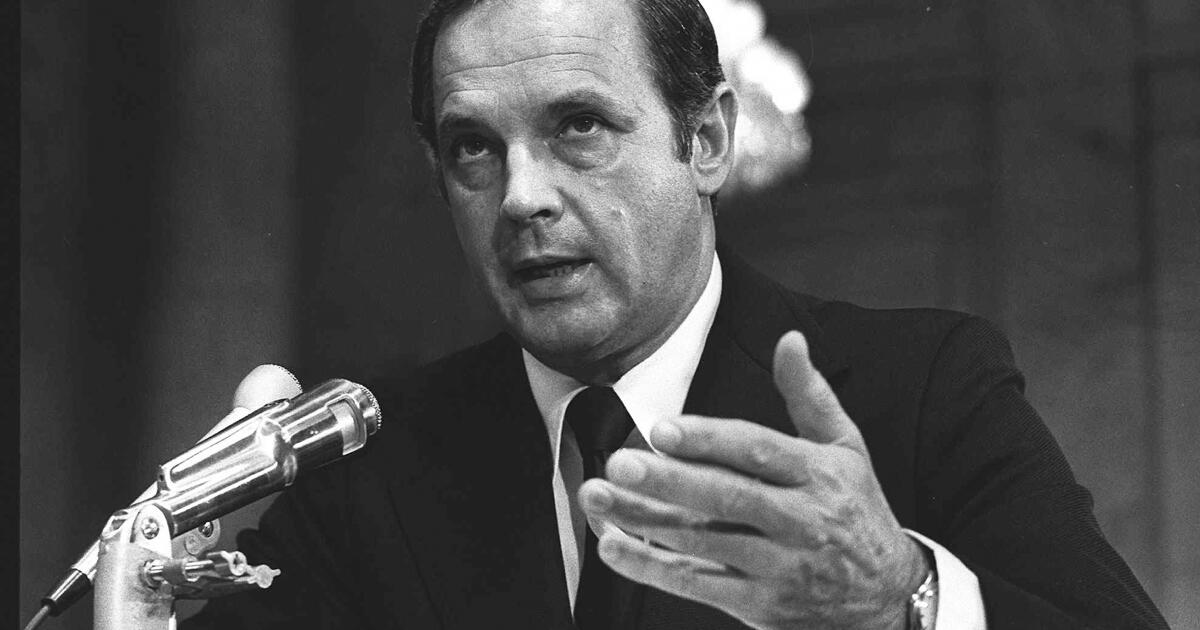
Alexander Butterfield, the Nixon aide who disclosed Watergate tapes, dies at 99

Alexander Butterfield, the White House aide who inadvertently hastened Richard Nixon’s resignation over the Watergate scandal when he revealed that the president had bugged the Oval Office and Cabinet Room and routinely recorded his conversations, has died. He was 99.

His death was confirmed to the Associated Press by his wife, Kim, and John Dean, who served as White House counsel to Nixon during the Watergate scandal and went on to, along with Butterfield, help expose the wrongdoing.

“He had the heavy responsibility of revealing something he was sworn to secrecy on, which is the installation of the Nixon taping system,” Dean said. “He stood up and told the truth.”

As a deputy assistant to the president, Butterfield oversaw the taping system connected to voice-activated listening devices that had been secretly placed in four locations, including Nixon’s office in the Executive Office Building and the presidential retreat at Camp David.

Butterfield later said that, besides himself and the president, he believed that only White House Chief of Staff H.R. Haldeman, a Haldeman assistant and a handful of Secret Service agents knew about the taping system.

“Everything was taped … as long as the president was in attendance,” Butterfield told Watergate investigators when testifying under oath during a preliminary interview.

The tapes would expose Nixon’s role in the cover-up that followed the burglary in 1972 at the Democratic Party headquarters in the Watergate building. To avoid impeachment by the House, Nixon resigned on Aug. 9, 1974, less than a month after the Supreme Court had ordered him to surrender the relevant tapes to the Watergate special prosecutor.

Butterfield believed he’d had a hand in the president’s fate. “I didn’t like to be the cause of that, but I felt that I was, in a lot of ways,” he said in a 2008 oral history for the Nixon Presidential Library and Museum.

Butterfield, a college friend of Haldeman’s at UCLA who had contacted him to ask about opportunities in the new Nixon administration, served as a deputy assistant to Nixon from 1969 to 1973. In that capacity, he worked under Haldeman and, among other duties, was secretary to the Cabinet and helped oversee White House operations.

The Air Force veteran had left the White House to become administrator of the Federal Aviation Administration when Senate committee staffers privately questioned him on July 13, 1973, during their investigation of the Watergate break-in. A routine question about the possibility of a taping system had been prompted by former White House counsel John Dean’s testimony that he believed a conversation he had had with Nixon may have been recorded.

When Butterfield acknowledged that a taping system indeed existed, he was brought before a public hearing of the Senate Select Committee on Presidential Campaign Activities. The public revelation on July 16, 1973, of a taping system designed to record all the president’s conversations stunned Nixon friends and foes alike. The tapes promised Watergate investigators a rich vein of evidence in their quest to determine what Nixon and others knew about the break-in — a great deal, as it turned out.

Efforts by investigators to gain access to the tapes sparked a yearlong legal battle that was resolved in July 1974 when the Supreme Court ruled unanimously that Nixon had to give them up.

The thousands of hours of tapes made public over the years — they are now controlled by the National Archives — provide a unique, if often unflattering, view of Nixon. His words exposed a bad temper, vulgar language, bigoted racial and religious views, and unvarnished opinions about national and international figures.

“I just thought, ‘When they hear those tapes …’ I mean, I knew what was on these tapes … they’re dynamite,” Butterfield told the Nixon Library. “I guess I didn’t foresee that the president might be put out of office or impeached, but I thought it would be a perilous few years for him. I guess I couldn’t conceive of [Nixon] being forced out of office. It had never happened before.”

Butterfield later said he believed that Nixon’s successor, President Ford, fired him as FAA administrator in 1975 as part of an agreement worked out between the Nixon and Ford staff members. He said he had heard from White House friends that he had been targeted shortly after his testimony to the Senate committee.

After leaving the FAA, Butterfield worked as a business executive in California. He earned a master’s degree from UC San Diego in 1994.

Alexander Porter Butterfield was born on April 6, 1926, in Pensacola, Fla.

He left UCLA to join the Navy and later earned a bachelor’s degree from the University of Maryland in 1956 and a master’s degree from George Washington University in 1967.

In 1948, he joined the Air Force and served as an instructor at a base near Las Vegas during the Korean War and later served in Germany. In Washington, he was a military assistant to the special assistant of the Defense secretary in 1965 and 1966 and later served as senior military representative of the U.S. and representative for the commander in chief, Pacific Forces, Australia. He retired at the rank of colonel after 20 years in the Air Force.

Butterfield was unsparing in his criticism of the former president in later years. Although he commended Nixon’s achievements in foreign affairs, he considered his former boss “not an honest man” and “a crook” and believed that Nixon knew about the Watergate break-in before it occurred and was the architect of the ensuing cover-up.

Butterfield found himself “cheering … just cheering” the day Nixon resigned, he told the Nixon Library, because “justice had prevailed.”

“I didn’t think that it would for a while,” he said. “This guy was the ringleader.”

Daniel and Tackett write for the Associated Press. Daniel, the primary writer of this obituary, retired from the Associated Press in 2023.

Source link

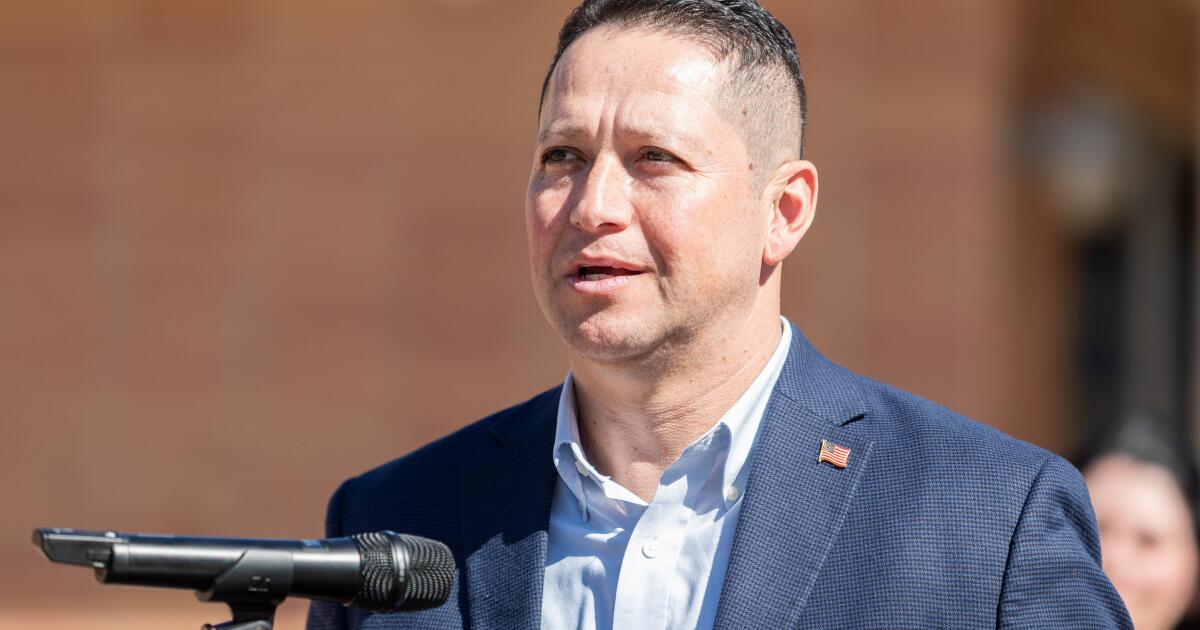
GOP Rep. Tony Gonzales of Texas ends reelection bid after admitting to affair with aide

Republican Rep. Tony Gonzales of Texas said late Thursday he was withdrawing from his reelection race, after having admitted an affair with a former staff member who later died by suicide, but he vowed to finish out his term in Congress.

He had faced calls from GOP leadership to end his reelection bid, and from others in Congress to resign.

“After deep reflection and with the support of my loving family, I have decided not to seek re-election,” Gonzales said in a statement posted late Thursday to X.

The move is the latest in a quickly changing situation that stunned Capitol Hill and resulted in a House Ethics Committee investigation into his conduct. Gonzales’ decision to bow out of the race appears to clear the field. On Tuesday, he had been forced into a May runoff against Brandon Herrera, a gun manufacturer and YouTube gun-rights influencer who narrowly lost to him in the 2024 primary.

House Speaker Mike Johnson and the GOP leadership earlier Thursday had called on Gonzales to withdraw from reelection after Gonzales, a day earlier, acknowledged a relationship that has upturned the political world in his home state and in Washington.

“We have encouraged him to address these very serious allegations directly with his constituents and his colleagues,” said Johnson, Majority Leader Steve Scalise, Whip Tom Emmer, and GOP Conference Chairwoman Lisa McClain in a statement.

“In the meantime, Leadership has asked Congressman Gonzales to withdraw from his race for reelection.”

Johnson, R-La., has been under enormous pressure from his own GOP lawmakers to take action, and several Republicans have already called for Gonzales to step aside. Rep. Anna Paulina Luna, R-Fla., has introduced two resolutions to punish Gonzales. The first seeks to remove him from his assignments on the House Appropriations and Homeland Security committees, while the second seeks to censure him.

House Democratic Leader Hakeem Jeffries of New York, meanwhile, said he would support expelling Gonzales from the House, a rare step that requires a two-thirds vote from the chamber.

GOP leaders notably did not call for Gonzales to resign from office as they struggle to maintain their slim majority in the House, which they hold by only a handful of seats.

Their move came after Gonzales, appearing on the “Joe Pags Show,” was asked whether he had a relationship with the aide, Regina Ann Santos-Aviles.

Santos-Aviles, 35, died after setting herself on fire in the backyard of her home in Uvalde, Texas. The Bexar County Medical Examiner’s Office later ruled her death a suicide.

“I made a mistake and I had a lapse in judgment, and there was a lack of faith, and I take full responsibility for those actions,” Gonzales said.

The congressman, now in his third term, had said he would not step down in response to the allegations, telling reporters recently that there will be opportunities for all the details and facts to come out.

Gonzales, a father of six, first won his seat in 2020 after retiring from a 20-year career in the Navy that included time in Iraq and Afghanistan.

In the interview broadcast Wednesday, Gonzales said he had not spoken to Santos-Aviles since June 2024. She died in September 2025.

“I had absolutely nothing to do with her tragic passing, and in fact, I was shocked just as much as everyone else,” Gonzales said.

Gonzales went on to say he had reconciled with his wife, Angel, and has asked God to forgive him. He also said he looked forward to the Ethics Committee investigation.

Johnson and GOP leadership urged that committee to “act expeditiously.”

Under House ethics rules, lawmakers may not engage in a sexual relationship with any employee of the House under their supervision.

Mascaro and Freking write for the Associated Press.

Source link