News Desk

Bulgaria’s President Rumen Radev says he will resign ahead of snap election | Elections News

Radev is widely expected to form his own political party prior to the upcoming snap vote.

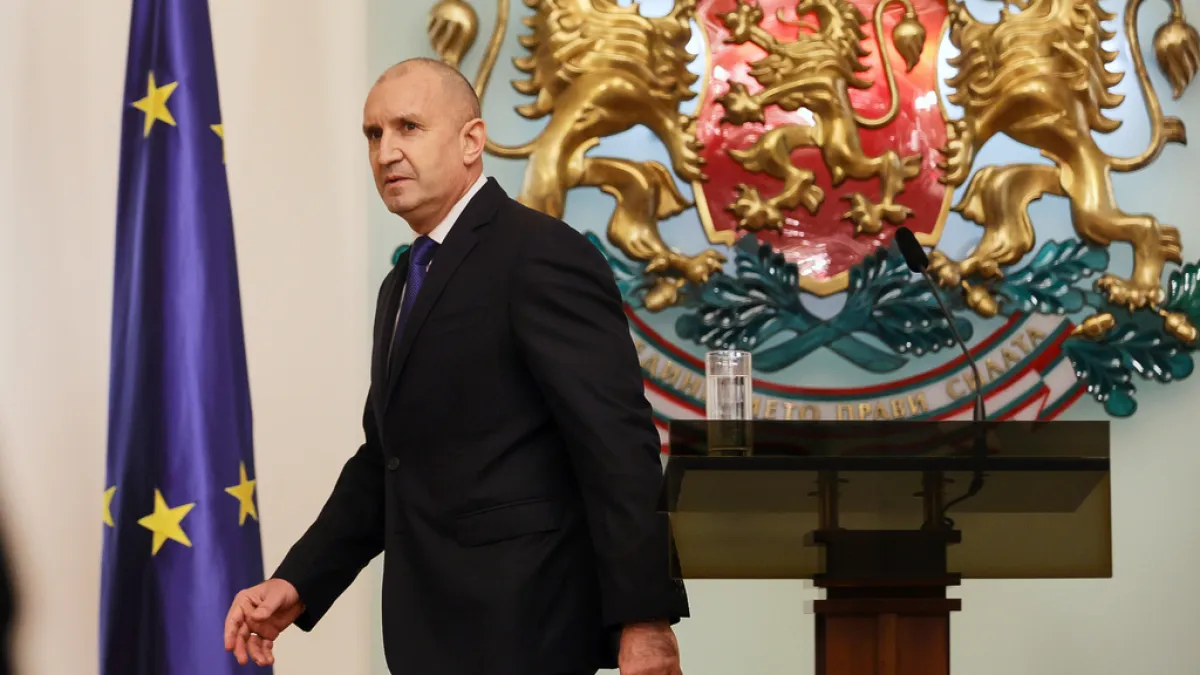
Bulgarian President Rumen Radev has said that he will resign, stoking speculation that he will form his own political party ahead of snap elections expected to take place in the months ahead.

Radev said on Monday that he would submit his resignation to the country’s Constitutional Court the following day. He will be replaced by Vice President Iliana Iotova if the court grants approval.

Recommended Stories

list of 3 itemsend of list

“Today, I am addressing you for the last time as president of Bulgaria,” the 62-year-old Radev said during a televised speech, adding that he was eager to participate in the “battle for the future” of the country.

His resignation, the first by a head of state in Bulgaria’s post-communist history, comes as the country – which is a member of the European Union and NATO – struggles to overcome a prolonged political crisis.

Bulgaria’s last government was swept out of power in December amid widespread anticorruption protests, of which the left-leaning Radev was an outspoken supporter. The upcoming snap election will mark Bulgaria’s eighth round of voting in five years.

Large anticorruption protests last month forced the resignation of the governing coalition, led by the centre-right GERB party. Attempts to form a new government within the current parliament have subsequently failed, and the country is headed towards its eighth parliamentary election since 2021.

Radev, whose second mandate ends in 2026, has repeatedly indicated that he may take part in new elections. The former Air Force general has been a vocal opponent of the leader of the GERB party, Boyko Borissov.

Radev has also opposed politician and oligarch Delyan Peevski – under sanctions from the United States and United Kingdom over alleged bribery, corruption and media manipulation – whose MRF New Beginning party has repeatedly backed the outgoing GERB-led coalition.

The former president has expressed doubt about Bulgaria’s decision to join the eurozone and is opposed to sending military aid to Ukraine, chastising European leaders for not doing enough to support the efforts of US President Donald Trump to facilitate a negotiated peace.

Radev did not mention on Monday what his plans are. Asked recently about forming a new party, he said there was a need for a party that “unites all democrats – left and right – regardless of where they belong or whether they are politically active at all, because we all need fair elections and democratic, free development”.

A recent Market Links poll found that Radev has an approval rating of 44 percent.

“His goal is to be close to the majority so that he doesn’t have to negotiate,” Parvan Simeonov from the Myara polling agency told the news agency AFP, adding that a solid result for Radev could be “a way out” of the country’s political crisis.
Source link

Green Day to open 60th Super Bowl by celebrating generations of MVPs

The NFL is marking the 60th anniversary of the Super Bowl with a hometown opening act.

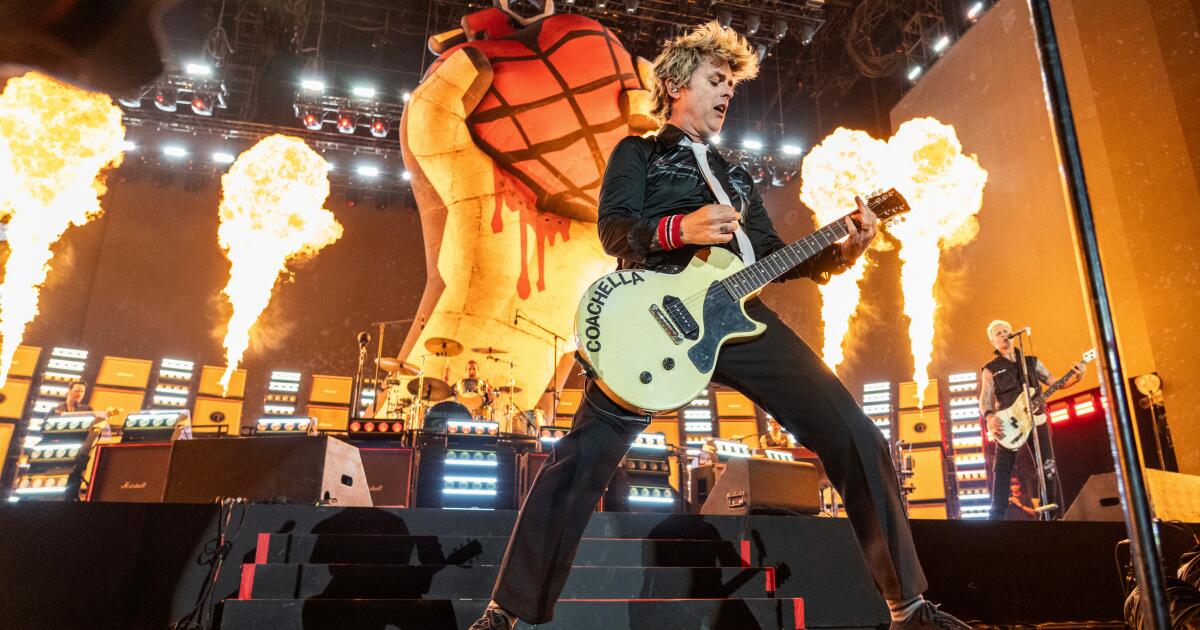
Green Day will kick off the big game with an opening ceremony Feb. 8 at Levi’s Stadium in Santa Clara, the league announced Sunday. The performance will celebrate six decades of the championship’s history, with the band helping usher generations of Super Bowl MVPs onto the field.

The trio, formed in the East Bay and made up of Billie Joe Armstrong, Mike Dirnt and Tré Cool, is expected to perform a selection of their best-known anthems as part of the tribute.

“We are super-hyped to open Super Bowl 60 right in our backyard!” lead singer Armstrong said. “We are honored to welcome the MVPs who’ve shaped the game and open the night for fans all over the world. Let’s have fun! Let’s get loud!”

The ceremony airs live at 3 p.m. Pacific on NBC, Telemundo, Peacock and Universo.

“Celebrating 60 years of Super Bowl history with Green Day as a hometown band, while honoring the NFL legends who’ve helped define this sport, is an incredibly powerful way to kick off Super Bowl LX,” said Tim Tubito, the league’s senior director of event and game presentation. “As we work alongside NBC Sports for this opening ceremony, we look forward to creating a collective celebration for fans in the stadium and around the world.”

The opening ceremony will take place ahead of the pregame entertainment, during which Charlie Puth is to perform the national anthem, Brandi Carlile will sing “America the Beautiful,” and Coco Jones will deliver “Lift Every Voice and Sing.”

Jonathan Landrum Jr. writes for the Associated Press.

Source link

A Year of Anarchy and the South and Central Asia

No sooner had 2026 begun than dramatic events in world politics followed one after another. The problem is not even the speed of these events but the difficulty of systematizing them. Forecasting is a thankless task. And the issue is not only the high probability of error. The conditions of the current transitional international system and the turbulent world make forecasting a process far from scientific. We lack the necessary tools, theory, and sufficient input information. It is very difficult to predict which events will be of central importance, which regions will be at the center of world attention, and where conflicts will begin and end.

Despite the enormous attention focused on the conflict in Ukraine and the events surrounding Iran, Palestine, and Venezuela, it can be assumed that the center of Eurasia will be one of the key regions in terms of conflict potential and world politics. Important political processes and, possibly, various actions should be expected due to the high conflict potential between India and Pakistan and the increased tensions between the United States and Taliban-controlled Afghanistan.

Anarchical Year? The brilliant Oxford University professor Hedley Bull published his book “The Anarchical Society” in 1977, arguing that “international society is a society without government, and in this respect it resembles primitive or archaic societies.”

One can expect an obvious archaization of international life. Classical realists, theorists of international relations, have led us to believe that the world is in a state of eternal and unchanging anarchy. Unlike domestic relations, there is no policeman in the world of global politics. The monopoly on force belongs to the state, but only within the borders of that state. This restrains members of society from using force for their own interests. In relations between countries, there is no such policeman. Liberal theorists believed that anarchy is a negative thing and should be combated through collective methods, especially through the use of various international organizations. They believed it was possible to create an international system in which a global policeman could emerge.

But what is to be done when a potential contender for the role of world policeman does not want such a fate, and the others do not possess sufficient resources and capabilities? What is to be done when the world has become so complex and the number of ambitious, influential powers has become so high that there is no single powerful force capable of restraining everyone? And what if the great military powers themselves have concluded that expanding the field of anarchy is beneficial to them?

Symbolically, in the prestigious Anglosphere journal International Organization, Alexander Wendt suggested that the level of anarchy will be determined by the great powers themselves. That is, he refuted the liberal view that anarchy is something that has a beginning and an end: “Anarchy is what the great powers make of it.”

It can be assumed that 2026 will be a year of expanding anarchy. Trumpist America will be the leading political actor whose actions will expand the field of anarchy and, in parallel, break down what remains (and much remains) of the current international system. Powers will be self-serving. The very concept of alliances will be rethought. Militarization processes will be widespread. Everyone who can afford it will arm themselves. The increase in the sphere of anarchy will lead to an expansion of conflict potential. There will be many conflicts. Military potential will determine the balance of power in international life. The technological race will reach a new level, blurring the line between the military and civilian spheres. Apparently, diplomatic agreements will remain overshadowed by military capabilities. It can be assumed that 2026 will break records for spending on armaments.

South and Central Asia

As I have already said, the Central and South Asian region will remain in the focus of world media attention. The conflict potential between the leading players in the political and economic life of the region is too high.

The US National Security Strategy, published at the end of 2025, pays extremely limited attention to the South and Central Asian regions. The document, developed during Donald Trump’s second presidential term, represents, in many ways, an atypical and, to a certain extent, innovative approach to strategic planning. It is noteworthy that Afghanistan is not mentioned at all in Trump’s strategy, and Pakistan is mentioned only once, exclusively in the context of the Indo-Pakistani settlement. Nevertheless, this arrangement of priorities is difficult to interpret as evidence of Washington’s withdrawal from an active role in the region.

Donald Trump, in turn, quite clearly and unambiguously outlined the priority interest of the United States—the Bagram airbase. In September 2025, Trump stated that if Afghanistan refused to return the Bagram airbase, the United States, which built it, would face “bad consequences.” A legitimate question arises: why does this facility remain so important to the US? Bagram has exceptional strategic and symbolic significance. According to Afghan legends, it was founded by Alexander the Great and is located near the Afghan-Chinese border, essentially in the geographical center of Eurasia. Trump himself emphasized that one of the key reasons for interest in the base is its proximity to facilities connected with China.

Another potential conflict is linked to the “eternal” military, political, and economic confrontation between two hostile countries—India and Pakistan. In May 2025, a real war broke out between Delhi and Islamabad, lasting several days. Indian artillery and air force struck military targets in Pakistan on May 7. The operation, codenamed “Sindhur,” was allegedly aimed at the “terrorist infrastructure” of pro-Pakistani terrorist groups that have certain ties to some military circles. Pakistan, in turn, denied all these accusations and launched a military operation in response to India’s actions.

The reason for the conflict was a horrific terrorist attack in the Indian part of the disputed territory of Kashmir on April 22. Islamists from a Pakistani terrorist organization opened fire on tourists in Pahalgam, killing several dozen people. Indian authorities claimed Pakistan’s involvement in the attack. Donald Trump stated that he was the one who managed to stop the conflict between the two warring countries. Furthermore, many observers and analysts believe that a significant recalibration of U.S. strategy in South Asia is signaling a deliberate warming of relations with Pakistan after years of prioritizing ties with India.

Thus, 2026 is unlikely to be a year of universal peace, cooperation, and prosperity. Unfortunately, we may face a very tense year with a number of complex conflicts.

Source link

Julia Bullock’s ‘From Ordinary Things’ is anything but ordinary

The art of the so-called art song is a thriving business. Singers galore are monthly recording songs from the rich 19th century classical repertory, while composers are busy making new ones. But what was once known as the Lieder recital — the German title for songs in a genre once dominated by Schubert, Schumann, Hugo Wolf and Richard Strauss — has approached its sell-by date.

The smart shopper will already note signs of staleness and mold in the old practice of a singer in stiff white tie and tails or gaudy gown, standing, arm propped on piano, of the second banana accompanist. Attention here was meant to be drawn not to the singer but the marvels of song, as you followed the text in your program book. The recital acted like a religious experience in which a rarefied atmosphere befits radiance.

A new generation of singers, however, has been strikingly upending the song recital, turning to songs from a wide variety of sources old, new and genre fluid. Singers think thematically and theatrically. Pianists become welcoming creative partners. Other musicians, stage directors, choreographers and dancers may be invited in.

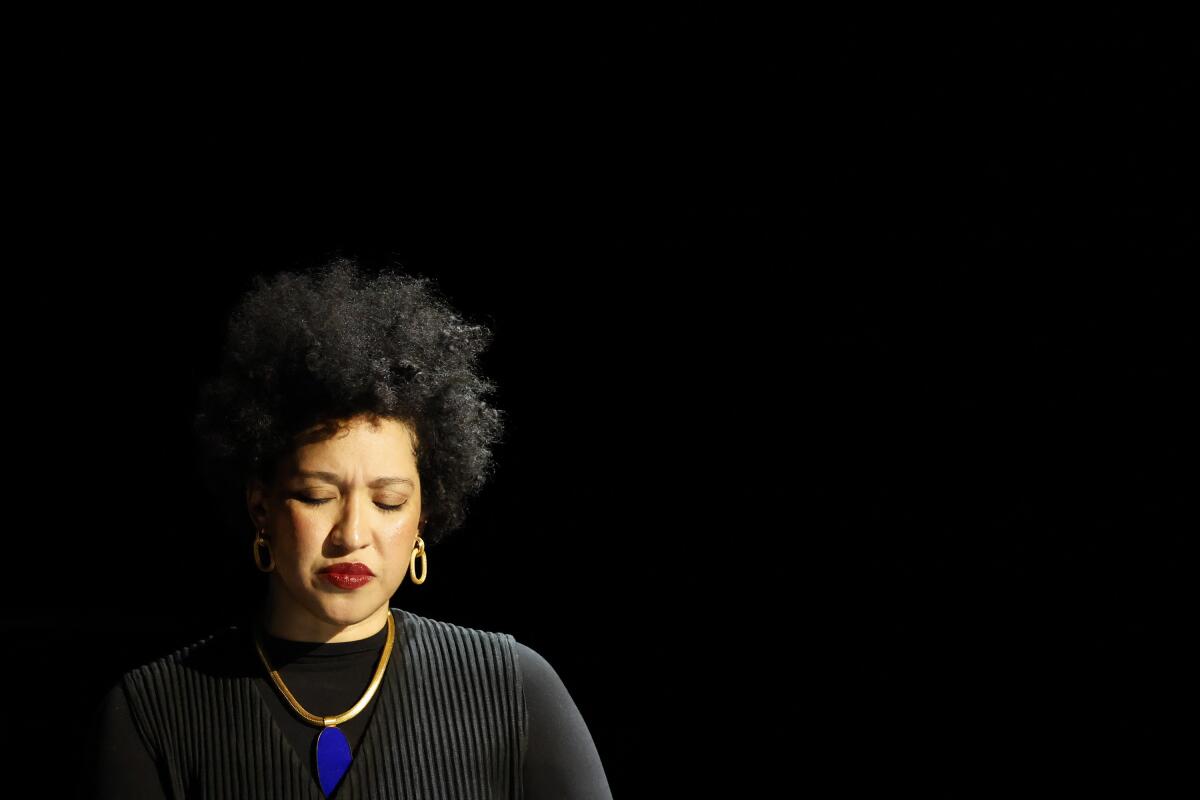
“From Ordinary Things,” which had its premiere as part of CAP UCLA’s series at the Nimoy Theater on Thursday night, is the latest project of one of the least ordinary and most compelling singers of this new generation, Julia Bullock. A rivetingly theatrical soprano, Bullock, in collaboration with percussionist/composer Tyshawn Sorey and director Peter Sellars, has developed a full-scale operatic evening, “Perle Noir: Meditations for Joséphine,” about the chanteuse Josephine Baker and slated next for Australia’s Adelaide Festival in March. Another project has been Bullock’s riveting staging, with dance, of Olivier Messiaen’s mystical, Amazonian, sex-love-death song cycle, “Harawi,” which came to the Wallis in October 2024.

Conor Hanick, a partner of Bullock’s in the experimental collective American Modern Opera Company (AMOC), was the pianist for “Harawi” and is again for “From Ordinary Things.” They are further joined by the equally versatile cellist, Seth Parker Woods. The title comes from the last line of “Shelter,” a song by André Previn with a text by Toni Morrison. “In this soft place/Under your wings/I will find shelter/From ordinary things.”

That leaves us Bullock with extraordinary things, and her program is surprising in all things. She begins in shock, singing unaccompanied, on a dark stage in a darkened hall, performers illuminated by powerful spotlights.

 Julia Bullock in a black top with a gold and blue necklace in front of a black background

Julia Bullock performs at the UCLA Nimoy Theater on Thursday in Los Angeles.

(Carlin Stiehl/For The Times)

Stark, discomforting amplification diminishes intimacy and the luxurious richness of Bullock’s soprano, which easily fills a room on its own, suggests quiet terror, the lonely state of Nina Simone’s “Images.” The unaccompanied solo about a woman who “thinks her body has no glory” gets it from Bullock. That progresses without a break into the first song, “Nahandove,” from Ravel’s “Songs of Madagascar,” with piano and cello but not the flute in Ravel’s original setting. Here beauty is celebrated with voluptuous rapture, setting the mood for “Oh, Yemanja,” a mythic, watery mother’s prayer from Tania León’s opera “Scourge of Hyacinths.”

A highlight was to have been a pair of songs by León, with texts by Kevin Young, written for the recital, but they were apparently not yet ready. A line from one of them is “All light wrong?” With the program and song texts only available to download on the cellphone, the audience was left in the dark without texts and, with amplification obscuring diction, not knowing what’s what.

Another Young line — “are my chief complaints” — suited the blowsy loudspeakers that messed up balances, which extended to a performance of George Walker’s rarely heard Sonata for Cello, that ends the first half, for no apparent reason other than it gives the spotlight to the instrumentalists and it is a score that begs to be heard.

Parker has been a glowing advocate of the early work, written in 1957, by the late composer whose music is only in the past few years beginning to find its way to the public thanks to the efforts of reviving neglected Black composers. The sonata does not have the vibrant complexity of Walker’s commanding later works, but it is tight, strong, accessible and with an inspired slow movement that it would be hard to get enough of.

 Cellist Seth Parker Woods and pianist Conor Hanick perform on a darkened stage

Cellist Seth Parker Woods and pianist Conor Hanick at the UCLA Nimoy Theater on Thursday in Los Angeles.

(Carlin Stiehl/For The Times)

The strange second half brought fewer complaints. An intermission bought time to familiarize oneself with text squeezed onto the cellphone screen. Amplification proved less objectionable. Bullock announced that while putting the program together she had come across songs by Robert Owens, a little-known American composer who lived in Munich, Germany, and died in 2017 and who wrote songs in the style of Richard Strauss to texts by the 19th century poet Joseph von Eichendorff. If not a find, a curiosity.

From there to the avant-garde. “Ultimate Rose” from Salvatore Sciarrino’s 1981 opera, “Vanitas,” turns early music, along with vocal and cello production, marvelously inside out. More Nina Simone, the harsh “Four Women,” then Previn. Along with “Shelter,” Bullock sang a song he wrote with Dory Previn (“It’s Good to Have You Near Again”) and arrangements he made of standards (The Gershwins’ “Love Walked In” and Rogers’ and Hart’s “Nobody’s Heart Belongs to Me”) for his album with Leontyne Price. The encore was Massenet’s “Elégie.”

Each song seems to exist for reasons of its own. Each song creates a different dynamic among the three performers. You listen, left in the dark, wondering but also in wonder, as Bullock asks you a question why each song mattered as much as it did.

You go home and read the texts and find there are no ordinary things.

Source link