Feb. 19 (UPI) — More than 550 commercial driver’s license schools were cited for safety violations, including employing unqualified teachers, using improper vehicles, failing to properly test students, among other violations, according to the Trump administration, which said the “sham” institutions received notice they would be removed from the federal government’s National Training Provider Registry.
The Department of Transportation said Wednesday that more than 300 investigators conducted 1,426 on-site inspections of driver training schools across the country in a five-day sting operation. The Commercial Vehicle Training Association said the inspections took place during the week of Dec. 8.
The DOT said more than 550 schools were found in violation of the Federal Motor Carrier Safety Administration’s safety standards. Of those, 109 training providers agreed to voluntarily remove themselves from the registry, while an additional 97 schools remain under investigation.
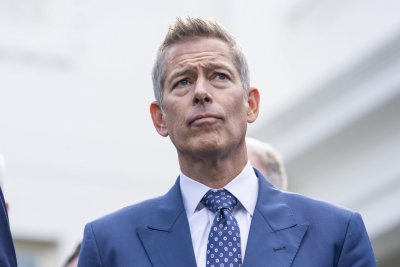
“For too long, the trucking industry has operated like the Wild, Wild, West, where anything goes and nobody asks any questions. The buck stops with me,” Transportation Secretary Sean Duffy said in a statement.
“American families should have confidence that our school bus and truck drivers are following every letter of the law and that starts with receiving proper training before getting behind the wheel.”
The department said some of the schools lacked qualified instructors, used fake addresses or failed to properly train drivers in the transportation of hazardous materials. One school provided training for school bus drivers, the department said.
Following the inspections, CVTA, the largest association of commercial truck driver training programs, said in a statement that it welcomed the initiative, saying it strengthened “the integrity of commercial driver education and reaffirmed the critical role high-quality training plays in protecting the motoring public.”
The routine of gently but skillfully pushing wooden canoes into the water body at the shores of Kainji Lake each dawn has been part of the lives of generations of fishermen in North-central Nigeria.
The lake was not always calm – vigorously exhaling and flooding the banks, then intermittently receding – but was inevitably connected to the lives that many communities have held firmly to across Kebbi, Niger, and Kwara states.
Today, that ancestral connection between the communities and the lake is evaporating rapidly. And it is not merely ecological. In some villages where government presence is absent, and terrorists have assumed authority, fishermen now wait for permission from non-state actors before casting their nets. In other areas within the Kainji region, they pay informal levies to armed groups operating from the forests. For decades, Nigeria’s national parks were imagined as spaces apart: buffers of nature against human pressure and political failure. Sambisa Forest shattered that illusion long ago when the Boko Haram terror group took control of it, transforming from a conservation zone into the most notorious symbol of jihadist insurgency in the country. Now, further west, a quieter but no less consequential transformation is unfolding.
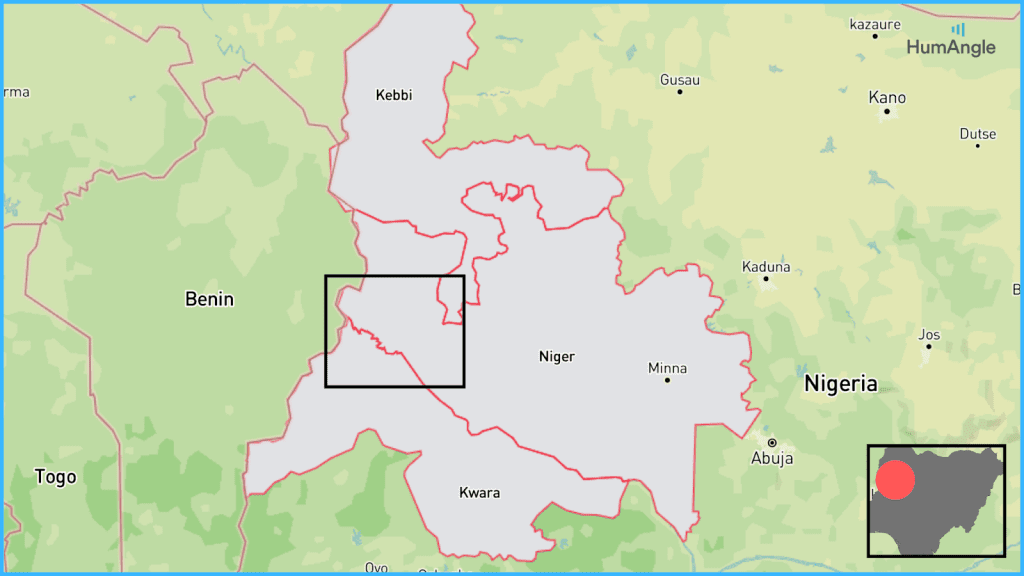
The Kainji Lake National Park (KLNP), sprawling across three states and bordering Benin, has slipped from a wildlife sanctuary into a strategic corridor where poverty, climate stress, criminal enterprises, violence, jihadist ideology, and Sahelian militancy intersect.
Kainji Lake National Park spans three states in Nigeria’s northern region and borders two countries. Map illustration: Mansir Muhammed/HumAngle.
A corridor
Security analysts increasingly describe Sambisa as a “fortress-base” model of insurgency: entrenched, ideological, territorially assertive. Kainji Lake fits a different and more elusive pattern—a “corridor-node” model.
Here, armed actors do not raise flags or announce governance structures. They pass through, networking, training, recruiting, and trading, before vanishing. The park links Nigeria’s troubled North West to the Middle Belt and, increasingly, to the destabilised Sahel. It connects Kebbi to Benin Republic’s Alibori and Atacora regions, Niger State to Niger Republic’s Tillabéri zone, and local grievances to transnational jihadist ambitions.
This distinction matters. Sambisa attracted relentless military pressure for more than a decade because it became a visible symbol of territorial breach. Kainji Lake did not. It appeared peripheral, quiet, manageable. In that absence of sustained attention, the park matured into something arguably more dangerous: a fluid connector for multiple armed actors rather than a single-group stronghold.
Communities along the lake, from Yauri and Ngaski in Kebbi to Borgu in Niger State and Kaiama in Kwara, depend on a fragile interweaving of fishing, floodplain farming, pastoralism, and cross-border trade. Fishing sustains thousands of households. Smoked and dried fish move through informal networks to Ilorin, Ibadan, southern Niger, and beyond. Seasonal farming follows the lake’s unpredictable pulse: millet, sorghum, maize, rice, and cowpea are cultivated on land that appears and disappears with the water’s rise and fall.
Fishing sustains thousands of households. Map illustration: Mansir Muhammed/HumAngle
Pastoralism runs through it all. Herders move cattle along routes that long predate colonial borders, grazing across Nigeria, Benin Republic, and Niger Republic as if the lines on maps were suggestions rather than laws. Weekly markets in Bagudo, Wawa, Babana, Kaiama, and Borgu draw traders from Benin’s north and Niger’s Tillabéri. Grain, livestock, fuel, kola nuts, dried fish, and cloth circulate through these hubs. Some of it is smuggling.
These networks matter because armed groups do not need to invent new pathways. They insert themselves into existing ones. The same tracks used by herders and traders now carry militants, arms couriers, recruiters, and ideological emissaries.
Climate stress as an accelerant
Climate change has exacerbated existing security vulnerabilities around Kainji Lake.
Erratic rainfall patterns and fluctuating water levels have made fishing yields unpredictable. Floodplains that once reliably supported seasonal farming now vanish early or arrive late. Pasture availability shifts without warning, intensifying competition between herders and farmers. Each shock further compresses livelihoods, forcing households to adapt through debt, migration, or risk-taking.
In this environment, armed groups offer something deceptively valuable: predictability. Access to grazing land. Protection from rivals. Permission to fish or farm. Even informal dispute resolution. Where the state provides uncertainty – sporadic enforcement, unclear rules, delayed response – armed actors provide immediate answers, enforced by violence if necessary.
Climate stress, in this sense, is not just an environmental issue but a governance crisis multiplier.
Fieldwork conducted by HumAngle across several local government areas in Kebbi, Niger, and Kwara states identified at least five active extremist factions operating within and around the park. These include the Mahmudawa (Mahmuda faction), Lakurawa, elements of Ansaru and Jama’atu Ahlis Sunna Lidda’awati wal-Jihad (JAS) led by Sadiku and Umar Taraba, and a newly emerged cell linked to Jama’at Nusrat al-Islam wal-Muslimin.
The groups do not operate in isolation. Many originate from northwest Nigeria and southern Niger, with local cover, as they undertake terror attacks in distant locations and return to their various hideouts within the region. What has emerged is a hybrid threat ecosystem where ideology, criminality, climate stress, and grievance reinforce one another.
Brokers, enforcers, and ideologues
The Mahmudawa illustrate the new logic of this ecosystem. Despite sustained air and ground operations by the Federal Government between September and December 2025, the group remains influential. Fragmented into smaller camps, some closer to the Benin border, they act as brokers linking criminal networks of jihadist actors. They facilitate training, arms movement, ransom negotiations and sanctuary for fighters arriving from outside the region.
Official claims regarding the arrest of their leader, Malam Mahmuda, remain unconfirmed in border communities, where continued attacks and coordinated leadership are still attributed to the group.
If the Mahmudawa are brokers, the Lakurawa are enforcers. With an estimated 300 fighters, they have become one of the most active jihadist–terrorist hybrids affecting Kebbi’s border communities. Operating from within and around KLNP, they routinely launch incursions into Bagudo and Suru LGAs, combining attacks on military targets with ideological messaging aimed at delegitimising the Nigerian state.
Their leadership shows signs of Sahelian exposure. Their fighters are drawn from local nomadic tribal networks and northwest terrorist pools. Kebbi, long considered peripheral, is now firmly part of the frontline.
Get our in-depth, creative coverage of conflict and development delivered to you every weekend.
Subscribe now to our newsletter!
The relocation of Sadiku and Umar Taraba, both veteran jihadist operatives, to the Kainji axis in 2024 marked a shift. Their presence injected technical expertise into a space previously dominated by loosely organised armed groups.
IED knowledge, structured training, and a sharper focus on high-value targets followed. Collaboration with criminal terrorist groups deepened. The abduction of foreign nationals near Bode Sa’adu illustrated this fusion starkly: JAS elements, Mahmudawa fighters, and allied terrorists executing a single operation where ideology and profit were indistinguishable.
JNIM’s shadow on the lake
The most alarming development emerged in late November 2025: the appearance of a group believed to be affiliated with JNIM along the Kebbi–Benin border corridor.
Witnesses describe predominantly foreign fighters, many believed to be Tuareg, moving at night in disciplined formations, wearing military-style uniforms with turbans on their heads, and engaging communities with a calculated restraint unfamiliar to local armed groups. So far, they have avoided major attacks.
That restraint is likely strategic.
Their presence suggests Kainji Lake could become a staging ground for Sahelian expansion into northwestern Nigeria — a shift that would fundamentally alter the region’s security calculus. Unlike local groups, JNIM brings external financing, battlefield experience, and a long-term vision.
Communities adapting under pressure
Communities in the lake basin are not passive observers. They are recalibrating in real time. Some negotiate access quietly to avoid displacement. Others maintain layered loyalties, sharing information selectively as a survival strategy. Vigilante groups that once patrolled forest edges retreat under sustained pressure. Traditional rulers face coercion or marginalisation. In certain settlements, schools and community buildings are repurposed by armed actors for operational use.
Access to fishing grounds, farmlands, and trade routes increasingly depends on permissions issued by commanders operating from forest camps rather than on decisions by local councils or chiefs. Authority has shifted, not through formal declaration, but through incremental control of movement and livelihoods.
How conservation and governance hollowed the ground
The transformation of Kainji Lake into a security corridor is as much the product of ideology as it is the cumulative outcome of governance failure layered over decades.
The creation of Kainji Lake National Park in 1976 displaced communities and restricted access to land and water without meaningfully integrating residents into conservation planning. Fishing zones were closed, grazing was curtailed, and farming was criminalised in places where alternatives did not exist. Promised livelihoods rarely materialised.
Park rangers – tasked with enforcing vast conservation boundaries – were underpaid, poorly equipped, and often absent. Their presence, when felt, was frequently punitive rather than protective.
Local governments in Bagudo, Suru, Kaiama, Borgu, and Ngaski remain chronically weak.
When armed violence escalated across the northwestern region, security deployments focused on Zamfara, Katsina, and parts of Niger State. Kebbi’s borderlands were treated as peripheral, stable, and low-risk. That assumption proved costly.
Border governance failed as well. Coordination with Benin and the Niger Republics remains distant, reactive, and politicised. Joint patrols are rare. Intelligence sharing is uneven. Communities know this. Armed actors understand it better.
Armed groups arrived first as guests, then as protectors, and finally as power brokers, filling gaps the state created—sometimes violently, sometimes persuasively.
Poverty caused by the absence of authority
In the absence of legitmate sate authority, people seek alternative systems of order. Armed groups exploit this vacuum expertly. They tax, regulate, punish, and reward. In some communities, the question is no longer whether armed groups are legitimate, but whether they are avoidable. Increasingly, they are not.
The Kainji axis experienced seven major attacks between 2025 and Feb. 2026: The Nov. 2025 abduction of 303–315 students from St. Mary’s School in Papiri (Niger State); the market raid in Kasuwan Daji that claimed the lives of about 30-42 people on Jan. 3, 2026; the Jan. 23 park ambush killing six; the Feb. 1 raids in Agwara and Mashegu (dynamiting a police station and church), and the Feb. 4 massacre in Kaiama. Map illustration: Mansir Muhammed/HumAngle.
Once a symbol of Nigeria’s conservation ambition, KLNP has become a largely ungoverned hub exploited by a mix of violent actors: jihadist cells, armed terrorist factions, and transnational militants with roots beyond Nigeria’s borders.
From the northwest’s perspective – particularly Kebbi State – the park functions as a rear operational hub. Armed groups operating in border local governments use it for recruitment, logistics, training, and cross-border movement into the Benin Republic. Its sheer size, rugged terrain, and weak oversight enable a dangerous convergence: criminal armed groups blending with jihadism.
This shift carries national implications
Kainji’s forests and waterways provide mobility, with the lake economy providing revenue streams and border proximity offering escape and reinforcement routes.
While Sambisa became synonymous with territorial insurgency, Kainji signals the maturation of a corridor-based conflict economythat binds Nigeria’s northwest to wider Sahelian instability through forest reserves and lake communities.
When conservation spaces double as conflict connectors, the impact extends beyond biodiversity loss. Human buffers weaken first as communities negotiate survival under parallel authorities. Ecological buffers follow as enforcement fractures and resource exploitation become embedded in armed group financing.
Communities adapt under the rule of local armed terror groups in the absence of state and local government authorities. Density map of settlements in the Kainji axis where terrorists control.
The lake basin lies close to Kainji dam, a critical energy infrastructure, touches sensitive international borders, and anchors trade and livelihood systems that extend deep into the country’s interior.
In 2026, the geographic corridor surrounding the lake and its forest reserves recorded some of the highest levels of mass killings and large-scale abductions in Nigeria. Armed groups operate with increasing confidence, widening their reach across rural settlements and mobility routes connecting Niger State to Kebbi, Zamfara, and beyond toward the Sahelian belt.
The warning signs are not limited to a single park
In April 2025, the Conservator-General of Nigeria’s National Park Service, Ibrahim Musa Goni, told HumAngle that six national parks across the country were overrun by terrorists. Two years earlier, the federal government had created 10 additional parks to prevent further takeovers. However, only four of those new parks are currently operational. In addition to the seven existing parks, only eleven national parks are currently functioning nationwide.
Even where reclamation has occurred, the process is complex. The Conservator General pointed to Kaduna State as an example, describing what he termed a “mutual understanding” between authorities and armed groups.
“They have agreed to resolve their issues,” he said. “[As a result], most of the forest and game reserves, and even the national park in Kaduna State, have today been freed of banditry.” This, he argued, has brought “relative peace” and enabled forest and game guards, including officers in Birnin Gwari, to resume operations.
The National Park Service has also redefined its institutional posture. “The government classified the National Park Service as a paramilitary organisation,” Goni explained. “And as a paramilitary organisation, the act provides that we can bear arms.” Rangers affiliated with the Service have received training from the United Nations Office on Drugs and Crime to address wildlife crime and respond to terror-related takeovers. According to Goni, this training has strengthened Nigeria’s capacity to confront forest-based criminality linked to armed groups and insurgents.
The approach is not solely security-driven. The Service engages surrounding communities through alternative livelihood programmes, skills training, and starter packs intended to reduce dependence on park resources. “This has, in a great deal, diverted the attention of most of them from the resources of the national parks,” Goni said, adding that it has helped contain hunting and wildlife trafficking.
Yet resource limitations remain significant. “Apart from managing wild animal resources and the plants, we also have to manage the human population,” he acknowledged, noting that the Service cannot meet the needs of every community bordering the parks.
A YOUNG rapper signed has died days after releasing a new single, at just 25 years old.
Janarious Mykel Wheeler, known by fans as Lil Poppa, died at 11:23am on Wednesday, according to the medical examiner.
Sign up for the Showbiz newsletter
Thank you!
Lil Poppa began releasing music in 2017, when he was just a teenagerCredit: TikTok / lilpoppaHe had more than 600,000 monthly listeners on SpotifyCredit: Getty
According to his Spotify profile Poppa began releasing music in 2017, when he was just a teenager.
When rumours of his death first circulated, fans flooded his social media begging for answers, however the young rapper’s cause of death is currently unknown.
At the time of his death Lil Poppa had more than 600,000 monthly listeners on Spotify and over 960 thousand followers on Instagram.
In a now-tragic final post shared on his Instagram story Tuesday night, Poppa appeared to be riding in a car as he listened to Letting it go by Rod Wave.
Lil Poppa, was born in Jacksonville, Florida, where he first started rapping at church with a group of friends and his older brother.
And at just 12 years old Poppa built a makeshift studio in the closet of his bedroom and started recording his music using just a laptop and a Radio Shack mic.
His big break came in 2018, when his independently released single Purple Hearts hit 2.3 million views on YouTube.
Since then he has released several albums with his label Collective Music Group, which has signed other industry heavyweights like GloRilla.
What was Lil Poppa’s cause of death?
The Fulton County Medical Examiner in Atlanta,Georgia, announced the tragedy, but didn’t give a cause of death,TMZreported.
According the a medical examiner, the young rapper’s time of death was 11.23am, but his cause of death is currently unknown.
Fans began expressing their concerns about rumours of his death online when the news first started spreading.
A distraught fan wrote: “poppa please say something this can’t be happening.”
What song made Lil Poppa famous?
Lil Poppa wrote songs about relationships, mental health, and love.
The artist was best known for his tracks including “Love & War,” “Mind Over Matter,” and “HAPPY TEARS”.
Just days before his death Poppa released a new single called “Out of Town Bae”.
“And I can’t change how I’m living, I ain’t got no feelings, I pour drank in my kidney, And it’s only for the healing” he sings in his most played song on Spotify, “Eternal Living”.
Lil Poppa wrote songs about relationships, mental health, and loveCredit: GettyJust days before his death Poppa released a new singleCredit: TikTok / lilpoppa
Feb. 19 (UPI) — Several victims of an avalanche that hit Northern California’s backcountry on Tuesday were connected to a private school for competitive skiers, the institution said.
Officials with Sugar Bowl Academy in Norden, Calif., confirmed Wednesday that multiple victims were either members or had strong connections with the school. They said they would not release the names of the victims and survivors.
“We are an incredibly close and connected community. This tragedy has affected each and every one of us,” Stephen McMahon, executive director of Sugar Bowl Academy, said in a statement.
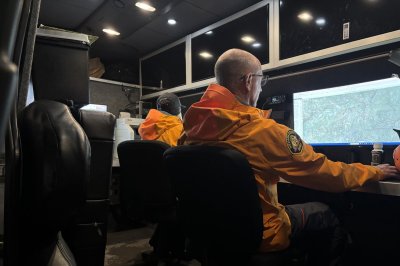
A group of 15 skiers, including four guides, set off Sunday for a three-day backcountry trip, and were returning amid dangerous conditions Tuesday when they were hit by an avalanche near Castle Peak in California’s mountainous Nevada County at about 11:30 a.m. PST.
Six members of the party became stranded, taking refuge in makeshift shelters. The remaining nine were unaccounted for.
Search teams were deployed, and the six surviving members — one guide and five clients — were rescued late Tuesday, according to authorities, who said the search for those missing would continue.
Authorities earlier Wednesday announced that eight of the unaccounted for had been confirmed dead and one was still missing. The deceased included three professional guides with Blackbird Mountain Guides, and one person was the spouse of a member of a deployed rescue team.
Of the six survivors, three were injured, including two who were unable to walk, authorities added.
The party consisted of nine men and six women whose ages ranged from 30 to 55.
Zeb Blais, founder of Blackbird Mountain Guides, which had organized the expedition, said all guides with the group were trained or certified in backcountry skiing and each was an instructor with the American Institute for Avalanche Research and Education.
“There’s still a lot that we’re learning about what happened,” Blais said in a statement. “It’s too soon to draw conclusions, but investigations are underway.”
Blackbird Mountain Guides has suspended field operations through Sunday at a minimum, according to Blais.
“Our most important focus is on those directly impacted and supporting their needs,” Blais said.
“We ask that people following this tragedy refrain from speculating. We don’t have all the answers yet, and it may be some time before we do. In the meantime, please keep those impacted in your hearts.”
Venezuelan popular power organizations have developed creative solutions to advance food sovereignty while under the US blockade. (FAO)
Natalia Burdynska Schuurman defended her MsC thesis at the University of Edinburgh on Venezuela’s struggle for food security and food sovereignty amid wide-reaching US-led unilateral sanctions.
See below for the abstract, research questions, and the full text.
Abstract
As global development actors grapple with mounting pressures to feed the world population, growing enforcement of unilateral coercive measures jeopardizes efforts to advance Sustainable Development Goal 2 (SDG-2, “Zero Hunger”). This dissertation examines efforts to achieve food security in Venezuela, a state currently targeted by over 1,000 unilateral coercive measures, since its incorporation as a constitutional right in 1999 and how such processes have been shaped by economic sanctions targeting its oil industry introduced by the United States in 2015. It employs a literature review, secondary data analysis and archival research, adopting a political economy and world systems lens as well as a historical, relational and interactive approach to food sovereignty research, centering the perspectives and experiences of Venezuelan communities. This dissertation argues that unilateral sanctions targeting Venezuela’s oil industry triggered the collapse of a political economy of food security structurally dependent on Venezuela’s macroeconomic stability within a dollarized international trade and financial system, catalyzing efforts to rebuild Venezuela’s food and agricultural system that transformed the landscape of national food sovereignty construction. It is hoped that this dissertation yields new insights into challenges and prospects facing national efforts to construct food sovereignty and global efforts to achieve food security today.
[…]
Research questions
This dissertation answers the primary question: How have unilateral sanctions targeting Venezuela’s oil industry shaped efforts to achieve food security in Venezuela?
It addresses the following contributory questions: What was the state of affairs characterizing Venezuela’s food and agricultural system prior to 2015? What advances and setbacks have been identified concerning the national goal to achieve food security, as enshrined in Venezuela’s Constitution of 1999? How have financial and trade sanctions targeting Venezuela’s oil industry introduced by the United States in 2015 correlated with macroeconomic and food security trends in Venezuela? How have financial and trade sanctions targeting Venezuela’s oil industry impacted food production, distribution and access in Venezuela? How have state and societal actors engaged in efforts to achieve food security in Venezuela responded to these consequences?
People are raving on about the drama series which is believed to be a ‘hidden gem’ and it’s available on a number of TV networks, including Disney+. So have you seen this before?
Christine Younan Deputy Editor Social Newsdesk
06:06, 19 Feb 2026
You can view this series on Disney+(Image: Kim Simms/ABC)
Looking for the next big TV series to binge-watch? It can be hard finding a new show to watch, especially if you’ve just finished something decent on Netflix or Amazon Prime.
Now people are raving on about a ‘hidden gem’ they found – and it’s available on a number of TV networks, including Disney+. After one TV fan asked for recommendations in a popular thread, many people flooded the comments section where they offered a number of suggestions, one of them being Will Trent, a American police TV drama. The series follows a Special Agent of the Georgia Bureau of Investigations.
As a child, Trent was abandoned and forced to endure a harsh coming-of-age in Atlanta’s overwhelmed foster care system. It was based on one of prolific New York Times author Karin Slaughter’s bestselling books.
The Reddit post read: “Any current network (CBS, ABC, NBC, etc.) TV shows that are any good? Most of the shows I currently watch are on streaming services and I’m wondering if there’s any hidden gems I’m missing out on.”
Many people shared their suggestions, including High Potential and The Rookie.
But plenty of viewers labelled Will Trent as a must-see. The series, which is also available on other network channels, can be streamed on Disney+ for subscribers.
The series was developed by Liz Heldens and Daniel T. Thomsen which stars Ramón Rodríguez and premiered on January 3, 2023, on ABC.
A year later in April, the series was renewed for a third season which landed on January 7, 2025. Then months later, the series was given the green light for a fourth season which finally premiered on January 6, this year.
The series follows Will who grew up in the Atlanta foster care system after being abandoned as a child. Despite being dyslexic and his upbringing having a lasting effect on him, he became a Special Agent in the Georgia Bureau of Investigation (GBI).
Will, a highly observant character, had been assigned a corruption case involving the Atlanta Police Department which shares an office building with the GBI.
The story also shows his on-again off-again relationship with APD Detective Angie Polaski, a childhood friend from the foster care system.
Will Trent has a 7.7 out of 10 rating on IMDb and 83% on Rotten Tomatoes. To watch it on Disney+, you must have a subscription on the streaming platform.
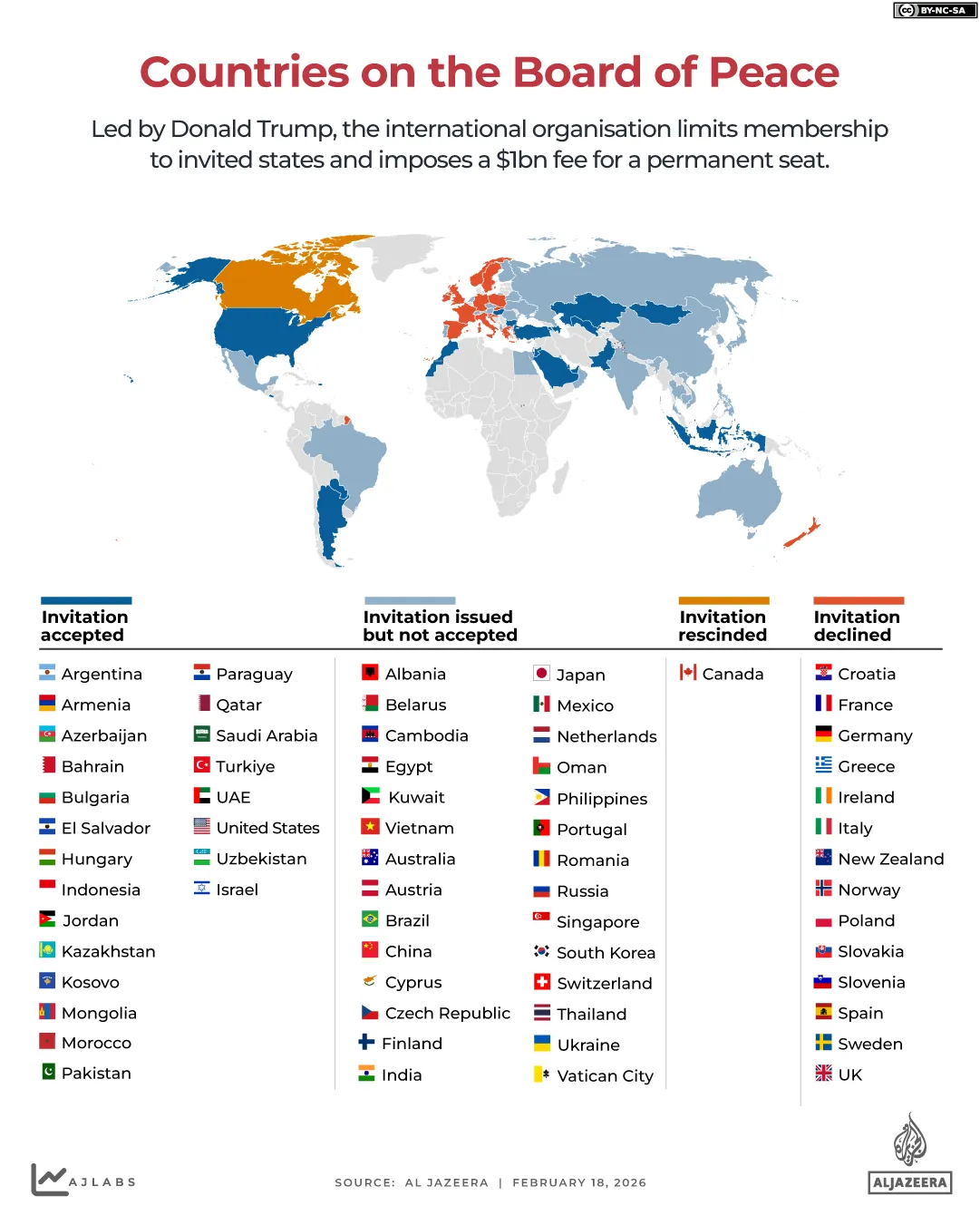
Washington, DC – United States President Donald Trump is set to hold his first “Board of Peace” summit in Washington, DC, an event where the US leader likely hopes to prove the recently launched panel can overcome scepticism – even from those who signed on in support – in the face of months of Israeli ceasefire violations in Gaza.
The summit on Thursday comes nearly three months to the day since the UN Security Council approved a US-backed “ceasefire” plan amid Israel’s genocide in Gaza, which included a two-year mandate for the Board of Peace to oversee the devastated Palestinian enclave’s reconstruction and the launch of a so-called International Stabilization Force.
Recommended Stories
list of 3 itemsend of list
Disquiet has surrounded the board since the November security council vote, with many traditional Western allies wary of the US administration’s apparent wider ambitions, which some have viewed as an attempt to rival the United Nations in a Trump-dominated format.
Others, including countries that have already signed on as members, have raised concerns about the board’s fitness to effect meaningful change in Gaza. Several regional Middle East powers have joined the board, with Israel becoming a late, and to some, disconcerting addition in early February.
As of Thursday’s meeting, the board still has no Palestinian representation, which many observers see as a major obstacle to finding a lasting path forward.
“What exactly does Trump want to get out of this meeting?” Yousef Munayyer, the head of the Israel-Palestine programme at the Arab Center Washington DC, questioned.
“I think he wants to be able to say that people are participating, that people believe in his project and in his vision and in his ability to move things forward,” he told Al Jazeera.
“But I don’t think that you’re going to see any major commitments until there are clearer resolutions to the key political questions that so far remain outstanding.”
‘Only game in town’
To be sure, the Board of Peace currently remains the “only game in town” for parties interested in bettering the lives of Palestinians in Gaza, Munayyer explained, while simultaneously remaining “extremely and intimately tied to the persona of Donald Trump”.
That raises serious doubts over the board’s longevity in what is likely to be a decades-long response to the crisis.
“Regional players that have a serious concern over the future of the region and concern over the genocide have no choice but to really hope that their participation in this Board of Peace allows them to have some leverage and some direction over the future of Gaza in the next several years,” Munayyer said.
He assessed the greatest opportunity for member states who “understand the challenges and understand the context” would be to focus on “what realistically can be achieved in the time period … to focus on the immediate needs and address them aggressively”. That includes health infrastructure, freedom of movement, making sure that people have shelter, pushing for an end to ceasefire violations, to name a few, he said.
At least 72,063 Palestinians have been killed in Gaza since October 7, 2023, with 603 killed since the October 11, 2025, “ceasefire” went into effect. Nearly the entire population of 2.1 million has been displaced, with more than 80 percent of buildings destroyed.
For his part, Trump, who has previously envisioned turning Gaza into a “Middle East Riviera”, struck a positive tone ahead of the meeting. In a post on his Truth Social account on Sunday, Trump touted the “unlimited potential” of the board, which he said would prove to be the “most consequential International Body in History”.
Trump also said that $5bn in funding pledges would be announced “toward the Gaza Humanitarian and Reconstruction efforts” and that member states “have committed thousands of personnel to the International Stabilization Force and Local Police to maintain Security and Peace for Gazans”.
He did not provide further details.
Meanwhile, Trump’s son-in-law, Jared Kushner, who is a member of the panel’s so-called “Gaza executive board”, unveiled the clearest vision yet of Washington’s “master plan” for Gaza in January.
The plan, assembled without any input from Palestinians in Gaza, outlined gleaming residential towers, data centres, seaside resorts, parks, and sports facilities, predicated on the erasure of the enclave’s urban fabric.
At the time, Kushner did not say how the reconstruction plan would be funded. He said it would begin following full disarmament by Hamas and the withdrawal of the Israeli military, both issues that remain unresolved.
Pressure on Israel?
As the US administration stargazes over sweeping construction plans, it is likely to face a starker reality when it meets with a collection of the 25 countries that have signed on as members, as well as several others that are sending observers to the meeting, according to Annelle Sheline, a research fellow in the Middle East programme at the Quincy Institute for Responsible Statecraft.
Any progress to show the board’s “proof of concept” would all-but-surely require asserting unilateral pressure on Israel, she noted.
“Trump is hoping to have countries back up his claim about the $5bn, to get actual commitments on paper,” Sheline told Al Jazeera.
“This is probably going to be challenging, because – especially the Gulf countries – have been very clear that they’re not interested in financing another reconstruction that’s just going to be destroyed again in a few years.”
Israel’s decision to join the board, which Israeli Prime Minister Benjamin Netanyahu had initially opposed, has piqued concerns about further influence over US policy. An act of good faith by the US to advance a more lasting peace could be the inclusion of a Palestinian official on the board, Sheline added.
She proposed widely popular Palestinian political prisoner Marwan Barghouti, who is continuing to serve consecutive life sentences in Israel, as a possible candidate. His release, she said, could be an example of an area where Washington could use its leverage to immediate effect.
In the shorter term, “[interested member states] are largely waiting for the security situation to resolve. Israel violates the ceasefire daily and moves the yellow line”, Sheline said, referring to the demarcation in Gaza behind which Israel’s military was required to withdraw as part of the first phase of the “ceasefire” agreement.
Indonesia’s government has said it is preparing to commit 1,000 troops to a stabilisation force, which could eventually grow to 8,000. But any deployment would likely remain delayed without better ceasefire guarantees, she said.
“It’s still an active warzone,” Sheline added. “So it’s very understandable that even Indonesia, which has hypothetically said it would contribute troops to the stabilisation force, is likely going to say we’re not actually going to do that until the situation is stable.”
An opportunity?
Ensuring an actual ceasefire is enforced – including creating accountability mechanisms for violations – remained “by far the most critical” task for the board’s inaugural meeting, according to Laurie Nathan, the director of the mediation programme at the Kroc Institute for International Peace Studies at the University of Notre Dame.
Trump’s Board of Peace is “not going to be able to play a meaningful reconstruction role in the absence of stability in Gaza, and stability requires adherence to the ceasefire”, he told Al Jazeera.
The next key step – and a major development that could come from Thursday’s meeting – would be a commitment of troops, although Nathan noted any deployment would still likely be deadlocked until a voluntary Hamas disarmament agreement is reached.
On the face of the situation, Trump would appear increasingly incentivised to use Washington’s considerable leverage over Israel to foster a stability in Gaza that the president has closely aligned with his own self-image.
After all, Trump and his allies have regularly portrayed the US president as the “peacemaker-in-chief”, repeatedly touting his success in conflict resolution, even if facts on the ground undermine the claims. Trump has been vocal in his belief that he should be awarded the Nobel Peace Prize.
Still, “Trump’s motivation is multifold,” Nathan explained.
“Does he care about peace? I think he does. Does he want to be a peace broker? Yes. Does he genuinely want the Nobel Peace Prize? Yes.”
“On the other hand, he is performative … it’s never quite clear how much of it is serious for him,” he added. “The further problem is that personal interests are always involved when Trump is doing these things.”
Wider ambitions?
Both Washington’s Western allies and experts in conflict resolution have scrutinised what appears to be the yawning scope of the Board of Peace, far beyond the Gaza purview approved by the UN Security Council last year.
A widely reported founding “charter” sent to invited countries did not directly reference Gaza as it took digs at pre-existing approaches to peace-building that “foster perpetual dependency and institutionalise crisis rather than leading people beyond it”. Instead, it envisioned a “more nimble and effective international peace-building body”.
Critics have further questioned Trump’s singular and indefinite role as “chairman” and sole veto-holder, which largely undermines the principles of multilateralism intended to be enshrined in organisations such as the UN. They have argued that the structure fosters a transactional approach both in dealings with the US government and Trump as an individual.
Richard Gowan, the programme director of global issues and institutions at International Crisis Group, said those concerns are unlikely to subside any time soon. Still, he did not see that precluding European countries from supporting the board’s effort if it is able to make meaningful progress.
“I think, in practical terms, you will see other countries trying to support what the board is doing in the Gaza case, while continuing to keep it at arm’s length over other issues,” he said.
Thursday’s meeting could indicate the Board of Peace’s dynamic and tone going forward.
“If Trump uses his authority under the charter to order everyone around, block any proposals he doesn’t like, and run this in a completely personalistic fashion,” Gowan said, “I think even countries that want to make nice with Trump will wonder what they’re getting into.”
“If Trump shows his mellower side. If he’s actually willing to listen, in particular to the Arab group and what they’re saying about what Gaza needs, if it looks like a genuine conversation in a genuine contact group,” he added, “that won’t erase all the questions about the board’s future, but it will at least suggest that it can be a serious sort of diplomatic framework.”
Sanaa, Yemen – Ahmed Abdu, 28, parked his motorbike near a hall under construction in the al-Jiraf neighbourhood of Sanaa. He walked some metres to deliver a food parcel to a customer.
Nearly a minute later, an air strike hit the hall, setting off a thunderous explosion.
Recommended Stories
list of 3 itemsend of list
Fire erupted, and smoke rose on the dark street at night. Passersby screamed and fled in panic. The attack happened last Ramadan, on March 19, 2025, in the Yemeni capital.
Ahmed, who survived, said he will never forget that moment of horror. He escaped unscathed, but his motorbike was charred, and nine civilians sustained injuries.
As Yemen enters this new Ramadan, memories of last year’s United States-led aerial campaign, Operation Rough Rider, are resurfacing in Sanaa.
The two-month operation, which Washington said targeted Houthi military infrastructure, killed at least 224 civilians, many of them in Ramadan last year.
Today, the country remains in tumult amid rising tensions in the region. Ahmed and thousands of people like him fear a repeat of the violence that shattered the holiest month of the year.
“I do not know whether this calm will continue in this Ramadan, or we will relive the intimidating war surprises we endured last year. Such an uncertainty is worrisome,” Ahmed told Al Jazeera.
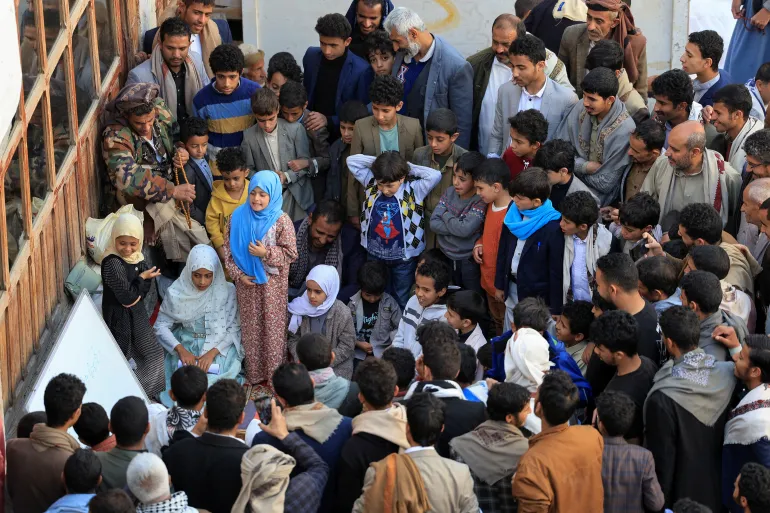
People gather around girls learning to recite the Quran at the Grand Mosque in Sanaa, Yemen [File: Khaled Abdullah/Reuters]
Ready for the second round
About 10 days before this Ramadan, the Houthis, who control northwest Yemen, including Sanaa, staged a mass protest in the capital under the slogan “Steadfast and ready for the next round”, referring to a possible confrontation with local or foreign adversaries.
The protest expressed solidarity with and support for Houthi allies, Iran and Lebanon’s Hezbollah, against the US and Israel. Houthi leaders said their hands were on the trigger and that any US attacks on Iran would prompt them to intervene.
Mohammed al-Bukhaiti, a member of the political bureau of the Houthi movement, warned the US against launching any “military aggression” against Iran, saying that attacking Iran would amount to a full-scale war in the region.
“We are men of action, not words,” al-Bukhaiti told Iranian television.
With the Houthi threats to support Iran militarily against Washington, the fear for many regular Yemenis is that their country could soon find itself a target of US warplanes once again.
People walk through a market ahead of the fasting month of Ramadan in Sanaa, Yemen, February 17, 2026 [Yahya Arhab/EPA]
The missile in the kitchen
The scars from previous US-Houthi attack exchanges still linger in war-ravaged Yemen.
The US said the strikes last year were carried out in retaliation for Houthi attacks on Israeli-linked vessels passing through the Red Sea, in solidarity with Gaza.
Construction worker Faisal Abdulkareem, 35, welcomes the arrival of Ramadan, but memories of the last one remain painful. He prays this month will pass peacefully without the horror of warplanes, missiles, and explosions.
“On a Ramadan night last year, I was lying in my room, facing the street. I heard the roar of a warplane. I was worried but did not panic. I reassured myself: This is a residential area with no military facilities, and it would not be targeted,” Faisal recalled.
About a minute later, an explosion rocked the area. The aluminium window frames were blown outwards, and shards of glass flew into Faisal’s room.
“The glass fragments struck parts of my body, including my head and hands. I wiped the blood away with a tissue as I tried to process happened. It was terrifying,” he said.
Faisal went outside to see exactly where the rocket had hit. “The missile landed in my neighbour’s kitchen. His house is about 20 metres [66 feet] away from my first-floor apartment. That spiritual Ramadan night turned into a moment of terror,” he told Al Jazeera.
Fortunately, no one was killed or seriously injured. But Faisal’s neighbour’s house sustained damage.
“People in the neighbourhood rushed to the house. Some said it was an American missile. Others suggested the Houthis launched the missile to intercept the US plane over Sanaa, but it fell on the house accidentally.”
Faisal said his neighbour had to bear the financial burden of repairing the damage to his house alone.
“We fasted from food and drink last Ramadan, but not from fear and grief,” Faisal said.
Peace vs solidarity
In a speech on preparations for Ramadan on February 13, Houthi chief Abdel-Malik al-Houthi said Israel and the US have sought to dominate the Middle East.
“This is why [the US and Israel] focus on removing [Iran], because they consider it to be at the forefront of the major obstacles that stand in the way of achieving that goal,” he added.
Such a goal is unacceptable, he said. “This is something that no human being with even a shred of humanity or human dignity left can accept.”
While the Houthi leader views engaging in the war as a duty, others consider it “unfair” to risk peace in Sanaa for the sake of solidarity with Iran.
Ammar Ahmed, a law student in Sanaa, keeps abreast of the regional news and views the US-Iran military clash as catastrophic for northern Yemen.
“The Houthi leadership is defiant, and it will not hesitate to hit American military assets in the region. So, we [civilians in northern Yemen] will again face US strikes,” said Ammar.
He argued that peace in Yemen should be prioritised over solidarity with Iran.
“Iran is a powerful country, and it can defend its interests. Even if the Houthis intervened, their missiles or drones would not cripple the US military. They will only bring us trouble,” Ammar told Al Jazeera.
Legitimate concerns
The future of Yemen’s Houthis is tied to Iran, and civilian worry over what lies ahead during Ramadan and in the months following is legitimate, Abulsalam Mohammed, the head of the Yemeni Abaad Studies and Research Center, told Al Jazeera.
“A war against the Houthis in northern Yemen remains an option [for anti-Houthi forces]. This option will be scrapped should the group come to talks and recognise the legitimacy of the UN-recognised Yemeni government,” said Mohammed.
He indicated that Houthi involvement in any US-Iran military conflict would only accelerate the launch of anti-Houthi operations by Saudi Arabia and the Yemeni government in Yemen’s north.
The Yemeni government has been emboldened by a recent campaign against the separatist Southern Transitional Council, forcing them out of much of southern Yemen with the backing of Saudi Arabia.
“The coming military operations against the rebel group, in my view, will not be limited to air strikes. There will be advances by local ground forces, coupled with foreign aerial cover. We witnessed how the separatists collapsed in the north, and the fall of the Houthis in the north is also possible,” Mohammed said.
The United Nations’s special envoy to Yemen, Hans Grundberg, warned that stabilisation in any part of the country will not be durable if the broader conflict in Yemen is not addressed comprehensively.
“It is high time to take decisive steps in this regard. Without a wider negotiated political settlement to the conflict, gains will continue to remain vulnerable to reversal,” said Grundberg in a briefing delivered to the UN Security Council on February 12.
For Sanaa resident Ahmed Abdu, it does not matter who wins any future conflict in the country. His priority is staying safe from the direct consequences of hostilities.
“During Ramadan last year, I lost my source of income, the motorbike, in an air strike. That loss could be replaced. I only wish a peaceful Ramadan this year and a lasting end to the war,” said Ahmed.
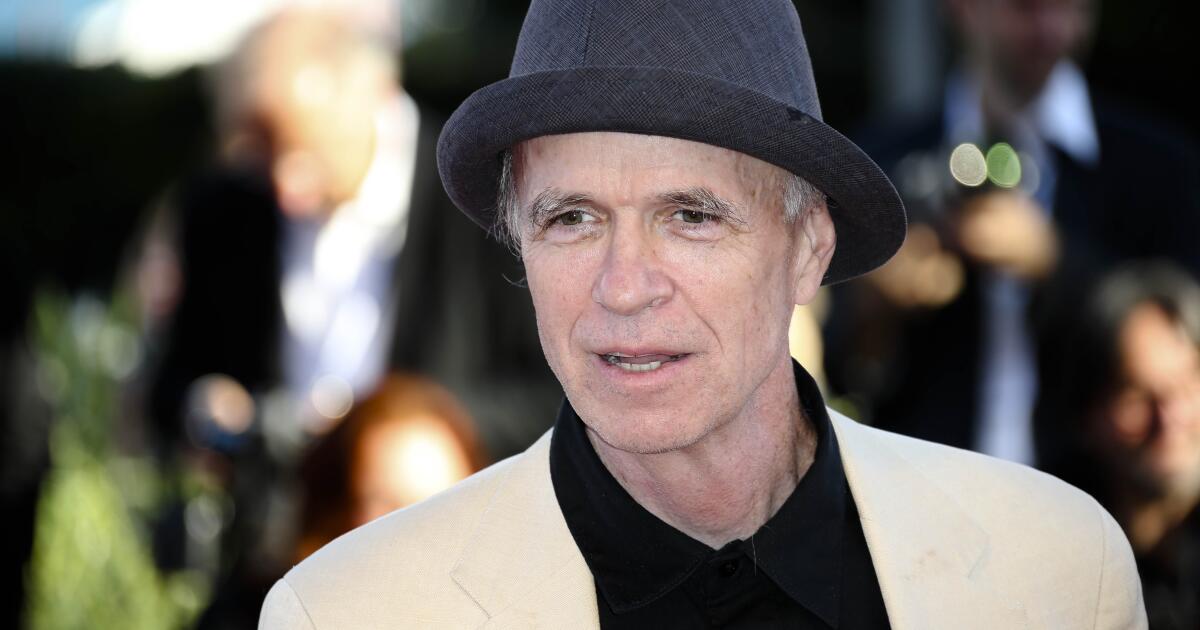
Tom Noonan, a character actor and filmmaker known for playing villains in “Manhunter” and “The Last Action Hero,” died on Valentine’s Day. He was 74.
The death was confirmed by Fred Dekker, director of “The Monster Squad,” who wrote on Facebook, “Tom’s indelible performance as Frankenstein … is a highlight of my modest filmography.”
Noonan had a nearly 40-year career on TV and in film, making his mark with a role in “Manhunter,” the 1986 movie based on a Thomas Harris novel.
In “Manhunter,” which starred William Peterson of “CSI: Crime Scene Investigation” as an FBI agent and “Succession” star Brian Cox as Dr. Hannibal Lecter, Noonan played Francis Dolarhyde, the serial killer also known as the Tooth Fairy. It was a performance that “knocked out” Dekker, who then pursued Noonan for “Monster Squad.”
Playing a killer wasn’t unusual for Noonan, who stood 6-foot-5 or 6-foot-6, depending on who you trust. On a 2013 episode of TV’s “The Blacklist,” he played “the Stewmaker,” a man with a taste for dissolving human bodies in acid. In the 1993 comedy “The Last Action Hero” he was the Ripper, a fictional nemesis who comes to life in the high-concept film-within-a-film starring Arnold Schwarzenegger as action star Jack Slater.
Born in Greenwich, Conn., on April 12, 1951, Noonan was raised by his math-teacher mother Rita and a large extended family after the death of his father, John Ford Noonan Sr. He went to school at Yale Drama and later founded New York’s Paradise Factory theater with Jack Kruger at the site of the Paradise Ice Cream Factory, where the ice cream cone was invented. The two built a theater and rehearsal rooms where the condemned building stood.
Paradise Factory now bills itself as “bringing the rigor of theatrical discipline to the process of cinematic art, and bringing the intimacy and immediacy of the cinema into theatrical performance art.”
“I wish I had more success as an actor,” the New York-based actor told The Times with a dash of melancholy in 2015. “I think people call me because they’re channel surfing late at night and they see me in a movie on cable.”
In that story, about the actor and his friend and collaborator Charlie Kaufman and Kaufman’s stop-motion animation film “Anomalisa,” a Times staff writer described Noonan: “Like Kaufman, he has a dark worldview, an idiosyncratic sensibility, blackly comic thoughts and, at times, an endearing crankiness.”
In “Anomalisa,” Noonan was credited with playing “Everyone Else” — and that wasn’t an exaggeration. Jennifer Jason Leigh and David Thewlis played the leads; Noonan voiced more than 40 other roles in the film.
“Even I can’t tell if it’s me sometimes,” he told The Times in 2015 about the extensive studio-recording process. “I mean, I recognize the voice, but I’m not sure where it came from.”
“My first TV interview was with Tom Noonan for a local NYC show called MIDDAY(?),” actor Jerry O’Connell wrote early Wednesday on Instagram, including a blurry image of them on the show’s set. “I was so nervous. Tom was so kind. I saw him in every (NYC) play he was in after. He bought my brother and I tickets to Eddie Murphy’s RAW (we were too young to purchase). Btw, on this episode, I was talking about a movie about to come out (Stand By Me) and Mr. Noonan was talking about his movie (Manhunter). Rest In Peace LEGEND.”
Noonan appeared in the famous 1980 flop “Heaven’s Gate” and cast a creepy gothic shadow decades later in “The House of the Devil” (2009). He was a ghoulish host of a late-night television horror program in the 2005 vampire movie “The Roost,” then played a wagon-train missionary in the 2007 western “Seraphim Falls.”
In 18 episodes of the series “Hell on Wheels,” which ran for five seasons on AMC, he was the Rev. Nathaniel Cole. Other TV credits included episodes of Fox’s “The X-Files,” HBO’s “The Leftovers,” CBS’ “CSI: Crime Scene Investigation” and the Louis C.K. series “Louie” (FX) and “Horace and Pete.”
Noonan’s half-dozen directing credits include the 1994 film “What Happened Was …,” which was produced as a play, then became a movie and then won the Sundance Grand Jury Prize for dramatic feature. In addition to writing and directing the movie, Noonan played the lead male role opposite actor Karen Sillas. Noonan also won Sundance’s Waldo Salt screenwriting award for the script.
The next year, his feature “The Wife” — a dark comedy once again written, directed by and starring Noonan — was a nominee for the same Sundance Grand Jury Prize. Described by the New York Times as a “bleakly funny evisceration of modern marriage,” the movie co-starred Karen Young, who was Noonan’s wife from 1992 to 1999.
And Noonan’s 2015 movie “The Shape of Something Squashed” was born out of confusion and some despair after his agent called him with what initially looked like a part in one of the “Mockingjay” installments of “The Hunger Games” franchise. When he got the script, though, he saw only one role for someone his age, and that job — playing President Snow — already belonged to Donald Sutherland.
Turns out there never had been a part in the offing. Sutherland was just busy, and Jennifer Lawrence and the rest of the “Hunger Games” cast needed someone to rehearse with them for a week.
After recovering from a brief emotional tailspin, Noonan knocked out the script for “The Shape of Something Squashed” — then directed and acted in the film.
He was preceded in death by his older brother, “A Coupla White Chicks Sitting Around Talking” playwright John Ford Noonan Jr., who died in 2018 at age 77.
Former Times staff writer Steve Zeitchik contributed to this report.
Illegal mining is a widespread issue in Nigeria, where operations lack both government oversight and safety protocols.
Published On 19 Feb 202619 Feb 2026
Share
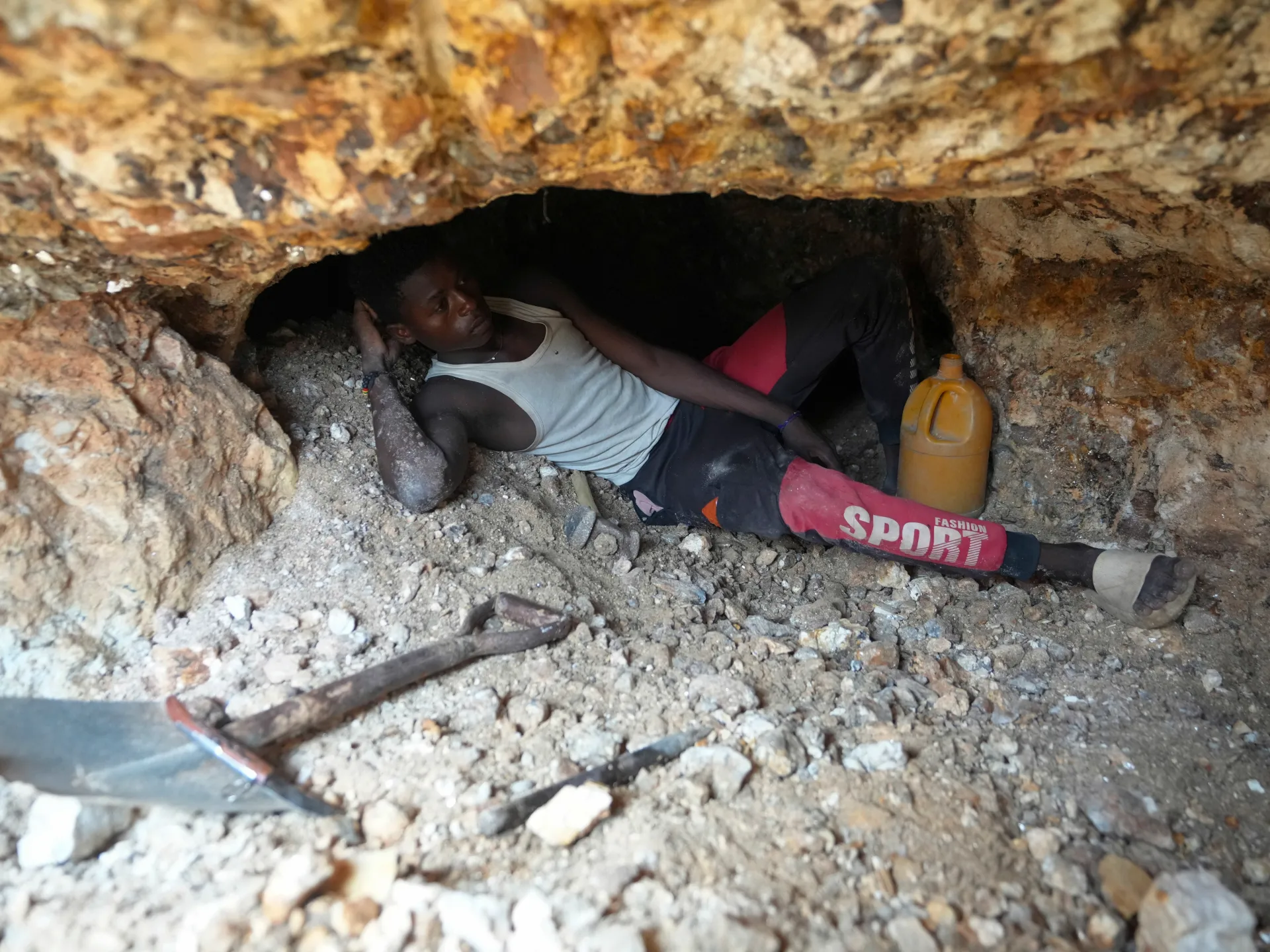
At least 37 miners have died from carbon monoxide poisoning at a mining site in central Nigeria, the Reuters news agency reports.
The deadly incident, which took place on Wednesday morning in the Kampani community in the Wase area of Plateau State, also resulted in the hospitalisation of 25 people, Reuters said, citing a police source and a security report the news agency obtained.
Recommended Stories
list of 3 itemsend of list
Government officials identified the location as a dormant lead mine where accumulated minerals had released lethal fumes.
The Plateau State government said many were feared dead without providing an exact figure, adding that others were receiving treatment in nearby hospitals.
Security forces have cordoned off the site to prevent further access.
Nigeria’s Minister of Solid Minerals Dele Alake said that the accident occurred when local villagers, unaware of the toxic nature of the emissions, reportedly entered the tunnel to extract minerals and inhaled the gas.
Illegal mining remains a widespread concern in Nigeria, where extractive operations frequently lack both government oversight and basic safety protocols.
The federal government in Nigeria has ordered an immediate suspension of all mining activities in areas near the accident site to allow for a comprehensive investigation, Reuters said.
Plateau State is a historical mining region, with its capital, Jos, known as the Tin City, though mining activities have slowed in recent years.
Several similar accidents have killed miners in Nigeria previously, including at least 18 people killed last year in Zamfara State in the northwest of the country after a boulder crashed onto an illegal mine during heavy rains.
The pursuit of mineral wealth across the African continent continues to be shadowed by a recurring cycle of mining disasters, as recent tragedies highlight the persistent dangers of both legal and irregulated operations.
An estimated 200 people were killed in a collapse at the Rubaya coltan mine in eastern Democratic Republic of the Congo last month.
The mine, located some 60km (37 miles) northwest of Goma city, the provincial capital of North Kivu province, collapsed after a landslide.
Rubaya produces about 15 percent of the world’s coltan, which is processed into tantalum, a heat-resistant metal that is in high demand by makers of mobile phones, computers, aerospace components and gas turbines.
Weekly insights and analysis on the latest developments in military technology, strategy, and foreign policy.
Russia is developing a new balloon-borne system that could provide battlefield access to high-speed data communications at a time when its forces are desperate to keep connected. The testing of the Barrage-1 balloon comes as Ukrainian troops are taking advantage of Russia’s loss of access to the SpaceX Starlink satellite constellation network. Both sides have become dependent on the SpaceX system for daily wartime operations, but the restrictions on Russia’s use of Starlink are allowing Kyiv’s forces to fend off attacks in some areas while advancing in others. You can read more about Russia’s Starlink troubles in our initial story here.
As we previously noted, the introduction of Starlink to the battlefield in Ukraine revolutionized how war is waged, giving users high bandwidth, relatively secure communications basically anywhere, all in a small, off-the-shelf package. Though Elon Musk’s SpaceX company provided them to Ukraine, Russians soon came to rely on them as well. However, earlier this month, the company created a list of verified users, cutting Russia off from the system and throwing its troops into disarray. We will talk more about that later in this story.
#Russia 🇷🇺🛰 War challenges create new demands – Barrage 1 Is Barrage 1 a counterpart to Starlink? Essentially yes, but the concept is a bit different. The project is being developed jointly by Aerodrommash and MSTU-Moscow State Technical University. Concept: An autonomous… pic.twitter.com/yZP7jmRk65
The Barrage-1 balloon recently underwent its first test flight, according to Russia’s Foundation for Advanced Studies (FFAS), which is developing the system. It “is designed to carry up to 100 kilograms (about 220 pounds) of payload at an altitude of up to 20 kilometers (about 12 miles),” FFAS recently announced on Telegram. One of the payloads being considered is “a promising 5G NTN terrestrial communication equipment, the testing of which is planned for the near future,” the organization claimed.
While not reaching anywhere near the low earth orbit (LEO) altitudes as the Starlink constellation – between 341 miles to 298 miles – Barrage-1 could still serve as an alternative access point for high-speed data transfer for troops on ground below.
Regardless of FFAS intentions, however, even if it is perfected, the Barrage-1 system will not provide the same level of coverage as Starlink, which is made up of thousands of laser datalink-connected satellites covering the globe. In contrast, Barrage-1 will be guided by “a pneumatic ballast system, which allows changing the flight altitude to utilize wind currents and move in the desired direction.”
“Due to this, the platform can maneuver and stay in a specified area or move along the trajectory required for the payload,” FFAS claimed, despite being in the very earliest stages of testing.
Russia has launched an aerostat with a 5G communication platform, designed to remain in the stratosphere at an altitude of 20–30 km. The “Barrage-1” can apparently adjust its altitude using a pneumatic ballast system, enabling it to use different winds to maintain its position. 1 https://t.co/MCFKyTIskvpic.twitter.com/MzQIKnvNWg
You can read all about how high-altitude balloons can stay on station even in the presence of prevailing winds in this past story of ours.
Even though it wouldn’t be a direct match to Starlink, at 12 miles high, it could provide wide-area connectivity similar to that offered by Starlink, albeit over a much more limited area. A mini ‘constellation’ of these systems spread over a region and mesh-networked together, could help solve the line of sight limitations of a single balloon.
Ukrainian Defense Ministry (MoD) advisor on defense technology and drone and electronic warfare (EW) expert Serhiy “Flash” Beskrestnov sees potential in this system.
“The platform is seen as an accessible and efficient alternative to expensive satellite constellations in LEO,” Beskrestnov explained on Telegram. “One of the priority tasks for ‘Barrage’ will be to test 5G NTN communication. Placing transmitters at an altitude of 20 km will allow providing high-speed internet and communication to vast territories where the construction of ground towers is impossible.”
“In theory and in practice, by controlling the altitude of an aerostat, it can be steered, not precisely, but enough to stay over any territory,” he added.
However, the Barrage-1’s comparatively low altitudes could make them targets for Ukrainian air defense systems and other countermeasures.
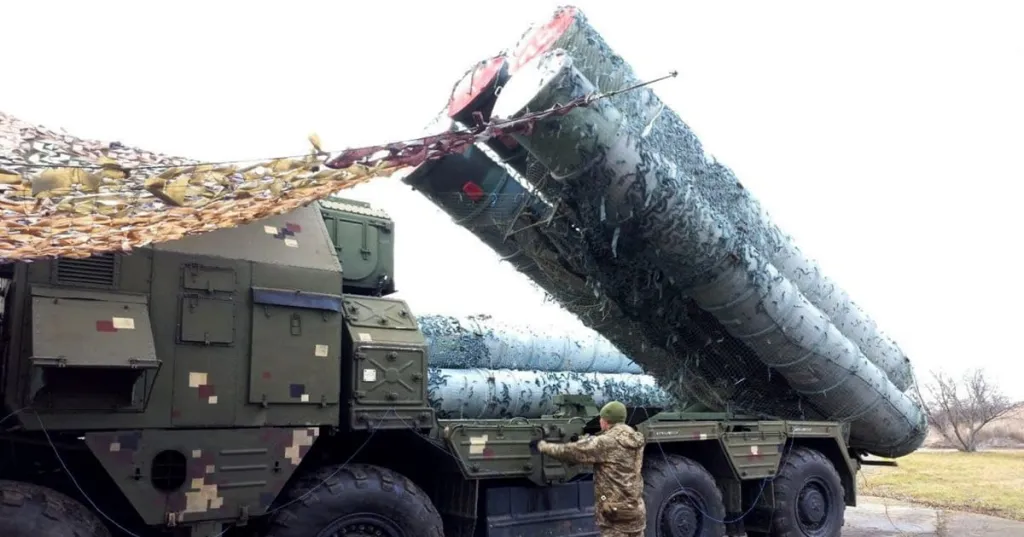
“And what’s most important for us? To have the means that can detect such objects over our territory,” Beskrestnov suggested. “And to have the ability to shoot down such targets if they pose a threat. As far as I remember, the S-300 [surface to air missile system] can engage targets at an altitude of 20-30 km (about 12 to 19 miles).”
Still, successfully targeting and engaging a balloon with a small radar signature using SAMs are two different things. Russia worked on this exact problem extensively during the Cold War, which you can read about here.
A Ukrainian S-300 surface-to-air missile system. (Ukraine Defense Ministry)
The balloons could also fall victim to other forms of attack. It isn’t hard to imagine Ukraine producing a drone to specifically hunt for these systems at longer ranges. Their emissions would make them hard to hide. Also, the electronic warfare aspect is worth noting for the same reasons.
The concept of using balloons as communications nodes is far from new. It has been around for many years. The U.S. military continues to eye using balloons to lug communications relays and gateways aloft as well. As we previously noted, the U.S. once even considered sending balloons over Cuba with equipment that would allow citizens to have access after the government cut it off. For homeland applications, high altitude balloons have been eyed to replace cellular towers, especially after natural disasters have wiped-out ground-based communications.
Concept art from a Raven Aerostar promotional video demonstrating how only a few balloons can establish a wide-area communications network. (Raven Aerostar via YouTube)
The SpaceX restrictions have impacted everything from Russia’s high-level command and control, to basic communications and data exchange between troops across the entire battlespace. It has also affected Russia’s drone warfare, including interfering with long-range aerial weapons and uncrewed ground vehicles (UGV). The Kyiv Post article claims that some Russian UGVs have relied on Starlink to operate.
“The loss of Starlink has now forced Russian military logistics troops to return to the use of manned trucks, cars, motorcycles or quad-cycle vehicles,” noted Mick Ryan, a retired Australian major general now serving as a military analyst. “These have proven to be more vulnerable to drone strikes.”
“Eventually shock wears off, responses are developed & counterpunches delivered. This will be the case with the Starlink shutdown. Ukraine will have limited time to exploit the opportunities of the degraded C2 environment now endured by Russian ground forces.”… pic.twitter.com/zytWvgdtFw
Losing Starlink has slowed down Russian offensive actions and increased their casualties while opening up opportunities for Ukraine to advance, Ukrainian military officials have claimed.
“For three to four days after the shutdown, they really reduced the assault operations,” Lt. Denis Yaroslavsky, who commands a special reconnaissance unit for the Ukraine Armed Forces, told the New York Post.
“The disruption comes as Russia suffers its worst death rate since the start of the four-year-old war,” U.S. and Ukrainian intelligence officials told the publication.
Russian sources concurred that restrictions on Starlink use are having major negative effects on the frontlines.
“As a result” of the SpaceX action, “instead of a planned strike against the enemy, where their (meaning ours) communications are instantly cut off while theirs remains operational, we have a hellish mess,” Andrey Medvedev, Deputy Chairman of the Moscow City Duma and Deputy Director General for Radio Broadcasting of the VGTRK television and radio company, stated on Telegram.
Compounding problems created for Russia by the restrictions on Starlink, the launch of its own satellite constellation system has reportedly been delayed by about a year.
“The Russian aerospace company Bureau 1440 announced the postponement of its initial deployment of 16 high-speed internet satellites,” the SatNews media outlet recently reported. “Originally scheduled for late 2025, the launch of the first batch for the ‘Rassvet’ (Dawn) Low Earth Orbit (LEO) constellation has been rescheduled for 2026.”
Seen as a domestic alternative to Starlink, the program has been plagued by manufacturing shortfalls.
“While Roscosmos Chief Dmitry Bakanov stated in September 2025 that deployment of the first 300 satellites would begin by the end of that year, industry sources now indicate that the production line has failed to meet the necessary volume,” SatNews noted. “Despite the delay, Deputy Minister of Digital Development Dmitry Ugnivenko had claimed as recently as December 2025 that all 16 initial satellites were complete. Bureau 1440 currently has only six experimental satellites in orbit, launched during the Rassvet-1 and Rassvet-2 missions to test laser inter-satellite links and 5G signal compatibility.”
Even if it is launched, the Rassvet satellite constellation, which will take years to become operational, is very unlikely to have the same capabilities as Starlink.
17/ “This is the Rassvet project from Bureau 1440. According to the announced plans, the launch of the first 16 low-orbit broadband internet satellites was supposed to take place in 2025 , but this never happened. pic.twitter.com/Ro2iWyAEtd
Amid all these issues, Russia is struggling to find more immediate ways to overcome the Starlink restrictions.
“There are no alternatives [to Starlink] right now – at least not at the level of today,” the Russian Colonelcassad Telegram channel explained. It added that Russia is looking for workarounds, but nothing appears to be imminent.
The Russian Gazprom Space Systems satellite array is not a viable alternative at the moment, Colonelcassad rightfully noted.
“There is Gazprom’s dish, it works, but, to put it mildly, it lags behind in connection speed and needs development or refinement,” he stated. “Of course, it is technically possible to provide high-speed internet in the fields by other methods, which many are currently working on.”
The long-term effect of the SpaceX decision on Starlink remains to be seen. This war has shown that both sides advance quickly when it comes to battlefield technology and Russia will have to find some kind of a workaround. However, for Moscow, the timing of the Starlink restrictions is not good, considering that the latest round of peace talks are currently underway in Switzerland. Russian President Vladimir Putin is sticking to his stance that Ukraine turn over territory in the eastern part of the country it still holds, something Ukrainian President Volodymyr Zelensky told Axios that the public won’t allow. Losing ground on the battlefield takes away an important bargaining chip for Russia.
Some fans were using the new AI video generator, backed by ByteDance, to refashion the finales for shows like “Game of Thrones” and “Stranger Things.” Others created battle scenes between iconic superheroes like Wolverine and Superman or between a Transformer and Godzilla.
As these Seedance videos amassed millions of views on social media, industry guilds like SAG-AFTRA and the Motion Picture Assn. have criticized the AI platform that was launched last week. Now, many major Hollywood studios are threatening to take legal action against ByteDance, the same Chinese parent that oversees TikTok.
Netflix, Warner Bros. Discovery, Paramount and Disney have all sent individual cease and desist letters, detailing the unauthorized reproduction of each of the studios’ copyrighted intellectual property.
Netflix and Warner Bros. Discovery were the latest studios to send cease and desists letter to ByteDance on Tuesday.
Netflix calls Seedance “a high-speed privacy engine” and says that they “will not stand by and watch ByteDance treat our valued IP as free, public domain clip art,” as stated in the letter. The streamer also cites the illegal use of sets derived from “Squid Game,” costumes from “Bridgerton” and character design from “KPop Demon Hunters.”
Warner Bros. Discovery looks to repurposed content, including characters from the “Harry Potter” and “Lord of the Rings” franchises, as well as superheroes like Batman, as “ blatant infringement” by ByteDance. The studio argues that it’s clear that their AI technology was trained on Warner Bros. copyrighted material “without authorization.”
“But the users are not the ones at the root cause of the infringement; they are merely building on the foundation of infringement already laid by ByteDance as Seedance comes pre-loaded with Warner Bros. Discovery’s copyrighted characters,” wrote the studios’ legal executive vice president Wayne Smith. “That was a deliberate design choice by ByteDance.”
Disney and Paramount were the first of the studios to call out ByteDance, sending their letters last Friday and Saturday. Disney accuses ByteDance of loading its Seedance service “with a pirated library of Disney’s copyrighted characters from Star Wars, Marvel, and other Disney franchises.”
“Over Disney’s well-publicized objections, ByteDance is hijacking Disney’s characters by reproducing, distributing, and creating derivative works featuring those characters. ByteDance’s virtual smash-and-grab of Disney’s IP is willful, pervasive, and totally unacceptable,” Disney’s attorney David Singer wrote, per Axios.
Paramount’s cease and desist letter was reviewed by The Times and makes similar assertions about ByteDance’s unapproved use of copyrighted material.
ByteDance has since pledged to implement more safeguards to protect copyrighted material in response to these letters.
“ByteDance respects intellectual property rights and we have heard the concerns regarding Seedance 2.0,” a company spokesperson said in a statement shared with CNBC. “We are taking steps to strengthen current safeguards as we work to prevent the unauthorized use of intellectual property and likeness by users.”
But with or without the safeguards, Dan Purcell, chief executive of Midnight Labs, an AI-powered company that specializes in IP protection for high-value entertainment, said these letters might be a bit of a delayed reaction from the studios.
“Once synthetic content is generated, it spreads instantly and at a massive scale. By the time lawyers engage, the damage is done,” said Purcell in a statement. “The only path forward is strict licensing, real-time enforcement, and consequences that actually hurt. Reactive letters won’t fix this. The industry needs to move at the speed of AI — not the speed of litigation.”
Environment group says FBI is visiting climate activists’ homes as Trump administration rolls back pollution protections.
Published On 19 Feb 202619 Feb 2026
Share
Environmental group Extinction Rebellion has said that climate change activists associated with the group are being investigated by the Trump administration, which is also openly working to roll back environmental protections in the United States.
The group’s New York chapter said that at least seven of its activists have been visited by FBI agents since Trump’s second term began last year, including one person who had two special agents from the FBI’s Joint Terrorism Task Force come to their home on February 6.
Recommended Stories
list of 4 itemsend of list
The Department of Justice also opened an investigation into the environmental group Climate Defiance earlier this month in response to what Extinction Rebellion said was a “viral peaceful protest”.
“Trump is weaponising the DOJ to attack peaceful protesters in order to appease a multi-trillion dollar fossil fuel industry that got him elected,” Extinction Rebellion’s New York chapter said in a statement shared on Instagram.
“We can only assume that they are feeling threatened by our movement,” the statement added.
Known as XR, the activist group garnered media attention worldwide through disruption, hitting roads, airports and other public transport networks with direct action protests against climate change in major cities.
The environmental group’s global website says it is a “decentralised, international and politically non-partisan movement using non-violent direct action and civil disobedience to persuade governments to act justly” on the climate emergency.
Activist Greta Thunberg has previously attended actions organised by the group.
‘The single largest deregulatory action in American history’
According to the natural resource monitoring group Global Witness, fossil fuel companies, including Chevron and Exxon, donated $19m to President Donald Trump’s inaugural fund last year, representing 7.8 percent of the total amount raised. A number of fossil fuel companies also donated to Trump’s re-election campaign.
Trump, who has called climate change a “hoax” and a “con job”, has taken several steps to fulfil his campaign promise to “drill, baby, drill” as president, including expanding oil extraction in Alaska’s Arctic National Wildlife Refuge.
The Trump administration also recently revoked a 2009 government declaration known as the “endangerment finding”, which has been used as the legal basis for regulating pollution under the Clean Air Act, which was originally adopted in 1963.
Trump, who described the endangerment finding as “one of the greatest scams in history”, has claimed that repealing it was “the single largest deregulatory action in American history, by far”.
The move has prompted alarm from environmental and health groups, more than a dozen of which filed a lawsuit on Wednesday over the Environmental Protection Agency’s decision to withdraw the endangerment finding, saying removing it will lead to “more pollution, higher costs, and thousands of avoidable deaths”.
Attacks by Israeli settlers in the occupied West Bank have intensified recently, backed by Israeli forces.
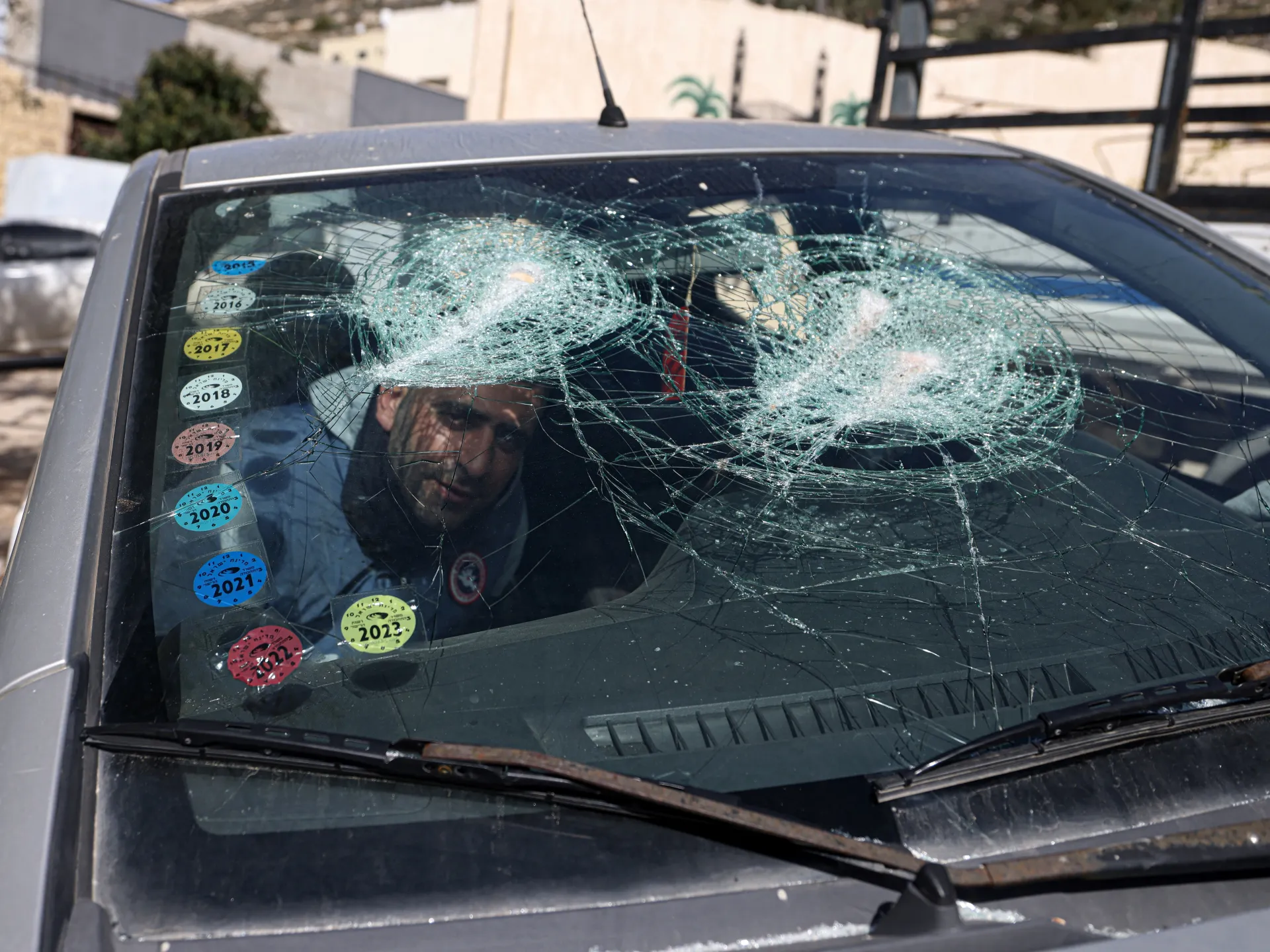
A young Palestinian man was killed and four other people were injured when a group of Israeli settlers, backed by Israeli forces, opened fire on a village in the occupied West Bank.
The death of the young man on Wednesday evening, identified as Nasrallah Abu Siyam, 19, marks the first killing of a Palestinian by Israeli settler gunfire so far this year, the official Palestinian news agency Wafa reports.
Recommended Stories
list of 3 itemsend of list
During the attack on the village of Mukhmas, located northeast of occupied East Jerusalem, Israeli settlers also stole dozens of sheep from local Palestinian residents, Wafa reports.
The attack on Mukhmas and other Palestinian towns and villages constitutes a “dangerous escalation in systematic terrorism and reflects a complete partnership between the settlers and the occupation forces,” Mu’ayyad Sha’ban, head of the Palestinian Authority’s Colonization and Wall Resistance Commission, told Wafa.
Calling for international protection for Palestinian communities, Sha’ban said that settlers have now killed 37 Palestinians in the occupied West Bank since October 2023, but the escalating violence would not deter Palestinians from holding onto their land.
Mukhmas and the adjacent Bedouin community of Khallat al-Sidra have faced repeated attacks by Israeli settlers, often occurring with the protection or presence of Israeli forces, according to reports.
The governorate of Jerusalem, one of the 16 administrative districts of Palestine, said in a statement that the killing of the young man by Israeli settlers was a “fully-fledged crime… carried out under the protection and supervision of the Israeli occupation forces.”
Translation: Martyr of the town of Mukhmas, Nasrallah Abu Siyam, who ascended after succumbing to his injury from settler gunfire during the attack on the town northeast of occupied Jerusalem.
The governorate said the attack was part of a dangerous surge of violence carried out by settlers in the occupied West Bank, including East Jerusalem, and characterised by the widespread use of live ammunition, direct shooting at Palestinian citizens, as well as burning local Palestinian homes, damaging vehicles and property, and seizing land.
Armed settler violence is being supported by “pillars of the Israeli government”, foremost among them far-right ministers Itamar Ben-Gvir and Bezalel Smotrich, the governorate added, according to Wafa.
According to the United Nations Office for the Coordination of Humanitarian Affairs (OCHA), more than 1,000 Palestinians have been killed by Israeli forces and settlers in the West Bank since 2023, and more than 10,000 people have been forcibly displaced.
Since the start of this year alone, almost 700 Palestinians in nine communities have been displaced due to settler attacks, including 600 displaced from the Ras Ein al-Auja Bedouin community in Jericho governorate, OCHA reports.
Earlier this week, Israel’s government approved a plan to designate large areas of the occupied West Bank as Israeli “state property”, shifting the burden of proof to Palestinians to establish ownership of their land in a longstanding situation where Israel has made it all but impossible to obtain property titles.
Described as de-facto annexation of the West Bank, the Israeli government’s decision has drawn widespread international condemnation as a grave escalation that undermines the Palestinian people’s right to self-determination.
Israel’s attempted land grab and killings by settlers come amid a sharp increase in Israeli military operations across the occupied West Bank, where forces have intensified raids, carried out forced evictions, home demolitions, and other repressive measures in multiple areas.
The final episode of Grantchester’s tenth season is set to air tonight, with another show set to replace it.
ITV’s ‘Grantchester’ returns to our screens for a seventh series
The tenth season of Grantchester has been delighting ITV viewers over recent weeks, but it’s set to come to an end tonight (Thursday, February 19).
The British crime drama was first broadcast in 2014 and followed Anglican vicar Sidney Chambers (James Norton), who investigated a series of mysterious wrongdoings in his small Cambridgeshire village. Sidney undertook his sleuthing adventures alongside Detective Inspector Geordie Keating (Robson Green).
Geordie and Alphy embarked on several new investigations when the show returned to ITV for its tenth season last month. As well as solving cases, there have also been some emotional revelations, including Alphy tearfully reading a letter written by his mother when she gave him up for adoption.
The heartbreaking scenes left viewers in tears, with one person writing on X (formerly Twitter): “What another brilliant, heartbreaking and heartwarming episode of #Grantchester. Top performances from all the cast. I’m absolutely broken.”
Another added: “I’m in absolute bits. Absolutely broke me,” while others have praised the cast’s compelling performances.
“Once again, Robson Green knocking it out of the park tonight,” one person wrote, with another adding: “Honestly #Grantchester is up there with the best on TV with great performances. I have no idea why @ITV @itvstudios @masterpiecepbs are ending it.”
Grantchester has had viewers gripped every week and will likely leave a gaping hole when the last episode airs at 9pm tonight. Ahead of the final season airing sometime next year, ITV bosses have confirmed what will takeover from Grantchester on Thursday nights.
The first episode of True Crime Presents’ second season, Murder on a Knife’s Edge, is set to begin at 9pm on Thursday, February 26.
For the latest showbiz, TV, movie and streaming news, go to the newEverything Gossipwebsite
It will centre around the case of Wayne Coventry, who sought love after 18 years with his childhood sweetheart, but the 37-year-old father-of-three was involved in a toxic relationship, and was sadly murdered in October 2019.
The first series of True Crime Presents aired last year, offering thought provoking and insightful input from victims and witnesses on a series of shocking murders.
The initial ten episodes explored several heartbreaking cases, including the death of EastEnders star Gemma McCluskie and 17-year-old Shafilea Ahmed.
Fans have praised the show since its release, with one IMDb user writing: “Quite a decent documentary series. Experts and witnesses given an in-depth analysis on five different murders… The stories are all engaging, some you may know quite well, while others may be new to you.”
Murder on a Knife’s Edge: True Crime Presents premieres at 9pm on Thursday, February 26 on ITV1, while Grantchester is available to stream on ITVX
Ensure our latest headlines always appear at the top of your Google Search by making us a Preferred Source.Click here to activateor add us as your Preferred Source in your Google search settings
The National Intelligence Service Logo photo taken at the agency’s headquarters in Seoul, South Korea, 01 November 2023. File. Photo by YONHAP / EPA
Feb. 18 (Asia Today) — An alleged financial link between a National Intelligence Service employee and a graduate student accused of sending a drone to North Korea has fueled questions about oversight and accountability within South Korea’s intelligence community, an Asia Today columnist wrote Tuesday.
The case surfaced last month when authorities disclosed that a man in his 30s had allegedly sent an unmanned aerial vehicle to North Korea. Initial investigations focused on possible involvement by the Army Intelligence Command.
However, political and intelligence sources cited in the column questioned why the National Intelligence Service, widely regarded as the control tower of South Korea’s intelligence apparatus, was not initially central to the probe.
The controversy deepened when investigators said an NIS Grade 8 employee had engaged in financial transactions with the graduate student. A joint military-police task force reportedly applied charges including general treason, a serious offense involving harm to national military interests or aiding an enemy state.
The NIS said the matter involved “a personal financial transaction by an administrative department employee” and denied any organizational link to North Korea-related operations. The agency argued that without proof of institutional involvement, the actions of an individual cannot be attributed to the entire organization.
The columnist wrote that regardless of whether the agency was formally involved, sustained contact and financial dealings between an intelligence officer and a suspect in a North Korea-related case raise concerns that go beyond individual misconduct.
The commentary also questioned whether internal control systems functioned properly and whether warning signs were missed. It noted that less than two years have passed since a separate intelligence leak involving a civilian employee at the military intelligence service.
The writer argued that the issue ultimately points to the broader condition of South Korea’s intelligence oversight system and called for a thorough investigation to address public doubts.
The territorial dispute flared up over the discovery of massive offshore oil deposits. (Archive)
Mérida, February 18, 2026 (venezuelanalysis.com) – The Venezuelan government commemorated the 60th anniversary of the Geneva Agreement and urged Guyana to engage in “good faith negotiations” to settle the longstanding dispute over the Essequibo Strip.
In a statement published on Tuesday, Caracas celebrated six decades of the agreement and reiterated that the treaty is “the only valid legal instrument for reaching a mutually acceptable solution to the dispute” over the 160,000 square-kilometer territory.
The 1966 accord, signed by Venezuela, the United Kingdom, and British Guiana, a British colony at the time, saw the different parties pledge to find an agreeable solution to the border issue.
The Venezuelan government’s communique noted that the treaty was submitted to the United Nations, arguing that it overruled the controversial 1899 arbitration ruling which awarded the territory to the United Kingdom.
The text also reaffirmed Venezuela’s sovereignty claim over the resource-rich territory and referenced the popular mandate from the December 3, 2023, referendum that saw over 90 percent of respondents back the country’s rights over the Essequibo Strip.
“The only possible solution to the territorial controversy is to engage in good faith negotiations, to achieve a satisfactory arrangement for the two parties that signed the Geneva Agreement,” the declaration concluded.
The Guyanese government responded on Wednesday with its own statement, arguing that the Geneva Agreement did not annul the 1899 Arbitral Award but rather established a framework for resolving the dispute that arose when Venezuela questioned the border’s validity in 1962.
Georgetown likewise noted that, in January 2018, the Secretary-General of the United Nations determined that the “good offices” mechanism had been unsuccessful in resolving the dispute.
“In accordance with Article IV (2) of the Geneva Agreement, the Secretary-General decided to submit the case to the International Court of Justice (ICJ) as the final means of resolution. Both Guyana and Venezuela were bound by that decision.”
Hours later, the Venezuelan government issued a second statement accusing Guyana of attempting to distort the spirit of the Geneva Agreement and reiterating Caracas’ position rejecting the ICJ’s jurisdiction over the border controversy.
“Venezuela will not recognize any decision emanating from the International Court of Justice on the territorial dispute surrounding Guayana Esequiba,” the document read.
Despite rejecting the Hague-based court’s authority on the matter, the Venezuelan government participated in a documentation-gathering process before the ICJ during 2023 and 2024. Acting President Delcy Rodríguez, then vice president, led the country’s legal efforts.
In August 2025, Caracas submitted further evidence backing its Essequibo sovereignty claim and challenging Georgetown’s historical and legal arguments. The case will advance to the oral hearings phase in May 2026.
In January, the Guyanese Minister of Foreign Affairs and International Cooperation, Hugh Todd, claimed that the ICJ’s ruling would be binding for both nations and that the case was now in the hands of “the highest and most respected judicial authority in the world.”
The longstanding territorial controversy flared up in 2015 after ExxonMobil discovered and began exploiting massive offshore oil reserves. Venezuelan authorities have raised their sovereignty claims and criticized Guyanese counterparts for giving drilling permits to multinational corporations in undelimited waters.
Caracas has also criticized the US’ interference in the issue, with successive administrations offering their full backing to Georgetown. Venezuelan authorities have accused Washington of stoking regional tensions amid plans to establish military bases in Guyana.
UCLA has canceled an upcoming lecture featuring CBS News editor-in-chief Bari Weiss.
Weiss was scheduled to give the annual Daniel Pearl Memorial lecture on Feb. 27, about “The Future of Journalism.” But according to the university, the program will not move forward as scheduled, after Weiss’ team withdrew from the event.
A source familiar with the UCLA program said the lecture was canceled due to security concerns from Weiss, despite the public university offering to obtain additional security for the event, the source said. The Daniel Pearl Memorial lecture series honors the late journalist and is considered the capstone of the university’s Burkle Center for International Relations. Previous speakers include journalists Jake Tapper, Anderson Cooper and Bob Woodward.
According to the source, several employees at both the Burkle Center and the International Institute expressed opposition to Weiss speaking on campus. The university was also expecting a large number of students to protest the event.
Neither Weiss nor CBS immediately responded to a request for comment.
Weiss founded the media company, The Free Press, which was purchased in October by Paramount, CBS’ parent company. Following the $150 million purchase, Weiss was installed as editor-in-chief of CBS News.
Two months after taking on the new role, Weiss made the widely panned decision to pull a “60 Minutes” episode that examined the alleged abuse of deportees sent from the U.S. to an El Salvador prison. The decision earned Weiss heavy criticism and accusations that the move was politically motivated.
The canceled UCLA lecture comes at a time of ongoing organizational upheaval at CBS, which this week made headlines amid an escalating battle with its own late-night talk host, Stephen Colbert, over the FCC’s effort to enact stricter enforcement of the equal-time rule.
A Russian drone strike on a five-story residential building in Kyiv, Ukraine, shows why a third of Ukrainian children are displaced, as reported by UNICEF on Tuesday. Photo by EPA/Stringer
Feb. 18 (UPI) — As the Ukraine war nears its fifth year, more than a third of Ukrainian children remain displaced following Russia’s invasion of its neighboring nation.
Russian forces invaded Ukraine on Feb. 24, 2022, which has led to the displacement of 2.59 million Ukrainian children, UNICEF reported on Tuesday.
The number of displaced children includes 791,000 who are still inside Ukraine and nearly 1.8 million who are refugees living outside of the country’s borders. Russian forces also have taken many Ukrainian children and relocated them to Russia.
“Millions of children and families have fled their homes in search of safety, with one in three children remaining displaced four years into this relentless war,” said UNICEF Regional Director for Europe and Central Asia Regina De Dominicis.
“For children in Ukraine, safety is increasingly hard to come by as attacks on civilian areas continue across the country,” De Dominicis said. “In many ways, the war is following these children.”
Many children and their families have been forced to flee their homes several times during the war as Russian forces targeted civilian areas.
A recently published UNICEF survey showed that a third of teen respondents between age 15 and 19 said they moved at least two times due to safety reasons so far during the war.
Bombardments by Russian artillery, attack drones and ballistic missiles have killed or injured more than 3,200 children since the war started.
Each year, the number of dead and injured has increased among Ukraine’s children, according to UNICEF.
“Obligations under international humanitarian law must be upheld, and every possible measure to protect children and the civilian infrastructure they rely on must be taken,” De Dominicis said.
“Every child has the right to grow up in safety, and without exception that right must be respected.”
Many of the support services for the country’s children also have been damaged or destroyed, including more than 1,700 schools and other education facilities, which deprives a third of Ukrainian children from attending school on a full-time basis.
Russian strikes on Ukraine’s energy infrastructure have deprived millions of Ukrainian children and their families of the power needed to heat their homes and water during the country’s extremely cold winters.
Babies and young children are especially vulnerable to harm due to a lack of electrical power, which could lead to hypothermia and respiratory illnesses.
More than 200 medical facilities also have been damaged or destroyed in Ukraine over the past year and many more before then.
The stress of the ongoing war is putting a severe mental strain on Ukraine’s children, who often experience a constant fear of attacks that force them to seek shelter in basements and remain isolated while at home.
About a fourth of Ukrainian youth between age 15 and 19 say they are losing hope for the country’s future.
UNICEF officials said they are working with local and national authorities to support Ukrainian children and provide them and their families with safe water, healthcare, food, educational support, mental health services and similar needs.
These are the key developments from day 1,456 of Russia’s war on Ukraine.
Published On 19 Feb 202619 Feb 2026
Share
Here is where things stand on Thursday, February 19:
Fighting
Russian forces launched multiple attacks on Ukraine’s Zaporizhia region, killing one person and injuring seven others over the past day, the region’s military administration said on the Telegram messaging platform.
The attacks involved 448 drones as well as 163 artillery strikes, causing damage to 136 homes, cars and other structures, the military administration said.
Russian forces also continued shelling Ukraine’s Donetsk region, forcing 173 people, including 135 children, to evacuate front-line areas over the past day, regional governor Vadym Filashkin said on Telegram.
A 54-year-old man was killed in a Russian attack in the Nikopol district of Ukraine’s Dnipropetrovsk region, Governor Oleksandr Hanzha said on Telegram.
Russian attacks also left many people without electricity across Ukraine, according to the Ministry of Energy, including more than 99,000 households in the Odesa region.
In Russia, one person was killed in a Ukrainian drone attack on the village of Aleynikovo in the country’s Bryansk region, Governor Alexander Bogomaz said.
Russia’s Ministry of Defence said that Russian forces seized the village of Kharkivka in Ukraine’s Sumy region and Krynychne in the Zaporizhia region, according to Russia’s state news agency TASS.
Ukrainian battlefield monitoring site DeepState said that Russian forces advanced in Nykyforivka in Ukraine’s Donetsk region.
Russian forces shot down 155 Ukrainian drones, 11 rocket launchers, and two guided aerial bombs in a 24-hour period, Russia’s Defence Ministry said, according to TASS.
Peace talks
Negotiators from Russia and Ukraine concluded the second of two days of US-mediated talks in Geneva, with both sides describing the negotiations as “difficult”.
Ukrainian President Volodymyr Zelenskyy said that although “progress has been made … for now, positions differ because the negotiations were difficult”.
President Zelenskyy later told the Piers Morgan Uncensored current affairs show that Russia and Ukraine were close to defining terms for how a potential ceasefire would be monitored, but progress on “political” issues had been slower, including on the most divisive issue of control of territory.
In Washington, White House spokeswoman Karoline Leavitt said there was “meaningful progress made” with pledges “to continue to work towards a peace deal together”, and more talks are expected in the near future.
Vladimir Medinsky, Russia’s top negotiator, said the two days of talks in Geneva were “difficult but businesslike,” telling reporters that further negotiations would be held soon, without specifying when.
Rustem Umerov, the head of Kyiv’s negotiating team, said that the second day had been “intensive and substantive” and that both sides were working towards decisions that can be sent to their presidents, he said.
Politics and diplomacy
Ukraine imposed sanctions against Belarusian President Alexander Lukashenko, promising to “increase countermeasures” against Minsk for supporting Russia’s war against Ukraine, including through providing relay stations for Russian drone attacks on Ukraine, Zelenskyy said on social media.
United States Senator Jeanne Shaheen of New Hampshire along with three other US senators from the Democratic Party visited Kyiv.
Shaheen told reporters that she “would hope that we would see a stronger effort and some real work when we get back to put pressure on Putin”.
Sport
Estonian Foreign Minister Margus Tsahkna said in a post on Telegram that “allowing Russian and Belarusian athletes to participate in the Milano-Cortina Paralympics while Russia continues its full-scale war against Ukraine is a disgrace”.
Estonian Public Broadcasting company Eesti Rahvusringhaaling announced it would not broadcast the games in protest at the decision to allow the Russian and Belarusian athletes to compete under their own flags.
The new Channel 5 programme follows the lives of working surgeons and left viewers moved
Viewers were impressed by new Channel 5 show The Surgeon(Image: Channel 5 screengrab)
Channel 5 viewers were emotional as a doctor battled to save an elderly lady in new series The Surgeon.
The TV series, which started on Channel 5 on Wednesday (February 18), shines a spotlight on doctors, with episode one focusing on bowel cancer surgeon Daren Francis. His first patient was a retired nurse named Doris, who worked for the NHS for over 50 years, with the narrator explaining that it was a “life-threatening emergency” after a blockage was discovered in her bowel.
The doctor had to operate before the bowel ruptured, admitting it was “a major operation” with increased risks given that Doris was 88.
Doris had said that she was in “excruciating” pain, with her daughter explaining further: “Mum was very sick and we weren’t sure whether to come or not because mum doesn’t like to be a nuisance. She doesn’t like, you know, I think being a retired nurse, I think she just doesn’t want to be a bother.”
Dr Francis told her: “It looks like the bowel’s blocked with a growth or a little lump. And that, we’ve got to consider is potentially a malignant or a cancerous growth.
“The plan is to take you to the operating theatre, general anaesthetic, you’ll be asleep, and make a cut in your tummy up and down. And then remove that piece of bowel, which is blocking the rest of the bowel.”
He continued: “So if we leave it there, the bowel can get stretched and stretched, and then eventually it could pop. Time is of essence. So we need to get on and do this. Otherwise, we’ll be in trouble.”
The programme then documented the successful operation, with viewers impressed by the surgeon’s skill. At the end of the episode, it was announced that Doris was recovering at home.
One viewer posted on X, which was formerly Twitter: “3 mins in and I am crying already! surgeons are so compassionate, skilled and amazing!”
Another shared a crying emoji as they posted “What a bloke. Skill and perfect bedside manner with patients.”
Someone else remarked: “”The Surgeon on 5 is phenomenal TV. Daren is an incredible human being. Amazing.”
Another impressed viewer said the surgeon was “fantastic”, as somebody else commented: “People talk about miracles but people like Daren create them here and now for people using his phenomenal surgery skills. Awe inspiring.”
“Never get tired of watching programmes like The Surgeon,” posted another viewer. “Skills beyond belief.”
For the latest showbiz, TV, movie and streaming news, go to the new **Everything Gossip** website.
Ensure our latest headlines always appear at the top of your Google Search by making us a Preferred Source.** Click here to activate**** or add us as your Preferred Source in your Google search settings.**
Fireworks erupt during the launch ceremony of the new 8,200-ton Aegis destroyer Dasan Jeong Yak-yong at the HD Hyundai Heavy Industries shipyard in the southeastern city of Ulsan, South Korea, 17 September 2025. The 170-meter-long, 21-meter-wide destroyer is equipped with advanced stealth features and enhanced detection and interception capabilities against ballistic missiles. File. Photo by YONHAP / EPA
Feb. 18 (Asia Today) — South Korea faces mounting strategic pressure as rivalry between the United States and China intensifies across the Indo-Pacific, raising questions about how Seoul should balance its security alliance with Washington and its economic ties with Beijing.
Analysts say the regional balance of power is entering a new phase. U.S. carrier strike groups continue to patrol the Western Pacific and longstanding alliances remain intact. Yet some experts argue Washington’s long-term strategy integrating economic, diplomatic and industrial policy lacks consistency.
In the March-April issue of Foreign Affairs, U.S. Indo-Pacific strategist Jack Cooper wrote that while American military power remains strong, its broader strategic integration has weakened. In an article titled “Asia After America,” he argued that policy shifts between administrations and the U.S. withdrawal from the Trans-Pacific Partnership have left gaps in regional economic leadership.
Cooper said the issue is not U.S. withdrawal but uncertainty over long-term strategic continuity. For allies, he wrote, the question is who shapes the regional order beyond crisis intervention.
Meanwhile, China has continued expanding its footprint through militarization of artificial islands in the South China Sea and sustained military activity near Taiwan. Beijing is also deepening regional economic integration through the Regional Comprehensive Economic Partnership and the Belt and Road Initiative, often referred to as the New Silk Road.
South Korea sits at the center of these tensions. Its security rests on its alliance with the United States, while China remains its largest trading partner. Key sectors such as semiconductors, batteries and artificial intelligence are directly exposed to U.S.-China competition.
Jung Seong-jang, vice president of the Sejong Institute, said in an interview that a Taiwan contingency could directly affect South Korea by disrupting critical sea lanes of communication.
A 2023 report by the Korea Institute for International Economic Policy found that 33.27% of South Korea’s maritime trade passes through or near the Taiwan Strait. The institute estimated that disruption of major shipping routes in the area could cause economic losses of about 445.2 billion won ($334 million) per day, based on current exchange rates.
Jung cautioned that direct South Korean military involvement in protecting sea lanes could heighten tensions with China, while North Korea might exploit regional instability to escalate provocations.
Joo Eun-sik, head of the Korea Institute for Strategic Studies, outlined several policy recommendations.
First, he called for deeper integration of the U.S.-South Korea alliance, including coordinated planning in maritime security, missile defense, space and cyber domains to strengthen deterrence against so-called gray-zone threats.
Second, he urged a combined economic and security strategy, strengthening supply chain cooperation and expanding investment in strategic technologies. He said South Korea’s defense industry should function not only as an export sector but as part of a broader strategic network.
Third, he emphasized maritime capabilities, describing sea routes from the Strait of Malacca through the South China Sea and Taiwan Strait as vital to South Korea’s economy. Expanding blue-water naval operations, submarine forces, maritime patrol and unmanned systems, he said, is essential.
Finally, he highlighted the need to build strategic autonomy within the alliance framework by investing in independent intelligence, surveillance and reconnaissance capabilities, space monitoring systems and layered missile defense.
Analysts say the Indo-Pacific order remains unsettled. Whether South Korea becomes a passive bystander or an active architect of its own strategy may depend on how effectively it integrates security, industry and technology into a coherent national plan.