



It was supposed to be a speech with a clear message of hope for survivors of the Palisades fire.
In her State of the City address in April, Los Angeles Mayor Karen Bass called for a law exempting fire victims from construction permit fees — potentially saving them tens of thousands of dollars as they rebuild their homes.
Eight months later, the City Council is still debating how much permit relief the city can afford. Palisades residents have been left hanging, with some blaming Bass for failing to finalize a deal.
“This should have been pushed, and it wasn’t pushed,” said electrician Tom Doran, who has submitted plans to rebuild his three-bedroom home. “There was no motor on that boat. It was allowed to drift downstream.”
Since the Jan. 7 fire destroyed thousands of homes, Bass has been announcing recovery strategies with great fanfare, only for them to get bogged down in the details or abandoned altogether.

After two of the most destructive fires in the state’s history, The Times takes a critical look at the past year and the steps taken — or not taken — to prevent this from happening again in all future fires.
At one point, she called for the removal of traffic checkpoints around Pacific Palisades, only to reverse course after an outcry over public safety. She pushed tax relief for wildfire victims in Sacramento, only to abruptly pull the plug on her bill. Her relationship with Steve Soboroff, her first and only chief recovery officer, quickly unraveled over pay and other issues. He left after a 90-day stint.
Critics in and outside the Palisades say the mayor’s missteps have undermined public confidence in the rebuilding process. They have also made her more politically vulnerable as she ramps up her campaign for a second term.

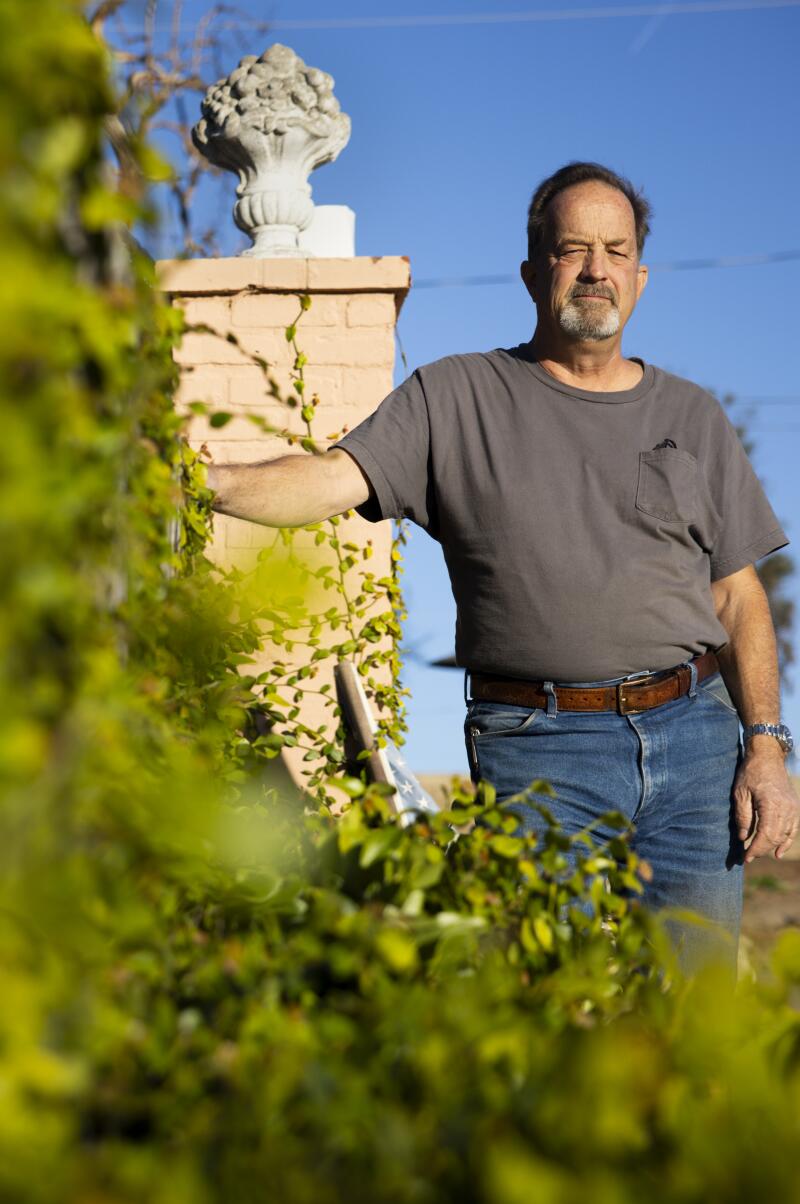


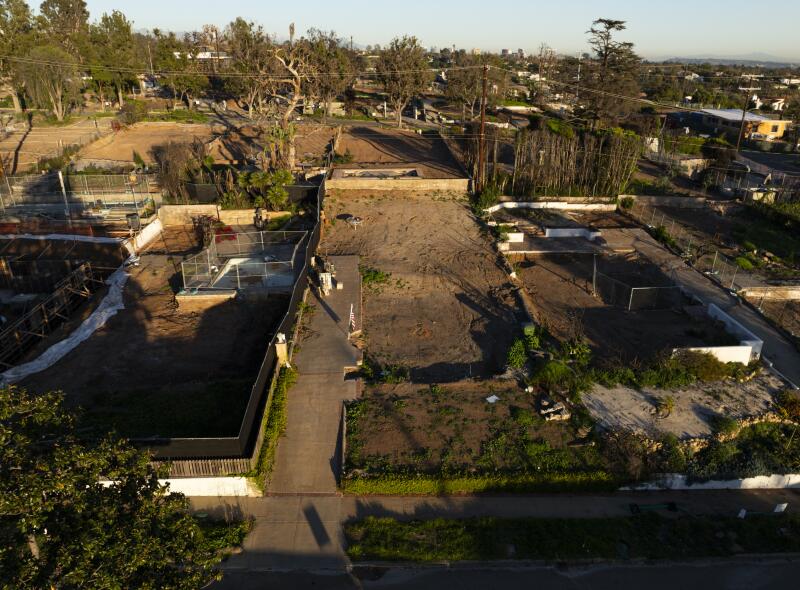
1. Tom Doran poses for a portrait in the remains of his home in the Pacific Palisades. Doran, who has submitted plans to rebuild the home he lived in for decades, has said that Los Angeles Mayor Karen Bass should have done more to secure passage of a law giving residents relief from city rebuilding permits after the wildfires. (Kayla Bartkowski / Los Angeles Times) 2. Statues are seen in an aerial of the remnants of Doran’s home. (Kayla Bartkowski / Los Angeles Times) 3. An aerial of the remains of Doran’s home. (Kayla Bartkowski / Los Angeles Times)
Bass, seated in her spacious City Hall office earlier this month, said the recovery is happening at “lightning speed” compared to other devastating wildfires, in part because of her emergency orders dramatically cutting the time it takes to obtain building permits.
By mid-December, more than 2,600 permit applications had been filed for more than 1,200 addresses — about a fifth of the properties damaged or destroyed in the fire. Permits had been issued at about 600 addresses, with construction underway at nearly 400, according to city figures.
Still, Bass acknowledged that fire victims are feeling angry and frustrated as they enter the holiday season.
“I think people have a right to all of those emotions, and I wouldn’t argue with any of them,” she said.
Rebuilding a community after a natural disaster is a monumental task, one with no clear playbook. Many of the obstacles — insurance claims, mortgage relief — reach beyond the purview of a mayor.
Still, Bass has plenty of power. City agencies crucial to the rebuilding effort report to her. She works closely with the council, whose members have sharply questioned some of her recovery initiatives.
Palisades residents had reason to be skeptical of the rebuilding process, given the problems that played out on Jan. 7: the failure to pre-deploy firefighters, the chaotic evacuation and the fact that Bass was out of the country on a diplomatic mission to Ghana.
In the weeks that followed, Bass was unsteady in her public appearances and at odds with her fire chief, whom she ultimately dismissed. She struggled to give residents a sense that the recovery was in capable hands.
Perhaps the most disastrous narrative revolved around Soboroff, a longtime civic leader known for his blunt, outspoken style.

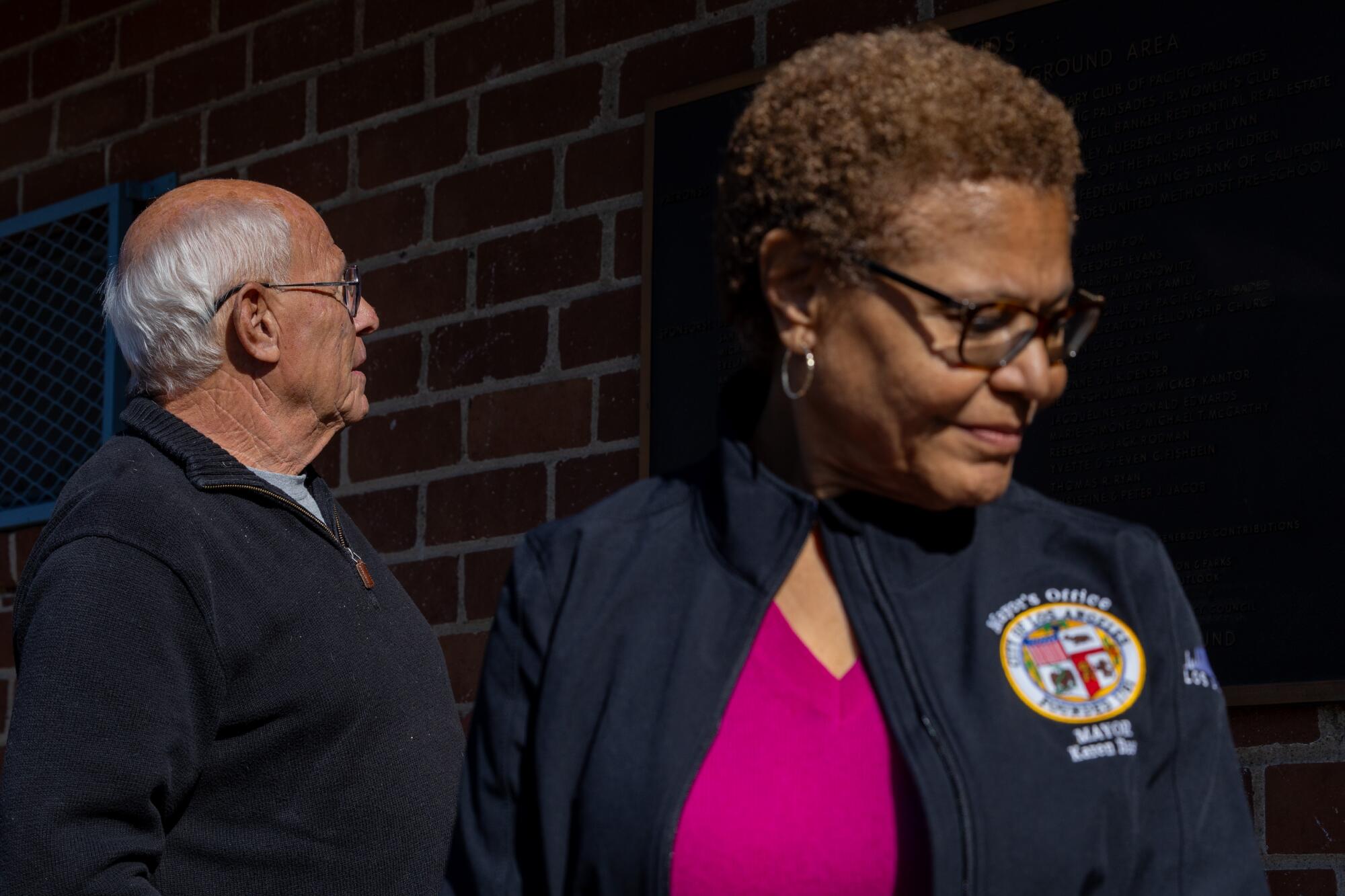
Mayor Karen Bass, right, and her disaster recovery chief, Steve Soboroff, during a news conference at Palisades Recreation Center on Jan. 27.
(Brian van der Brug / Los Angeles Times)
To many, the assignment made sense on paper. Soboroff had a background in home building, roots in the Palisades and extensive knowledge of City Hall.
Soboroff initially expected to receive a salary of $500,000 for three months of work as chief recovery officer, with the funds coming from philanthropy. After that figure triggered an outcry, Bass changed course, persuading him to work for free. Soon afterward, Soboroff told an audience that he had been “lied to” about whether he would be compensated. (He later apologized.)
Soboroff also voiced frustration with the job itself, saying he had been excluded from key decisions. At one point, Bass appeared to narrow his duties, telling reporters he would focus primarily on rebuilding the community’s historic business district and nearby public areas.
Bass told The Times that she does not view her selection of Soboroff as a mistake. But she acknowledged there were “challenges along the way” — and decisions where Soboroff was not included.
“In those first few months when everything was happening, I’m sure there were decisions he wanted to be in that he wasn’t in,” she said.
In April, amid Soboroff’s departure, Bass said she was searching for a new chief recovery officer. She repeated that assertion in July. Yet she never publicly announced a replacement for Soboroff, baffling some in the Palisades and providing fresh ammunition to her critics.
Real estate developer Rick Caruso, who ran against Bass in 2022 and founded the nonprofit SteadfastLA to speed the rebuilding process, said the recovery czar position is still desperately needed, given the size of the task ahead.
“You’ve got infrastructure that has to be rebuilt, undergrounding of power lines, upgrading of water mains. At the same time, you want to get people back in their homes,” said Caruso, who is weighing another run for mayor.

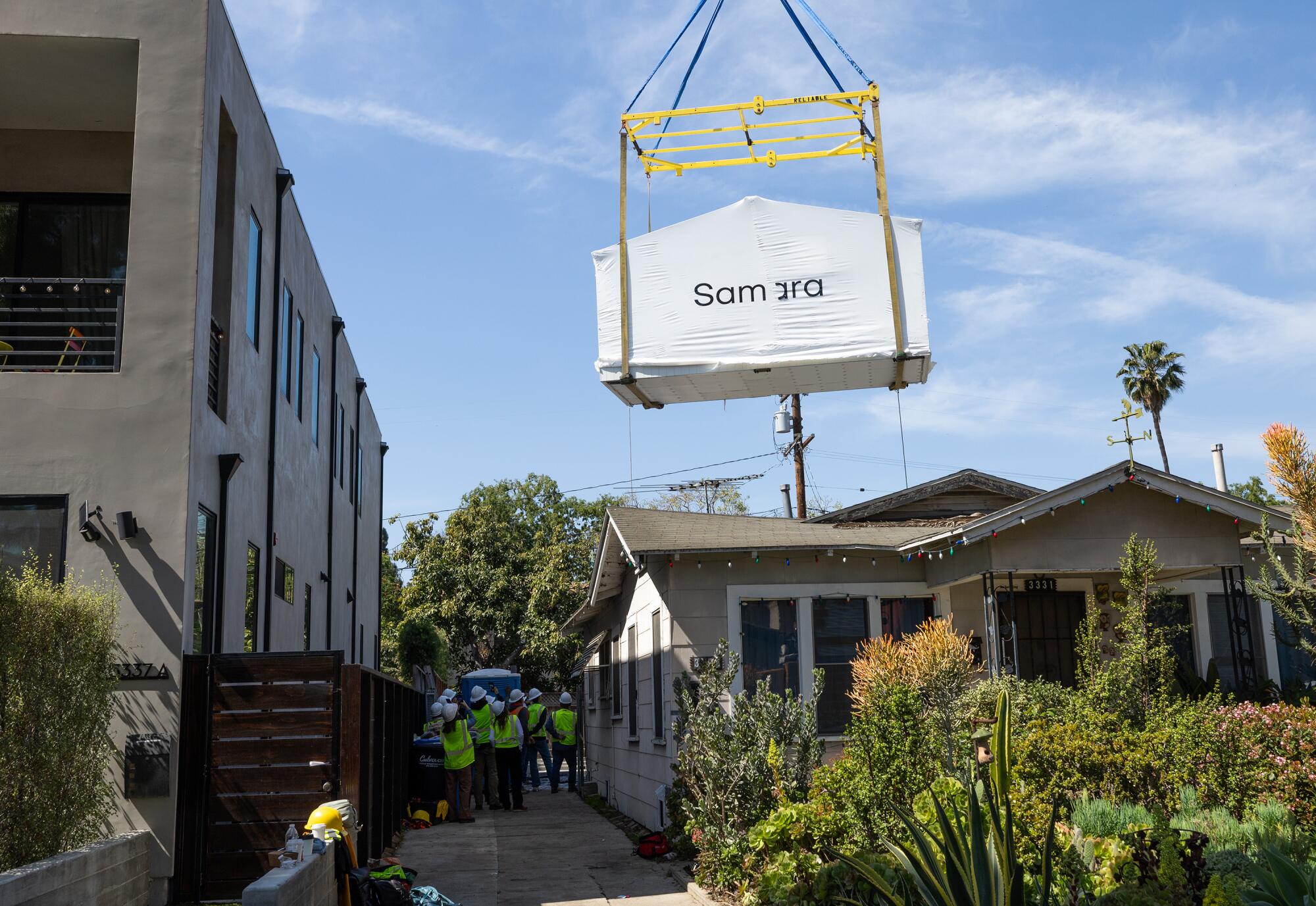
A Samara XL modular house is lowered into place at a project site in Culver City on March 21. Developer and former mayoral candidate Rick Caruso’s Steadfast L.A. nonprofit wants to raise $30 million in the hopes of providing between 80 and 100 Samara XL homes for fire victims.
(Myung J. Chun / Los Angeles Times)
Behind the scenes, Bass opted not to select a single person to replace Soboroff, going instead with a trio of consultants. By then, she had confronted a spate of other crises — federal immigration raids, a $1-billion budget shortfall, a split with county officials over the region’s approach to homelessness.
Soboroff declined to comment on Bass’ handling of the recovery. Early on, he pushed the mayor’s team to hire the global engineering giant AECOM to oversee the recovery. Bass went initially with Hagerty, an Illinois-based consulting firm that specializes in emergency management.
At the time, the mayor pointed out that Hagerty was already working with county officials on the Eaton fire recovery in Altadena and Palisades fire recovery in other unincorporated areas.
The city gave Hagerty a one-year contract worth up to $10 million to provide “full project management” of the recovery, Bass said at the time.
Hagerty quickly ran into trouble. At community events, the firm’s consultants struggled to explain their role in the rebuilding.
Two months after Soboroff stepped down, Bass announced she was hiring AECOM after all to develop a plan for rebuilding city infrastructure. Hagerty ended up focusing heavily on the logistics around debris removal, helping the city coordinate with the federal Army Corps of Engineers, which spearheaded the cleanup.
Hagerty quietly finished its work earlier this month, billing the city $3.5 million — far less than the maximum spelled out in the firm’s contract.
The confusion over Hagerty’s role created a major opening for Bass’ best-known challenger in the June 2 primary election: former L.A. schools Supt. Austin Beutner, a onetime high-level deputy mayor.
Beutner, whose home was severely damaged in the Palisades fire, called the selection of Hagerty a “fiasco,” saying it’s still not clear what the firm delivered.
“The hiring of Hagerty proved to be a waste of time and money while creating a false sense of hope in a community that’s dealing with a terrible tragedy,” he said.
Executives with Hagerty did not respond to multiple inquiries from The Times.

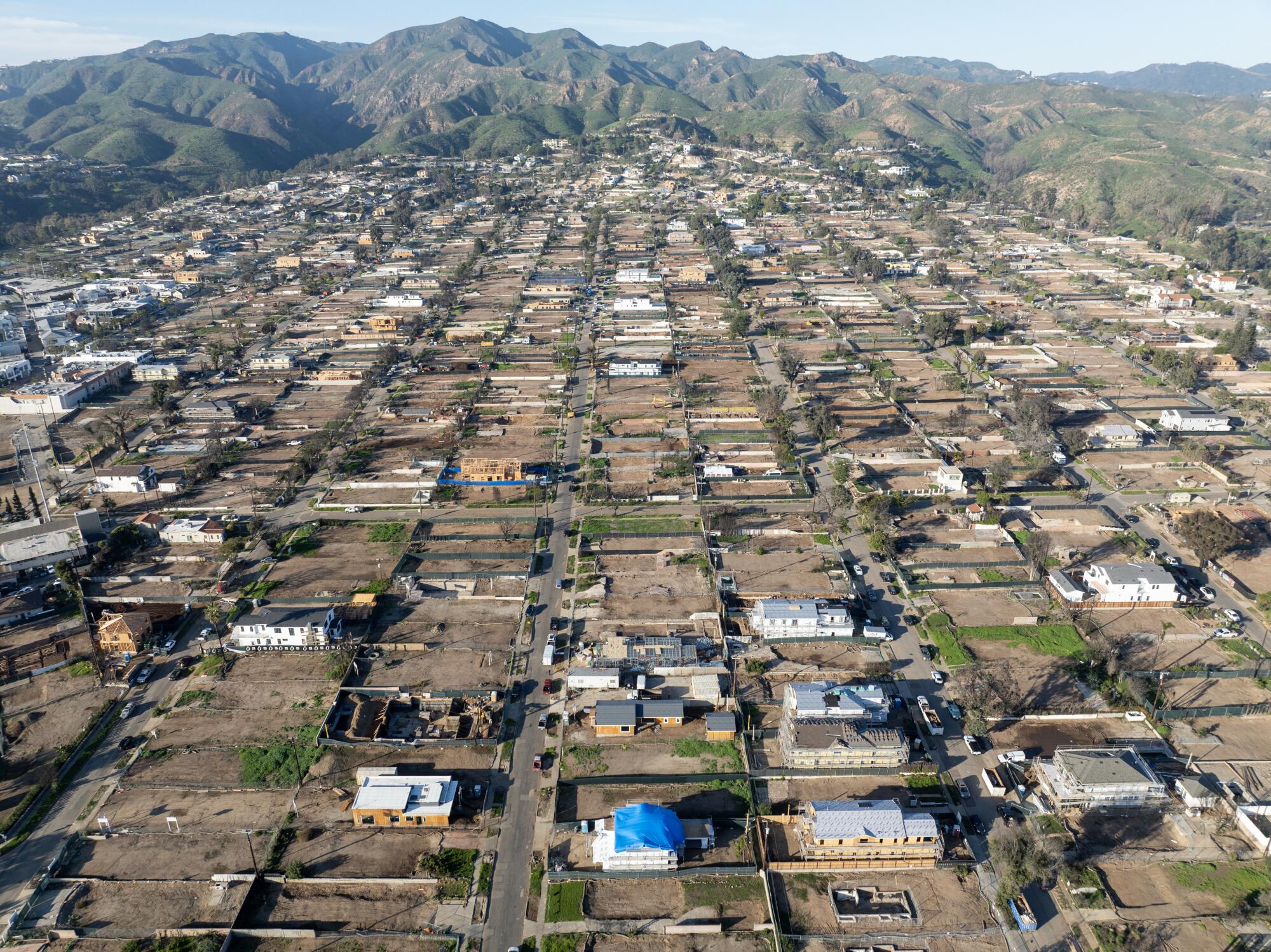
An aerial image of some homes being reconstructed and lots that remain empty in Pacific Palisades.
(Allen J. Schaben / Los Angeles Times)
AECOM joined the city in June, working to prepare reports on the rebuilding effort that dealt with infrastructure repairs, fire protection and traffic management. Those reports are now expected by the one-year anniversary of the fire.
Matt Talley, who spent part of the year as AECOM’s point person in the Palisades, praised Bass for her focus on the recovery, saying he watched as she took lengthy meetings with Palisades community members, then made sure her staff worked to address their concerns.
“I think the mayor gets a bad rap,” said Talley, who left AECOM in mid-November. “She takes a lot of incoming, but in her heart, she really does want to drive the recovery and do the right thing, and that’s evidenced by the meetings she’s having with the community.”
Bass, in an interview, said she eventually decided to have three AECOM staffers form a “recovery team,” instead of a single replacement for Soboroff.
“It didn’t make sense to go in the other direction,” she said. “We evaluated that for quite a while, met with a number of people, consulted many experts.”
By the time Bass announced AECOM’s hiring, she had also begun pursuing another initiative: relief from Measure ULA, the city’s so-called mansion tax, which applies to most property sales above $5.3 million.
Proponents argued that Palisades residents should not have to pay the tax if they sell their burned-out properties. For those who can’t afford to rebuild — either because they are on fixed incomes or have little insurance — selling may be the only option, they argued.
In June, Caruso sent Bass a proposal showing how Measure ULA could be legally suspended. By then, Bass had tapped former state Assembly Speaker Bob Hertzberg to work on a bill overhauling Measure ULA, not only to aid fire victims but to spur housing construction citywide.
Three months later, near the end of the legislative session in Sacramento, Bass persuaded some L.A.-based lawmakers to carry the bill, infuriating affordable housing advocates who accused her of attempting an end run around voters.
But right before a key hearing, Bass announced she was withdrawing the bill, which had been submitted so late that it missed the deadline for lawmakers to make changes.
Bass said city leaders are now working to identify other pathways for suspending ULA in the Palisades.
Meanwhile, her push for permit relief is also a work in progress.


Alice Gould, who lost her home in the Palisades fire, is rebuilding her home on Akron Street in Pacific Palisades. Gould, who has lived on the property for 28 years, is upset that Mayor Karen Bass has not yet secured passage of a law to exempt fire victims from city permit fees for rebuilding.
(Genaro Molina / Los Angeles Times)
In April, a few days after her State of the City speech, Bass issued an emergency order suspending the collection of permit fees while the council drafted the law she requested. If the law isn’t enacted, fire victims will have to pay the fees that are currently suspended.
Councilmember Bob Blumenfield, who sits on the council’s powerful budget committee, said Bass’ team did not contact him before she issued her order.
“When I read that, my first thought was: ‘That’s great. How are we gonna pay for that?’” he said.
Bass issued a second emergency order in May, expanding the fee waivers to include every structure that burned. By October, some council members were voicing alarms over the cost, warning it could reach hundreds of millions of dollars, depending on the details.
Palisades residents called that estimate grossly inflated. On Dec. 2, dozens of them showed up at City Hall to urge the council to pass legislation covering every residential building that burned — not just single-family homes and duplexes, a concept favored by some on the council.
Council members, still struggling to identify the cost, sent the proposal back to the budget committee for more deliberations, which will spill into next year because of the holiday break.
Bass defended her handling of the issue, saying she used her “political heft” to move it forward. At the same time, she declined to say how far-reaching the relief should be.
Asked whether the Palisades should be spared from permit fees for grading, pools or retaining walls, she responded: “I can’t say that,” calling such details “minutiae.”
“What I wanted to see happen was, all fees that were possible to be waived should be waived,” she said.

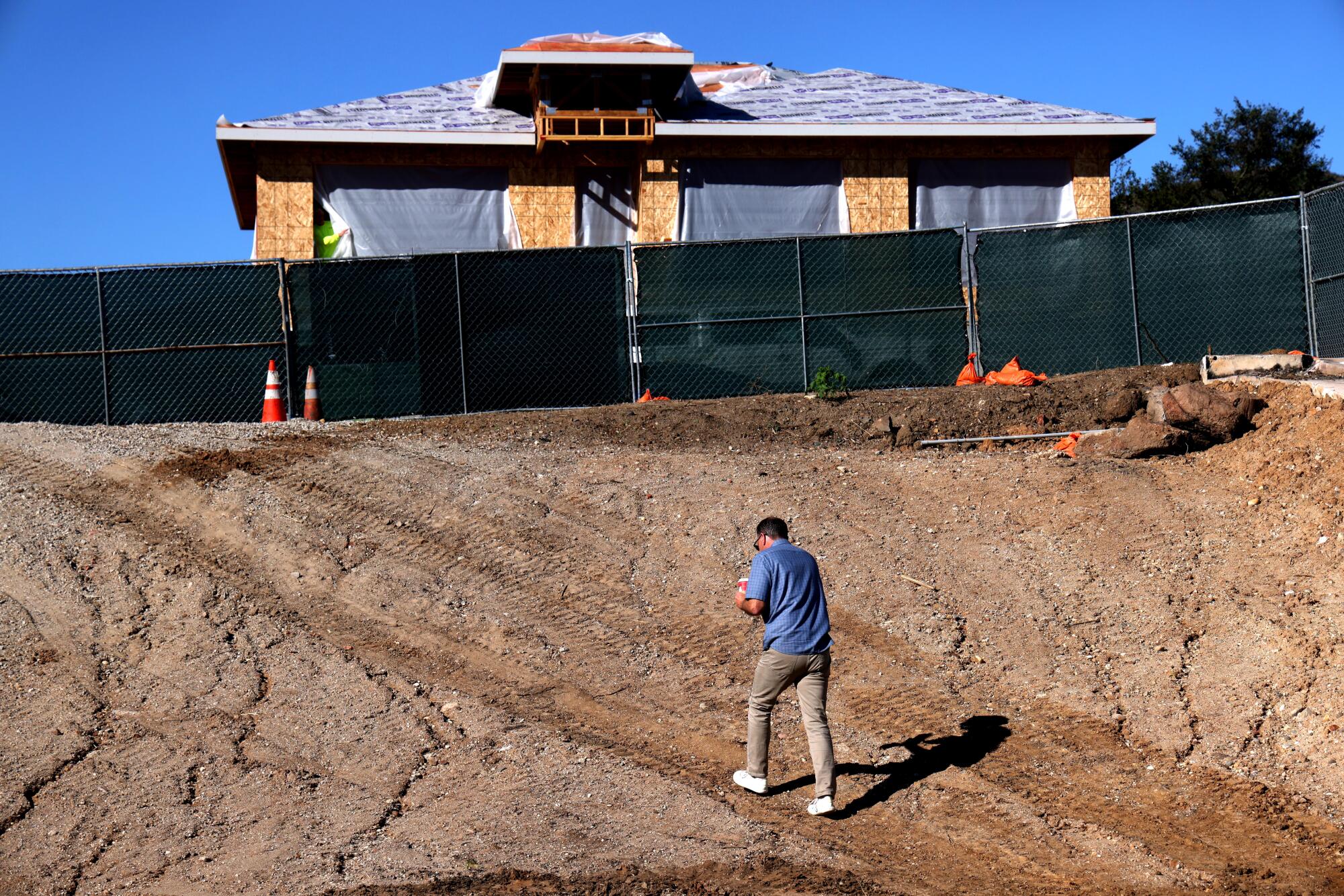
Hank Wright, against a backdrop of his neighbor’s home being built, walks on the property where he lost his four-bedroom home in the Palisades fire.
(Genaro Molina / Los Angeles Times)
Hank Wright, whose four-bedroom home on Lachman Lane burned to the ground, remains frustrated with the city, saying he doesn’t understand why Bass was unable to lock down the votes.
“She has not been the point person that I wanted her to be,” he said. “I don’t think she has been able to corral that bureaucracy.”