


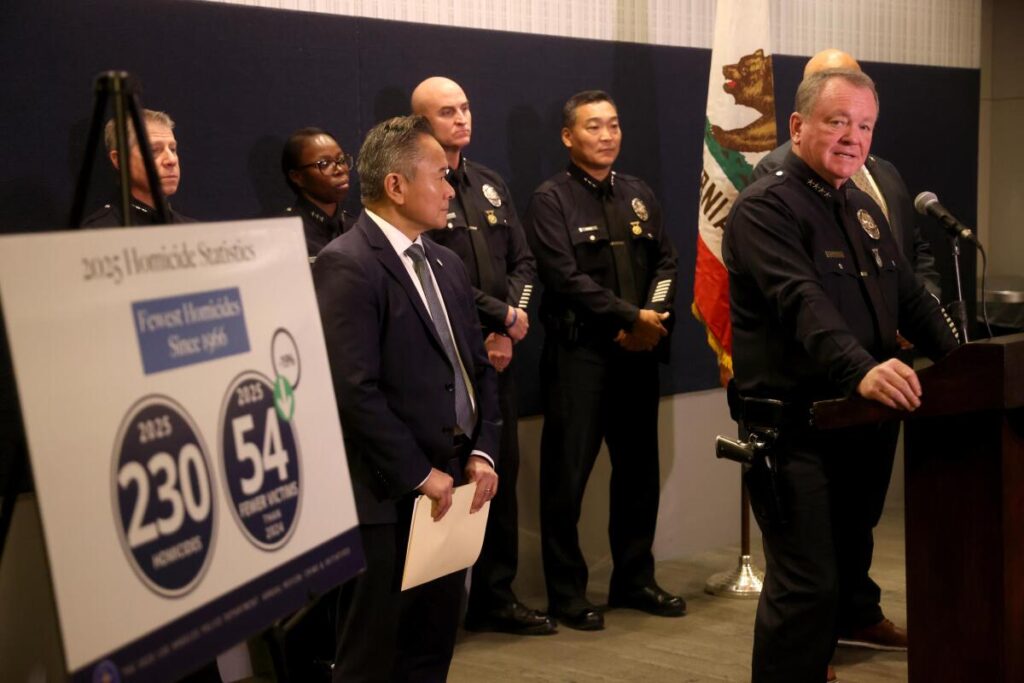
Los Angeles police solved more than two thirds of all homicides citywide in 2025, a year that ended with the fewest number of slayings in six decades, according to statistics presented by local authorities on Thursday.
Of the 230 homicides logged in areas patrolled by the LAPD, officials said that 156, or 68%, were considered solved. By the department’s definition, a homicide can be “cleared” through an arrest or other factors, including if the killing was deemed legally justified or the suspect dies. Whether the case results in criminal charges or a conviction is not part of the department’s methodology.
Factoring in the 78 homicides from past years that were solved in 2025, the clearance rate rose to 101%, officials said.
LAPD Chief Jim McDonnell said the department’s success in solving homicides was the result of more data-driven actions against the relatively small number of individuals responsible for an outsize proportion of violent crimes, as well as collaboration with federal law enforcement and other agencies.
McDonnell pointed to an 8% reduction in the number of gunshot victims citywide, a decline he attributed to a significant increase in the number of guns seized by police. In 2025, LAPD officials recovered 8,650 firearms, 1,000 more than the previous year, he said. Gang killings still account for most of the city’s homicides, but are far below where they were in years past, officials said.
The chief said police need to remain diligent since “every life lost was one too many.” The trends for other categories of violent crime were a “mixed bag,” he said, and concerns about property crimes such as burglary and vehicle thefts remain ongoing.
He said that the declining numbers were proof that a depleted department, stretched thin by low recruitment numbers and recent protests and wildfires, was still performing admirably. At the same time, he acknowledged that the decline was likely also the result of other factors that govern the ebb and flow of crime.
Historically, experts have cast a skeptical eye on police-driven explanations for clearance rates, arguing that community attitudes and behaviors, prosecutors’ thresholds for filing homicide charges, and other variables may have more to do with solving homicides more than any particular law enforcement model.
The homicide tally marked the city’s lowest total since 1966, when the city’s population was nearly a third smaller. The downturn mirrors precipitous drops in many other large cities nationwide last year — and has sparked a range of theories about what’s going on.

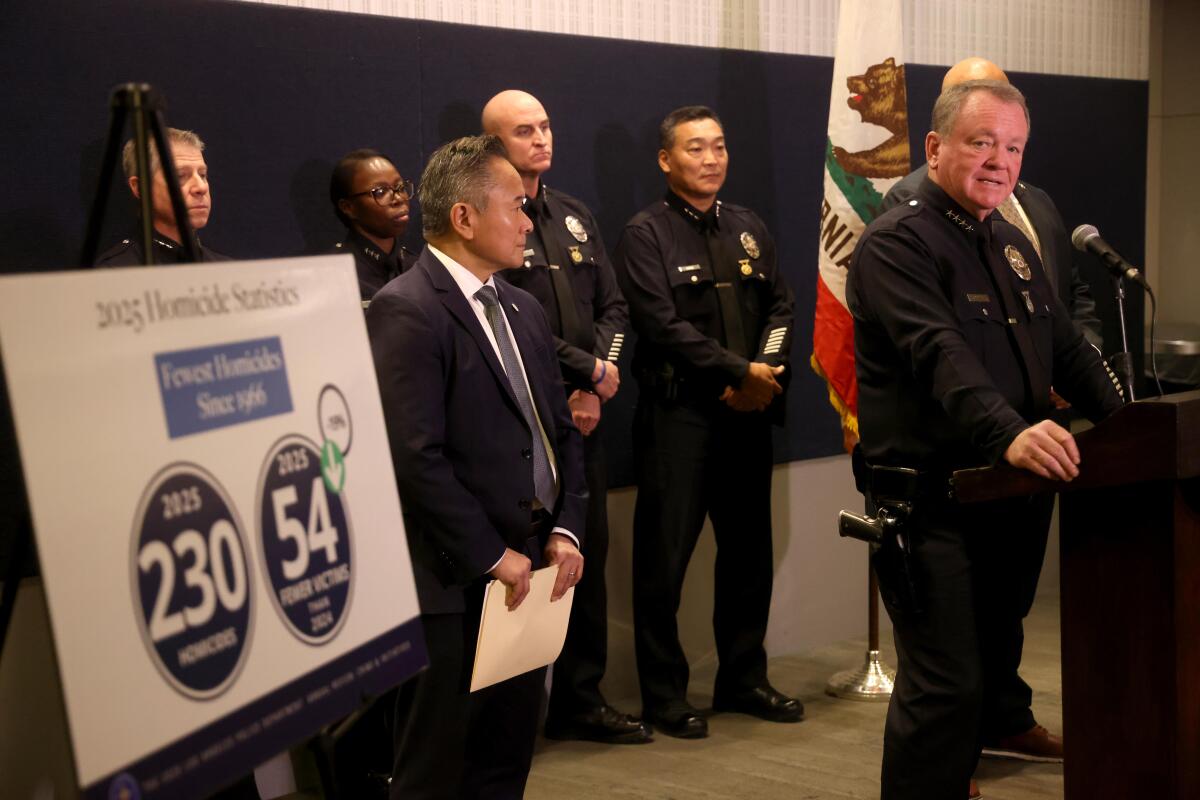
LAPD Chief Jim McDonnell, right, points to statistics showing an increase in the homicide clearance rate, a measure of how often detectives are marking investigations as closed.
(Genaro Molina / Los Angeles Times)
For those who view violent crime as a public health issue, the steep decrease is rooted in powerful social forces that are far beyond the control of law enforcement. Those factors include the return of social services that declined during the pandemic, and fatigue from decades of bloodshed.
Still others say it’s simply a matter of numbers: with lighter caseloads, homicide detectives have more time to thoroughly investigate each new killing.
Sal Labarbera, a former supervisor of detectives in South Bureau homicide, called the citywide solve rates a “beautiful” achievement.
“This is how it’s supposed to be. When murders are down, reinforce the teams and solve the older cases. In the past, when homicides were down, they sometimes took detectives away from homicide investigations,” he said. “It’s especially extraordinary considering the number of sworn officers are decreasing.”
According to statistics maintained by the state Department of Justice, homicide clearance rates statewide have hovered around 60% over the past decade, with a high of 64.6% in 2019 and a low of 54.5% in 2021. In Los Angeles, the percentage of slayings that have been solved rose slightly from 2024, but was down from the 79.9% clearance rate that the department achieved in 2023.
The data presented at a news conference Thursday didn’t offer a breakdown of how last year’s solve rates differed geographically in the department’s 21 patrol areas.