


TWO years ago, Take That’s Howard Donald delivered 52 tapes to Netflix in an enormous Ikea bag.
He had spent the past 35 years quietly filming the band as they transformed from working-class lads into bona fide global stars.
“Are you sure it wasn’t a Prada bag?” Howard teases as I interview the group to celebrate the release of a three-part Netflix docuseries based on that footage.
Jokes aside, Howard, Gary Barlow, Jason Orange, Mark Owen and Robbie Williams handed full editorial control to director David Soutar to tell their story with zero interference.
It was a bold move given the much-publicised trials and tribulations of one of Britain’s biggest bands, who have landed 12 No1 singles in their 35-year career.
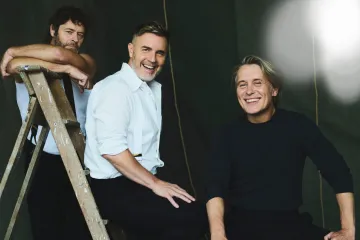
The series features candid new interviews with current members Gary, 55, Howard, 57, and Mark, 54, alongside never-before-seen footage and photographs.
Robbie, 51, and Jason, 55, allowed archive chats with them to be used to narrate their part in the story.
In one emotionally-charged interview, Gary talks about his struggle with bulimia, which started following Take That’s split in 1996 and his rivalry with Robbie.
Taunts from Robbie are replayed during the documentary, with footage showing him saying: “My problem always was with Gary, I wanted to crush him. “I wanted to crush the memory of the band and I didn’t let go. Even when he was down I didn’t let go.”
Speaking at the premiere of the documentary at Battersea Power Station in South London on Monday night, Gary admits it was tough to watch.
‘Butt of the joke’’
He said: “It’s a narrative that I haven’t thought about for years and years. When we had our reunion we spent a lot of time talking about it and I remember leaving on one particular day and we’d discussed everything. And I remember leaving and my shoulders were light.
“And I’d not thought about it since because I’d not needed to. And it brought it all back. Tricky times they were.”
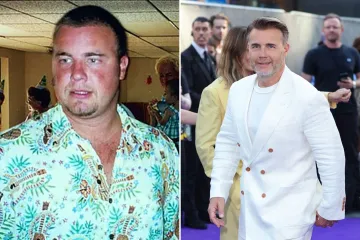
In the documentary, Gary shares previously unseen photographs of him as he struggled to find his purpose and says: “You’re the butt of the joke. It was so excruciating you just want to crawl into a hole.
“There was a period of 13 months where I didn’t leave the house once. I’d also started to put weight on.
“The more weight I put on the less people would recognise me and I thought, ‘This is good. This is what I have been waiting for. This is a normal life’.
“So I went on this mission then, if the food passed me I would just eat it. And I’d killed the pop star.
“I would have these nights and I would eat and eat and eat but however I felt about myself, I felt ten times worse the day after.”
At his heaviest, Gary, who has three children with his wife Dawn, weighed just over 17 stone.
He explained: “One day I thought, I have been out, it’s 10 o’clock, I have eaten too much, I need to get rid of this food.
It only took a few years to get that low, but it took me years to get back to who I wanted to be. Ten years probably.
Gary Barlow
“You just go off to a dark corner of the house and you make yourself sick. You think it’s only once and all of a sudden you’re walking down that corridor again and again.
“Is this it? Is this what I am going to be doing forever?”
By 2003, Gary turned his life around, and he said: “I just went, ‘No, I’m not having this any more, I’m going to change. I want to change and I’m determined that this is not who I’ve become’.
“It only took a few years to get that low, but it took me years to get back to who I wanted to be. Ten years probably.”
Discussing his recovery with The Sun in 2021, he explained: “I’ve been very strong-minded about how I live and what I eat.
“In general, I work on a 90/10 — 90 per cent sensible-choice food and ten per cent fun choices.
“Buy a nice little writing book, one you’ll feel good about holding and keeping on you at all times. Do a food diary every day, and look down and you’ll see what you’re doing wrong.
“A food diary will also show you what you’re missing in your diet. If you want to get serious and go to a dietician or to a friend and seek help, you can show them the diary.”
Howard is also painfully honest about how hard life was following the end of Take That.
In the documentary, Howard recalls returning home and says: “I felt like I was the only one who didn’t grow up, even though I was the eldest.
“I was a nobody in school, I didn’t go to university, I didn’t think I’d do anything but I felt like a superhero up on that stage.
“It was going towards a depressive state. I decided to go to the Thames.
“I was seriously thinking I was going to kill myself but I was too much of a s**tbag to do it.”
Speaking backstage at the premiere, Howard explains that the band did not want to hide the painful parts of their journey.
He said: “I think it is such a true documentary. You can easily do a documentary and take out all the bits that you feel uncomfortable with — and there are quite a lot of uncomfortable bits in there.
“But it’s true of the last 35 years of Take That. There is a lot of footage people have never seen. It’s good for people to see.”
Mark is also seen struggling to cope with life after the band, who landed their first Top Ten hit with a cover of Tavares’ It Only Takes A Minute in 1992.
He said backstage: “We were working hard, playing all these gigs and things got very hard — but then we got back together. Maybe miss out on the middle bit.”
‘I got a lot of stick’
Like Robbie and Gary, Mark attempted to launch a solo career, but was dropped by his label in 1997, a year after Take That split.
He added: “You start to feel very negative about yourself.”
Robbie and Jason’s clashes with the band’s former manager, Nigel Martin-Smith, are also discussed in the doc.
Robbie says: “Nigel as a manager, he never managed me, he managed Gary Barlow. I wanted him to love me but he never did.”
Jason adds: “When I was in Take That the first time around I was the dancer and I accepted that at the time.
“I don’t know if this is the time or place to say, I was told not to bother singing, ever.”
After the group came back as a four-piece without Robbie in 2005, they ceased working with Nigel and found new representation.
Of the change, Jason says: “Robbie and I got a lot of stick from Nigel. He made us all feel insecure.
“I could feel worthless in the band and I didn’t deserve to feel that. I didn’t want to feel that any more.
“We had chosen our own management, we had chosen our own people, we were in control.”
Director David admits there was some trepidation when it came to showing the three episodes for the first time.
In about 25 minutes we’d put things to bed that had haunted us for years.
Gary on Robbie feud
Speaking backstage alongside producer Gabe Turner, David said: “We talked long and hard about how to do it.
“There is some really hard stuff in there for them, it was a tricky thing for them to watch and it was nervy for us to watch it with them.
“They allowed us to push them to that place. We asked them to lay down their story and they allowed us to take them to that place.”
Gabe added: “Episode two is punchy. With a lot of documentaries you are building that relationship for the first time, you’re working on the fly, but these guys know us and know what we want to do.
“I felt really positive about how little they wanted to see it. They handed us the keys and said, ‘Do you thing’.”
As well as the tough times, Take That fans get a front seat to the inner workings of the group’s comeback with Robbie in 2011.
‘Haunted us for years’
Opening up about healing their old wounds, Robbie says: “I needed Gary to listen to my truth.”
Gary continues: “There were things around people not being supportive of his songwriting and his weight. I’d called him Blobby rather than Robbie one day, which I shouldn’t have done.
“Then I hit him with things he had done to me that I didn’t like
“In about 25 minutes we’d put things to bed that had haunted us for years.”
As well as hearing original demos on the series, fans also get treated to a new single, You’re A Superstar, at the end of the third episode.
The track, taken from their tenth album, is expected to be released later this year.
We’ve got the first steps, we’ve got the Netflix documentary, then we’ve got the Circus tour, then there will be new music.
Gary
Backstage at the screening in London, Howard said the trio have spent months working on the material, adding: “It’s going really well.
“We’ve all been writing separately, writing together and I think we’ve got a really good choice of really good songs.
“We are really proud of them and we just can’t wait for people to hear them.
“We’ve got the first steps, we’ve got the Netflix documentary, then we’ve got the Circus tour, then there will be new music.”
Mark continued: “The tenth album feels quite special. I am really excited about what I am hearing.
“It’s given us a boost, the songs that are coming through and the fact it’s our tenth record, it’s like ‘Go on guys!’.”
Ahead of their 17-date Circus Tour, which kicks off at St Mary’s Stadium in Southampton on May 29, fans will be wondering now if history will repeat itself — and Robbie will rejoin again.
And Gary for one is hopeful, saying yesterday: “At some point it’s going to happen.
“And that’s one of the wonderful things about our band — you never know what’s around the corner.”
- Netflix’s Take That is available to stream now.
BRAVE BOYS GO WARTS AND ALL
THESE days, most big stars who promise a warts-and-all documentary about their lives end up pulling a Kim Kardashian and overseeing every last scene.
But not Take That, who were brave enough to hand over hundreds of hours of footage to Netflix to tell their story.
For the most part, the three-parter is the most mesmerising trip down memory lane – with Gary, Howard, Jason, Robbie and Mark starting their career in the band by performing in gay clubs and then school halls in a desperate bid to make it.
But with all the hilariously fun Nineties fashion and moments of shared joy, there is a heavier undertone that echoes around episode one before loudly arriving in the second.
The realities of being shoved into the emotional mincing machine, which was sadly part and parcel of being a pop star in the Nineties, are hard to watch.
My heart hurt as Mark, who penned my favourite Take That song Shine, begged people to ask about his solo music when the band split in 1996 – and when Jason admitted he was told that he was only good enough to dance and “shouldn’t bother singing”.
And I was close to tears as Howard recounted reaching such a desperate point after they split that he considered taking his own life.
I’m lucky enough to work with big musicians regularly and, each time, I am reminded that no matter how famous they are, they are all human.
I’ve watched artists break down backstage under the strain of big tours and have been privy to quiet moments of anxiety and fear over their chart performances.
For Take That to pull back the showbiz curtain to allow the public and fans to see the realities of the highs and lows of fame was a brave move – but, boy, it paid off.
For me, it’s a must-watch.