


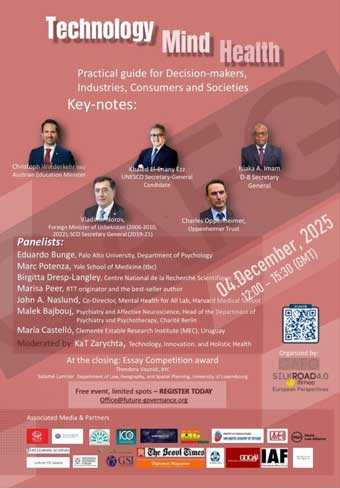
The Technology Mind Health half-day summit, hosted by the Global Academy for Future Governance (GAFG) and its partners, brought together interdisciplinary leaders, researchers, and thinkers to explore the intersection of digital technologies and human psychological well-being. Reflecting the Academy’s foundational mission to enhance the development of governments, businesses, academia, civil society, and consumers through ethical and human-centered deployment of technology, the event underscored that technological progress, when governed thoughtfully, can strengthen individual and collective mental health rather than undermine it.
What made this event truly unparalleled on a global scale was its extraordinary diversity, uniting every geography and every generation under the Global Academy’s platform. No other gathering brings together both the developing and the developed world in such a format—not only in its audience but also among its speakers.

The summit indeed offered a genuinely equal platform across continents and age groups: from seasoned experts and leading professionals to the youngest participant, just 11 years old. All stood side by side, engaged in a shared mission to confront one of the most urgent issues of our time, the relationship between technology, mind, and health, and to collectively explore the challenges and chart future pathways.
Or, as the Development-8 Secretary-General, Isiaka A. Imam, urged previously, the emerging digital world must be co-written by all nations, not inherited by a few. These are words that were further detailed by Charles Oppenheimer, who warned that AI is a new primordial fire, powerful enough to uplift humanity or to undo it.
Mission and Framing
Founded to advance the ‘3M’ matrix (maximum good for maximum species over maximum time), mindful, measurable, and mutually beneficial technological integration across sectors, the Global Academy for Future Governance promotes sustainable progress free of hidden social, environmental, and health costs. Its interdisciplinary, multispatial, cross-sector mandate aligns with pressing global needs to distinguish substantive technological challenges from hype and to strengthen frameworks that enable early identification and mitigation of risks.
The Technology Mind Health summit of early December 2025 opened with a warm introduction delivered by Dr. Philippe Reinisch, GAFG co‑founder. He highlighted this gathering as the inaugural event for the newly created GAFG and emphasized the importance of bridging technology and society with human enhancement, including human mental wellness.
Acting as the GAFG host, Jesinta Adams, Assistant Director-General of GAFG, spoke passionately about the central role different generations play at the intersection of technology and mind health.
Voices from Leadership and Thought
The event began with a prerecorded (unauthorized) address by Dr. Khaled El‑Enany Ezz, a candidate for UNESCO Secretary‑General. This powerful note reflected on humanity’s current crossroads amid rapid technological change, underscoring rising challenges related to health, wealth inequality, and psychological well‑being. He emphasized education as the essential tool for guiding technological deployment with wisdom, extending beyond technical mastery into cultural and ethical literacy. His message was clear: “Use technology as a tool rather than a master.”
Following this, Vladimir Norov, former Foreign Minister of Uzbekistan and former Secretary‑General of the Shanghai Cooperation Organisation, addressed the Summit. He drew attention to expanding societal risks, including threats to mental health, social cohesion, privacy, and equitable access, but urged attendees to consider the transformative potential of AI when governed ethically. Highlighting examples from medical innovation in Central Asia, Norov stressed three core principles for beneficial technological integration: human‑centered design, ethical governance, and resilience building. He concluded, “Technology does not replace us but elevates us.”
Expert Contributions on Mind, Health, and Technology
Closing on the high level, the keynote addresses and the substantive section as the central part of the Summit have started with Dr. KaT Zarychta, a specialist in technology, innovation, and holistic health. She opened by comparing artificial intelligence to the human mind, reminding audiences that AI cannot feel, empathize, or emotionally self‑correct. She argued that the most effective path forward lies in human‑AI collaboration, where evidence‑based digital tools support rather than supplant human capacities. Dr. Zarychta closed with a call to co‑create a world where psychological well‑being is nurtured and protected in tandem with technological innovation.
As the next speaker, Marisa Peer, RTT founder and bestselling author, focused on the role of social media as a source of disconnection and psychological distress. She highlighted the platforms’ addictive dynamics and their proliferation of unrealistic ideals that fuel dissatisfaction and self‑doubt. She urged reimagining digital spaces as tools for learning, growth, and mental enrichment—enabling technology to expand, not contract, human potential.
Prof. John A. Naslund, co‑director of the Mental Health for All Lab at Harvard Medical School, addressed the global mental health crisis, particularly rising depression rates. He introduced the EMPOWER Model, a psychosocial behavioral intervention framework emphasizing community‑based support and scalable delivery. Naslund highlighted the model’s adaptability, from teenagers to adults, and its multilingual expansion, demonstrating how evidence‑driven designs can strengthen resilience across populations.
Dr. Malek Bajbouj, Head of Psychiatry and Psychotherapy at Charité Berlin, examined psychological health in contexts of conflict, pandemics, and ecological anxiety. He described the accelerating demand for mental health support and positioned trustworthy digital tools as essential if governed ethically. According to Dr. Bajbouj, resilient mental health systems rest on population‑wide strategies, transparent communication, and sustained trust in public institutions.
From Uruguay, Professor María Castelló of the Clemente Estable Research Institute investigated neurological and psychological effects of prolonged technology use, especially in youth. She highlighted concerns about brain development, anxiety, depression, and unhealthy digital habits. Yet Castelló also acknowledged potential cognitive benefits, such as enhanced memory, behavioral functioning, and multitasking skills. Her call to action called for policies that address digital inequities and mental health from a neuro‑social perspective rather than one‑size‑fits‑all approaches.
In her part, Prof. Birgitta Dresp-Langley identified excessive childhood exposure to digital environments as a central factor underlying a range of growing health concerns. Prolonged screen time indoors reduces children’s exposure to natural daylight, which is essential for healthy visual development, sleep regulation, and metabolic balance. This deficit is linked to increasing rates of early myopia, obesity, sleep disorders, depression, and behavioral difficulties, with risks emerging even in very young children.
French professor Dresp-Langley proposes a unifying biological model in which reduced daylight and increased artificial light disrupt vitamin D and melatonin production, leading to deregulation of serotonin and dopamine pathways in the developing brain. These neurochemical changes resemble those seen in addictive disorders and may result in long-term cognitive, emotional, and behavioral consequences. She concluded her detailed writing contribution to the Summit by concluding that urgent awareness, preventive policies, and increased outdoor activity are needed to mitigate these risks.
Youth Engagement and Future Directions
The event culminated with the announcement of winners from the Technology Mind Health Essay Competition, led by Theodora Vounidi (Balkan Youth Initiative founder). Contestants (aged 14-18 and 18-28) discussed the correlation between digital technology and mental health and the need for balance between analog and digital time, as well as the newly formed ‘always online’ (sub-)culture.
With 40 global submissions comprising about 60 writers, as some elected to work in teams, including from the youngest entrant at age 11 (demoiselle Tess), the competition highlighted both the breadth of youth engagement and the global relevance of the human technology dialogue.
First place was awarded to Nikos Galitsis from Greece, second place to Claudio Monani from Italy, and third place was awarded to Kenedy Agustin from the Philippines, while fourth place was secured by a participant from India. Fifth place was awarded to the youngest entrant from Singapore. The top three winners of the competition were given the opportunity to present their work, offering insightful perspectives on the emerging intersection of technology and mental health.
Main takeaways & future outlook
The Technology Mind Health summit highlighted a crucial truth—as encapsulated in the closing remarks by Prof. Anis H. Bajrektarevic, GAFG cofounder, “technological advancement is inevitable, but its impact on humanity is not predetermined—it depends on the collective choices we make.”
Across sessions, speakers emphasized that technology can either be a catalyst for psychological well-being or a source of disruption, depending on how it is designed, governed, and integrated into society. Ethical frameworks, evidence-based policies, and human-centered governance are essential to ensure that digital tools empower rather than diminish individual and collective mental health.
Equally important is the role of education, intergenerational dialogue, and global collaboration. As the GAFG summit demonstrated, solutions require insights from every sector, culture, and age group—from seasoned professionals to the youngest participants. By fostering awareness of risks such as digital overexposure, social media-induced stress, and inequitable access, while simultaneously encouraging innovative approaches for mental wellness, society can navigate the technological landscape thoughtfully.
Ultimately, the responsibility to shape a future where technology enhances rather than undermines human flourishing lies with all stakeholders—governments, academia, civil society, businesses, and individuals alike.
By successfully conducting such a complex and content-rich event, the GAFG demonstrated its true capability to provide flexible, impartial, and highly engaging solutions for the FAST technology to both the public and private sectors.
In recognition of the summit’s success and the youth essay competition’s impact, the Global Academy for Future Governance (GAFG) has decided to annualize both the Technology-Mind-Health Summit and the essay competition (with its BYI partner), ensuring ongoing dialogue and engagement at the intersection of technology, meridians, generations, and mental well-being.