


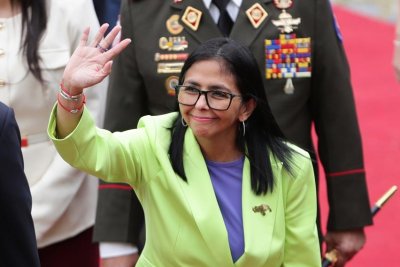
“The people of Venezuela do not accept orders from any external actor. The people of Venezuela have a government and that government obeys the people,” interim President Delcy Rodriguez said Monday. Photo by Ronald Pena/EPA
Jan. 27 (UPI) — Venezuela’s interim president, Delcy Rodríguez, has reiterated comments made over the weekend that her country “does not take orders from any external actor,” saying the government answers only to the Venezuelan people.
Her remarks Monday followed recent statements by U.S. officials about Venezuela’s political and economic direction after the Jan. 3 U.S. military operation that captured former president Nicolás Maduro and his wife.
Rodríguez spoke during a public consultation on a partial reform of Venezuela’s Organic Hydrocarbons Law, according to local newspaper Últimas Noticias. She was responding to comments by U.S. Treasury Secretary Scott Bessent, who suggested Washington could influence decisions by the Venezuelan executive branch and the timing of possible elections.
“The U.S. Treasury secretary has made statements that are inappropriate and offensive, and I have to respond to them,” Rodríguez said. “The people of Venezuela do not accept orders from any external actor. The people of Venezuela have a government and that government obeys the people.”
Her comments came shortly after Bessent said leaders of Venezuela’s executive branch would follow orders from President Donald Trump‘s administration.
“We have left members of the [Venezuelan] government in their positions and they will take charge of administering the country,” he said in an interview with the YouTube channel Derecha Diario TV. Bessent also suggested that other leaders could be placed “under custody,” without naming names, “for the benefit of the Venezuelan people.”
Bessent added that “Everyone says, ‘What if Venezuelan leaders return to their old habits?’ I think when they see the videos of the president being expelled from Caracas and in a cell in New York, they will follow U.S. orders.”
On Sunday, Rodriguez delivered a similar message during a meeting with oil workers in the eastern state of Anzoátegui, where she openly criticized foreign interference in Venezuela’s internal affairs.
“Enough of Washington giving orders to politicians in Venezuela. Let Venezuelan politics resolve our differences and internal conflicts,” she said, according to footage broadcast by state television network Venezolana de Televisión.
In her latest remarks, Rodríguez said Venezuela does not rule out relations with the United States as long as they are based on mutual respect.
“We are not afraid of respectful relations with the United States, but they must respect international law, Venezuela’s dignity and its history,” she said.
At an event Monday with business leaders and officials from the energy sector, Rodríguez also outlined the government’s projections for the oil industry — the country’s main source of revenue.
She said the government expects a 55% increase in oil investment by 2026 as part of a strategy to revive crude production, according to financial outlet Ámbito Financiero.
Investment in the sector totaled nearly $900 million last year and is projected to reach $1.4 billion in 2026. The plan is supported by a legal reform that has already passed a first reading in parliament.
The initiative seeks to loosen regulatory conditions and expand participation by domestic and foreign private companies. A central pillar of the reform using productive participation contracts, enabled under the so-called Anti-Blockade Law, which the executive branch describes as a successful model.
Rodríguez said these contracts have helped attract capital and boost production despite international sanctions, adding that 29 such agreements are in place.
“We have to move from being the country with the largest reserves on the planet to being a giant producer,” she said, defending a framework that keeps state ownership of resources while incorporating new management models.
During the hydrocarbons law consultation, Chevron Venezuela President Mariano Vela highlighted the company’s long-standing presence in the country, noting that Chevron has been a key partner in Venezuela’s oil industry for more than 100 years.
He thanked Chevron’s Venezuelan workers, joint venture employees and state oil company PDVSA for their long-term commitment to building “an even brighter future for the Venezuelan people.”
“We are prepared to continue contributing our operational expertise with technological innovation, hard work and the goal of creating a more competitive oil and gas sector,” Vela said.