



The U.S. Air Force is in the process of taking back responsibility for the Airborne Command Post (ABNCP) mission, better known by the nickname Looking Glass. ABNCP is a nuclear command and control mission set, which involves relaying orders to nuclear-capable bombers and silo-based Minuteman III intercontinental ballistic missiles. In turn, the service is working up new requirements for future aircraft serving in this role, which are commonly referred to as ‘doomsday planes,’ and one option might be the forthcoming Boeing 747-based E-4C Survivable Airborne Operations Center (SAOC) jets.
Air Force Gen. Stephen Davis, head of Air Force Global Strike Command (AFGSC), talked about the future of Looking Glass and the E-4C during an exclusive interview with TWZ‘s Howard Altman. The U.S. Navy is separately working to retire its fleet of Boeing 707-based E-6B Mercury jets that currently serve in the Looking Glass role with joint crews that include Air Force personnel. The E-6Bs also perform the Navy’s Take Charge And Move Out (TACAMO) mission, which entails the ability to relay orders to Ohio class nuclear ballistic missile submarines, even if they are submerged. The Navy’s replacement E-130J Phoenix II aircraft will only be configured for the TACAMO mission.




This is Davis’ first interview since taking up his current post last November. He also discussed ongoing work on the B-21 Raider and other areas of interest for his command.
“In terms of the Looking Glass platform, we did get recently assigned, the Air Force did, that mission [and] that will come to Global Strike,” Davis said. “We’re currently developing the capabilities documents, the requirements for that.”
“No decision has been made on if that will be a separate platform, or that might be collocated or brought into the SAOC program,” Davis added. “So, no decision on that at this point.”
The E-4Cs are set to supplant the Air Force’s current fleet of four E-4B Nightwatch aircraft, also known as the National Airborne Operations Center (NAOC). Three of those planes started their careers in the 1970s as E-4A Advanced Airborne Command Posts (AACP) before being upgraded to the E-4B standard. The fourth E-4B was acquired separately in the 1980s. The E-4Bs are all based on the older 747-200 models that have become steadily more difficult to operate and maintain. Boeing shuttered the 747 production line entirely in 2022. As such, the Sierra Nevada Corporation (SNC) is converting newer 747-8is acquired second-hand from Korean Air into E-4Cs.

The E-4Bs and future E-4Cs are both also described as ‘doomsday planes,’ but are also capable of acting as larger and more robust flying command centers than the E-6Bs.
For the Looking Glass mission, the current E-4Bs do lack a key feature: the Airborne Launch Control System (ALCS). With the ALCS, the E-6Bs can directly command the launch of Minuteman III missiles while in flight. This creates an additional obstacle to any adversary that might seek to prevent the use of these silo-based intercontinental ballistic missiles with a first strike targeting ground-based command and control links. It is worth noting here that the main purpose of the Minuteman III force is as a ‘warhead sponge’ that would require an opponent to expend substantial resources on trying to neutralize it in any nuclear exchange.


Witness History: Unarmed ICBM Test Launch – 625th Strategic Operations Squadron
One E-4B was test-fitted with ALCS in the past, at a time when the Air Force envisioned those aircraft taking over the Looking Glass mission from EC-135Cs used in that role at the time. The service subsequently decided it was too expensive to use the NAOCs for that mission. Looking Glass passed to the Navy’s E-6s after the EC-135Cs were retired in the late 1990s.
The prospect now of using the E-4C in this role raises similar cost, as well as capacity questions. As noted, the SAOCs will be configured from the outset as more capable flying command centers for use by top U.S. officials, including the President of the United States. Looking Glass has somewhat similar, but different mission requirements, including when it comes to aircraft that have be available at all times.
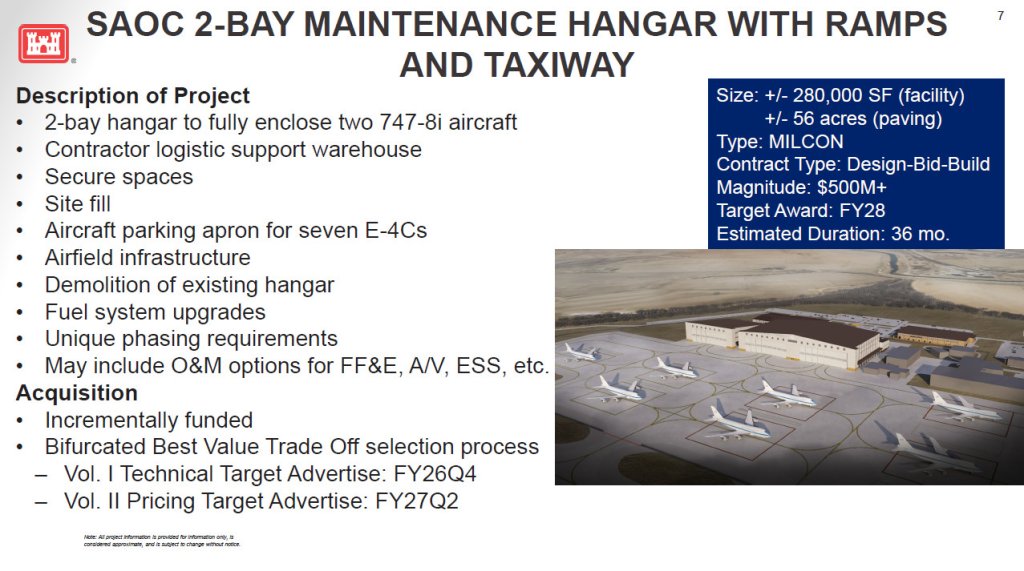
All that being said, the SAOC fleet is set to be larger than the NAOC fleet. AFGSC’s Gen. Davis confirmed in the interview that the Air Force is looking to acquire six E-4Cs, at a minimum, and potentially up to eight of the jets. Previously released U.S. Army Corps of Engineers contracting documents had already discussed plans for improvements at Offutt Air Force Base in Nebraska to accommodate as many as eight SAOC jets. Offutt is currently home to the E-4B and E-6B fleets.

The Air Force could still look to other platforms to perform the Looking Glass mission. Last year, Congress pushed to have the service report back on whether a C-130 Hercules-based design like the one the Navy is now pursuing for TACAMO could be another option. A business jet might be another starting place. It is even possible that part of the mission could migrate in another direction entirely with the help of space-based communications capabilities.
Last month, the Air Force Life Cycle Management Center (AFLCMC) announced it would be hosting an industry day for a Looking Glass-Next (LG-N) program to provide information to prospective vendors.
“The LG-N program is aimed at recapitalizing missions currently executed on the E-6B,” according to the notice. “The Government is seeking information on industry’s ability to deliver a complete weapon system to include aircraft, mission systems, training systems, system integration lab, training, and ground support systems.”
Whether or not the E-4Cs end up being part of the LG-N solution, and what other aircraft might serve in this role in the future, remains to be seen. Regardless, the Air Force is now well on its way to taking back control of the Looking Glass mission.
Contact the author: joe@twz.com