


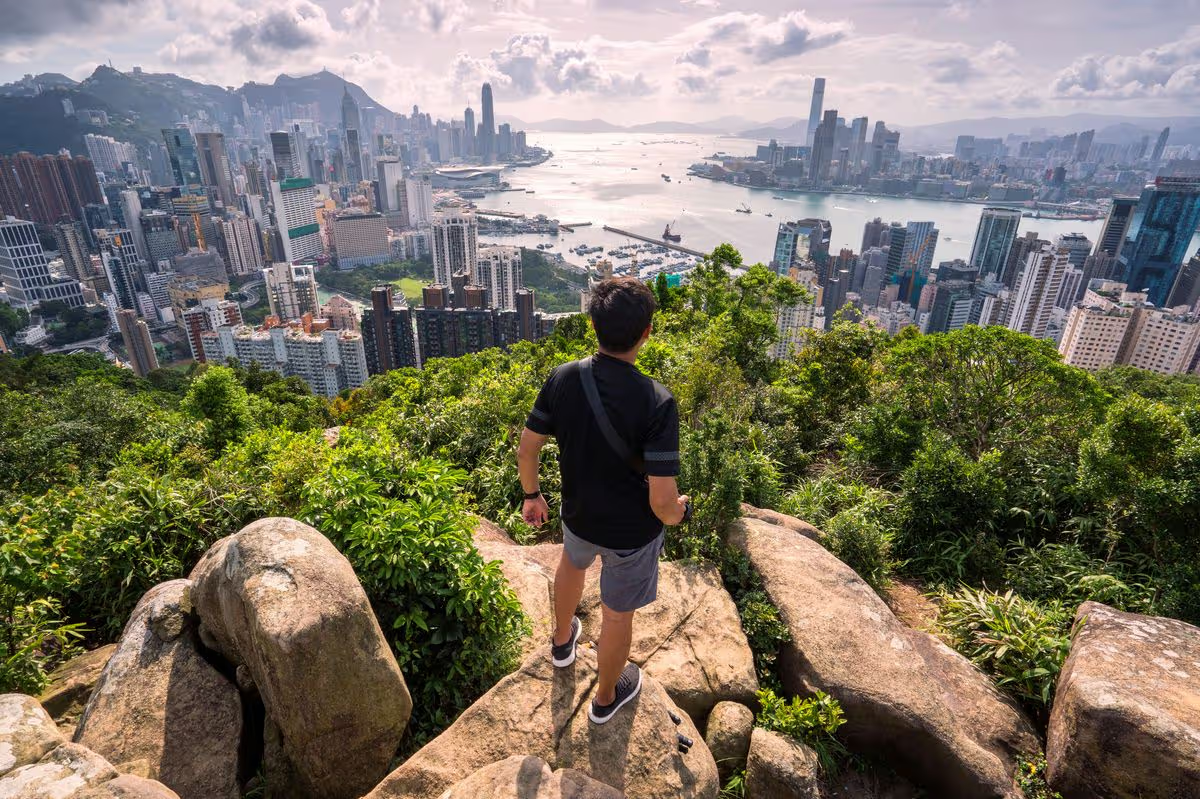
It’s best known for its mighty concrete jungle, but Chris Granet discovers Hong Kong’s greener side, with forested peaks to hike and pristine coastline and islands to explore

Hong Kong is full of surprises (Image: Getty Images)
The sunshine glittered off the jade waters as we chugged gently out of the busy harbour. Surrounding us were dozens of traditional fishing boats, like the one I was on. Surrounding them was a horizon full of hills, soaring out of the sea and carpeted in lush forests.
Our destination was Sharp Island in the distance, a tiny coral-encircled gem that could’ve been Thailand, Vietnam, or any remote region of Southeast Asia. Surprisingly, I was in Hong Kong. I say that surprisingly because when you think of Hong Kong, you think of the typical Asian megacity. Dense urban living. High-rises and hustle. Manic traffic and neon nightscapes. All of which are true of Hong Kong, and fantastic to experience, but what most people don’t realise is that you can also get off the beaten track within minutes and find pristine nature and beaches.
Formed by supervolcanic eruptions, the territory comprises 430 subtropical square miles across 263 islands, endless peninsulas, and swathes of craggy mainland. Nestled at the heart of this is the main Hong Kong Island and city, which for me has to be one of the world’s best cities for natural settings. However, it’s far from remote – it’s the fourth most densely populated region in the world, with 7.5 million residents. Everywhere you look in the city are tightly packed groves of skinny tenement blocks. It’s like nowhere I’ve ever seen. “We have very little flat land here,” explained our guide. “Most of it is made from demolished hills or reclaimed from the sea – we have to build upwards, not outwards.” But this also means 53% of the land is still forest, with 40% designated as country parks.
The quickest way to experience this would be to journey up Victoria Peak, which stretches up behind the city but is usually obscured by the vertiginous towers. We headed over to the Peak Circle Walk, which gently loops around the summit, on a stroll that encompassed tranquil woodlands and cinematic views of the world-famous skyline and bay below. Magnificent. If you want to avoid the crowds, then there are several trails back down to the city, which are made all the more pretty in the evening once the towers start turning on their technicolored light shows. Hong Kong Island’s southern side is another quick escape into nature, with curving coastal roads, low-rise neighbourhoods, cute coves, and those ubiquitous jungled hills.
It was a gloriously sunny day when I walked the Dragon’s Back trail on the most southeastern peninsula. The name is attributed to the ridge rolling between gentle peaks that resembles the mythical creature’s spine, tumbling down to a bay on one side, and the sea on the other. Despite it being November, it felt like summer as we then made our way down through the woodlands to Big Wave Bay, a glorious golden arc of sand that’s just one of over 100 beaches in the territory. We sat and had a light lunch and a glass of vino in the shade of an outdoor cafe while watching the surfers ride the crashing waves. Bliss.
Nearby, giant Lantau Island has plenty of options. Connected to the mainland by bridges, it’s home to the massive airport – but I took a different sky ride in the glass-bottomed Ngong Ping 360 cable car. It whisked us up and away from a generic concrete suburb over swathes of that lush greenery to the lofty Po Lin Buddhist monastery. The walk from the cable car terminal to the monastery was lined on both sides with tourist shops – not quite the spirit of immaterialism Siddhartha had intended, but handy for those, like me, in need of another coffee. The ornately pretty monastery is famous for its large seated Buddha statue, which we reached via a long flight of stairs as breathtaking as the panoramic views at its summit. On the coastline nearby is the picturesque fishing village of Tai O, with scores of ramshackle wooden houses precariously propped up on stilts on the sides of a little estuary. It was all very quiet as we wandered its maze of backstreets, feeling a hundred miles and years from Hong Kong city. But it perked up as we reached its busier center, and at The Crossing Boat restaurant overlooking the river, we sat at a spinning table and shared a sizzling seafood lunch. Prawn, scallops and fish all locally caught, plus an array of Cantonese stir fries.
If you want proper pristine, then head up to the 58 square mile Hong Kong Unesco Global Geopark on a wild peninsula, with a cluster of islands fanning out from the mainland. It’s the epicentre of the volcanic drama that shaped the region, sculpting surreal honeycombed sea caves, hexagonal rock columns and sheer cliffs, softened over the eons by ocean erosion and dusted with white sand beaches. Truly spectacular. It’s here that Sharp Island is located. It’s easily accessible from the chirpy tourist town of Sai Kung, with its busy harbourfront heaving with seafood restaurants and boat crews clamouring to offer you tours and rides to the many destinations around the Geopark. The usual price for a return ticket to Sharp Island is 50-60 Hong Kong dollars per person (approx £6), but our group of six paid 150HKD pp (approx £15pp) as we chartered the whole boat. Said boat was a little wooden fishing vessel, like most of the others in the harbour, all prettily painted in nautical blues and greens.
I sat perched at its front basking in the high sun for the 15 minutes it took to chug over to the little island’s southern tip. There, our surly boatman dropped us off, then made his way to the northern tip, where he collected us up later. We hiked the 1.5 mile long trail, a ridge walk similar to Dragon’s Back, offering more postcard-worthy views. Branching off Sharp’s northwestern shore is its Instagram-famed bar of shingle and rock that connects it to Kiu Tau islet. It’s only visible during low tide and was sadly in the process of being re-swallowed by the sea as we arrived.
Further offshore are plenty of snorkelling opportunities as, incredibly, Hong Kong is home to more coral species than the entire Caribbean combined, as well as over a quarter of all of China’s marine biodiversity.
Back at Sai Kung harbour, we indulged in more sizzling seafood, with hearty dishes big enough to share, like the fully stacked braised crab roe and shrimp casserole, at a reasonable £10 a pop. Very nice indeed. As I sat digesting our meal, staring out to sea and watching the Saturday afternoon crowds ambling through the sunshine, it was easy to forget that I was still in the midst of a roaring megametropolis.
BOOK THE HOLIDAY
Cathay Pacific flies direct to Hong Kong from London, from £549 return. Book at cathaypacific.com Dorsett Wan Chai has doubles from £113 per night with breakfast. Dorsett Kai Tak has doubles from £115 per night with breakfast. Both hotels offer complimentary shuttle service to major transport hubs, shopping, and dining destinations. Find out more and book at dorsetthotels.com
Find out more at discoverhongkong.com