


Kazakhstan, Turkmenistan, Uzbekistan, Kyrgyzstan and Tajikistan, Ukraine, Moldova, Armenia, Abkhazia, Georgia, Lithuania, Latvia, Estonia and Belarus have some seriously interesting bus stops

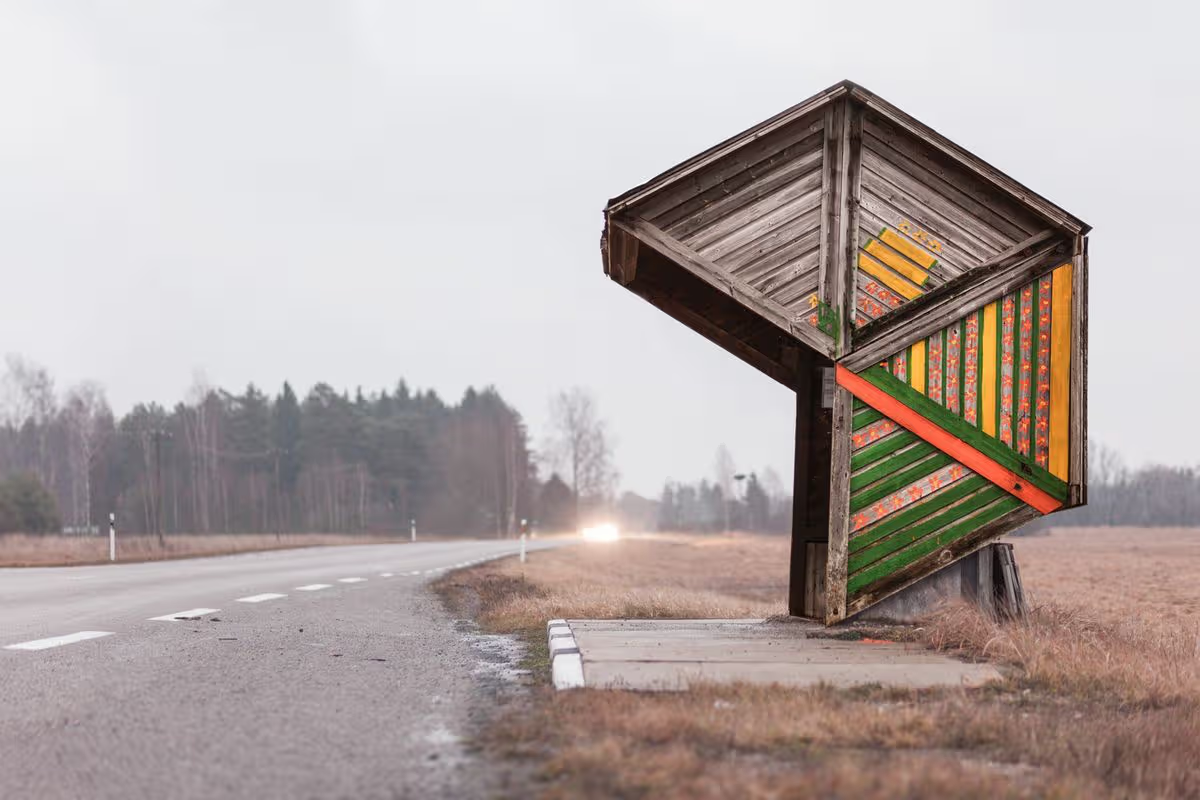
Christopher Herwig has spent decades chronicling the Soviet Union’s bus stops
Find yourself at a bus stop in the UK, and there’s a decent chance you’ll share it with some wads of chewing gum and a bit of scrawled graffiti, sat on an uncomfortable bench designed to stop unhoused people from lying down.
In terms of artistic flair, the most creativity you’re likely to see is a traffic cone balanced on the roof.
The same cannot be said for former Soviet Union countries, where the world’s most striking and strange bus stops are scattered across the rural landscape. From Kazakhstan, Turkmenistan, Uzbekistan, Kyrgyzstan and Tajikistan, to Ukraine, Moldova, Armenia, Abkhazia, Georgia, Lithuania, Latvia, Estonia and Belarus, the Eastern Bloc nations are adorned with a reminder of the Empire in the form of public transport infrastructure, 30 years after it collapsed.
Do you have a story to share? Email webtravel@reachplc.com
READ MORE: One of the UK’s ‘worst seaside towns’ is getting a huge £37.5million revampREAD MORE: I couldn’t survive on my pension so I moved to country with £240 a month rent
The Mirror’s Jonathan Reynolds found himself enchanted by the unusual shelters during a recent trip to Moldova, a country of 2.2 million that is the poorest in Europe. What it is rich in, Jonathan discovered, is bus stops.
“For Christmas a couple of years ago, my brother had bought me the book Soviet Bus Stops volume 1, and in it was a section of Moldova and pictures of these amazing bus stops that had been designed and built with such creativity and care. Often, it includes intricate mosaic designs in a structure created to provide shelter and comfort for the local commuters,” he explained.
“So, I woke up early, before the sun came up, picked up my hire car at 6am and headed out into the Moldovan countryside to find as many bus stops I could. I wasn’t disappointed.”
One particularly striking bus stop has large, intricately designed mosaic stars running along the wall, beneath a ski-chalet style roof. Another is a long, dry-stone wall with a corrugated roof lolling over the top of a small bench, providing protection from the elements, while echoing the style of contemporary British artist Andy Goldsworthy.
The creator of Soviet Bus Stops volume 1 is Canadian photographer Christopher Herwig, who has spent years travelling more than 30,000 km by car, bike, bus and taxi across 14 former Soviet countries to document the unexpected treasures of modern art.
He started the project in 2002 during a trip from St Petersburg to Sweden, on which he pledged to take a photo of something every hour. “I was trying to get out of that mindset that I needed to find a stunning National Geographic monument. I wanted to make ordinary things look cool or interesting. Bus stops, clothes lines, power lines, whatever you’d find on these farm roads.”
When he got to the Baltic countries, he started coming across the bus stops. “They were much more individualist, unique, minimalistic. They were beautiful pieces of architecture and design.”
In the two decades since, Christopher has returned to the Bloc multiple times, to take more photos and to unravel the history of the bus stops.
“I spoke to architects and designers to find why these curious things are on the side of the road. They’re quite unexpected, in that it’s a bus stop, on a rural road, but also, in that it was the Soviet Union. I had a different impression, growing up in Canada, of what the Soviet Union was like in terms of creativity and art. I thought a lot of things were standardised and controlled, without a great scope for freedom of expression, but these bus stops went against that,” he said.
“I could not find any evidence that it was a centralised plan from Moscow. But it was not something that was discouraged either. Bus stops were classified as something called a small architectural form, which didn’t have the same stringent rules and necessity to be approved or ideologically controlled as other monuments or bigger buildings.”
One of the key architects behind the bus stops was George Chakhava, whose unusual work decorates Georgia’s Black Sea coast.
“He created some of the wildest bus stops I could find. He was working in concrete and mosaics. George had a lot that went over different animal themes. An octopus, an elephant, a fish, a wave. One of his has a big concrete crown with a large gap in the roof. It gives no protection from the elements.”
This intriguing tension between form and function is replicated in Kyrgyzstan, where a plump bird forms the main structure of the bus stop. Its wings are too small to offer any protection to passengers from the wind or rain. Another is, simply, a large hat.
“The bus stop showed a lot of regional and national pride, more so than communist ideals. The Kyrgyzstan hat is a traditional hat, for example. There are some, however, that are blatantly propaganda and have hammers and sickles.”
While Christopher did meet people who loved their bus stops, such as a group of Estonian factory workers who took great pride in designing their very own, others saw them as eyesores.
“They are not something that’s treasured. They are seen by a lot of people as something that should be taken down. People tend to go to the bathroom there or throw their rubbish there. I’ve had people approach me asking why I’m taking photos of this yucky scene,” the photographer explained.
Copes of Christopher’s book are available online. His Instagram page is herwig_photo.