


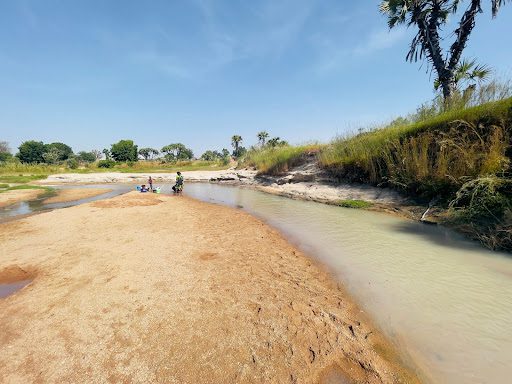
Blessing William crouched by the stream in Bole-3 at dawn, scrubbing pots and dishes. The water surface had a milky tint, and a faint aftertaste lingered each time she drank from it. Still, this remains the only source of flowing water for her family and the wider community.
As a child, the 30-year-old mother of four used to come to the local stream to wash, fetch water, and swim. Back then, the water was clear and safe to drink without filtration.
“There are a lot of changes now,” she said. “We now struggle to get clean water.”
Her experience reflects a wider reality of over 500 residents in Bole-3, a community you would describe as disadvantaged. There is no electricity, no proper road network, and no primary health care centre. For decades, the local stream has been its most precious resource.
Today, the stream has dwindled to a shallow trickle. Large stretches of the riverbed lie exposed, the current barely moving. In July 2024, white sediments began to cloud the stream, and many residents complained of a strange aftertaste that lingered on their tongues after drinking.
What went wrong?
These changes began shortly after a company run by Chinese nationals started mining operations in the community. Located in Yola-South, Adamawa State, in northeastern Nigeria, Bole-3 sits atop large deposits of fluorite beneath its rocky ground. When the mining company arrived a year ago, it built a dam to supply water for washing extracted minerals, which residents say has reduced the stream’s flow and contaminated the remaining water.
“As a result of how they blocked it to construct the dam, we don’t have enough water flowing into the stream this year,” Williams Ayuba, the village head, told HumAngle. “Although the water level naturally dwindles in November every year, it has not been this severe.”
When the community’s only borehole collapsed, water scarcity worsened. The village head mobilised some residents to meet with the company. The borehole was later repaired by the company’s representatives, but it stopped functioning three months later. However, the community has been unable to reach the company since then.
Like several other residents, all of Blessing’s children, who drink from the river, have been coming down with diarrhoea, which she described as chronic.
Celestina Jasckson, another resident of the Bole-3 community, echoes Blessing’s concern. “The water gives us diarrhoea all the time, and that’s how we are suffering,” she said, adding that she continues to consume it despite the risks.
However, diarrhoea is not the only health issue locals have been battling since the suspected contamination became pronounced in Bole-3. Eden Dimas, a healthcare provider who runs the only dispensary in the community, noted that “a lot of residents” have been arriving at the centre regularly with rashes covering different parts of their bodies.
“I am sure it is the chemicals. You could taste it while drinking the water,” Eden said.
The skin condition remains undiagnosed as the dispensary lacks lab equipment. The facility does not admit patients or offer delivery services; it only administers painkillers and provides other basic treatments. For childbirth and more complex care, residents travel an hour to a primary healthcare centre in Lakare, a neighbouring community.
When cases exceed what he can manage locally, Eden often refers residents with issues like the itchy skin to hospitals in Yola, the state capital, where many cannot afford treatment.
In the past, Ekklesiyar Yan’uwa a Nigeria, the Christian denomination that owns the dispensary, used to supply drugs whenever stocks were running short, but that has dwindled, leaving the dispensary barely functional. Part of the building has even been converted into a single room now occupied by a family.
Eden now buys drugs from Yola only when a sick person provides money for medication.
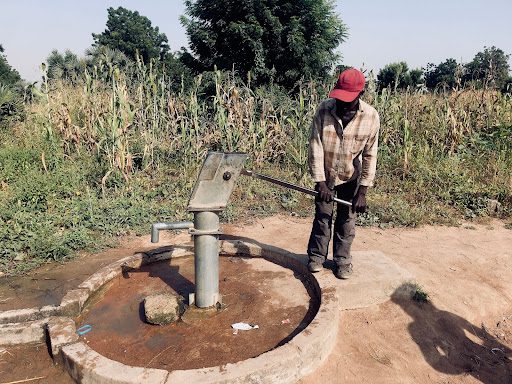
The stream and the unnamed mine
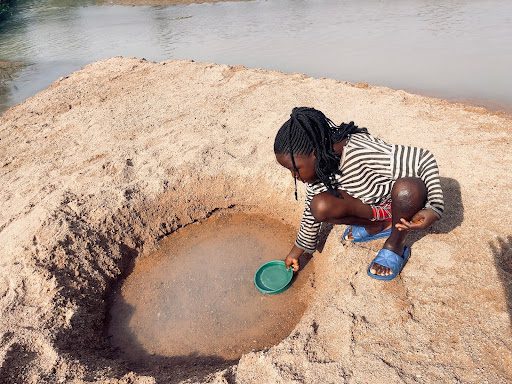
As contamination of the stream worsened, locals dug small ponds nearby. HumAngle learned from residents that the water in the pond is less polluted than that of the stream, so while the main stream serves their other needs, they use the pond for drinking and cooking.
“We did everything we could. We wrote to the company, but we have not seen any results yet. It’s like we don’t have anyone to help us,” the village head said. He added that locals have now resigned themselves to their fate.
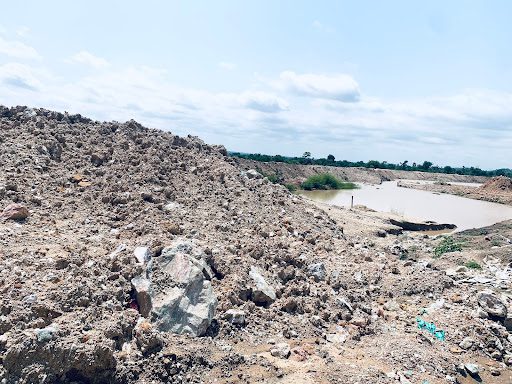
Residents in Bole-3 refer to the mining company as the “China Company”. It is located on the outskirts of the host community, and it takes less than an hour by motorcycle to reach the mine.
The mine stretches across a wide, open area covered with fluoride and some monazite rocks. Fluorite is a valuable mineral that is used in refining hydrofluoric acid, aluminium smelting agents, optical lenses, gemstones for jewellery, flux for steelmaking, ceramics, and opalescent glass.
When HumAngle visited the mine, heaps of smaller rocks were scattered around, and labourers were also seen working under the watch of a Chinese supervisor.
Philip Ezra*, a Bole-3 resident, worked at the mine but resigned due to frequent illness and severe body aches. He was responsible for manual excavation and sorting, working at least 10 hours daily for a monthly compensation of ₦70,000.
During his employment, he recalled that a small pond had been dug at the mine for workers’ water consumption. “As time went by, I began to come down with typhoid and realised that it was from the water. I was always weak,” he said. “The water conditions and the strenuous nature of the work made me sick.”
When he returned home in June 2025 after resigning, Philip observed that the stream level had dropped and the water quality had deteriorated. “I noticed that the water tasted like the one from the labourer’s pond at the site,” he said.
Like other residents, Philip believes the significant reduction in water level in the stream is due to the dam built around the mine. “They trapped a large quantity of water from the source and turned it into a source for washing extracted minerals and carrying out other mining activities,” he said.
When HumAngle visited the mine, the supervisors did not respond to the inquiries. A letter submitted in November last year has yet to receive a response.
No signage at the site shows the company’s name, and workers who spoke to HumAngle claimed they did not know it. One employee, who asked not to be named, said the company was licensed and approved by the state government, but that “its name had yet to be formally ascribed”.
This explanation is highly unlikely, as companies registering with the Corporate Affairs Commission and the Nigeria Mining Cadastre Office are required to provide a name and board details. We reached out to the Adamawa Ministry of Environment and Natural Development and have not received a response.
To independently verify residents’ claims, HumAngle collected water samples from the Bole-3 stream in November 2025 and submitted them for laboratory analysis at Modibbo Adama University, a public research institution in Yola. The samples were tested twice for fluoride concentration and overall water quality, including heavy metal levels.
A Yola-based laboratory scientist who analysed and interpreted the results, and asked not to be named, said the water was unsafe for drinking, cooking, bathing, or other domestic use.
According to the scientist’s interpretation of the findings, the samples contained elevated levels of heavy metals, including Lead, Cadmium, Copper, and Chromium. Prolonged exposure to these substances, the scientist explained, can cause chronic diarrhoea, skin rashes, gastrointestinal irritation, and other long-term health problems.
“The health symptoms reported by residents, particularly skin rashes and chronic diarrhoea, are consistent with known effects of chronic heavy-metal exposure,” the scientist added.
Expert recommends solutions
In communities with long-standing mining activities, exposure to toxic dust and heavy metals poses severe health risks. A study at Arufu, a mining community in Wukari, Taraba State, found high concentrations of heavy metals, and the water was declared unsafe for consumption.
“There are rocks that bear the fluoride. So, naturally, it can enter through the dissolution of fluoride-bearing minerals in all these soils. However, human activities can also elevate fluoride in the water,” said Hamza Muhammad Usman, the Executive Director of Environmental Care Foundation in Adamawa State.
Hamza explained that mining disrupts large volumes of rock and wells, exposing the minerals buried beneath them. “It can increase the release of fluoride and other heavy metals, including other contaminants into the water,” he added.
The environmental expert also noted that contaminants move faster through fractured drainage, a geological feature caused by blasting, which forms gully erosion. “This lets contaminants move quickly because mining creates new channels where none existed before. Pollutants can then reach streams and rivers that recharge groundwater,” he said.
Hamza emphasised that the geology and duration of mining activity, rainfall, and even groundwater flow, determine contamination levels. He added that contamination can occur within months in some cases, or take years in others, depending on the intensity of human activity.
He also recommended some cost-effective options for removing contaminants from water, including the Nalgonda technique, which uses lime and alum.
“There is also the bone char,” he said. This involves burning animal bones until they are nearly charcoal. “It is good for absorbing things like this. If they are burnt completely, it becomes like charcoal, you can use them, which is very effective to absorb fluoride and is viable in rural communities,” Hamza said.
The Yola-based scientist, who analysed the lab results, advised the immediate cessation of the water’s use, the provision of alternative safe water supplies, confirmatory lab testing, and medical screening for affected residents, highlighting the particular risks to children, pregnant women, and vulnerable adults.
“It is a public health hazard requiring immediate intervention,” the scientist added.
And yet, on the lips of the residents is the same urgent question: “If we can no longer use the Bole-3 stream, what should we drink?”
*Names with asterisks have been changed to protect the sources.