


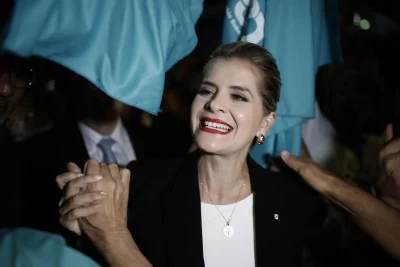
Laura Fernández Delgado, candidate of the ruling Partido Pueblo Soberano, is leading in polls one week out from Costa Rica’s elections. File Photo by Jeffrey Arguedas/EPA
Jan. 26 (UPI) — With one week to go before presidential elections scheduled for Sunday, Feb. 1, Costa Rica closed its campaign season amid a polarized political climate and with the ruling party leading most opinion polls.
In recent weeks, multiple surveys have shown Laura Fernández Delgado, candidate of the ruling Partido Pueblo Soberano, holding first place with support levels close to 40%. That figure would be enough for the former cabinet minister to secure a first-round victory.
However, polls also point to high voter indecision, estimated at around 45%, in a context marked by political fragmentation and an unusually large field of candidates, local newspaper El Observador reported.
A recent survey by the Centro de Investigación y Estudios Políticos (CIEP) of the Universidad de Costa Rica places Fernández at 30% support, still well ahead of the remaining 19 candidates competing for the presidency.
Second place is held by Álvaro Ramos of the Partido Liberación Nacional, who polls below 8%. Most other candidates register less than 2.3% support.
Fernández, 39, has campaigned on a continuity platform, seeking to capitalize on the popularity of President Rodrigo Chaves, who is expected to leave office with approval ratings near 60%. His support has been driven in part by a confrontational style and rhetoric against traditional politics and established elites.
Chaves, who is constitutionally barred from seeking re-election, has governed amid persistent political tension and frequent institutional clashes. His administration has been characterized by sharp rhetoric, public disputes with other branches of government and a governing style that emphasizes direct communication and political confrontation.
The elections follow a dispute with the Tribunal Supremo Electoral, which in October 2025 asked the Legislative Assembly to lift the president’s immunity to investigate alleged violations of electoral rules, including his participation in campaign activities.
Public security has emerged as one of the dominant themes throughout the campaign, reflecting growing concern among voters over rising violent crime and the expanding influence of organized crime in several regions of the country, according to daily La Nación.
During debates organized by media outlets and universities, candidates broadly agreed that addressing insecurity requires more than law enforcement alone. Proposals have emphasized criminal intelligence, increased police presence, improved coordination among state institutions and the recovery of territories affected by organized crime.
According to CIEP, two out of three Costa Ricans believe the country’s security situation is worse than a year ago. Long viewed as one of Central America’s safest nations, Costa Rica is facing an unprecedented security crisis.
Organized crime, fueled largely by drug trafficking, has expanded its presence in neighborhoods in southern San Jose, as well as in the provinces of Limón and Puntarenas. In 2024, Costa Rica recorded a homicide rate of 16.6 per 100,000 inhabitants, ranking eighth highest in Latin America, surpassing Guatemala and approaching levels reported in Mexico.