winter games

Organizers of the Winter Games made clean energy a priority. Here’s how

It takes an immense amount of energy to power venues and make snow for the Winter Olympics and, for the 2026 Milan-Cortina Games, organizers pledged that virtually all of the electricity would be clean.

The organizing committee said that electricity use was where it could make the most meaningful impact, since it has been one of the main drivers of planet-warming emissions at major events. And Italy’s largest electricity company, Enel, guaranteed the supply of entirely certified renewable electricity for event venues.

Here’s a look at what that meant:

To guarantee 100% renewable energy, Enel bought certificates

The organizing committee said in its sustainability report from September that its Games-time electricity would be 100% green, fed by certified renewable sources. In rare cases where temporary power generation is required, hydro-treated vegetable oil would be substituted for traditional diesel fuels, it said.

“This is also an opportunity to contribute to a broader shift — showing athletes, spectators and future host cities that cleaner energy solutions are increasingly viable for events of this scale,” the committee said Friday in a statement to the Associated Press. “We hope the steps taken for these Games can support ongoing progress across major events.”

Enel said it was supplying 85 gigawatt-hours of power for the Olympic and Paralympic Winter Games. It bought “guarantee of origin,” or GO, certificates on the market from renewable energy plants to cover the entire Games’ energy demand.

GO certificates are a European mechanism created in 2001. Each certificate corresponds to 1 megawatt hour of electricity produced using a certified renewable source.

Certificates are a way to prove your energy is green

These certificates are traded on the power market, in negotiations between companies or through brokers.

Once used, they are canceled to prevent the same megawatt hour from being claimed twice. This system is meant to support the development of renewable sources by helping companies meet their green energy targets.

Enel told the AP in a statement that its commitment to cleanly lighting up the events “translates the values of sustainability and inclusion inherent in the Games into concrete terms, combining technological innovation and environmental protection.”

Although many say GOs are vital to promote the Earth’s decarbonization, the system has its detractors. Matteo Villa, who leads the data lab at the Italian Institute for International Political Studies, said it is a “great way to promote your event,” but it’s not making Italy cleaner or more renewable.

The Games can only be as clean, or as sustainable, as the whole of Italy, Villa added.

Enel says it produces a lot of clean electricity in Italy

Nearly three-quarters of the electricity Enel produced in Italy in 2025 was carbon-free, according to its preliminary full-year operational data. About 50% came from hydropower, followed by 17% geothermal and less than 10% from wind, solar and other renewables. The remainder was mostly from gas-fired power plants.

Many power plants that use water to produce electricity are in northern Italy, where mountains and rivers make for highly productive facilities. But Italy’s national grid is still largely reliant on fossil fuels, according to country-specific data from the International Energy Agency.

Enel built new primary substations in Livigno and Arabba, so electricity could be distributed throughout the territory. It also built and upgraded distribution infrastructure in the Livigno, Bormio and Cortina areas, which will benefit residents after the Games.

Enel has a spot in the fan village in Cortina, where events are livestreamed.

Another challenge: emissions from spectators and athletes traveling

Sustainability was a major focus of the Games, as the organizers and the International Olympic Committee sought to model how to cut carbon pollution while running a major event. Researchers say the list of locales that could reliably host a Winter Games will shrink substantially in coming years.

“Every Games we strive to push innovation in sustainability, reduce the overall impact and the carbon footprint,” Julie Duffus, the IOC’s head of sustainability, told the AP on Friday. She highlighted the use of clean power, upgrades to the energy system and the way these Games were designed so that most venues would be existing or temporary.

Matteo Di Castelnuovo, a professor of energy economics at the SDA Bocconi School of Management in Milan, said he expected the Olympics to stay committed to clean energy, and that “the challenge lies somewhere else to make them greener.” The thornier issue for Olympic organizers, and for any business, is figuring out how to reduce the emissions stemming from transportation, he added.

The amount of greenhouse gases estimated to be released into the atmosphere as a result of the Games was similar to the emissions of 4 million average-sized, gasoline-fueled cars driving from Paris to Rome, the organizing committee said in its greenhouse gas management strategy. The largest share of the carbon footprint were activities indirectly related to the Games, such as accommodations and spectator travel. Air travel is a significant contributor because burning jet fuel releases carbon dioxide.

Karl Stoss, who chairs the Games’ Future Host Commission, has said they may need to eventually reduce the number of sports, athletes and spectators who attend.

Many skiers, including Team USA members Lindsey Vonn and Mikaela Shiffrin, expressed concern during the Games about climate change accelerating melt of the world’s glaciers.

McDermott writes for the Associated Press. AP writer Colleen Barry and video journalist Brittany Peterson in Milan contributed to this report.
Source link

With Winter Olympics over, L.A. is officially on the clock for 2028 Summer Games

In fair Verona, L.A., unofficially, takes the torch.

While the Olympic flag passed from Italy to France at Sunday’s closing ceremony, handing off the Winter Games from Milan-Cortina to the French Alps, the flame will burn next in L.A.

In just over two years, the United States will host the country’s first Summer Games since 1996, welcoming an Olympic movement that is surging in popularity but unsteady in a changing world, as the Games return to Los Angeles for the third time.

The Milan-Cortina Olympics are expected to rake in record TV numbers for NBC. They already produced the most-watched women’s hockey game on record when an average of 5.3 million viewers took in the United States’ thrilling overtime win over Canada. The rivalry game contributed to the largest weekday audience for a Winter Games since 2014 with an average of 26.7 million viewers who also watched U.S. star Alysa Liu win the country’s first Olympic gold medal for women’s singles figure skating in 24 years.

The smiling 20-year-old with horizontal stripes in her hair became a sensation in Milan just as 41-year-old mother of two Elana Meyers Taylor did in Cortina d’Ampezzo after the five-time Olympian won her first gold medal in bobsled, jumping into the arms of her nanny and, through tears, signing to her deaf children, “Mommy won.”

No matter protests, politics or planning hurdles, the Olympics sought to remain a stage for those athletes to shine.

“You showed us what excellence, respect and friendship look like in a world that sometimes forgets these values,” International Olympic Committee President Kirsty Coventry said to the Olympians in her speech while standing on a platform in the stands placed in front of the Italian delegation. “You showed us that the Olympic Games are a place for everyone. A place where sport brings us together.”

After record numbers from the 2024 Paris Summer Games, the Milan-Cortina Games sold 1.3 million tickets, which, accounting for 80% of the expected tickets, was “beyond our expectations,” Milano Cortina 2026 chief executive officer Andrea Varnier said at a news conference. Of the 63% of international fans who attended the Games, the United States, at 14%, bought the second-most tickets.

Fans filled arenas that were finished just in time in Milan. They withstood snowstorms in Livigno, cheered the debut of ski mountaineering in Bormio and held their breath while multiple skiers got airlifted off the downhill course in Cortina.

The most widespread Games in history created distinct pockets of Olympic spirit separated by hours on trains and miles of winding mountain roads. The Olympics that preached harmony finally united in a single city known for love, beauty and grudges. The Milan-Cortina Games represented seemingly every Shakespearean theme.

Athletes got engaged. Sponsors organized hair and makeup sessions in the Olympic villages, which went through an average of 365 kilograms of pasta and 10,000 eggs a day. A cheating scandal rocked curling.

The closing ceremony set at the Roman amphitheater at the heart of the city that inspired “Romeo and Juliet” celebrated the Games as “beauty in action.” But beneath the glittering gold medals, there was pain.

Alpine skier Lindsey Vonn suffered a horrific crash and has already undergone four surgeries on her broken leg. Ukrainian skeleton athlete Vladyslav Heraskevych was disqualified when he refused to compete without his helmet honoring Ukrainian athletes who’ve been killed in the war with Russia.

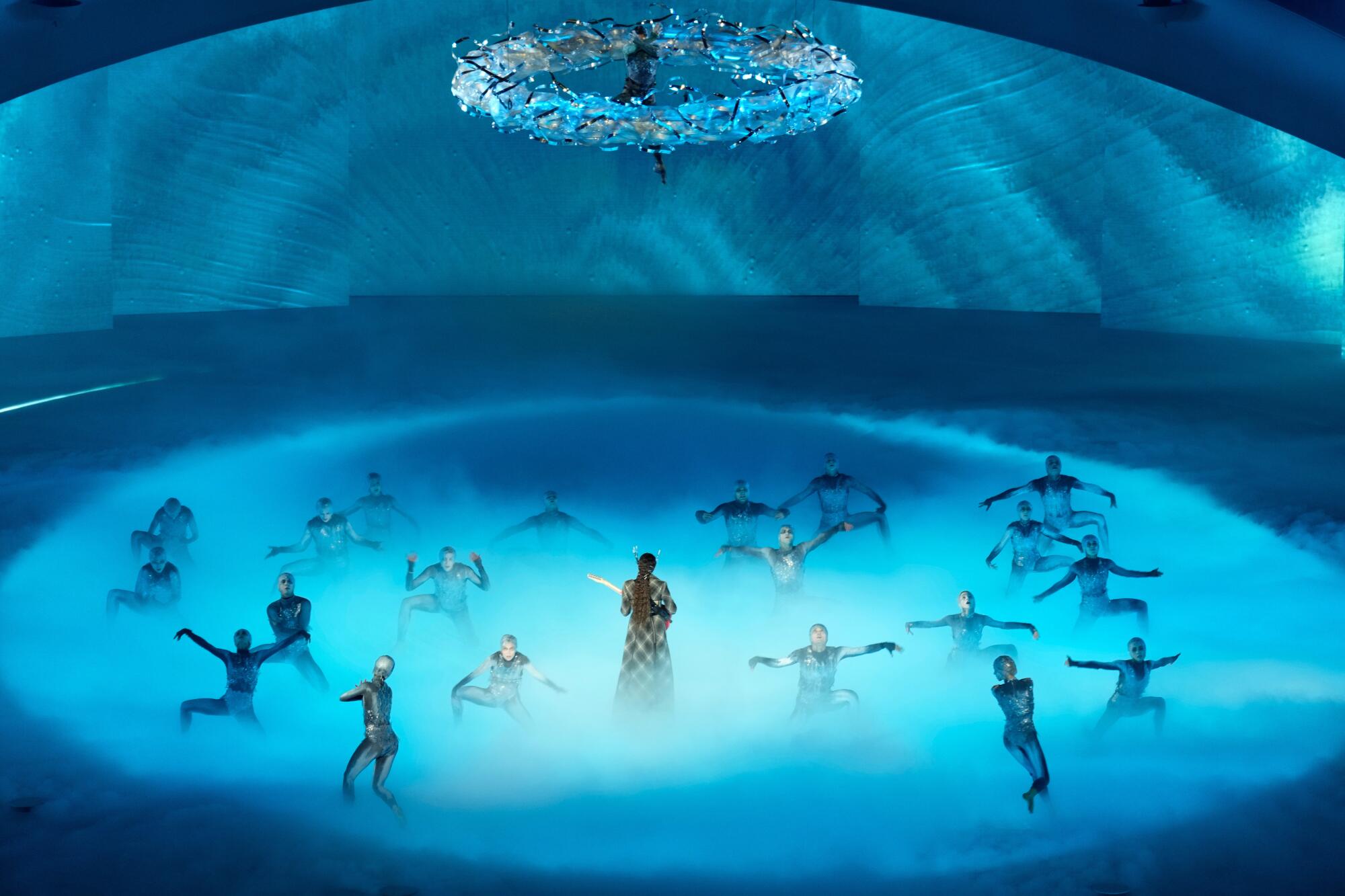
Artists perform on a stage with blue lighting

Artists perform during the closing ceremony of the 2026 Winter Olympics in Verona, Italy.

(Bernat Armangue / Associated Press)

Already holding the weight of their personal dreams, U.S. athletes faced additional pressure answering questions about the country’s political landscape. After freestyle skier Hunter Hess he said he had “mixed emotions” representing the United States at the Olympics, President Trump called the 27-year-old “a real loser” on social media.

Two weeks later, Hess held his thumb and forefinger in the shape of an “L” to his forehead after his first qualifying run.

Athletes pleaded for assistance navigating an onslaught of social media threats as the Olympic spotlight grows with every Games. Coventry said at a news conference last week that the IOC has a safeguarding unit that monitors the organization’s social media platforms for hateful messages. More than 10,000 such comments were taken down during the Paris Games, IOC spokesperson Mark Adams said. The number for the Milan-Cortina Games hadn’t been finalized.

With the largest delegation of any country at the Games, the United States won the second-most medals with 33, including 12 golds, the most Olympic titles for the country at any single Winter Games. The total gold medals surpassed the 10 won in Salt Lake City in 2002, the last time the United States hosted an Olympic Games.

After more than two decades away, the Games will return to the United States twice in the next eight years. L.A. will host the 2028 Games and Utah will have the 2034 Winter Games.

Approaching the final stretch of an 11-year planning period, the L.A. Games confronted another challenge this month when a growing number of local politicians called for LA28 chairman Casey Wasserman’s resignation after racy emails he exchanged with Ghislaine Maxwell were revealed in the Epstein files. After initial hesitation, L.A. Mayor Karen Bass and other leaders joined the chorus calling for Wasserman’s dismissal.

But LA28 doubled down on his role. The executive committee of the LA28 board stood by Wasserman after a review from an outside legal firm found that the Hollywood mogul’s relationship with Maxwell “did not go beyond what has already been publicly documented.”

As with his 2026 organizing committee counterpart Giovanni Malago, Wasserman would be expected to deliver speeches in 2028.

Source link