walkers

MOCA acquires Kara Walker’s reimagining of a Stonewall Jackson statue

The Museum of Contemporary Art has acquired Kara Walker’s sculpture “Unmanned Drone,” a cornerstone of the museum’s groundbreaking “Monuments” exhibition.

It joins the 158 works by 106 artists that were added to MOCA’s permanent collection last year, including major works by Jacqueline Humphries, Mike Kelley, Shizu Saldamando, Mary Weatherford, Julie Mehretu and Nairy Baghramian. Fifty artists are new to the collection, including Jonathas de Andrade, Leilah Babirye, Meriem Bennani, Paul Chan, Cynthia Daignault and Ali Eyal.

“Unmanned Drone” — a towering testament to the power of transmogrification — commands a room of its own at the Brick, which co-presented the “Monuments” exhibition in October. Walker created the 13-foot-tall bronze sculpture out of a statue of the prominent Confederate Gen. Stonewall Jackson that was originally in Charlottesville, Va. The statue had been removed after serving as a significant gathering place for the infamous 2017 Unite the Right rally of white supremacists.

A detail of an arm on a Stonewall Jackson sculpture.

A detail of a severed arm — part of Kara Walker’s sculpture “Unmanned Drone,” which she created using a decommissioned statue of Confederate Gen. Stonewall Jackson.

(Etienne Laurent / For The Times)

In a review of “Monuments,” which declared the exhibition “the most significant American art museum show right now,” former Times art critic Christopher Knight called “Unmanned Drone” “devastating” and “brilliant.”

In an interview last fall, Brick director Hamza Walker explained to The Times that the city of Charlottesville issued a request for proposals from organizations interested in taking possession of the statue. The Brick applied and was deeded the statue, taking physical possession on Jan. 6, 2022. The gallery then gave the statue to Walker.

“They were getting rid of the Lee and the Stonewall Jackson statues, and they said, ‘We don’t want them put back up for further veneration,’” Hamza Walker said. “And so the idea of giving the statue to an artist fit that bill.”

Other applicants skipped over the line about not putting them up for further veneration, Hamza Walker said, noting that the Brick’s proposal was up against ones from Civil War battlefields and Laurel Hill, the birthplace of Confederate general J.E.B. Stuart.

A detail of a horse’s nostril on a sculpture of Stonewall Jackson.

A detail of the horse’s nostril in Kara Walker’s sculpture “Unmanned Drone,” which MOCA has acquired.

(Etienne Laurent / For The Times)

Kara Walker sliced apart the statue with a plasma cutter and welded it back together in an entirely new form. She did away with Jackson’s face and put much of the focus on his famous steed, Little Sorrel. The horse now stands upright with its head pushing out from the back of its saddle.

“She didn’t want you to be able to identify with him. She wanted the emphasis on Little Sorrel rather than the myth of the man,” Hamza Walker explained of Kara Walker’s intentions. “She wanted to reduce it to horse and rider.”

“The fiend has no head,” Knight commented in his review. “The folkloric Euro-American story of the ‘headless horseman’ comes to mind — a nightmarish, animated corpse who haunts the living. As a metaphor for obtuse white supremacy, still active today, that terror figure is hard to beat.”

Walker’s work was the only transformed statue out of the nearly dozen decommissioned statues related to the Confederacy featured in the “Monuments” exhibition. The others were all presented as they looked when they were removed, many during the protests that swelled in the summer of 2020 in the wake of the murder of George Floyd.

A detail of a sword on a Stonewall Jackson sculpture.

A detail of a sword on Kara Walker’s sculpture “Unmanned Drone.”

(Etienne Laurent / For The Times)

In addition to “Unmanned Drone,” MOCA announced several other acquisitions that were either featured in recent exhibitions or have significant connections to the museum. These include an environmental sculpture by Olafur Eliasson; work by Takako Yamaguchi; a media installation by Paul Pfeiffer titled “Red Green Blue (2022), co-acquired with the Brooklyn Museum; and pieces by Cynthia Daignault, Shizu Saldamando and Henry Taylor.

“The expansion of MOCA’s collection this year reflects a sustained and deeply collaborative effort to think critically about what it means to build a museum collection in the twenty-first century,” Clara Kim, chief curator and director of curatorial affairs, said in a statement.

Source link

Abandoned medieval village lay forgotten for centuries now loved by walkers

One of Britain’s most renowned deserted medieval villages, with a church and manor house, attracts walkers and history enthusiasts despite its challenging terrain with a steep walk

Today, it’s considered the UK’s ‘best preserved’ medieval village, attracting visitors from far and wide who want to marvel at its history. Yet it remained deserted for hundreds of years after its residents vacated the settlement.

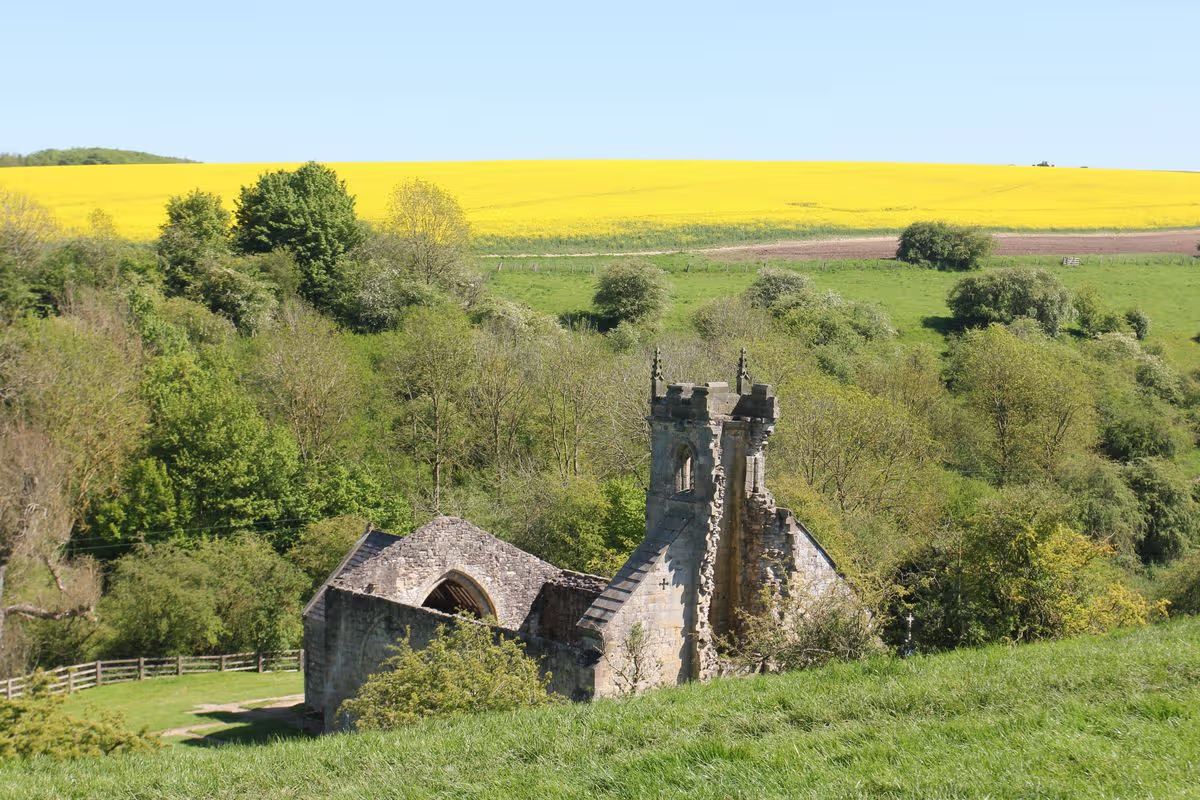
Wharram Percy in North Yorkshire is one of Britain’s largest deserted medieval villages and certainly its most famous. Visitors can wander through the atmospheric site, exploring the ruins of ancient dwellings, a church, and a manor house that once formed a community.

Throughout an extensive 60-year period, archaeologists have steadily uncovered fascinating insights into Wharram Percy’s past. Their discoveries have revealed why the settlement was deserted initially and how people lived there centuries ago.

READ MORE: Stunning island ‘bursting with colour’ still sunny in February at 30CREAD MORE: City just 3 hours from UK has been named the ‘most welcoming’ in the world

Nestled on the edge of a Yorkshire valley, this remarkable village was inhabited for as long as six centuries before being abandoned sometime after the 1500s. Experts believe that even now, the footprints of former houses remain visible in the earth, complementing the more prominent ruins that draw inquisitive tourists.

The history is complex, but experts believe the earliest settlement dates back to around 50 BC. This land was later converted into farmland, fell into disuse in the 5th century, and eventually evolved into a Middle Saxon settlement.

Steeped in history, the medieval village has become a popular attraction, whether that’s dog walkers in the local area or those passing by. Perfectly positioned between the tourist hotspots of Scarborough Castle and Clifford’s Tower in York, it’s an ideal midway stop when travelling between these two landmarks.

While admission to the village itself is free, visitors pay a modest £2 parking fee. It’s worth noting that getting to the settlement involves a roughly 3/4-mile trek from the car park to the main site, often steep and muddy. The site’s rugged terrain can pose a challenge for some visitors and is generally not suitable for wheelchairs or pushchairs.

One visitor described the parking on TripAdvisor as a “sharp gravelled decline” and a “daunting” journey unsuitable for those with limited mobility, as the path traverses fields. Another also warned: “Parking on the Heritage car park off the B1248 prepare for a trek to the village.”

Yet, it hasn’t put people off from making the journey, as one joyfully shared: “This lovely deserted mediaeval village is truly fascinating! The history is incredible, and it was wonderful to wander around and explore. We really lucked out and had beautiful weather, so we got to sit on the grass by the pond and soak it all in.”

Another lauded their experience and said: “Lovely walk from the car park to the site, but people with mobility issues may struggle. It’s a fascinating historical site that has been really well managed. Only a few visitors when we visited, which added to the peace and tranquillity of the place. Loved it!”

“Great walk with the dog. Parked in the free car park and walked downhill on the path to a cow field. Crossed over into the fields of Wharram Percy. Lovely walk around and interesting to imagine how it once was all those years ago. The walk back was uphill and quite a trek. We really enjoyed it. It’s a small historical site, sometimes people expect too much. We loved it. Nice walk out and then to the Stone Trough Inn for lunch,” another commented.

Do you have a travel story to share? Email webtravel@reachplc.com

Source link