voter

Trump’s deportations are losing him the ‘Mexican Beverly Hills’

Carlos Aranibar is a former Downey public works commissioner and remains involved in local Democratic politics. But until a few weeks ago, the son of Bolivian and Mexican immigrants hadn’t joined any actions against the immigration raids that have overwhelmed Southern California.

Life always seemed to get in the way. Downey hadn’t been hit as hard as other cities in Southeast L.A. County, where elected officials and local leaders urged residents to resist and helped them organize. Besides, we’re talking about Downey, a city that advocates and detractors alike hyperbolically call the “Mexican Beverly Hills” for its middle-class Latino life and conservative streak.

Voters recalled a council member in 2023 for being too wokosa, and the council decided the next year to block the Pride flag from flying on city property. A few months later, Donald Trump received an 18.8% increase in voters compared to 2020 — part of a historic shift by Latino voters toward the Republican Party.

That’s now going up in flames. But it took a while for Aranibar to full-on join the anti-migra movement — and people like him are shaping up to be a real threat to President Trump and the GOP in the coming midterms and beyond.

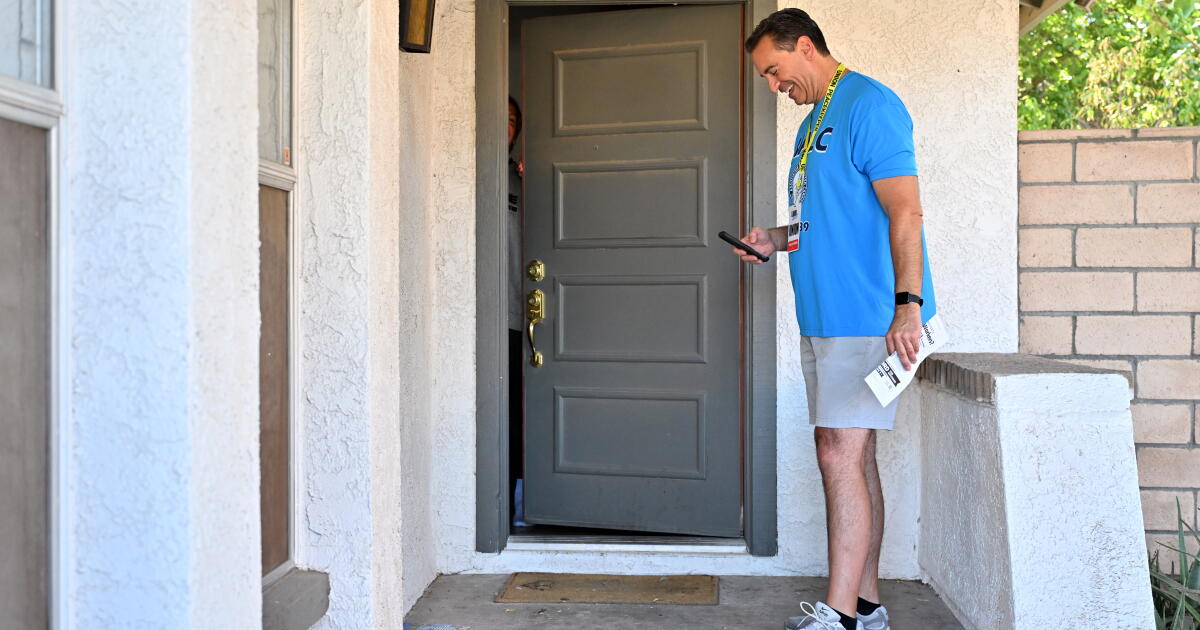
On Jan. 27, Aranibar saw a Customs and Border Protection truck on the way home from work. That jolted Aranibar, an electrician with the International Brotherhood of Electrical Workers’ Local 11, into action.

“It’s not something like that I was in a bubble and I was finally mad — I’ve been mad,” the 46-year-old said. “But seeing [immigration patrols] so close to my city, I thought ‘That’s not cool.’”

He Googled and called around to see how best to join others and resist. Someone eventually told him about a meeting that evening in a downtown Downey music venue. It was happening just a few days after Border Patrol agents shot and killed Minneapolis resident Alex Pretti after he tried to shield a fellow protester from pepper spray, and a few weeks after immigration agents tried to detain two Downey gardeners with legal status before residents hounded them away and recorded the encounter.

Aranibar joined more than 200 people standing shoulder to shoulder for the launch of a Downey ICE Watch group. They learned how to spot and track immigration agents and signed up for email updates. A box of whistles was passed around so people could alert their neighbors if la migra was around.

“Who here has been a member of a patrol?” an organizer asked from the stage.

Only a few people raised their hands.

“I saw familiar faces and new faces, energized — it was really nice,” Aranibar said afterward. “I got the sense that people in Downey have been fired up to do something, and now it was happening.”

A similarly unexpected political awakening seemed to be happening just down the street at Downey City Hall, on the other side of the political aisle.

Mayor Claudia Frometa set tongues wagging across town after video emerged of her whooping it up with other Latino Trump supporters the night he won his reelection bid. Activists since have demanded she speak out against the president’s deportation deluge, protesting in front of City Hall and speaking out during council meetings when they didn’t buy her rationale that local government officials couldn’t do much about federal actions.

“Mayor Frometa is not a good Californian right now,” councilmember Mario Trujillo told me before the Jan. 27 council meeting. During the previous meeting, Frometa cut off his mic and called for a recess after Trujillo challenged Frometa to talk to “her president” and stop what’s going on. “It’s not a time to deflect, it’s not a time to hedge — it’s a time to stand up. She’s giving us a bulls—t narrative.”

Downey Mayor Claudia Frometa listens to public testimony

Even Downey Mayor Claudia Frometa, a supporter of President Trump, has called out his immigation policies.

(Ronaldo Bolanos/Los Angeles Times)

That night, Frometa listened to critics like Trujillo slam her anew while wearing a wearied smile. When it was her turn to speak at the end of the night, she looked down at her desk as if reading from prepared remarks — but her voice and gesticulations felt like she was speaking from somewhere deeper.

“This issue [of deportations] which we have been seeing unfold and morph into something very ugly — it’s not about politics anymore,” Frometa said. “It’s about government actions not aligning with our Constitution, not aligning with our law and basic standards of fairness and humanity.”

As she repeatedly put on and removed her glasses, Frometa encouraged people to film immigration agents and noted the council had just approved extra funding for city-sponsored know-your-rights and legal aid workshops.

“This is beyond party affiliation,” the mayor concluded, “and we will stand together as a community.”

Suddenly, the so-called “Mexican Beverly Hills” was blasting Trump from the left and the right. Among Latinos, such a shift is blazing around the country like memes about Bad Bunny’s Super Bowl halftime show. Trump’s support among former voters has collapsed to the point that Florida state senator Ileana Garcia, co-founder of Latinas for Trump, told the New York Times that the president “will lose the midterms” because of his scorched-earth approach to immigrants.

Former Assembly member Hector de la Torre said he’s not surprised by what’s happening in a place like Downey.

“When it hits home like that, it’s not hypothetical anymore — it’s real,” he said. De La Torre was at the Downey ICE Watch meeting and works with Fromenta in his role as executive director of the Gateway Cities Council of Governments, which advocates for 27 cities stretching from Montebello to Long Beach to Cerritos and all the southeast L.A. cities.

“People are coming out the way they maybe didn’t in the past “ he continued. “It’s that realization that [raids] can even happen here.”

Mario Guerra is a longtime chaplain for the Downey police department and former mayor who remains influential in local politics — he helped the entire council win their elections. While he seemed skeptical of the people who attended the Downey ICE Watch — “How many of then were actual residents?” — he noted “frustration” among fellow Latino Republicans over Trump and his raids.

“I didn’t vote for masked men picking people up at random,” Guerra said before mentioning the migra encounter with the gardeners in January. “If that doesn’t weigh on your heart, then you’ve got some issues. All this will definitely weigh on the midterms.”

Even before Frometa’s short speech, I had a hint of what was to to come. Before the council meeting, I met with the termed-out mayor in her office.

The 51-year-old former Democrat is considered a rising GOP star as one of the few Republican Latino elected officials in Los Angeles and the first California Republican to head the nonpartisan National Assn. of Latino Elected and Appointed Officials. Her family moved to Downey from Juarez, Mexico when she was 12. Whites made up the majority of the suburban city back then, and it was most famous in those days as the land that birthed the Carpenters and the Space Shuttle.

Now, Downey is about 75% Latino, and four of its five council members are Latino.

So what did Frometa expect of Trump in his second term?

“I was expecting him to enforce our laws,” she replied. “To close our border so that we didn’t have hundreds of thousands coming in unchecked. I was expecting him to be tough on crime. But the way it’s being played out with that enforcement and the tactics is not what we voted for. No. No.”

Over our 45-minute talk, Frometa described Trump’s wanton deportation policy as “heartbreaking,” “racial profiling,” “problematic,” “devastating” and “not what America stands for.” The mayor said Republicans she knows feel “terrible” about it: “You cannot say you are pro-humanity and be OK with what’s happening.”

Asked if she was carrying a passport like many Latinos are — myself included — she said she was “almost” at that point.

Neighbors walk past a home with signs showing support for then president-elect Trump

A home in Downey shows support for Trump in 2024.

(Gina Ferazzi/Los Angeles Times)

Frometa defended her relative silence compared to other Latino elected officials over the matter.

“We live in a time that is so polarizing that people want their elected officials to come out fighting,” she said. “And I think much more can be accomplished through different means.”

Part of that is talking with other Southern California Republicans “at different levels within the party” about how best to tell the Trump administration to “change course and change fast,” although she declined to offer details or names of other GOP members involved.

I concluded our interview by asking if she would vote for Trump again if she had the chance.

“It’s a very hard — It’s a hard question to answer,” Frometa said with a sigh. “We want our communities to be treated fairly, and we want our communities to be treated humanely. Are they being treated that way right now? They’re not. And I’m not OK with that.”

So right now you don’t know?

“Mm-hmm.”

You better believe there’s a lot more right-of-center Latinos right now thinking the same.

Source link

L.A. County officials push new sales tax to offset Trump health cuts

L.A. County voters will be asked this June to hike the sales tax rate by a half-cent to soften the blow of federal funding cuts on the region’s public health system.

The county Board of Supervisors voted 4 to 1 Tuesday to put the sales tax on the ballot. County officials estimate it would generate $1 billion per year to replenish the shrinking budgets of local hospitals and clinics. The tax, if approved by voters this summer, would last for five years.

The supervisors say the increased tax — a half-cent of every dollar spent — would offset major funding cuts in the One Big Beautiful Bill Act, which is expected to slash more than $2 billion from the county’s budget for health services over the next three years.

“Millions of people look to us to step up even when the federal government has walked away,” said Supervisor Holly Mitchell, who introduced the ballot proposal along with Supervisor Hilda Solis.

The tax was pushed by Restore Healthcare for Angelenos, a coalition of healthcare workers and advocates, who argue it is necessary to ward off mass layoffs of healthcare workers and keep emergency rooms open.

Mitchell said she was trying to make sure supervisors learned their lesson from the closure of Martin Luther King Jr./Drew Medical Center in 2007, which ripped a gaping hole in the health system for South L.A. residents who had to travel farther to more crowded emergency rooms.

“People died as a result of that,” she said. “I don’t want to go back there.”

Supervisor Kathryn Barger cast the lone no vote, saying she believed the county should look to the state for help rather than taxpayers. She also said she was concerned the tax money was not earmarked for healthcare costs but rather would go into the general fund, giving officials more discretion over how it gets spent.

“We are not, as a whole, credible when it comes to promises made, promises broken,” she said.

Audience members hold up signs inside the L.A. County Hall of Administration

Members of the audience hold up signs inside the county Hall of Administration, where supervisors discussed how to replenish more than $2 billion in federal funding cuts to the county healthcare system.

(Myung J. Chun / Los Angeles Times)

As part of the tax hike, voters would be asked to also approve the creation of an oversight group to monitor how the money is spent. The supervisors also voted on a spending plan for the money, which would have the largest chunk of funds go to care for uninsured residents.

Los Angeles County currently has a sales tax of 9.75% with cities adding their own sales tax on top. If the healthcare hike passes this summer, the sales tax would be more than 11% in some cities. Palmdale and Lancaster, some of the poorest parts of the county, would potentially have the highest sales tax of 11.75%.

County public health officials painted a grim picture of what life looks like for the poorest and sickest residents if new money doesn’t flow into the system. Emergency rooms could be shuttered, they warned. Contact tracing and the daily testing of ocean water quality could slow down. Tens of thousands of health workers could lose their jobs, they said.

“The threat is real already,” said Barbara Ferrer, the head of the county Department of Public Health.

Some on Tuesday condemned the measure as well-intentioned but ill-formulated. The California Contract Cities Assn., a coalition of cities inside Los Angeles County, argued a larger sales tax would “disproportionately burden the very residents the County seeks to protect.”

“My phone has been blowing up,” said Janice Hahn, one of two supervisors who said the Citadel Outlets, a large shopping mall in City of Commerce, called to say they were worried shoppers were going to start crossing county lines.

With the effects of the federal cuts expected to be felt across the state, other California counties have already started to look to consumers to replenish government coffers. Last November, Santa Clara County voters approved a similar sales tax measure to raise money for the public health system.

Source link

How California is preparing to fend off federal interference in 2026 election

In recent weeks, Marin County Registrar Natalie Adona has been largely focused on the many mundane tasks of local elections administrators in the months before a midterm: finalizing voting locations, ordering supplies, facilitating candidate filings.

But in the wake of unprecedented efforts by the Trump administration to intervene in state-run elections, Adona said she has also been preparing her staff for far less ordinary scenarios — such as federal officials showing up and demanding ballots, as they recently did in Georgia, or immigration agents staging around polling stations on election day, as some in President Trump’s orbit have suggested.

“Part of my job is making sure that the plans are developed and then tested and then socialized with the staff so if those situations were to ever come up, we would not be figuring it out right then and there. We would know what to do,” Adona said. “Doing those sort of exercises and that level of planning in a way is kind of grounding, and makes things feel less chaotic.”

A woman with long black hair, black T-shirt and a shawl poses against a wall framed by shadows.

Natalie Adona faced harassment from election deniers and COVID anti-maskers when she served as the registrar of voters in Nevada County. She now serves Marin County and is preparing her staff for potential scenarios this upcoming election, including what to do if immigration agents are present.

(Jess Lynn Goss / For The Times)

Across California, local elections administrators say they have been running similar exercises to prepare for once unthinkable threats — not from local rabble-rousers, remote cyberattackers or foreign adversaries, but their own federal government.

State officials, too, are writing new contingency plans for unprecedented intrusions by Trump and other administration officials, who in recent days have repeated baseless 2020 election conspiracies, raided and taken ballots from a local election center in Fulton County, Ga., pushed both litigation and legislation that would radically alter local voting rules, and called for Republicans to seize control of elections nationwide.

California’s local and state officials — many of whom are Democrats — are walking a fine line, telling their constituents that elections remain fair and safe, but also that Trump’s talk of federal intervention must be taken seriously.

Their concerns are vastly different than the concerns voiced by Trump and other Republicans, who for years have alleged without evidence that U.S. elections are compromised by widespread fraud involving noncitizen voters, including in California.

But they have nonetheless added to a long-simmering sense of fear and doubt among voters — who this year have the potential to radically alter the nation’s political trajectory by flipping control of Congress to Democrats.

An election worker moves ballots to be sorted.

An election worker moves ballots to be sorted at the Orange County Registrar of Voters in Santa Ana on Nov. 5, 2024.

(Allen J. Schaben / Los Angeles Times)

Trump has said he will accept Republican losses only if the elections are “honest.” A White House spokesperson said Trump is pushing for stricter rules for voting and voter registration because he “cares deeply about the safety and security of our elections.”

Rick Hasen, an election law expert and director of the Safeguarding Democracy Project at UCLA Law, said some of what Trump says about elections “is nonsensical and some is bluster,” but recent actions — especially the election center raid in Georgia — have brought home the reality of his threats.

“Some worry that this is a test run for trying to seize ballot boxes in 2026 and prevent a fair count of the votes, and given Trump’s track record, I don’t think that is something we can dismiss out of hand,” Hasen said. “States need to be making contingency plans to make sure that those kinds of things don’t happen.”

The White House dismissed such concerns, pointing to isolated incidents of noncitizens being charged with illegally voting, and to examples of duplicate registrations, voters remaining on rolls after death and people stealing ballots to vote multiple times.

“These so-called experts are ignoring the plentiful examples of noncitizens charged with voter fraud and of ineligible voters on voter rolls,” said Abigail Jackson, the White House spokesperson.

Experts said fraudulent votes are rare, most registration and roll issues do not translate into fraudulent votes being cast, and there is no evidence such issues swing elections.

A swirl of activity

Early in his term, Trump issued an executive order calling for voters nationwide to be required to show proof of U.S. citizenship, and for states to be required to disregard mail ballots received after election day. California and other states sued, and courts have so far blocked the order.

This past week, Trump said outright that Republicans should “take over” elections nationwide.

The Justice Department has sued California Secretary of State Shirley Weber and her counterparts in other states for refusing to hand over state voter rolls — the lawsuit against Weber was tossed — and raided and seized ballots from the election office of Fulton County, long a target of right-wing conspiracy theories over Trump’s 2020 election loss.

President Trump walks behind former chairperson of the Republican National Committee Michael Whatley.

President Trump walks behind former chairperson of the Republican National Committee Michael Whatley as he prepares to speak during a political rally in Rocky Mount, N.C., on Dec. 19.

(Andrew Caballero-Reynolds / AFP via Getty Images)

Longtime Trump advisor and ally Stephen K. Bannon suggested U.S. Immigration and Customs Enforcement agents will be dispatched to polling locations in November, reprising old fears about voter intimidation. White House Press Secretary Karoline Leavitt said she couldn’t rule that out, despite it being illegal.

Democrats have raised concerns about the U.S. Postal Service mishandling mail ballots in the upcoming elections, following rule changes for how such mail is processed. Republicans have continued pushing the SAVE America Act, which would create new proof of citizenship requirements for voters. The U.S. Supreme Court is considering multiple voting rights cases, including one out of Louisiana that challenges Voting Rights Act protections for Black representation.

Charles H. Stewart, director of the MIT Election Data + Science Lab, said the series of events has created an “environment where chaos is being threatened,” and where “people who are concerned about the state of democracy are alarmed and very concerned,” and rightfully so.

But he said there are also “a number of guardrails” in place — what he called “the kind of mundane mechanics that are involved in running elections” — that will help prevent harm.

California prepares

California leaders have been vociferous in their defense of state elections, and said they’re prepared to fight any attempted takeover.

“The President regularly spews outright lies when it comes to elections in this country, particularly ones he and his party lose,” Gov. Gavin Newsom said in a statement. “We will continue to correct those lies, rebuild much-needed trust in our democratic institutions and civic duties, and defend the U.S. Constitution’s grant to the states authority over elections.”

California Atty. Gen. Rob Bonta and Secretary of State Shirley Weber.

California Atty. Gen. Rob Bonta and Secretary of State Shirley Weber take questions after announcing a lawsuit to protect voter rights in 2024.

(Damian Dovarganes / Associated Press)

California Atty. Gen. Rob Bonta said in an interview that his office “would go into court and we would get a restraining order within hours” if the Trump administration tries to intervene in California elections, “because the U.S. Constitution says that states predominantly determine the time, place and manner of elections, not the president.”

Weber told The Times that the state has “a cadre of attorneys” standing by to defend its election system, but also “absolutely amazing” county elections officials who “take their job very seriously” and serve as the first line of defense against any disruptions, from the Trump administration or otherwise.

Dean Logan, Los Angeles County’s chief elections official, said his office has been doing “contingency planning and tabletop exercises” for traditional disruptions, such as wildfires and earthquakes, and novel ones, such as federal immigration agents massing near voting locations and last-minute policy changes by the U.S. Postal Service or the courts.

“Those are the things that keep us up at night,” he said.

Los Angeles County Registrar-Recorder Dean Logan said the county no longer has ballots from the 2020 election.

Los Angeles County Registrar-Recorder Dean Logan said the county no longer has ballots from the 2020 election.

(Irfan Khan / Los Angeles Times)

Logan said he is not currently concerned about the FBI raiding L.A. County elections offices because, while Fulton County still had its 2020 ballots on hand due to ongoing litigation, that is not the case for L.A. County, which is “beyond the retention period” for holding, and no longer has, its 2020 ballots.

However, Logan said he does consider what happened in Georgia a warning that the Trump administration “will utilize the federal government to go in and be disruptive in an elections operation.”

“What we don’t know is, would they do that during the conduct of an election, before an election is certified?” Logan said.

Kristin Connelly, chief elections officer for Contra Costa County, said she’s been working hard to make sure voters have confidence in the election process, including by giving speeches to concerned voters, expanding the county’s certified election observer program, and, in the lead-up to the 2024 election, running a grant-funded awareness campaign around election security.

Connelly — who joined local elections officials nationwide in challenging Trump’s executive order on elections in court — said she also has been running tabletop exercises and coordinating with local law enforcement, all with the goal of ensuring her constituents can vote.

“How the federal government is behaving is different from how it used to behave, but at the end of the day, what we have to do is run a mistake-free, perfect election, and to open our offices and operation to everybody — especially the people who ask hard questions,” she said.

Lessons from the past

Several officials in California said that as they prepare, they have been buoyed by lessons from the past.

Before being hired by the deep-blue county of Marin in May, Adona was the elected voting chief in rural Nevada County in the Sierra foothills.

In 2022, Adona affirmed that Trump’s 2020 election loss to Democrat Joe Biden was legitimate and enforced a pandemic mask mandate in her office. That enraged a coalition of anti-mask, anti-vaccine, pro-Trump protesters, who pushed their way into the locked election office.

Protesters confronted Adona and her staffers, with one worker getting pushed down. They stationed themselves in the hallway, leaving Adona’s staff too terrified to leave their office to use the hallway bathroom, as local, state and federal authorities declined to step in.

“At this point, and for months afterwards, I felt isolated and depressed. I had panic attacks every few days. I felt that no one had our back. I focused all my attention on my staff’s safety, because they were clearly nervous about the unknown,” Adona said during subsequent testimony before the Senate Judiciary Committee.

In part because she knows what can go wrong, Adona said her focus now is on preparing her new staff for whatever may come, while following the news out of Georgia and trying to maintain a cool head.

“I would rather have a plan and not use it than need a plan and not have one,” she said.

Clint Curtis, the clerk and registrar of voters in Shasta County — which ditched its voting machines in 2023 amid unfounded fraud allegations by Trump — said his biggest task ahead of the midterms is to increase both ballot security and transparency.

Since being appointed to lead the county office last spring, the conservative Republican from Florida has added more cameras and more space for election observers — which, during the recent special election on Proposition 50, California’s redistricting measure, included observers from Bonta’s and Weber’s offices.

He has also reduced the number of ballot drop boxes in the vast county from more than a dozen to four. Curtis told The Times he did not trust the security of ballots in the hands of “these little old ladies running all over the county” to pick them up, and noted there are dozens of other county locations where they can be dropped off. He said he invited Justice Department officials to observe voting on Proposition 50, though they didn’t show, and welcomes them again for the midterms.

“If they can make voting safer for everybody, I’m perfectly fine with that,” he said. “It always makes me nervous when people don’t want to cooperate. Whatcha hiding? It should be: ‘Come on in.’”

Election workers inspect ballots after extracting them from envelopes.

Election workers inspect ballots after extracting them from envelopes on election night at the Los Angeles County Ballot Processing Center on Nov. 5, 2024, in the City of Industry.

(Gina Ferazzi / Los Angeles Times)

Weber, 77 and the daughter of an Arkansas sharecropper whose family fled Southern racism and threats of violence to reach California, said that while many people in the U.S. are confronting intense fear and doubt about the election for the first time, and understandably so, that is simply not the case for her or many other Black people.

“African Americans have always been under attack for voting, and not allowed to vote, and had new rules created for them about literacy and poll taxes and all those other kinds of things, and many folks lost their lives just trying to register to vote,” Weber said.

Weber said she still recalls her mother, who had never voted in Arkansas, setting up a polling location in their home in South L.A. each election when Weber was young, and today draws courage from those memories.

“I tell folks there’s no alternative to it. You have to fight for this right to vote. And you have to be aware of the fact that all these strategies that people are trying to use [to suppress voting] are not new strategies. They’re old strategies,” Weber said. “And we just have to be smarter and fight harder.”

Source link

The biggest surprises and snubs of the 2026 Oscar nominations

Oscar nominations landed Thursday morning and you’d really have to be a curmudgeon to complain, what with the year’s two best films, “One Battle After Another” and “Sinners,” hauling in the most nods. One of these movies is going to win best picture (probably “One Battle”), continuing a nice little streak of top-shelf winners. “Oppenheimer” to “Anora” to “One Battle After Another”? That’s the best run since the early ’90s when “The Silence of the Lambs,” “Unforgiven” and “Schindler’s List” prevailed.

Of course, not everyone is celebrating this morning. “Wicked: For Good”? The complete disrespectation! The latest “Avatar” sequel? More ash than fire.

The Oscars cap their nominees at five per category (with the exception of best picture), leading, invariably, to some surprises and omissions — some egregious, some understandable. For alliteration and search engine optimization, we’ll call these “snubs,” though you’d have to be a true narcissist, say somebody who’d threaten to invade a country because he felt scorned over not winning a prize, to really take it personally.

Fortunately, Hollywood is free of ego, leaving us just to rationally contemplate the academy’s choices and examine the snubs and surprises of the nominations for the 98th Academy Awards, which will be presented on March 15.

Cynthia Erivo, left, and Ariana Grande in "Wicked: For Good."

Cynthia Erivo, left, and Ariana Grande in “Wicked: For Good.”

(Giles Keyte/Universal Pictures/Giles Keyte / Universal Pictures)

SNUB: “Wicked: For Good” (picture)
The first “Wicked” earned 10 nominations last year, going on to win two Oscars. Surely, the sequel would be popular too. But the box office was down (more than $200 million globally), the reviews were mostly meh, and academy members took note. Duplicating the first movie’s Oscar haul was going to be a challenge, as some voters would naturally resist rewarding something they had just honored a year ago. And the material posed its own challenges, as the musical’s second act isn’t as fun or focused. But to go from 10 nominations to being completely shut out? What a difference a year makes.

SURPRISE: “F1” (picture)
There’s a demographic in the motion picture academy affectionately known as “steak-eaters,” men in the autumn of their years who appreciate a good Dad Movie centered on old(ish) guys who most definitely know best. With membership broadening, this demo has lost a bit of its influence over the years. But the dudes can take a victory lap today, celebrating the nomination of Joseph Kosinski’s swaggering, vroom-vroom sports movie.

SNUB: “Avatar: Fire and Ash” (picture)
The third “Avatar” movie has grossed $1.3 billion worldwide, which is impressive, though still about $1 billion behind 2022’s “Avatar: The Way of Water.” That movie, like the first one, was nominated for best picture. But “Fire and Ash” couldn’t even manage a nod from the Producers Guild, a group that operates from a bigger-the-better mentality. There’s a feeling of fatigue about the franchise, with even creator James Cameron giving the distinct impression that he’s ready to move on. Here’s another signal that it’s time.

SNUB: “It Was Just an Accident” (picture)
The warning signs were there. Jafar Panahi’s searing (and often funny) social critique of authoritarianism did not fare well on the Oscar or BAFTA early lists. But with the current political climate and the alarming events transpiring in Panahi’s native Iran, it still felt like it’d make the best picture cut. Its absence feels like a big miss or, less charitably, a dereliction of duty.

Stellan Skarsgård, left, and Elle Fanning in a scene from director Joachim Trier's "Sentimental Value."

Stellan Skarsgård, left, and Elle Fanning in a scene from director Joachim Trier’s “Sentimental Value.”

(Kasper Tuxen/Neon)

SURPRISE: Joachim Trier, “Sentimental Value” (director)
Trier seemed to be slipping down the ranks of contenders, but voters no doubt appreciated his film’s salty view of Hollywood as well as the way “Sentimental Value” subtly shifted between past and present, hope and hurt. Trier also earned an original screenplay nomination, repeating the success he enjoyed with his last movie, “The Worst Person in the World,” also starring Renate Reinsve.

SNUB: Guillermo del Toro, “Frankenstein” (director)
Scorsese stumped for him, as did David Fincher, George Lucas and Jason Reitman. “It’s a remarkable work,” Scorsese said during a Q&A with Del Toro. “It stays with you. I dreamed of it.” The affable, movie-loving Del Toro has won many fans inside and outside the industry over the years, along with Oscars for directing and producing the 2017 best picture winner “The Shape of Water” and for “Pinocchio,” the enchanting 2022 movie that snagged animated feature. “Frankenstein” isn’t his best work, but Del Toro did snag a Directors Guild nod. And “Frankenstein” itself earned 9 Oscar nominations. The directors branch, though, went with Trier.

SNUB: Jafar Panahi, “It Was Just an Accident” (director)
Panahi has had quite the year: He won the Palme d’Or at Cannes in May and was sentenced in December to one year in prison for “propaganda activities” related to his work. Both speak to the effectiveness of “It Was Just an Accident,” a withering critique of the cruelty and corruption of an authoritarian regime. Panahi did receive his first Oscar nomination, an original screenplay nod.

SURPRISE: Kate Hudson, “Song Sung Blue” (lead actress)
Hudson’s winning turn in this sincere heart-warmer about a husband-wife Neil Diamond tribute act gave the actor her first nomination since her spectacular arrival a quarter-century ago in “Almost Famous.” “Song Sung Blue” had its own lane in this race, appealing to voters starved for the kind of sincere adult drama that studios once routinely made. And Hudson had a number of famous friends — Demi Moore, Reba McEntire and, of course, her mom, Goldie Hawn — hosting screenings and singing her praises. Maybe even singing some Neil Diamond songs. Who can resist? Not voters.

Chase Infiniti in "One Battle After Another."

Chase Infiniti in “One Battle After Another.”

(Warner Bros. Pictures)

SNUB: Chase Infiniti, “One Battle After Another” (lead actress)
Infiniti’s placement in the lead category, clearing the decks in supporting for co-star Teyana Taylor, raised a few eyebrows. She’s only in the movie for about half an hour, and though her character drives the action and ends the movie in spectacular fashion, that wasn’t enough in a category flush with weightier work.

SNUB: Amanda Seyfried, “The Testament of Ann Lee” (lead actress)
For true believers in Seyfried’s frenzied work in Mona Fastvold’s story of devotion and delusion, it’s hard to shake this one off.

SNUB: Cynthia Erivo, “Wicked: For Good” (lead actress)
Here’s the rub: The second half of “Wicked” no longer centers Erivo’s Elphaba. When she’s on the screen — and not wearing that sex cardigan — she’s still great, masterfully conveying Elphaba’s vulnerability and sadness. But in a competitive lead actress category, Erivo simply didn’t have the screen time to convince voters to give her an encore nomination.

SURPRISE: Delroy Lindo, “Sinners” (supporting actor) Lindo finally earned his first Oscar nomination, riding the wave of “Sinners’” record haul. His portrayal of the world-weary Mississippi bluesman Delta Slim was central to the movie’s exploration of life in the Jim Crow South and included a powerful monologue that told the story of the lynching of a fellow musician. The movie wouldn’t have been as special without it.

Paul Mescal in "Hamnet."

Paul Mescal in “Hamnet.”

(Agata Grzybowska / Focus Features)

SNUB: Paul Mescal, “Hamnet” (supporting actor) He played Shakespeare, but voters weren’t in love. How sharper than a serpent’s tooth it is to have a thankless audience.

SNUB: Ariana Grande, “Wicked: For Good” (supporting actress)
Grande functioned as a co-lead in the first “Wicked,” winning a supporting actress nomination last year, and took center stage in the sequel. But her Oscar fortunes waned as “Wicked: For Good” couldn’t replicate the spell the original cast on audiences. It’s possible too that, good as she is at light comedy, some voters didn’t buy Glinda’s transformation after spending nearly the entire movie betraying Elphaba at every turn. With friends like her, who needs enemies?

SURPRISE: Elle Fanning, “Sentimental Value” (supporting actress)
SAG-AFTRA voters ignored the cast of “Sentimental Value” for the Actor Awards, but the ensemble came back in a big way with the academy. Fanning, playing an A-list American actress navigating the strained family dynamics of the auteur who hired her for his comeback, joined Reinsve, Inga Ibsdotter Lilleaas and Stellan Skarsgård among the nominees.

SNUB: Odessa A’zion, “Marty Supreme” (supporting actress)
A’zion’s chances at a nomination seemed to rise along with the success of “Marty Supreme.” She picked up an Actor Award nomination earlier this month for playing Rachel, the film’s chaos-creating schemer. Oh well. Maybe we’ll see her at the Emmys later this year for her tumultuous turn as a Gen Z influencer in “I Love LA.”

SNUB: “No Other Choice” (international feature)
Oscar voters have been resistant to Park Chan-wook in the past, ignoring the likes of “Decision to Leave” and “The Handmaiden.” But “No Other Choice,” a humane — and darkly comic — look at ugly things people can do when desperate felt like a potential breakthrough. Park will have to wait … again.

Source link

Supreme Court rejects GOP challenge to California’s new election map

The Supreme Court ruled Wednesday that California this fall may use its new election map, which is expected to send five more Democrats to Congress.

With no dissents, the justices rejected emergency appeals from California Republicans and President Trump’s lawyers, who claimed the map was a racial gerrymander to benefit Latinos, not a partisan effort to bolster Democrats.

Trump’s lawyers supported the California Republicans and filed a Supreme Court brief asserting that “California’s recent redistricting is tainted by an unconstitutional racial gerrymander.

They pointed to statements from Paul Mitchell, who led the effort to redraw the districts, that he hoped to “bolster” Latino representatives in the Central Valley.

In response, the state’s attorneys told the court the GOP claims defied the public’s understanding of the mid-decade redistricting and contradicted the facts regarding the racial and ethnic makeup of the districts.

Gov. Gavin Newsom proposed re-drawing the state’s 52 congressional districts to “fight back against Trump’s power grab in Texas.”

He said that if Texas was going to redraw its districts to benefit Republicans so as to keep control of the House of Representatives, California should do the same to benefit Democrats.

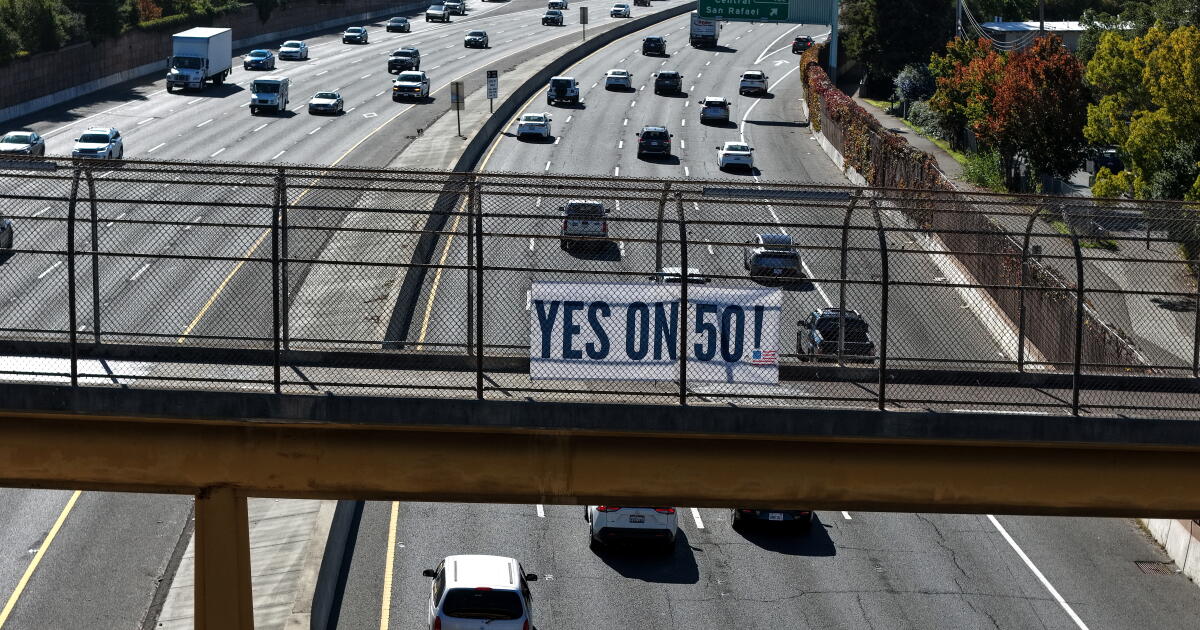
The voters approved the change in November.

While the new map has five more Democratic-leaning districts, the state’s attorneys said it did not increase the number with a Latino majority.

“Before Proposition 50, there were 16 Latino-majority districts. After Proposition 50, there is the same number. The average Latino share of the voting-age population also declined in those 16 districts,” they wrote.

It would be “strange for California to undertake a mid-decade restricting effort with the predominant purpose of benefiting Latino voters and then enact a new map that contains an identical number of Latino-majority districts,” they said.

Trump’s lawyers pointed to the 13th Congressional District in Merced County and said its lines were drawn to benefit Latinos.

The state’s attorneys said that too was incorrect. “The Latino voting-age population [in District 13] decreased after Proposition 50’s enactment,” they said.

Three judges in Los Angeles heard evidence from both sides and upheld the new map in a 2-1 decision.

“We find that the evidence of any racial motivation driving redistricting is exceptionally weak, while the evidence of partisan motivations is overwhelming,” said U.S. District Judges Josephine Staton and Wesley Hsu.

In the past, the Supreme Court has said the Constitution does not bar state lawmakers from drawing election districts for political or partisan reasons, but it does forbid doing so based on the race of the voters.

In December, the court ruled for Texas Republicans and overturned a 2-1 decision that had blocked the use of its new election map.
The court’s conservatives agreed with Texas lawmakers who said they acted out of partisan motives, not with the aim of denying representation to Latino and Black voters.

“The impetus for the adoption of the Texas map (like the map subsequently adopted in California) was partisan advantage pure and simple,” Justice Samuel A. Alito Jr. wrote in a concurring opinion.

California’s lawyers quoted Alito in supporting their map.

Source link

GOP leaders sound increasingly confident they can pass a spending package and end partial shutdown

Speaker Mike Johnson’s ability to carry out President Trump’s “play call” for funding the government will be put to the test on Tuesday as the House votes on a bill to end the partial shutdown.

Johnson will need near-unanimous support from his Republican conference to proceed to a final vote, but he and other GOP leaders sounded confident during a Tuesday morning press conference that they will succeed. Johnson can afford to lose only one Republican on party line votes with perfect attendance, but some lawmakers had threatened to tank the effort if their priorities are not included. Trump weighed in with a social media post, telling them, “There can be NO CHANGES at this time.”

“We will work together in good faith to address the issues that have been raised, but we cannot have another long, pointless, and destructive Shutdown that will hurt our Country so badly — One that will not benefit Republicans or Democrats. I hope everyone will vote, YES!,” Trump wrote on his social media site.

The measure would end the partial government shutdown that began Saturday, funding most of the federal government through Sept. 30 and the Department of Homeland Security for two weeks as lawmakers negotiate potential changes for the agency that enforces the nation’s immigration laws — U.S. Immigration and Customs Enforcement, or ICE.

“The Republicans are going to do the responsible thing,” Johnson said.

Running Trump’s ‘play call’

The House had previously approved a final package of spending bills for this fiscal year ending Sept. 30, but the Senate broke up that package so that more negotiations could take place for the Homeland Security funding bill. Democrats are demanding changes in response to events in Minneapolis, where two American citizens were shot and killed by federal agents.

Johnson said on Fox News Channel’s “Fox News Sunday” it was Trump’s “play call to do it this way. He had already conceded he wants to turn down the volume, so to speak.” But GOP leaders sounded as if they still had work to do in convincing the rank-and-file to join them as House lawmakers returned to the Capitol on Monday after a week back in their congressional districts.

“We always work till the midnight hour to get the votes,” said House Majority Leader Steve Scalise, R-La. “You never start the process with everybody on board. You work through it, and you could say that about every major bill we’ve passed.”

The funding package passed the Senate on Friday. Trump says he’ll sign it immediately if it passes the House. Some Democrats are expected to vote for the final bill but not for the initial procedural measure setting the terms for the House debate, making it the tougher test for Johnson and the White House.

Democratic leader Hakeem Jeffries has made clear that Democrats wouldn’t help Republicans out of their procedural jam, even though Senate Democratic leader Chuck Schumer helped negotiate the funding bill.

Jeffries, of New York, noted that the procedural vote covers a variety of issues that most Democrats oppose, including resolutions to hold former President Bill Clinton and former Secretary of State Hillary Clinton in contempt of Congress over the Jeffrey Epstein investigation.

“If they have some massive mandate,” Jeffries said of Republicans, “then go pass your rule, which includes toxic bills that we don’t support.”

Key differences from the last shutdown

The path to the current partial shutdown differs from the fall impasse, which affected more agencies and lasted a record 43 days.

Then, the debate was over extending temporary coronavirus pandemic-era subsidies for those who get health coverage through the Affordable Care Act. Democrats were unsuccessful in getting those subsidies included as part of a package to end the shutdown.

Congress has made important progress since then, passing six of the 12 annual appropriations bills that fund federal agencies and programs. That includes important programs such as nutrition assistance and fully operating national parks and historic sites. They are funded through Sept. 30.

But the remaining unpassed bills represent roughly three-quarters of federal spending, including the Defense Department. Service members and federal workers could miss paychecks depending upon the length of the current funding lapse.

Voting bill becomes last-minute obstacle

Some House Republicans have demanded that the funding package include legislation requiring voters to show proof of citizenship before they are eligible to participate in elections. Rep. Anna Paulina Luna, R-Fla., had said the legislation, known as the SAVE Act, must be included in the appropriations package.

But Luna appeared to drop her objections late Monday, writing on social media that she had spoken with Trump about a “pathway forward” for the voting bill in the Senate that would keep the government open. Luna and Rep. Tim Burchett, R-Tenn., met with Trump at the White House.

The Brennan Center for Justice, a think tank focused on democracy and voting rights issues, said the voting bill’s passage would mean that Americans would need to produce a passport or birth certificate to register to vote and that at least 21 million voters lack ready access to those papers.

“If House Republicans add the SAVE Act to the bipartisan appropriations package it will lead to another prolonged Trump government shutdown,” said Schumer, of New York. “Let’s be clear, the SAVE Act is not about securing our elections. It is about suppressing voters.”

Johnson, of Louisiana, has operated with a thin majority throughout his tenure as speaker. But with Saturday’s special election in Texas, the Republican majority stands at a threadbare 218-214, shrinking the GOP’s ability to withstand defections.

Freking writes for the Associated Press. AP video journalist Nathan Ellgren and writer Lisa Mascaro contributed to this report.

Source link

In stunning upset, Democrat wins Texas state Senate seat

Democrat Taylor Rehmet flipped a reliably Republican state Senate district in Texas in Saturday’s special election, continuing a string of surprise victories for Democrats across the U.S. in the year since President Trump returned to the White House.

Republican Lt. Gov. Dan Patrick called it “a wake-up call for Republicans across Texas,” where the GOP controls every statewide office.

“Our voters cannot take anything for granted,” Patrick wrote on X, while noting low-turnout special elections are always unpredictable. “I know the energy and strength the Republican grassroots in Texas possess. We will come out fighting with a new resolve, and we will take this seat back in November.”

Rehmet, a labor union leader and veteran, easily defeated Republican Leigh Wambsganss, a conservative activist, in the Fort Worth-area district, which Trump had won by 17 points in 2024. With almost all votes counted, Rehmet was leading by more than 14 percentage points — a more than 30-point swing.

“This win goes to everyday working people,” Rehmet told supporters.

Rehmet’s victory added to Democrats’ record of overperforming in special elections so far this cycle, beginning in March — when they prevailed in a Pennsylvania legislative district made up of suburbanites and farmers that Democrats hadn’t held in a century — and continuing through November, when they dominated candidate and ballot contests from Maine to California. Zohran Mamdani, a Democratic socialist, was elected mayor of New York City, a Democratic stronghold that saw the highest voter turnout in a mayor’s race in 50 years.

The showings come as Trump’s approval ratings hover around or below 40%. A January AP-NORC poll found that a majority of U.S. adults disapprove of the way he’s handling foreign policy, trade negotiations and immigration, as well as the economy.

Democrats said Saturday’s results in Texas were further evidence that voters under the second Trump administration are motivated to reject GOP candidates and their policies.

Texas Democratic Party Chair Kendall Scudder said Rehmet won by standing with working people and talking to Texans about the future.

“This win shows what is possible in Texas with strong organizing, great candidates and strategic investments,” he said in a statement. “People are noticing that Democrats have the workers’ backs and are delivering results.”

Democrats’ other recent state victories included wins for governor in Virginia and New Jersey and in special elections in Kentucky and Iowa. And, while Republican Matt Van Epps won a Tennessee special election for a U.S. House seat, the relatively slim margin of victory gave Democrats hope in the district for this fall’s midterms.

With that backdrop in mind, Trump and Vice President JD Vance have pushed states to redraw their political maps to Republicans’ advantage headed into those contests, which will determine partisan control in Washington. Some Democratic states — most notably California — have countered with their own redistricting efforts.

The Texas Senate seat was open because the four-term GOP incumbent, Kelly Hancock, resigned to take a statewide office. Hancock easily won election each time he ran for the office, and Republicans have held the seat for decades.

The district is redder than its home county, Tarrant. Trump won the county by 5 points in 2024, but Democrat Joe Biden carried it in 2020 by about 1,800 votes out of more than 834,000 cast.

Trump posted about the race on his social media platform earlier Saturday, urging voters to get out to support Wambsganss. He called her a successful entrepreneur and “an incredible supporter” of his “Make America Great Again” movement.

Rehmet had support from national organizations including VoteVets, a veterans group that said it spent $500,000 on ads. Rehmet, who served in the Air Force and works as a machinist, campaigned on lowering costs, supporting public education and protecting jobs.

Wambsganss warned her party not to be complacent.

“The Democrats were energized,” she said in a statement. “Too many Republicans stayed home.”

Rehmet’s victory allows him to serve until early January, and he will face Wambganss again in the November general election to try to keep the seat for a full four-year term. The Texas Legislature is not set to reconvene until 2027, and the GOP still will have a comfortable majority.

Hanna and Smyth write for the Associated Press.

Source link

In some states, a push to end all property taxes for homeowners

It is a goal spreading among anti-tax crusaders — eliminate all property taxes on homeowners.

Rising property values have inflated tax bills in many states, but ending all homeowner taxes would cost billions or even tens of billions in most states. It is unclear whether lawmakers can pull it off without harming schools and local governments that rely on the taxes to provide services.

Officials in North Dakota say they are on their way, using state oil money. Wednesday, Republicans in the Georgia House unveiled a complex effort to phase out homeowner property taxes by 2032. In Florida, GOP Gov. Ron DeSantis says that is his goal, with lawmakers considering phasing out nonschool property taxes on homeowners over 10 years. And in Texas, Republican Gov. Greg Abbott says he wants to eliminate property taxes for schools.

Republicans are echoing those who say taxes, especially when the tax collector can seize a house for nonpayment, mean no one truly owns property.

“No one should ever face the loss of their home because they can’t pay rent to the government,” Georgia Republican House Speaker Jon Burns of Newington said Wednesday.

An election-year tax revolt

These audacious election-year efforts could be joined by ballot initiatives in Oklahoma and Ohio to eliminate all property taxes. Such initiatives were defeated in North Dakota in 2024 and failed to make the ballot in Nebraska that year, although organizers there are trying again. Another initiative in Michigan may also fail to make the ballot.

“We’re very much in this property tax revolt era, which is not unique, it’s not new. We’ve seen these revolts in the past,” said Manish Bhatt, vice president of state tax policy at the Tax Foundation, a Washington, D.C., group that is generally skeptical of new taxes.

Previous backlashes led to laws like California’s Proposition 13, a 1978 initiative that limited property tax rates and how much local governments could increase property valuations for tax purposes.

The efforts are aimed at voters like Tim Hodnett, a 65-year-old retiree in suburban Atlanta’s Lawrenceville. Hodnett’s annual property tax bill rose from $2,000 to $3,000 between 2018 and 2024. He sees those figures starkly because he paid off his mortgage years ago, and he pays his taxes all at once instead of making monthly payments.

Hodnett said he is disabled and living on $30,000 a year. He is about to get a big property tax break, because seniors in Gwinnett County are exempt from school property taxes, about two-thirds of his bill. But he would love not to pay that other $1,000.

“It would be nice to be exempt from property taxes,” Hodnett said.

Will there be replacement revenue?

The question is whether local governments and K-12 schools should be expected to cut spending, or whether they will be allowed to make up revenue from some other source.

“I think the complete elimination of the property tax for homeowners is really going to be very difficult in most states and localities around the country, and undesirable in most places,” said Adam Langley of the Lincoln Institute of Land Policy, a Massachusetts nonprofit that studies land use and taxation.

Florida Chief Financial Officer Blaise Ingoglia, a Republican, has been touring the state arguing that local governments are overspending, trying to show they don’t need the $19 billion in property taxes they collect from homeowners for whom the property is their primary residence. Local governments have been disputing those figures.

North Dakota is using earnings from the state’s $13.4-billion oil tax savings account to gradually wipe out homeowner property taxes. Last year, North Dakota’s Republican-controlled Legislature expanded its primary residence tax credit from $500 to $1,600 a year. Officials in December said the tax credit wiped out property taxes for 50,000 households last year and reduced bills for nearly 100,000 more. That cost $400 million in state subsidies for the 2025 and 2026 tax years.

“It works, and we know we can build on it to provide even more relief and get property taxes to zero for the vast majority of North Dakota homeowners,” Republican Gov. Kelly Armstrong said.

The situation is murkier in Texas, which has been using state surplus funds to finance property tax reductions, and under the Georgia proposal, which calls for shifting taxes around.

A shift from property to sales taxes

Burns wants Georgia to wipe out $5.2 billion in homeowner property taxes — more than a quarter of the $19.9 billion in property taxes collected in 2024 — telling cities, counties and school districts to fall back on current or new sales taxes.

Not only will Burns’ plan need the Republican-led Senate to agree, but it will require Democratic support to meet the two-thirds hurdle for a state constitutional amendment and then voter approval in November.

While most property taxes go to schools, the majority of sales taxes don’t in some communities. It is unclear whether localities would redivide sales taxes. Also, local governments and schools would remain limited to a combined 5% sales tax rate, atop the state’s 4% rate. Some schools and governments might not be able to raise sales taxes enough to recover lost revenue.

Georgia would go from currently shielding $5,000 in home value from taxation to $150,000 in 2031 before abolishing most homeowner property taxes in 2032. The plan would limit yearly property tax revenue growth to 3% on other kinds of property.

Local governments would able to send homeowners a yearly bill for specified services such as garbage pickup, street lighting, stormwater control and fire protection, but lawmakers aren’t calling that a tax. Voters could also approve assessments for government or school improvements. Authors said they haven’t decided whether property owners could lose homes for unpaid assessments.

Burns also wants to spend about $1 billion to cut property tax bills in 2026, but it is unclear whether Republican Gov. Brian Kemp will agree. A spokesperson declined to comment.

Georgia previously tried to limit how much home values could rise for tax purposes, one common approach nationwide. But a majority of school districts and many other local governments have opted out. Georgia’s senators are still pursuing that approach, with a Senate committee on Wednesday voting to make the limit mandatory.

Amy writes for the Associated Press. AP writer Jack Dura in Bismarck, N.D., contributed to this report.

Source link

Column: Even as Trump shreds the Constitution, keep your eye on the Epstein files

The arrest of independent journalists Don Lemon and Georgia Fort, in connection with an anti-ICE protest that interrupted a church service in Minnesota, is a test for the American people. Well, some of us. Many of us already didn’t like what we saw happening across the country. Many believed the un-American threats during the campaign and voted against this regime in 2024.

So this is a test for the Americans who — after seeing law enforcement seemingly use a 5-year-old as bait and shoot Renee Good and Alex Pretti to death — still said they’re on board with everything.

The voters who agreed with Donald Trump when he said “they’re bringing drugs, they’re bringing crime” back in 2015, and were OK with him 10 years later, popping up in the Epstein files and pardoning criminals — including a corrupt former Latin American leader who took bribes to let 400 tons of cocaine be smuggled into the U.S.

This isn’t a test for the voters whose biggest concern was the price of groceries or border security. This is a test for the voters who used that rhetoric about groceries and the border as cover for their unsavory feelings about immigrants. The same feelings that greeted other groups — the Jews, the Italians, the Irish — when they first came to this land. The ethnicity may be different, the conspiracy theories may be new, but at the end of the day, it’s the same old predictable story.

So, if you’re the type to cast a ballot just to own the libs, the arrest of journalists is a test for you.

On Jan. 18, protesters — believing one of the pastors at Cities Church in St. Paul was also the acting field director of the local Immigration and Customs Enforcement office — entered the building and disrupted a service. The only reason anyone outside of St. Paul knew any of this is that we have freedom of speech and freedom of the press. Because people like Lemon and Fort had the courage to be there, knowing they had 250 years of American tradition backing up their right to do their jobs. That’s the point of the 1st Amendment.

Remember, if we don’t have journalists like Fort and my friend Lemon — people who are willing to do the work required to document history, or read legislation, or hold elected officials accountable — then you no longer have freedom of the press. You have state-controlled media by way of oligarchy. That may feel good to some factions now, but the problem with “now” is that it never lasts. The Constitution, though, has a real opportunity to stick around. But it needs constant protection.

In the old days, the ultra-rich used to buy local media companies to make money or for prestige in the community. Now it feels as if many owners’ goal is to control and curb journalism. Once the free press is in a cage, free speech has little room to fly. That is the byproduct of this wave of media consolidation, whether the billionaires who are engaged in these acquisitions planned to do that or not.

In addition, historically journalism has been under attack by governments not because it was a threat to society, but because it threatens those who want to control society. The reason most presidents spar with journalists is that they want to control the narrative.

But it appears the current president wants to control reality.

The impulse to rewrite reality is why Trump established Truth Social. It’s why the administration posts AI-generated images and doctored photos.

The sense that the president can create his own truth is why one day, the administration can defend the 2nd Amendment, and the next, suggest that legally carrying a weapon is a fatal mistake. After all, if he is free to trample the 1st Amendment, what’s the problem with kicking the 2nd around whenever he needs to?

Trampling the rights of the people: that is the test — for the rapidly dwindling minority of Americans who still stand behind Trump. He’s experimenting to see if enough of his supporters will accept having their rights taken away so long as the theft appears not to hurt them.

For the many Americans who have never voted for Trump, the arrests of Lemon and Fort are not a total shock. We have seen the “Trump 2028” hats and take this thinly veiled threat against the 22nd Amendment seriously.

But for the Americans who vehemently denounced President Obama for wearing a tan suit, where exactly is “arresting journalists for doing their job” on the threat-to-democracy scale? And why do you think Trump is doing this now?

Nearly a year ago, Atty. Gen. Pam Bondi said she had the Epstein client list on her desk for review. Then the administration waffled and refused to turn over its files. On Friday, it finally did release 3 million pages of documents.

And on Thursday night, knowing that release was imminent, the Justice Department just happened to arrest journalists.

That doesn’t feel like a coincidence.

It doesn’t even feel like politics. It all feels like a test democracy desperately needs America to pass.

YouTube: @LZGrandersonShow

Source link