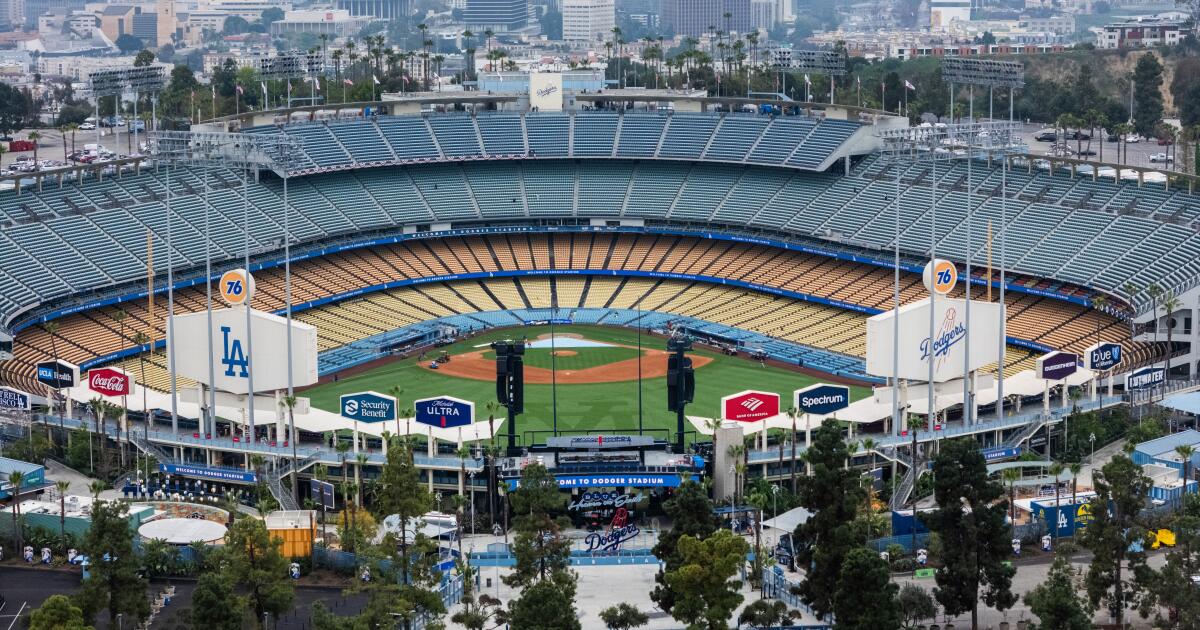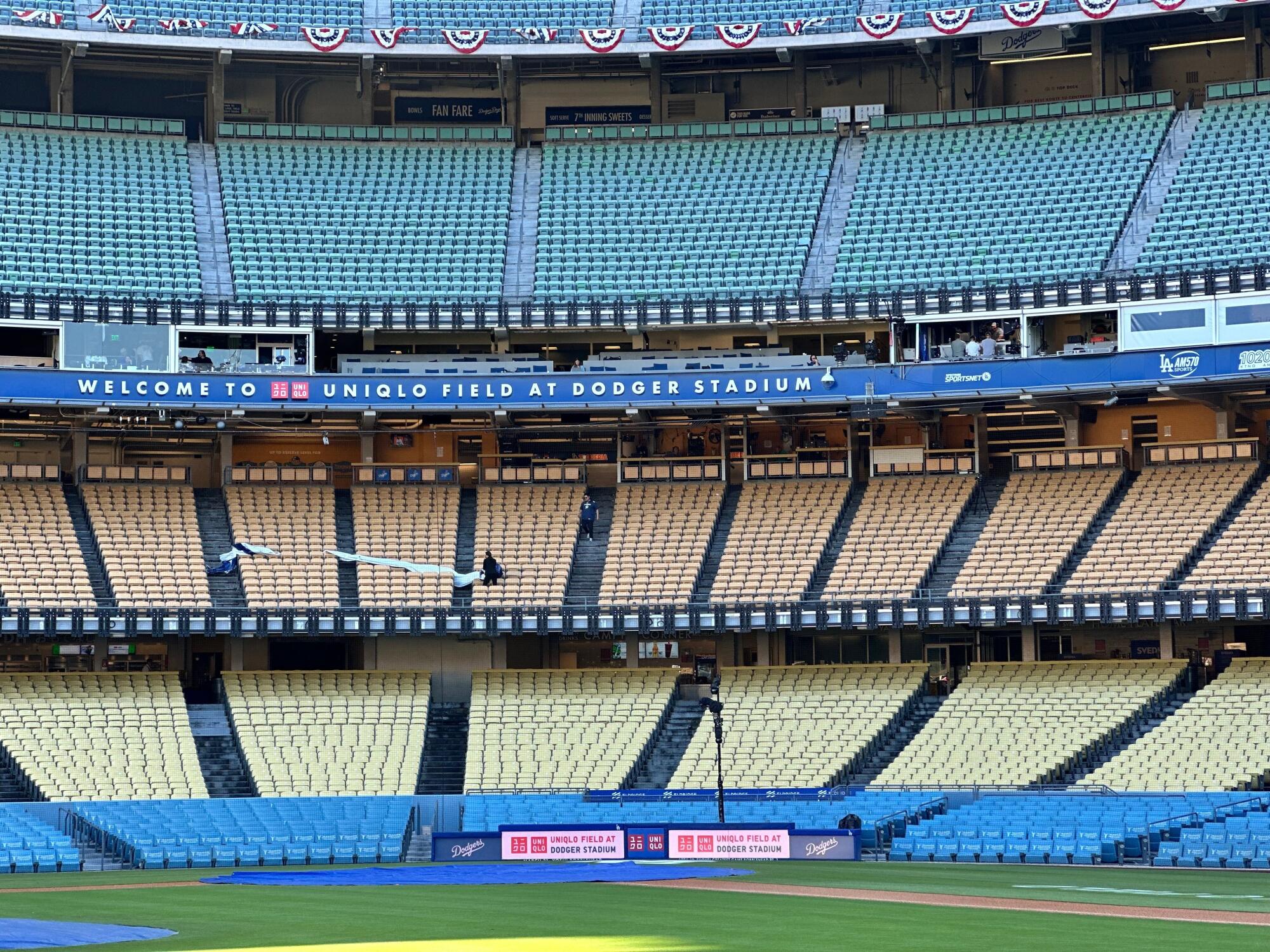
The signs say Uniqlo Field. You will continue to say Dodger Stadium
It was Dodger Stadium on Wednesday, when the grass outside the baseline and the bright red sign high above center field read “UNIQLO FIELD.” It will be Dodger Stadium on Thursday, when the defending World Series champions open their new season, and forevermore.
The official name of our summer home is now Uniqlo Field at Dodger Stadium. The team announcers will say that, and so will some of the signs. The fans won’t, and the founder of the company that just spent nine figures on the name you won’t use said he completely understands.
“That’s a very natural reaction,” Uniqlo founder Tadashi Yanai told me through an interpreter. “We respect that.”
Yanai said his company’s deal with the Dodgers covers five years. He would say only that the total value was “more” than $125 million. That provides the Dodgers with an annual naming rights payment in line with the ones at Crypto.com Arena, Intuit Dome and Sofi Stadium, without the Dodgers having to sell naming rights to the actual venue.
Are the Dodgers baseball’s version of a gold mine? Yes. Do they spend big and win big? Also yes. Do you mind if Uniqlo essentially covers Freddie Freeman’s salary this season?
“We need a lot of revenue to put out the product that we do,” Dodgers president Stan Kasten said. “That’s not a secret. And we’re proud of everyone who helps us do it: all of our fans, all of our media partners, and all of our sponsor partners. They are all important. It is how this all comes together.”
While Uniqlo would be delighted if you used its name, whatever local fans choose to call the stadium is not critical to the success of the partnership.
For a Japanese company in pursuit of brand awareness and expansion in the United States and elsewhere, there might be nothing better than getting your name in front of millions of fans around the world watching Shohei Ohtani play on television.
Ohtani made an estimated $125 million in endorsements and sponsorships last year, Sportico reported, a larger annual haul “than any other athlete in the history of sports.”
“The Dodgers are such a popular team,” Yanai said. “I usually ask my wife, after I come back from the office, whether Shohei hit a home run. I think all the Japanese people do that.”

Uniqlo Field signs were unveiled Wednesday at Dodger Stadium in the wake of the team’s naming rights deal.
(Beth Harris / Associated Press)
According to Forbes, Yanai is the richest man in Japan, where baseball teams carry corporate names. Why not buy a team and call it, say, the Uniqlo Bears?
“I always keep saying that could be very interesting,” he said, “but my wife turned it down. She keeps telling me, ‘Tadashi, you are not cut out to manage sports teams.’”
Instead, he is managing Uniqlo, an apparel company that pitches itself as blending comfort with quality. “We do not make disposable clothing,” Yanai said in the company’s last annual report.
Uniqlo has 794 stores in Japan but only 77 in the United States, including 14 in the Southland. Koji Yanai, a senior executive officer and Tadashi’s son, said the company aspires to grow annual U.S. revenues from $6 billion to $30 billion.
He shared what might be a more challenging aspiration.
“The Uniqlo Field at Dodger Stadium name may be very new for everyone,” he said, “but I hope in the near future the fans will like it and will love it.”
United Airlines Field at the Coliseum? Yeah, no.
Jeff Marks, the chief executive of Los Angeles-based Innovative Partnerships Group, once brokered a naming rights deal in which the Cal football team would play on Kabam Field at California Memorial Stadium. He tried to find a receptive audience for the name.
“We educated a lot of freshmen, sophomores, and newcomers,” Marks said. “Are you going to go after alumni who have been calling it Memorial Stadium? No. So you didn’t focus on that. You focused on people that could be more impressionable, and it worked.”
With Dodger Stadium, we’ll see. For the 2026 season, it is now time for Dodgers baseball, but not before one reporter at a press conference Wednesday asked company officials whether Uniqlo would provide the Dodgers players with free clothing.
Kasten could not pass up the chance to interject.
“We pay them enough,” he said with a grin, “to shop at Uniqlo stores.”