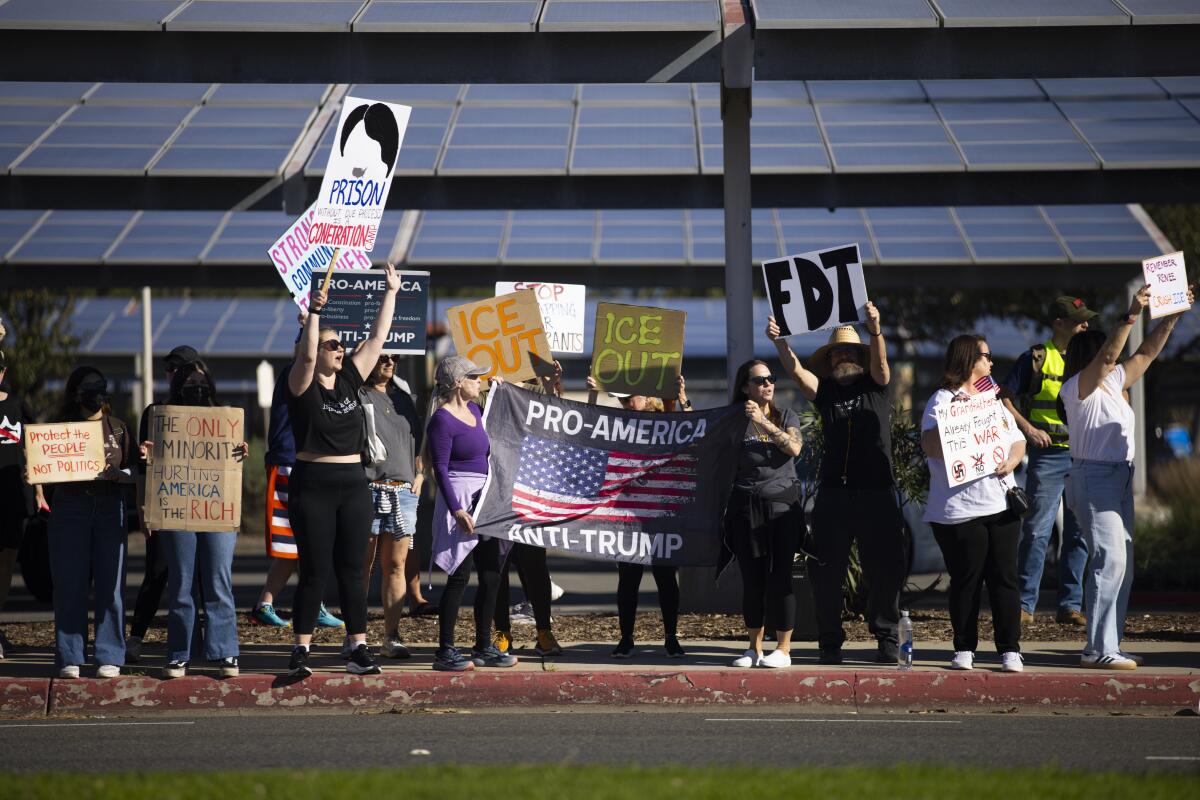
Thousands gather statewide in anti-ICE protests, including hundreds in Huntington Beach
More than 60 largely peaceful protests took place this weekend against U.S. Immigration and Customs Enforcement actions, including several in Southern California.
But while many protests were without incident, they were not short on anger and moments of tension. Organizers called the gatherings the “ICE Out for Good” weekend of action in response to the fatal shooting of Renée Nicole Good by an Immigration and Customs Enforcement agent in Minneapolis.
In Huntington Beach, Ron Duplantis, 72, carried a diagram to represent the three shots fired at Good, including one through her windshield and two others that appeared to go through her side window.
“Those last two shots,” he said, “make it clear to me that this is murder.”

Participants in the “ICE Out” protest hold signs Sunday in Huntington Beach.
(Kayla Bartkowski / Los Angeles Times)
Huntington Beach has seen past clashes between Trump supporters and anti-racism activists, but as of mid-afternoon, Sunday’s protest was tense at times, but free of violence. About 300 people — and two dozen counterprotesters — stood outside City Hall, with protesters carrying anti-ICE signs, ringing cowbells and chanting “ICE out of O.C.”
As cars sped past them on Main Street, many motorists honked in a show of solidarity, while some rolled down their windows to shout their support for ICE, MAGA and President Trump.
“The reason why I’m here is democracy,” said Mary Artesani, a 69-year-old Costa Mesa resident carrying a sign that read “RESIST.” “They have to remember he won’t be in office forever.”

Participants in the “ICE Out” protest in Huntington Beach hold signs as a car with a MAGA hat in the windshield passes.
(Kayla Bartkowski / Los Angeles Times)
The Trump administration has largely stood behind the ICE agent, identified as Jonathan Ross, with Homeland Security Secretary Kristi Noem saying he acted in self-defense. Democratic officials and many members of the public have said the videos of the shooting circulating on social media appear to contradict at least some of the administration’s assertions.
“I’m outraged a woman was murdered by our government and our government lied to our faces about it,” said protester Tony Zarkades, 60, who has lived in the Huntington Beach area for nearly 30 years. A former officer in the Marines, Zarkades said he is thinking of moving to Orange to escape the presence of so many Trump supporters in Huntington Beach.
Large protests against ICE occurred in the Bay Area as well as Sacramento and other California cities over the weekend. In Oakland, hundreds demonstrated peacefully on Sunday, although the night before, protesters assembled at the Ronald V. Dellums Federal Building and left graffiti, according to a report in the San Francisco Chronicle.
In Los Angeles on Saturday night, protesters marched through the downtown area to City Hall and past the
Edward Roybal Federal Building, with the L.A. Police Department issuing a dispersal order at about 6:30 p.m., according to City News Service.
While many of the protests focused on what happened to Good in Minnesota, they also recognized Keith Porter Jr., a man killed by an off-dutyICE agent in Northridge on New Year’s Eve.
In Huntington Beach, the coastal community has long had a reputation as a Southern California stronghold for Republicans, though its politics have recently been shifting. Orange County has a painful legacy of political extremism, including neo-Nazism. In 2021, a “White Lives Matter” rally in the area ended in 12 arrests.
On Sunday, a small group of about 30 counterprotesters waved Trump and MAGA flags on a corner opposite from the anti-ICE rally.

Counterprotester Victoria Cooper, 72, holds signs and shouts at participants of the “ICE Out” protest in Huntington Beach.
(Kayla Bartkowski / Los Angeles Times)
“We’re here to support our country and president and support ICE,” said Kelly Johnson, who gave his age as “old enough to be your sugar daddy.”
Wearing an “ICE Immigration: Making America Safe Again” T-shirt, Kelly said the protesters were “paid agitators” who had been lied to by the media.
“Look at the other angles of the [shooting] videos,” he said. “She ran over the officer.”
Standing with him was Jesse Huizar, 66, who said he identifies as a “Latino for Trump” and was here to “support the blue.”
The Chino resident said he came to the U.S. from Mexico when he was 5, but that he has no fear of ICE because he “came here legally.”
Huizar said Good’s death was sad, but that she “if she had complied, if she got out of her car and followed orders, she’d be alive right now.”
But their voices were largely overpowered by those of the anti-ICE protesters. One of the event’s organizers, 52-year-old Huntington Beach resident Denise G., who declined to give her last name, said they’ve been gathering in front of City Hall every Sunday since March, but that this was by far one of the largest turnouts they have seen.
She felt “devastated, angry, and more determined than ever” when she saw the video of Good’s shooting, she said.

Counterprotester Kelly Johnson stands across from the “ICE Out” demonstration.
(Kayla Bartkowski / Los Angeles Times)
“It could be any one of us,” she said. “The people not out here today need to understand this could be their family member, their spouse, their children. The time is now. All hands on deck.”
Nearby, 27-year-old Yvonne Gonzales had gathered with about 10 of her friends. They said they were motivated to come because they were outraged by the shooting.
“I wish I was surprised by it,” Gonzales said, “but we’ve seen so much violence from ICE.”
She suspected that race was a factor in the outpouring of support, noting that Good was a white woman while many others who have been injured or killed by immigration enforcement actions have been people of color, but that it was still “great to see this turnout and visibility.”
A few feet away, 41-year-old Christie Martinez stood with her children, Elliott, 9, and Kane, 6. She teared up thinking about the shooting and the recent ICE actions in California, including the killing of Porter.
“It’s sad and sickening,” said Martinez, who lives in Westminster. “It makes me really sad how people are targeted because of their skin color.”
