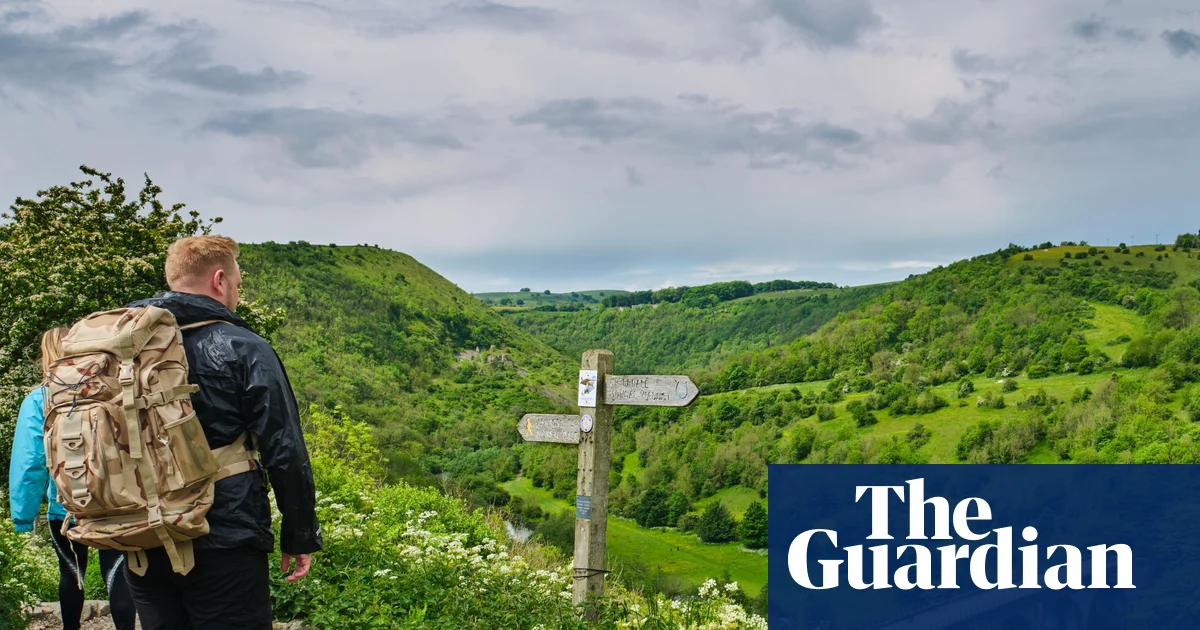
Start/finishCoombs Road in Bakewell to Blackwell Mill in Chee Dale, but there are lots of access points along the way Distance8.5 miles Cycle, hike or ride a horse along the Monsal Trail to explore a swathe of Derbyshire’s industrial history. This former stretch of the Midland Railway line winds past the imposing structures of two 18th-century cotton mills, through illuminated railway tunnels and over the Headstone Viaduct, which gives glorious views of the River Wye and Monsal Dale below. Interpretation and listening panels along the route explain the area’s history, geology and wildlife, while a short detour on to Monsal Head offers a panoramic view of the viaduct itself. Pause here for lunch or a pint at the Monsal, or stop in at Hassop Station Cafe, which offers bike rental alongside hefty sandwiches, homemade cakes and wood-fired pizza at weekends. monsaltrail.org.uk
The Strawberry Line, Somerset
Cycling on the Strawberry Line at Shute Shelve railway tunnel. Photograph: Joe Dunckley/Alamy
Start/finishYatton railway station to the old (unused) Cheddar railway station Distance10.7 miles Named for the fruity cargo that trains once carried from the strawberry fields up to London, this flat, accessible route – shared by walkers, cyclists and wheelchair users – knits together former railway stations, cider orchards and small, historic towns. Direct trains run from Bristol to Yatton, where the not-for-profit, community-run Strawberry Line Cafe serves hearty breakfasts and homemade cakes, while next door the Strawberry Line Cycle Project offers bike hire and accessories such as child seats. The route runs through wildlife-rich wetlands, open grazing land and lush valleys, while the medieval square at Axbridge gives an insight into the region’s rich history, dating back to the 10th century, when it was a busy commercial centre. Settle in at the Almshouse Teashop, in a building almost 600 years old, for freshly made soup and sweet treats, before setting off again. thestrawberryline.org.uk
The Mawddach Trail, Gwynedd, Wales
The toll bridge at Penmaenpool, over the Mawddach. Photograph: Henry Ciechanowicz/Alamy
Start/finishMarian Mawr car park in Dolgellau to Barmouthviaduct Distance9.5 miles Mostly running alongside the Mawddach estuary, this tranquil trail is a great choice for birders, with peregrine falcons and buzzards whirling above, and curlews and oystercatchers in the salt marshes. The wide, even surface also makes it ideal for wheelchairs and mobility scooters, and there are several joining points along the trail, meaning you can walk or bike as little or as far as you like. Just next to the 150-year-old Penmaenpool wooden toll bridge, the George III hotel and pub offers sweeping estuary views and classic pub food (including particularly fine pies), or pick up picnic supplies from Fork, Cork and Feathers in Dolgellau, which has a cold counter crammed with cured meats, cheeses and other local produce. There are seats and picnic tables dotted all the way along the trail. mawddachtrail.co.uk
The Cuckoo Trail, East Sussex
The Cuckoo Trail. Photograph: Johan Siebke/Alamy
Start/finishStation Road in Heathfield to Hampden Park in Eastbourne Distance14 miles A great choice for a family adventure, this mostly flat trail has five augmented reality “story stops” along the way – where, with just a quick scan of the QR code, children can interact with animated wildlife characters, solve puzzles and take a selfie with a grumpy badger. There are sculptures too, including carved wooden seats made from oak trees that fell during the great storm of 1987 and steel sculptures that act as mileposts. Cuckoo Shack Cafe, part of Priory Court Farm in Polegate, is set right on the trail and offers homemade-cakes, sandwiches and excellent coffee, but it is only open at weekends and during school holidays. Otherwise, a quick diversion into Hailsham offers a clutch of places to eat, including Neapolitan street food and wood-fired pizza at Rustico. wealden.gov.uk
The Flitch Way, Essex
The former Rayne railway station, near Braintree. Photograph: PA Images/Alamy
Start/finishBraintree station to Start Hill, near Bishop’s Stortford Distance15 miles Discover a tranquil side of Essex by following this rural trail along the edge of the former royal hunting ground of Hatfield Forest – where fallow deer roam between the ancient oak trees – and Great Notley Country Park, where families can take advantage of the 1.2km play trail, with slides, forts and swings. The main refreshment stop is 2 miles along the trail from Braintree at the Rayne Station centre, which combines the Booking Hall Cafe with the free-to-enter Railway Carriage Museum, a visitor centre and toilets. For something more sustaining (and a pint or two), the Lion and Lamb pub is just a short detour off the trail, in the pretty village of Little Canfield. Keep an eye out for kestrels and buzzards, plus brown hares dashing out of the hedgerows. explore-essex.com
The Wirral Way, Merseyside and Cheshire
Thurstaston beach. Photograph: David Chapman/Alamy
Start/finishWest Kirby railway station to Hooton railway station Distance12.2 miles One of the first converted railway lines in England, the Wirral Way is now a dramatically beautiful coastal path running along the Wirral Peninsula. It takes in the Wirral Country Park, where Wirral Way Bikes offers cycle hire for adults and kids (including ebikes), and clifftop picnic spots have gorgeous views over the Dee estuary. Take a detour down the cliffs to Thurstaston beach for a spot of fossil hunting or a quick paddle, and pause at Hadlow Road station, which has been preserved in all its 1950s glory (when the passenger service stopped) as an open museum; it also operates as an information point for the trail. Time your walk or ride for sunset, when the mudflats glow rose-pink and gold as the sun drops below the Clwydian Hills, and take the short connecting path down to the Harp Inn, Little Neston, set directly on the estuary, for a sundowner to go with the view. visitcheshire.com
The Crab and Winkle Way, Kent
Rewilded bison on the Blean. Photograph: Donovan Wright/PA
Start/finishCanterbury West station to Whitstable Harbour Distance7.5 miles Following the route of one of the earliest railway lines, built in 1830, this hiking and cycling trail passes through the Blean, a large swathe of ancient woodland, home to the 13th-century church of St Cosmus and St Damian, and an RSPB reserve. It’s also home to Europe’s first free-roaming bison, introduced as part of a rewilding initiative in 2022 by the Kent Wildlife Trust and Wildwood Trust. There’s not really anywhere en route to stop and eat, so either pick up treats for a picnic at the Goods Shed in Canterbury (an indoor farmers market, closed mondays) or save yourself for oysters and a glass of fizz at the Whitstable Oyster Company, right on the beach. explorekent.org
The Dava Way, Moray and Highland, Scotland
The collie dog memorial on the Dava Way. Photograph: John Bracegirdle/Alamy
Start/finishMannachie Avenue in Forres to Dulicht Bridge in Grantown-on-Spey Distance24 miles Unusually for a rail trail, the Dava Way includes a stiff climb from the Moray Firth up over Dava Moor to the Dava Summit, at 320 metres (1,050ft), before heading back down to Grantown-on-Spey, following the Highland Railway line that operated for over a century, from 1863 to 1965. The ascent is well worth it for the spectacular views across the Moray Firth to Sutherland in the north, and south to the Cromdale Hills and the Cairngorms, while the ride back down is a breeze. The Divie Viaduct, built in 1863, is the most famous landmark along the way, while the Halfway Hut is a restored shelter that makes a perfect spot for a picnic, with old photographs and route info on the walls (not for overnight stays). davaway.org.uk
Revolut gets an OCC thumbs up to launch a US bank, but lending ambitions are another issue.
Technically, financial technology company Revolut is already a bank across several regions—it holds licenses in the U.K., France, Mexico and Australia.
Now, in the U.S. market, it is one step closer to bankhood.
The London-based startup announced Thursday that it has received conditional approval from the U.S. Office of the Comptroller of the Currency for a national bank charter. The move would help the company grow its customer base from 80 million to 100 million by mid-2027.
It also exemplifies Revolut’s agility as a fintech compared to traditional banks, which typically take years to pull off similar expansion efforts.
“Legacy banks are working with legacy systems,” David Tirado, Revolut’s VP of Profitability and Global Business, told Global Finance in an interview last year. “Revolut, on the other hand, built our proprietary technology from the ground up with a global mindset. While competitors struggle to scale across different markets and regulatory landscapes, our systems were designed for this from day one.”
What Else Does Revolut Need?
Revolut still needs a green light from the Federal Deposit Insurance Corp. and the Federal Reserve, as well as final sign-off from the OCC, before it can open the proposed bank.
Once fully approved, Revolut said it would offer U.S. customers loans, credit cards, FDIC-insured deposits, and access to stablecoins and cryptocurrencies.
In a prepared statement, Revolut founder and CEO Nik Storonsky said the conditional approval was “an important first step towards establishing the proposed Revolut Bank US,” adding that it gives the company “the foundation to build in the world’s largest financial market.”
The U.S. bid follows Revolut’s expansion across Latin America, where the company recently launched a bank in Mexico and is pursuing licenses in Brazil, Colombia, Peru and Argentina. This year, Revolut has also obtained banking licenses in France, Australia and the U.K., a payments license in the United Arab Emirates, and is seeking a banking license in South Africa.
The company claims to add roughly 1 million customers every 17 days.
What About Lending?
Whether Revolut can become a customer’s primary financial institution without being a major loan underwriter remains to be seen. Revolut’s consumer lending segment remains small relative to its tens of billions in customer deposits. Still, it’s worth noting that the so-called neobank’s loan book, as of March, is up 120% year over year at $2.9 billion.
Felipe Peñacoba Martinez, CEO of Getnet Platforms Payments Hub and former CIO at Revolut Bank (EU), told Global Finance in June: “Revolut is aware this takes time, and they’re going slower than in other areas.”
Ultimately, the central question facing the industry is whether fintechs like Revolut can scale core banking products faster than traditional incumbents can modernize their digital ecosystems.
Anthony Noto covers corporate finance and private credit. Contact him at anoto@gfmag.com
It was a Thursday evening, and I was performing Gloria Gaynor’s 1978 hit “I Will Survive” for my audience of three on an ocean pier as we waited for the partial lunar eclipse.
As we shimmied to ‘70s hits via a Bluetooth speaker, I boasted about winning a talent competition in my tiny town thanks to my rendition of the disco classic. “We need to see these dance moves!” a fellow camper proclaimed.
Somehow, we had this island all to ourselves.
This was one of several memories I made last week when I traveled to Santa Cruz Island in Channel Islands National Park to stay at Prisoners Harbor Campground on its opening night. When the National Park Service announced that reservations would open Aug. 18, I spent 11 hours that day refreshing the page, waiting for my chance. At last, site No. 1 was mine.
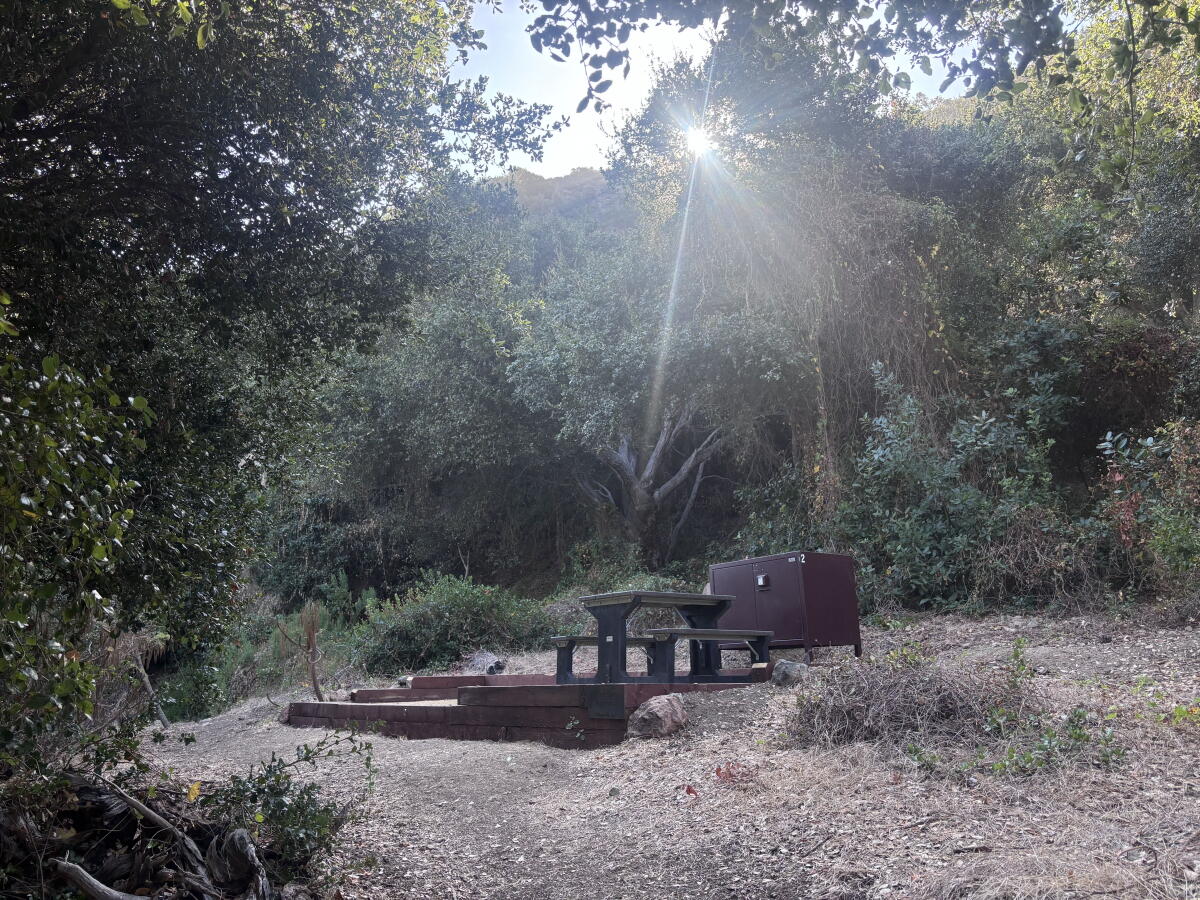
Campsite No. 2 at the Prisoners Harbor Campground on Santa Cruz Island.
(Jaclyn Cosgrove / Los Angeles Times)
In this edition of The Wild, I lay out how you can create your own memories at this quiet campground on a lesser traveled side of Santa Cruz Island. I will explain how to book your site and ferry, what to pack and what you can do while on the island.
You are reading The Wild newsletter
Sign up to get expert tips on the best of Southern California’s beaches, trails, parks, deserts, forests and mountains in your inbox every Thursday.
By continuing, you agree to our Terms of Service, which include arbitration and a class action waiver. You agree that we and our third-party vendors may collect and use your information, including through cookies, pixels and similar technologies, for the purposes set forth in our Privacy Policy such as personalizing your experience and ads.
Step 1: Book your campsite ⛺
Prisoners Harbor Campground is a small, rustic campground open year-round on Santa Cruz Island, the largest island in California. Although the National Park Service lists the campground as having six sites, it technically has seven. Reservations can be made for $15 a night through Recreation.gov.
Prisoners Harbor Campground is about a 13-mile hike southwest from Scorpion Canyon Campground, the popular 31-site spot where most folks visiting the island camp. Unlike Scorpion Canyon, Prisoners Harbor does not have any water on site and is a more DIY experience. There are also fewer tours and experiences led by outfitters on this side of the island.
The map of Prisoners Harbor Campground.
(Jaclyn Cosgrove / Los Angeles Times)
Each campsite at Prisoners Harbor has a dirt-packed tent pad, a picnic table and metal food storage containers that everyone called “fox boxes,” as the island fox is the largest land predator on the island (and will absolutely steal your food, and maybe your shoes).
From the pier, you’ll walk about one-fifth of a mile on a mostly flat dirt road, passing the brick Prisoners Harbor warehouse and two pit toilets. You will cross the Cañada del Puerto, which was dry during our visit but can swell to 3 feet and become impassable, according to the park service.
I was pleased to find that site No. 1 is tucked away in the campground’s northern corner. It is shaded by oak trees and surrounded by thick brush, offering privacy and the feeling like you exist only in this one little corner of the world.
Site No. 2 is on the path to site No. 1 and isn’t presently bookable on Recreation.gov. (I’m guessing the park service will remedy that soon, as the site exists and is ready for campers!)
The shaded campsite No. 6 at Prisoners Harbor Campground.
(Jaclyn Cosgrove / Los Angeles Times)
Sites No. 3, 4, 5 and 6 are all positioned in a row on the southwestern corner of the campground. Similar to site No. 1, site No. 6 is tucked under thick tree canopy. I think it’s probably shaded for most, if not all, of the day. Sites No. 3, 4 and 5 also have some shade.
Site No. 7 is the accessible campsite and has a ramp leading up to it. It is fairly exposed, appearing to have the least amount of shade and privacy. It is closest to the pit toilet, though, which also has a ramp leading up to it.
As I was getting ready for bed, I noticed the soothing sound of ocean waves. My friend Christine was already cozy inside the tent, and I asked her if she’d turned on an ambient soundtrack on her phone to fall asleep. “No, that’s just the ocean!” she said.
Step 2: Book your ferry ⛴️
There are only two ways to get to Santa Cruz Island: Take a private boat or, the more popular route, book a ferry through Island Packers, leaving out of Ventura Harbor.
A roundtrip ferry to Prisoners Harbor costs $72 for children ages 3 to 12, $96 for campers ages 13 to 54, $91 for those 55 and older. It is also $91 for members of the U.S. military.
Upon booking your ferry, you must read the rules that Island Packers emails to you. I cannot stress that enough. There are weight limits (i.e. no single item may weigh more than 45 pounds) and limitations about what you’re allowed to bring. That said, it’s all fairly easy to follow — like not packing your water or fuel inside your bag, as those both are packed in specific places on the boat.
Christine, a friend of The Wild, paddles along the coastline of Santa Cruz Island near Prisoners Harbor.
(Jaclyn Cosgrove / Los Angeles Times)
Step 3: Plan out what you’d like to do on the island 🚣😎
With Prisoners Harbor being more of a DIY experience than Scorpion Canyon, one of the most important things you can do is plan ahead and book your activities at least a full day — ideally a few days — before your trip.
I knew I wanted to try snorkeling, but I don’t own gear — yet. Thanks to a recommendation from Island Packers, whose staff graciously answered all my questions, I contacted Ventura Dive and Sport to see what was doable. Owner Zach Cantrell was helpful and accommodating, setting me up with everything I needed, including a 7-mm wetsuit that made me feel like an actual marine mammal thanks to my ability to float while wearing it. Cantrell also made it easy to return my gear since the ferry was returning after his shop was closed.
Outside of snorkeling, you can also rent a kayak through Channel Islands Kayak Center. Or you can bring your own kayak, keeping in mind that Island Packers has specific rules around which kayaks you’re allowed to bring. You should also take a look at the National Park Service’s safety guidance regarding the risks of ocean kayaking.
The hike along Navy Road offers nice views of ocean and mountain ranges on the mainland.
(Jaclyn Cosgrove / Los Angeles Times)
You can also swim near the Prisoners Harbor pier, but you should keep in mind:
The beach here is not sandy, but rather covered with rocks of varying sizes; pack swim shoes to protect your feet
The waves can get choppy, so make sure not to swim alone
There are stingrays in the area, so enter the water doing the stingray shuffle
There are sea urchins on some rocks in the area, so watch out for those as well, as their sting also hurts
On the island, there’s, of course, hiking. There are two trailheads at Prisoners Harbor:
The 4-mile out-and-back Pelican Bay hike, a challenging trek that traverses along the coastline, offering seemingly endless views of the area, before ending at the bay and Tinkers Harbor, another spot where you can swim and snorkel; The hike is on Nature Conservancy land, an environmental nonprofit that owns 76% of the island, and the conservancy requires that you sign a waiver and only traverse the hike when an Island Packers staffer is present on the trail.
A hike along Navy Road that you can take to the backcountry Del Norte campground, or to a variety of other spots on the island, should you pack a paper map or download a map before your trip.
Christine and I had originally planned to check out the Pelican Bay hike on Friday morning, but then a kind island visitor said we could borrow their kayaks for free. That was an irresistible offer.
I’ve kayaked several times on rivers and in lakes but never on the ocean, so I wanted to be fairly cautious. We paddled northwest along the island’s coast, taking in the island’s jagged rocky cliffs. We spotted what appeared to be a small sea cave but agreed it wasn’t a good idea to explore without a guide who knows the island. You should always be ready on any adventure to check in with yourself and your travel companions about your skill and comfort levels. If the reason you’re wanting to do something is really just “FOMO,” ask yourself if it should instead be a “NO-GO.” (Yes, I just made that up.)
Kayakers leave out of Scorpion Anchorage on Santa Cruz Island.
(Jaclyn Cosgrove / Los Angeles Times)
I saw repeatedly on the National Park Service website that the island’s weather conditions can change rapidly, including while out on the kayak. Christine was out front and noted the wind was picking up. We swiftly paddled back, carried in part by the waves, which pushed our kayaks along in a similar sensation to surfing. I quickly fell in love with that feeling!
Despite the campground being fully booked, there were only two other campers during our trip — retired educators and travel besties Kim Eaton and Annemarie Lee, both of Riverside. They’d visited the Channel Islands multiple times, including Anacapa, Santa Rosa, San Miguel and had made previous trips to Santa Cruz, and they’d always wanted to do the Pelican Bay hike.
We were all on the island when it was particularly hot and humid, so the duo chose to go halfway and turn around.
The cloudy night sky, as seen from the Prisoners Harbor pier.
(Jaclyn Cosgrove / Los Angeles Times)
“The views were beautiful,” Eaton said, noting how clearly they could see the rugged coastline and waves. “We saw you guys kayaking!”
“The color of that ocean is beautiful,” Lee added.
Rocky outcroppings near Scorpion Anchorage.
(Jaclyn Cosgrove / Los Angeles Times)
Step 4: Plan what you’ll pack, including all your water
Everything you pack in, including your trash, you must pack out. There is no food for purchase, and there is no water at Prisoners Harbor, so you must bring whatever you plan to use for drinking and other purposes. I brought 4 gallons, and Christine packed 2. As I said, it was pretty hot, and we left the island with about a gallon and a half left.
I didn’t realize coolers were allowed. Nearby in campsite No. 4, Kim and Annemarie not only had a cooler but large ice cubes they’d frozen specifically for the trip, which last longer thanks to their size. “So if you like your cocktails, you’ll have ice” for multiple days, Kim said.
Step 5: Don’t miss the boat!
Island Packers requires campers to check in an hour before the boat leaves.
I left my home just before 6 a.m., picked up Christine and boogied to Island Packers, parking just before 8 a.m. Parking at Ventura Harbor is free Monday through Thursday, and $10 for a full-day pass Friday through Sunday and on major holidays.
After checking in, we worked with Island Packers staffers to load our gear onto the boat. I also thankfully had time to buy a four-shot latte next door at Freedom Coffee. Island Packers has several items for sale in their gift shop, including waterproof phone cases and other items you might have forgotten at home.
As you board the boat, make sure you remember wherever you tuck your return ticket. Our departure time from the island was 4:15 p.m. Friday, which gave us the better part of the day to explore.
An island fence lizard rests on a log at campsite No. 1, scoping out the new visitors to its island.
(Jaclyn Cosgrove / Los Angeles Times)
Step 6: Have fun!
Full of motion-sickness drugs and glee, we boarded the boat. I tried to keep my expectations low for what we’d see on the trip to the island. I’ve been on three whale watching excursions out of Long Beach, including once when we didn’t see any whales.
A bottlenose dolphin swims alongside the Island Packer boat on its journey to Santa Cruz Island.
(Jaclyn Cosgrove / Los Angeles Times)
However, shortly into our trip, our boat was visited by bottlenose dolphins that swam next to us. As we neared Scorpion Anchorage to drop off the passengers day-tripping and camping there, we saw so many common dolphins, it felt like an organized and official welcoming celebration.
A humpback whale near the coastline of Santa Cruz Island.
(Jaclyn Cosgrove / Los Angeles Times)
But the real magic happened shortly before we docked at the Prisoners Harbor pier when our captain Pancho spotted at least one (maybe two) humpback whale. We paused for a bit to take in the majestic animal’s movements. Christine and I agreed it was easy to see how sailors believed in sea monsters, given how otherworldly the humpback’s body appears as it slithers in and out of the water.
Before leaving for the island, I’d read about how the island foxes will approach you while you’re eating, and that they’ll come into your campsite to try to snag your food. We didn’t have that experience, thankfully, as the campground is so new, and the animals aren’t used to people being there yet.
These tiny canines remained rather elusive — until just before we left. We were headed to the restroom when I gasped. An island fox, about the size of a large house cat, was busy foraging for food in the leaves. It made me happy to see it act naturally, rather than begging us for human food.
An island fox roots through leaves in pursuit of a meal.
(Jaclyn Cosgrove / Los Angeles Times)
The fox cautiously walked a few feet past us on its journey for bugs and other snacks. It was a last bit of island magic before we left.
Although the beauty and biodiversity of the island is a major reason to visit, I carried something else with me back to the mainland, though. To a person, everyone was kind to each other. Prisoners Harbor, through its simple design, offers you the opportunity to move slower, notice more and just enjoy life in a way that’s harder to do when you have cellphone service.
For those looking for a simple escape near L.A., Prisoners Harbor Campground is that and so much more. Late-night karaoke is not required — but highly recommended.
3 things to do
Declan Beck, left, his brother Colson and friend Dayna Monbello visit Malibu Creek State Park near Calabasas.
(Mel Melcon / Los Angeles Times)
1. Celebrate biodiversity around L.A. and beyond California Biodiversity Day, which actually runs for a week from Saturday through Sept. 13, will include several opportunities to get outside and learn in L.A. County. Malibu Creek State Park and UCLA Stunt Ranch are both hosting one-day data collection events, called bioblitzes. Friends of Ballona Wetlands will offer a freshwater marsh tour on Sept. 12 in Playa Vista. And Arroyos & Foothills Conservancy will host a native plant walk. Find events near you at californianature.ca.gov.
2. Celebrate the black walnut in Ascot Hills Coyotl wan Macehualli and several other local groups will host a “Black Walnut Day” from 10 a.m. to 4 p.m. Saturday at Ascot Hills Park. The annual gathering will include plant adoptions, a bird walk, a community bike ride, hiking and more. Learn more at the organization’s Instagram page.
3. Plant seedlings near Agoura Hills The Santa Monica Mountains Fund, a local nonprofit, needs volunteers from 9 a.m. to noon Saturday to work at Cheeseboro Canyon. Volunteers will plant hundreds of live plants grown from locally collected seed. Register at eventbrite.com.
The must-read
(Ryan Gillett / For The Times)
Falling during a hike can lead to a serious injury, or even worse. This is why it’s crucial that hikers not only wear appropriate footwear but also ensure their ability to balance isn’t being hampered by underlying health issues. Times staff writer Deborah Vankin recently wrote “Get A Leg Up,” a multipart series on improving our balance. First, you read about how to test your balance IQ to discern any issues you might have. Then, you can use exercises that Deborah explains to improve your balance. “Knowing your balance ability is a critical component of self-care,” says Mike Teater, director of balance for Fyzical, a national network of clinics specializing in balance and dizziness, “so you can age gracefully and do the things you want to do — and enjoy the life you built for yourself.”
Happy adventuring,
P.S.
The L.A. River community is mourning the loss of Steven Appleton, founder of the LA River Kayak Safari. A longtime L.A. River supporter, Appleton died July 25 at his Elysian Valley home following an 18-month battle with a rare and aggressive form of esophageal cancer, according to a GoFundMe page launched to help his family. Times staff writer Doug Smith wrote of Appleton in 2019, “For more than a decade, he has been launching kayak expeditions just upstream from his newly acquired parcel. He has literally blazed water trails by moving broken chunks of concrete to eliminate obstacles to wading and kayaking.” Money from the GoFundMe fundraiser will help Appleton’s family cover his memorial and final expenses. Thank you, Steven, for doing your part to help our local river.
For more insider tips on Southern California’s beaches, trails and parks, check out past editions of The Wild. And to view this newsletter in your browser, click here.
ON most holidays the hotel is just the place you sleep between the actual highlights found in the local area.
You dump your bags, find the pool, and spend the rest of the week trekking out to beaches, theme parks, waterparks and attractions that cost an extra small fortune in entry tickets.
One affordable hotel sits directly inside Spain’s PortAventura WorldCredit: Supplied
But as a holiday expert who’s worked in travel for years now, I’ve got a bank of places where the hotel is THE main event.
We’re talking lodges where elephants wander past your balcony, a futuristic hotel built directly across an active Formula 1 circuit and a full-blown Wild West town with hyper-coasters right outside your bedroom door.
Best of all, you can book the flights, accommodation and headline experience in a single package.
Here are six stays where checking in feels like buying a front-row ticket to something massive.
1. Stay inside a zoo: Magic Natura Animal Waterpark and Polynesian Lodge Resort, Benidorm
Stay in a Polynesian-style lodge on-site at Magic Natura Animal Aquapark ResortCredit: Jet2holidays
Magic Natura isn’t just ‘near’ a wildlife park – the entire resort is actually in Terra Natura Benidorm.
You stay in wooden, Polynesian-style lodges scattered across the landscape, with private wooden terraces looking straight into enclosures filled with elephants, rhinos and big cats.
Sitting outside your room with a morning brew watching an elephant amble past is basically breakfast with Sir David Attenborough…minus Sir David Attenborough, I assume.
Hotel guests get free, direct access to both Terra Natura and the neighbouring Aqua Natura waterpark, which packs in massive multi-lane slides, splash zones and animal keeper talks.
It completely eliminates the daily trek between different attractions because the zoo, waterpark, and hotel are all in the same place.
And I tracked down a 5-night bed and breakfast stay here from £263pp, flying direct from London Luton on 5 October.
The deal
Book a 5 night bed-and-breakfast stay at Magic Natura Animal Waterpark and Polynesian Lodge Resort from 5 October, with return flights from London Luton, for £263pp.
2. Stay on an F1 racetrack: W Abu Dhabi Yas Island
You can stay overlooking the Yas Marina Circuit at the W Hotel in Abu DhabiCredit: Getty
Lots of hotels overlook race circuits but the W Abu Dhabi is built directly on top of one.
The futuristic glass structure spans the Yas Marina Circuit, with the actual Formula 1 track running straight beneath the hotel building.
Your balcony, the main pool deck, and the restaurants look directly down onto the tarmac, meaning even outside Grand Prix weekends you’ll regularly see supercars testing or track-day drivers tearing past below your room.
On selected evenings, the circuit runs the free TrainYAS programme, opening the track to the public.
You can literally jog or walk an entire lap of the Abu Dhabi Grand Prix circuit, pass straight underneath your own hotel, and then head upstairs for a buffet breakfast.
Good luck finding a Travelodge that offers that.
You’re also sitting right on Yas Island, which means Ferrari World, Warner Bros. World and Yas Waterworld are right on your doorstep.
Outside of Grand Prix week, the prices drop significantly, and I found a 7-night bed and breakfast holiday here from £640pp, including return flights from London Stansted on 9 September.
The deal
Book a 7 night bed-and-breakfast stay at W Abu Dhabi – Yas Island from 9 September, with return flights from London Stansted, for £640pp.
3. Stay like a rock star: Hard Rock Hotel Marbella, Spain
You can order a Fender guitar, bass or a Crosley vinyl turntable to your room at Hard Rock MarbellaCredit: Roberto Lara FOTOGRAFIA
Most music-themed hotels slap a framed guitar on the lobby wall and call it a day.
Hard Rock Hotel Marbella lets you order an actual Fender guitar, bass or a Crosley vinyl turntable straight to your room through their complimentary Sound of Your Stay programme.
The guitars come with high-spec headphones, which is a very thoughtful touch for both aspiring rock stars and everyone staying in the room next door.
The music theme runs right through the property, from live acoustic sets and proper jazz bands to poolside DJ sessions that feel genuinely curated rather than an animator playing cheesy pop tunes beside the buffet.
It’s strictly Adults Only, sits right near the Puerto Banús marina and features two distinct pool zones – one built for day parties, and a quiet one built for recovering from them.
And the best part is, you don’t need a rock star’s bank balance to book it either.
I spotted a 5-night bed and breakfast holiday from £353pp, with direct flights from London Gatwick on 31 October.
The deal
Book a 5 night bed-and-breakfast stay at Hard Rock Hotel Marbella from 31 October, with return flights from London Gatwick, for £353pp.
4. Stay inside a Wild West theme park: PortAventura Hotel Gold River, Spain
The Wild West-themed Hotel Gold River sits within the PortAventura Theme ParkCredit: PortAventura Theme Park
Hotel Gold River recreates a full 19th-century American gold-rush town, complete with timber storefronts, an authentic saloon, a sheriff’s office, and rooms set inside Wild West-style buildings.
And at this hotel, you are literally sleeping inside PortAventura World, with a private hotel entrance dropping you straight into the park.
PortAventura packs six themed lands and world-class rollercoasters, including the massive Shambhala and the stomach-churning Furius Baco.
Younger kids get the dedicated SesamoAventura Sesame Street land, while Ferrari Land sits right next door.
The biggest win for families here though is pure convenience: you can enter the park, pop back to your room for a siesta or a swim, and head back out for the evening shows without paying for daily parking or coach transfers.
When you consider that park tickets are bundled into the package, the price is borderline ridiculous.
I found 5 nights room-only with direct flights from Birmingham on 4 October for just £255pp. Bargain.
The deal
Book a 5 night room-only stay at PortAventura Hotel Gold River from 4 October, with return flights from Birmingham and theme park tickets included, for £255pp.
5. Stay in a palace with its own funfair: Haydarpasha Palace, Antalya
Stay at a palace with its own on-site funfair at Haydarpasha PalaceCredit: Jet2holidays
Haydarpasha Palace looks like someone took a historic European railway station, an Ottoman palace and a family theme park, then decided there was absolutely no reason not to mash them all together.
This massive 5-star resort features multi-lane waterslides, bowling alleys, kids’ clubs and its own seasonal funfair complete with a Ferris wheel and bumper cars inside the grounds.
Because it’s a fully all-inclusive set-up, all your food, drinks and most of the entertainment are wrapped into the upfront cost.
The hotel links directly to its private sandy beach via an underground tunnel beneath the coastal road, meaning families can easily spend a full week here without ever running out of things to do or leaving the resort perimeter.
You can grab a 5-night all inclusive stay here from £348pp, including direct flights from London Gatwick on 31 October.
The deal
Book a 5 night all-inclusive stay at Haydarpasha Palace from 31 October, with return flights from London Gatwick, for £348pp.
1. Stay at a world-class entertainment resort: Rixos Premium Seagate, Sharm El Sheikh
Rixos Premium Seagate in Sharm El Sheikh hosts mega festivals, international DJ sets and moreCredit: booking.com
Standard ‘hotel entertainment‘ usually means a mini-disco and someone from the animation team attempting a questionable tribute act.
Rixos operates in an entirely different universe.
Across their Sharm El Sheikh resorts, the brand hosts legitimate festival-grade productions, touring international DJs and headline pop stars – Enrique Iglesias and Jennifer Lopez have both performed exclusive concerts for Rixos guests.
Even during an ordinary week, the scale of entertainment is massive.
Alongside nightly stage shows and live bands, the resort includes a huge on-site waterpark, multiple swimming pools, a private coral reef beach and over a dozen speciality restaurants and bars – as part of its premium all-inclusive offering.
And I found a 5-night all inclusive break here from £505pp, with direct flights from London Gatwick on 7 December.
The deal
Book a 5 night all-inclusive stay at Rixos Premium Seagate from 7 December, with return flights from London Gatwick, for £505pp. Secure your holiday with a £19pp deposit.
I didn’t want to feel disappointed, so I suggested we leave.
My friend Mejin countered that we should give the moon a little more time to show itself.
We’d hiked up to Five Points, where five trails meet in Griffith Park, with the goal of watching the moon rise over the nearby Los Angeles River and Elysian Valley.
You are reading The Wild newsletter
Sign up to get expert tips on the best of Southern California’s beaches, trails, parks, deserts, forests and mountains in your inbox every Thursday.
By continuing, you agree to our Terms of Service, which include arbitration and a class action waiver. You agree that we and our third-party vendors may collect and use your information, including through cookies, pixels and similar technologies, for the purposes set forth in our Privacy Policy such as personalizing your experience and ads.
But the smog was thick, and the view was obscured. I already felt beat down by life. Now, the moon was a no-show? But as Mejin and I chatted with passersby about why we were standing around — no one seemed as hyped about the moon as we were — we spotted a flicker of golden light, low in the sky.
In this edition of The Wild, our weekly outdoors newsletter, I will recommend three night hikes around L.A. where you should have great views to watch the moon rise. Each trail offers an opportunity to still get outside despite this oppressive heat wave L.A. is experiencing this week. And this week’s full moon is extra special. On Thursday night, we’ll be able to witness a partial “blood moon” eclipse. Sounds spooky, and it isn’t even Halloween yet!
First, let’s talk through the time of sunset and the moon’s rise so you can plan your hike accordingly:
Thursday: Sunset at 7:25 p.m., moon rise at 7:16 p.m.
Friday: Sunset at 7:24 p.m., moon rise at 7:43 p.m.
Saturday: Sunset at 7:22 p.m., moon rise at 8:09 p.m.
Sunday: Sunset at 7:21 p.m., moon rise at 8:37 p.m.
A view of the super blue moon as seen from the Hollywood Hills on August 2023.
(Jason Armond / Los Angeles Times)
In terms of the partial “blood moon” eclipse, here’s what you need to know, thanks to a story by Times staff writer Fedor Zarkhin:
“The main stage of the eclipse will begin at 7:34 p.m., when the moon will fall under the core, or umbra, of Earth’s shadow. It will gradually turn a reddish, copper color as sunlight bends and filters through the atmosphere to fall on the otherwise-obscured part of the moon.”
“The eclipse will peak at 9:13 p.m. — when 96% of the moon’s surface will fall under the Earth’s shadow.”
“The most visible phase of the eclipse will end at 10:52 p.m.”
“The eclipse will end entirely just after midnight.”
If you’d like to look for your own full moon hike, rather than using the list below, your hiking spot will ideally include:
Clear views to the east. The moon generally rises in the northern hemisphere in the eastern sky (at around 102 degrees on Thursday in L.A., coordinates you can find using your cellphone’s compass).
Open after hours. Several of our local parks are only open from sunrise to sunset (outside of special events). Make sure to check the hours (if there are any) if you’re planning to take a night hike not listed below.
A wide dirt or paved path. None of the hikes below are terribly technical. That’s intentional, as the best night hikes are those along a wide fire road or paved path.
The moon rising in Thousand Oaks over Simi Peak to the east in October 2021 in the phase known as waxing gibbous.
(Al Seib / Los Angeles Times)
Friends. It’s best to hike in a group at night, in part because your chatter and laughter will alert any animals that you’re nearby.
Hiking poles. Although none of these trails are terribly technical, there’s still an inherent risk that comes with hiking. Consider bringing poles for the trip down, just to give yourself a bit more purchase on the sandy soil.
Extra water. We’re all slowly melting in this heat wave. Pack more water than you’d normally bring because we’re probably all a bit more dehydrated than usual this week!
The moon rises above the snow-capped San Gabriel Mountains and the Los Angeles skyline as rain clouds begin to envelope the sky. The view is from Kenneth Hahn State Recreation Area in January 2021.
(Genaro Molina / Los Angeles Times)
As always, please remember to practice the seven Leave No Trace principles out on the trail, which include picking up after yourself (including orange peels) and not playing loud music. This better ensures we leave it better than we found it so everyone, including our local wildlife, can continue to enjoy our public lands.
OK, toss an extra water bottle in your pack and let’s take a look at these hikes!
Hikers sit on the ledge of the Topanga Lookout, a concrete base of a fire lookout that is believed to have been torn down in the 1970s after smog made the lookout tower irrelevant.
(Jaclyn Cosgrove / Los Angeles Times)
1. Topanga Lookout
Distance: 2.1 miles Elevation gained: About 350 feet Difficulty: Easy end of moderate Dogs allowed: Yes Nearest to:Topanga Accessible alternative: An L.A. County beach with accessible offerings
The 2.1-mile trek out and back to the Topanga Lookout takes hikers along the Topanga Ridge Motorway (called Topanga Tower Motorway on some maps) to an iconic spot in the Santa Monica Mountains where, on a clear day, you can see dozens of miles away.
Along the way, you’ll spot massive rock slabs that look like the forgotten frisbees of Zeus and his pals. And you’ll be treated to a lush habitat of native plants, including prickly phlox, chaparral yucca, black sage, hollyleaf cherry and Coulter’s Matilija poppy.
Hikers light the path to the Topanga Lookout in the Santa Monica Mountains.
(Jaclyn Cosgrove / Los Angeles Times)
To begin, you’ll park near the trailhead at Stunt and Saddle Peak roads. Be careful if crossing the road, as that large bumblebee you hear nearby is actually a sports car ripping along the road. From the trailhead, you’ll take Topanga Ridge Motorway for just over a mile northeast. You will pass an entry point for the Backbone Trail and a private road.
The trail starts as a wide paved path before transitioning after about a third of a mile to a dirt path of varying widths. Although it’s not overly technical — I chatted with a hiker walking it in slides — the trail has some uneven surfaces, so a headlamp or good flashlight is necessary when hiking it at night.
You will pass at least one spur trail — unofficial, user-generated — including one that’s steep and unstable. I overheard one youthful hiker tell their friends, “Dude, I almost died three times.” Not a ringing endorsement for that route. Plus, it didn’t sound like it offered any better views than you’ll get at the lookout spot.
As you approach the lookout, you’ll notice a steep path up to the concrete base. If you, instead, take the foot path to the right of the lookout, you’ll find stairs that allow you a much easier time getting to the top. You likely won’t find solitude — I interacted with a dozen hikers on a Wednesday night — but you will find incredible views of the Santa Monica Mountains and L.A. County. I was blown away.
A headlamp lights the path ahead as the stars twinkle above near the Topanga Lookout in the Santa Monica Mountains.
(Jaclyn Cosgrove / Los Angeles Times)
I kept calling this spot the Topanga Overlook in my head, knowing that was wrong. It hadn’t clicked for me that this used to be the site of a fire lookout tower, hence the reason there’s a concrete structure here.
Believed to be built in 1934, the Topanga site was one of three fire lookout towers that the L.A. County Fire Department maintained in the Santa Monica Mountains with the other two located at Castro Peak and Triunfo Peak near the Ventura County line, according to a 1958 Times article. (For more history on fire lookouts in L.A. County, including how to hike to an existing one, you can read this article I wrote about Vetter Mountain.)
An almost full moon rises over the Santa Monica Mountains and nearby cities.
(Jaclyn Cosgrove / Los Angeles Times)
The Forest Fire Lookout Assn. lists the reason for the Topanga Lookout’s demolition to be “unknown.” However, I think I figured out what happened.
Author Milt McAuley wrote in one of his Santa Monica Mountains hiking guidebooks that the lookout tower was removed in the 1970s but provided no further details. This was around the time that air quality was worsening in L.A. County.
The sunset as seen from the Topanga Lookout trail in the Santa Monica Mountains.
(Jaclyn Cosgrove / Los Angeles Times)
“The County Fire Department has seen the day coming when the lookout tower would be outmoded,” Deputy Fire Chief George Brunton said in a 1969 Times article. “Too much smog cuts the effectiveness of the lookout operators and as the area becomes populated we no longer feel the need for these fixed fire spotters.”
Brunton told The Times that the county was launching a pilot program (somewhat literally) to use helicopters as fire lookouts. Officials had already closed the Triunfo tower and another at Parker Mountain near Saugus. “If the pilot program proves successful, other towers will be shuttered, according to Brunton,” the story reads.
Today, the Topanga Lookout and the surrounding area is mostly public land. Please respect any “No Trespassing” signs you see, as there remains some private land nearby, and if able, bring a trash bag with you. Unfortunately, not all visitors practice Leave No Trace!
The view from the Seco View Trail in Debs Park.
(Jaclyn Cosgrove / Los Angeles Times)
2. Seco View and Oak Grove trails to overlooks
Distance: 1.4 to 1.86 miles Elevation gained: 600 feet Difficulty: Moderate Dogs allowed: Yes Nearest to: Northeast L.A. Accessible alternative: L.A. River trail near the Taylor Yard bridge
This short jaunt through Ernest E. Debs Regional Park in the Montecito Hills offers great views at any time of day, with a bonus of great spots to sit at the top.
To begin, park at Hermon Park, or walk from the Highland Park Metro stop, as it is about a 0.7-mile walk to the trailhead from there.
From Hermon Park, head south, crossing Via Marisol from the crosswalk. From the crosswalk, you’ll walk west to the trailhead.
You will take the Seco View Trail southwest-ish for just over a quarter of a mile before turning left (or south) on Oak Grove Trail. You will follow Oak Grove Trail for about a quarter of a mile and then continue on Oak Grove Trail as it jags to the right (or west). You’ll quickly come to a wider dirt path. Turn left (or west).
A green park bench at Debs Park.
(Gina Ferazzi / Los Angeles Times)
In just 300 feet, you’ll come to a paved path where you can turn left or right and reach benches either way. From here, the choice is yours to sit, rest and enjoy the moon rise.
On your way back, you have the option of following a wide-but-steep path down rather than returning on Oak Grove Trail.
The moon rises over Elysian Valley in late July.
(Jaclyn Cosgrove / Los Angeles Times)
3. Five Points via Fern Canyon Trail
Distance: About 2.4 miles Elevation gained: About 475 feet Difficulty: Moderate Dogs allowed: Yes Nearest to: Atwater Village Accessible alternative: Griffith Park Observatory paved paths
This 2.4-mile journey will take you to Five Points (5-Points on some maps), where five trails meet and offer you the opportunity to extend your adventure (as long as you packed a map).
Exit the parking lot in the southeast corner and head to the Lower Beacon Trail, a wide flat dirt path parallel to the road. You’ll only be on this for about 200 feet.
At Five Points in Griffith Park, where, on a clear day, you can see Santiago Peak, the highest peak in Orange County.
(Jaclyn Cosgrove / Los Angeles Times)
Soon, you will turn left (or southwest) onto the Fern Canyon Nature Trail.
You stay on this lush shady path for just under one-fifth of a mile, continuing southwest until you reach the Fern Canyon Trail, a wide dirt path.
You will follow Fern Canyon Trail as it takes you first west, then southeast before taking you eastward to Five Points.
From Five Points, you can hang out until you spot the sturgeon moon, the name for this month’s full moon. And if it doesn’t come quickly, consider waiting.
3 things to do
A tribute will honor the life and music of Swamini Alice Coltrane Turiyasangitananda.
(Adam Corey Thomas / TreePeople)
1. Celebrate Alice Coltrane’s birthday in Beverly Hills TreePeople and Living Earth will host a tribute to Alice Coltrane from 7 to 10 p.m. Thursday at TreePeople’s outdoor venue in Beverly Hills. Proceeds from ticket sales will go toward the musicians, money needed to restore the ashram Coltrane established that burned in the 2018 Woolsey fire and to TreePeople, a local nonprofit that has planted more than 3 million trees in our region. Tickets range from $33 to $66 plus a $3.21 processing fee. Purchase at livingearth.la.
2. Bird-watch in a cemetery in Altadena Pasadena Humane will host a wildlife walk from 6:30 to 8 p.m. Friday through Mountain View Cemetery in Altadena. Guests will learn about local birds, squirrels and coyotes, and also the history of the graveyard. Tickets are $7.18. Register at eventbrite.com.
3. Locate lizards in Culver City Herpetologist Earyn McGee will host a lizard art walk from 10 a.m. to 1 p.m. Saturday at the Stoneview Nature Center (5950 Stoneview Drive) in Culver City. After taking a hike to observe lizards in their natural habitats, McGee will lead the group in an art activity at the nature center. Register at docs.google.com.
The must-read
A male tule elk frolics near the Tomales Point Trail, part of the Point Reyes National Seashore in Inverness.
(Josh Edelson / For The Times)
Point Reyes National Seashore is a stunningly beautiful 110-square-mile expanse about an hour north of San Francisco. It’s at the heart of a debate between environmentalists and ranchers over the best way to manage the landscape. Times staff writer Susanne Rust wrote that after a lawsuit brought by environmentalists over the future of ranching there, in 2025 “a settlement was announced with the National Park Service laying out how the park would function going forward. Natural landscapes and wildlife would take priority over agriculture. Eleven of 13 historic ranching families would leave and be made whole for their losses.” But the remaining two families want to continue the fight. And they’re apparently finding the ear of the high-ranking officials of the Trump administration.
Happy adventuring,
P.S.
I’ve had a handful of moments on the trail when I felt like I was in real danger. The time I accidentally went off trail and ended up on an unstable hillside, dropping my pack in a river below. The time a bear slapped my tent. And because I’m a wimp, the moment when two entangled snakes emerged from the bushes and looked at me — before returning to their tryst. If you hike often enough, you will undoubtedly run into some kind of trouble. I’d love to hear from you. I write Between a Rock, an outdoors survival series that I hope helps educate other outdoors folks about how to respond in the face of emergencies. I’ve interviewed folks who’ve faced down mountain lions and bears, and underprepared strangers. You can submit your story via this form, and I will reach out if I’d like to hear more. I love these interviews because I always learn something too.
For more insider tips on Southern California’s beaches, trails and parks, check out past editions of The Wild. And to view this newsletter in your browser, click here.
I spent my 10-year-old niece’s last week of summer freedom with her, jumping into and swimming in our family’s lake and overall being feral in nature.
She told me after our trip that she was dreading her return to school, communicating her Gen Alpha feelings via a simple broken heart emoji. It felt too soon for me too.
That energy is what inspired this week’s edition of The Wild, our weekly outdoors newsletter. Below I outline three great hikes around Los Angeles that are kid-friendly and great options to decompress after your family’s first week back to school (including if you’re a kid-free household with a tired educator). I hope you find these trails as rejuvenating as I did!
You are reading The Wild newsletter
Sign up to get expert tips on the best of Southern California’s beaches, trails, parks, deserts, forests and mountains in your inbox every Thursday
By continuing, you agree to our Terms of Service, which include arbitration and a class action waiver. You agree that we and our third-party vendors may collect and use your information, including through cookies, pixels and similar technologies, for the purposes set forth in our Privacy Policy such as personalizing your experience and ads.
Before we dive in, a few quick reminders:
You will not have cellphone reception for at least two of these hikes. Download trail maps ahead of time on your hiking navigation app, and also download an offline map of your driving route on your phone’s GPS navigation app.
Pack extra water, especially if traveling to the San Gabriel Mountains, as mountain weather can be hard to predict, and it can be hotter than you anticipate.
Take your time on twisting mountain roads; use paved vehicle turnouts to let faster traffic pass you, and watch out for cyclists; turn on your headlights when entering Angeles National Forest, regardless of the time of day.
Let someone know where you’re going, including what time you’ll be back. Place a completed version of this form (or something like it) on your vehicle’s dashboard — just in case!
And practice Leave No Trace principles, including not feeding any wildlife, picking up after yourself (including toilet paper) and not playing any loud music, as it bothers grumpy hikers like me and also the wildlife (the latter being more important than the former).
OK, now that you’re prepared to be safe and good to nature, let’s talk about those hikes!
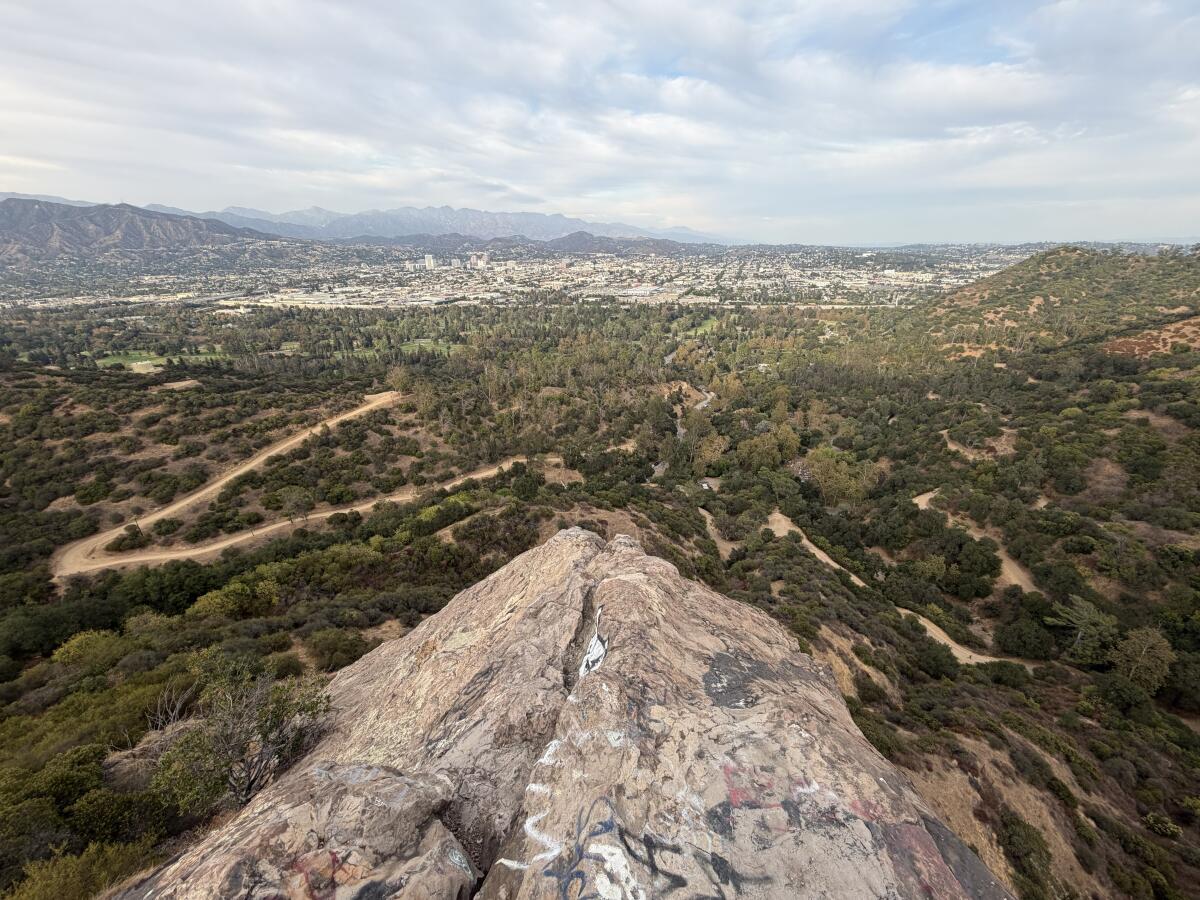
The view of the L.A. area and our local mountains from Bee Rock in Griffith Park.
(Jaclyn Cosgrove / Los Angeles Times)
1. Old Zoo — Bee Rock Loop (Griffith Park Explorer Segment 7)
Distance: 5 miles Elevation gained: 930 feet Difficulty: Moderate Dogs allowed: Yes Nearest to: Atwater Village Accessible alternative: Rio de Los Angeles Park loop
The Old Zoo — Bee Rock Loop is a 5-mile hike that takes you up to Bee Rock, an epic lookout point in Griffith Park. The route is part of Friends of Griffith Park’s Griffith Park Explorer, which organizes official trails into 15 hikeable segments (rather than you getting lost or ending your hike far from where you parked — not that I’ve ever experienced that).
I have passed Bee Rock at least a dozen times and each time told my hiking companion, “I really need to hike up there sometime!” I finally did last week, and I am already itching to return.
After leaving, I wanted to know how this local monolith got its name. I went to The Times’ archives, where I couldn’t find a precise answer.
Bee Rock as seen from the Bill Eckert Trail in Griffith Park.
(Jaclyn Cosgrove / Los Angeles Times)
“Bee Rock acquired its name from the millions of bees which store their honey in its tiny caves which honeycomb it,” a March 1940 Times story read. Seems reasonable.
Retired ranger Bill Eckert told hikers per a 1985 story that Bee Rock got its name “because bees were attracted to the sweets at the old zoo’s refreshment stands and made their homes in the rock’s crevices.”
Eckert has a trail named after him, so I did feel inclined to believe his story.
As I searched for a clear answer, I felt better when I discovered that even experts like Gerry Hans, president of nonprofit Friends of Griffith Park, aren’t sure.
“There are theories and legends,” Hans wrote in a blog post in 2022. “The first is that the outcrop simply looks like a beehive. Another tale describes maintenance workers at the Old Zoo dumping spoiled soda syrup off the cliff, which lured swarms of bees. A third theory suggests that bees naturally take up residence in the holes and pocks on the cliff side overlooking Spring Canyon.”
Hans wrote that he had seen bees in the rock’s small caverns, but to do so, you must have good binoculars.
Armed with those facts and maybe some binocs, you can head out on the trail.
To begin your hike, you’ll park at Merry Go Round Lot One and head to the Lower Beacon Trail just past the southeast corner of the parking lot. Take good care in selecting where to start, as there are about five different paths you could take here.
You will head west on the Lower Beacon Trail, briefly walk southwest along the Fern Canyon Trail before taking the Upper Zoo Trail for much of the way. You’ll reach the Bee Rock Trail at 1 mile into your hike.
Views from the Bee Rock Trail around golden hour in Griffith Park.
(Jaclyn Cosgrove / Los Angeles Times)
You will follow the Bee Rock trail northwest for a short jag before you come to what might feel like a dead end.
The Bee Rock Trail narrows and heads south. You will take a few switchbacks up, wondering how you suddenly became surrounded in tree canopy. Hopefully the sky is helicopter-free and you can hear the local chatter of acorn woodpeckers and California scrub jays.
You’ll arrive at a chain-link fence where you can take a narrow dirt path to the rocky outcropping atop Bee Rock. If hiking with children, it’d be good for the adults to go first, as there are a few spots where the fence has been cut, and the allure of venturing farther than one should out onto boulders is high.
The view is stunning, and on a Thursday evening, I had it all to myself as the sun lowered near the horizon. It was a clear day, and I could see a large swath of Glendale and nearby Mt. Thom and Tongva Peak in the Verdugos and farther away Josephine Peak, Strawberry Peak and several other summits in the San Gabriel Mountains.
From here, you can turn around and head back to your car, especially if the smaller hikers among you are tired, or continue onward to complete the loop. The rest of the trail is not challenging, as you’re either walking on a flat trail or headed downhill. And it’s generally not crowded. If you’re hiking with a teenager, the rest of the trail offers a quiet few miles to talk together about the school day.
One of the pools along Soldier Creek.
(Jaclyn Cosgrove / Los Angeles Times)
2. Lewis Falls
Distance: About a mile out and back Elevation gained: About 300 feet Difficulty: Easy, but requires proper footwear Dogs allowed: Yes Nearest to: North of Azusa Accessible alternative: West Fork National Scenic Bikeway
The 1-mile out-and-back trek to Lewis Falls offers hikers a gorgeous journey along Soldier Creek, lined with California bay laurels, oak trees and hulking old conifers. The trail runs mostly parallel to the creek until you reach its end, where you must cross the creek, rocks and logs to reach Lewis Falls.
You will start by finding parking, its own adventure, as there is no lot. Rather, you will need to find a spot along Highway 39 near the trailhead. I didn’t have any trouble on a weekday, but on a weekend, it might be more challenging. That is essentially the only real downside of this trail.
A large old conifer provides shade along Soldier Creek.
(Jaclyn Cosgrove / Los Angeles Times)
You will hike slightly northeast for about half a mile before reaching the falls. Along the way, you’ll have ample opportunity to take a dip in Soldier Creek, as multiple pools remain, even this late in our summer.
If you find yourself saying, “Wow, this trail is really steep,” you are likely on the wrong path. You will spot multiple spur trails, likely created by either an impatient human or dexterous deer. You can identify them mostly by looking them over and realizing they offer a quicker, more dangerous option than the trail before you.
Soldier Creek features several shorter waterfalls as well as nearby Lewis Falls.
(Jaclyn Cosgrove / Los Angeles Times)
Although it is generally called Lewis Falls by hikers, the cascade historically had a different name.
“Longtime San Gabriel Mountains visitors and old maps refer to Soldier Creek Falls as ‘Lewis Falls,’ in honor of forest ranger Anselmo Lewis, who once patrolled these parts,” former Times outdoors writer John McKinney wrote in a 1998 article.
Although this trail is short, it does require a bit of technical expertise but nothing too tricky. You will find yourself navigating boulders and, at one point, using a root to step down onto the rest of the trail. It requires just a little patience and looking ahead of yourself to determine the safest route.
I was greeted by small blue dragonflies as I hiked along the creek. Instead of racing back to my car, I lay down on a log and listened to the sounds of rushing water and chirping birds. Soldier Creek provides any hiker willing to slow down with an opportunity to reset, regardless of whether you have homework waiting for you at home.
And if you aren’t ready to go home, consider heading five miles north on Highway 39 to the Crystal Lake Recreation Area, where further adventure — and a snack at the Crystal Lake Cafe — awaits.
Once you reach Mt. Hillyer, you’ll be greeted by large rocks that are fun to scramble along.
(Jaclyn Cosgrove / Los Angeles Times)
3. Mt. Hillyer via Silver Moccasin Trail
Distance: 5.8-mile lollipop loop Elevation gained: About 1,100 feet Difficulty: Moderate Dogs allowed: Yes Nearest to: About 45 minutes northeast of La Cañada Flintridge Accessible alternative: Paved paths through Chilao Campground
This 6-mile jaunt along the Silver Moccasin Trail, which is just over 50 miles when fully open, takes you through high desert and pine trees.
Shaped like a lollipop, the trailhead sits about half a mile northwest of the Chilao Visitor Center, which is typically open on the weekend. You will head north for a mile before turning left (or west) off the Silver Moccasin Trail.
You will follow Horse Flats Road to the Rosenita Saddle trailhead, where you’ll take the trail southwest to Mt. Hillyer.
Views of the San Gabriel Mountains from the trail to Mt. Hillyer.
(Jaclyn Cosgrove / Los Angeles Times)
Keep an eye out for Jeffrey pines, which will have deeply furrowed bark and round prickly cones. Their bark smells like butterscotch or vanilla, which I always love pausing to sniff.
The trail also features Coulter pines that produce massive cones nicknamed widowmakers because of their size. The Coulter pine cones can weigh up to 11 pounds. If you’re in the area when it’s windy, please watch your head.
To reach Mt. Hillyer, you’ll follow a short spur trail about half a mile southwest from the Rosenita Saddle trailhead. Mt. Hillyer features several large boulders, perfect for kids to scramble and play on. It’ll also offer you sweeping views of the San Gabriel Mountains.
A hiker takes the path to Mt. Hillyer in the winter in Angeles National Forest.
(Jaclyn Cosgrove / Los Angeles Times)
You can make the trail a loop by continuing south until it jags back east, meeting back up with the paved road you previously took.
And for the ultimate weekend adventure, grab a first-come, first-served campsite at Chilao Campground, and then you can hike and check out the Chilao Visitor Center, which is open from 9 a.m. to 3 p.m. on Saturday and Sunday through November. As a bonus, there’s a short, flat nature trail at the east end of the nature center parking lot where you can typically find massive Coulter pine cones to inspect. A seasonal creek flows through this area too.
Regardless of which option you choose, I hope you make great memories in our local public lands.
3 things to do
The Milky Way is seen in the western night sky near Mt. Pinos in the Los Padres National Forest.
(Raul Roa / Los Angeles Times)
1. Ponder astrophysics in Pasadena Caltech will host a stargazing lecture from 8 to 10 p.m. Friday at the Cahill Center for Astronomy and Astrophysics (1216 E. California Blvd. in Pasadena). Philosophy professor Charles “Chip” T. Sebens will lecture about basic questions that remain regarding atoms. A Q&A and then guided stargazing will follow. The event is free, and no registration is required. Learn more at events.caltech.edu.
2. Improve insect habitat near Altadena The Invertebrate Club of Southern California needs volunteers from 8 to 11:30 a.m. Saturday at Eaton Canyon. Participants will yank invasive plants to help restore the canyon. Volunteers must be 14 years or older. Registration is required. Sign up at signupgenius.com.
3. Peek at sandpipers in Pacoima The San Fernando Valley Audubon Society will host a bird walk from 8 to 10 a.m. Saturday. Guests will meet at the ranger station (10965 Dronfield Ave. in Pacoima) before heading out on a 1- to 3-mile walk through riparian areas, grassy lawns and unique rock formations. Birders can expect to see 30 to 50 species. Learn more at the group’s Instagram page.
The must-read
Johnson’s Beach, along the Russian River, is one of the most popular spots along the lower Russian River.
(Christopher Reynolds / Los Angeles Times)
The lower Russian River and the small communities along the watercourse in Sonoma County offer visitors every kind of adventure, whether you want to stay in a tent and simply float or you want a high-end outdoors experience. That’s what I gleaned from reading Times staff writer Christopher Reynolds’ article about how to get the most out of a visit to the Northern California sylvan paradise. “On summer weekends, thousands show up in Guerneville with kayaks, canoes, inner tubes — just about anything that will float, preferably with a cooler attached,” Reynolds writes. “Then they spend hours gliding downstream past scenery that might as well be a Northern California highlight reel: vineyards, redwood forests and eventually a beach scene full of driftwood and sea stacks.”
After finishing the piece, I immediately searched online for how far away L.A. is from Guerneville. It’s a long drive, but my colleague makes it sure feel worth it.
Happy adventuring,
P.S.
Everyone should feel safe to recreate and work in outdoor spaces. To better ensure Deaf and Hard of Hearing folks feel supported wherever you recreate or volunteer, consider taking CorpsTHAT‘s upcoming “ASL for the Outdoors” virtual classes. Classes run from September to November and range from beginner to advanced. The fee is $250 per student. You can learn more, including how to register, at the organization’s website.
For more insider tips on Southern California’s beaches, trails and parks, check out past editions of The Wild. And to view this newsletter in your browser, click here.
IT can be hard to relax on holiday when kids are running riot – so check out these hotels where children’s clubs take centre stage.
Kids can play games, try out new sports, check out the waterparks enjoy the minidisco, and even have a whole plan curated for them – here are some of our favourites.
Daios Cove in Crete has specially curated children’s activitiesCredit: Booking.comGF Victoria has a kids’ club with a race track insideCredit: loveholidays
Parklane, Cyprus
Parklane Hotel in Cyprus has one of Europe’s largest kids clubsCredit: Booking.com
Not only will the Parklane Hotel in Limassol be a hit with the adults but kids will love it too.
The Explorers Kids Club at Parklane covers more than 3,000m², making it one of the largest kids clubs in Europe.
Sign up for the Travel newsletter
Thank you!
With its sensational castle kids club, pirate ship splash pool and sports facilities, for children aged from four months to 11 years.
Flights and a stay in this hotel start from £699pp.
TUI BLUE Sensatori Akra Fethiye has five swimming pools and plenty of activities for kidsCredit: TUI.co.uk
The TUI BLUE Sensatori Akra Fethiye is another fab family spot with five swimming pools, six restaurants and seven bars.
The Kids’ Club runs six days a week, with activities like Silly Science and Water Mania.
There are activities designed for teens too, including mocktail-making sessions – every evening kicks off with a children’s show but there are also cabaret performances and silent discos.
You can get a 7-night all-inclusive stay here from £1058pp.
GF Victoria, Tenerife
There’s an indoor racing track for kids at the GF VictoriaCredit: GF Victoria Costa Adeje
Children will be obsessed with the kids’ club play area at GF VictoriainTenerife which has a whole programme of activities.
There’s a Baby Club too where little ones can play and craft at the Mini Club; kids can race around on the track. There’s also a Teen Club with gaming, DJ sets, table football and air hockey.
For more action, there’s an adventure park with a climbing wall, hanging bridges, zip line and tree houses.
A family of four can stay here for seven-nights in September from £659pp.
The Land of Legends Nickelodeon Hotels & Resorts Antalya, Turkey
If you want round the clock entertainment head to The Land of Legends NickelodeonCredit: On the Beach
This hotel is a children’s haven thanks to its ample amount of activities not to mention warm weather.
When it comes to activities, Club Nick offers unforgettable experiences for children with themed activities, play areas, and beloved Nickelodeon characters.
Given the resilience and diversity of our local mosquito population and our warming climate, Los Angeles doesn’t really have an easily defined mosquito season.
That was one of my biggest takeaways — and bummers — from my conversation with Chris Barker, an epidemiology professor at UC Davis who has studied mosquitoes for almost 30 years, including at his lab.
“I hate to say it, but there are mosquitoes year-round,” Barker said, “and in Southern California in particular, many of your mosquitoes are active year-round, and they don’t go through a reproductive pause, so they’re really just waiting on conditions to be right for biting and for development. In that sense, the warmer [weather], the better for the mosquitoes, and the worse it is for us.”
For this week’s edition of The Wild, our weekly outdoors newsletter, I spoke to Barker about how hikers can best avoid nature’s rudest insect this summer. I wanted to understand what common misconceptions hikers have about mosquitoes, any behavioral changes we can make and what types of trails are most likely to have active mosquito populations. (Spoiler alert: It’s a lot of them.)
First, let’s quickly discuss the mosquitoes that you will find in Southern California, as Barker emphasized to me that we shouldn’t just imagine mosquitoes as one bloodthirsty monolith.
“There are many species of mosquitoes that exhibit a wide range of behaviors, and some species never bite people,” Barker said. “Knowing just a little bit of mosquito biology can help a hiker know when and” where to hike.
Types of mosquitoes found around L.A. hiking trails
In California, there are more than 50 species of mosquitoes, living from below sea level in the desert to above 10,000 feet in our mountains, according to the UC Agriculture and Natural Resources.
Thankfully, our local population is smaller than that and includes:
Three mosquitoes in the Aedes genus: Often dubbed “ankle biters,” the black-and-white-striped female aedes mosquitoes bite during the day, often around the legs, often multiple times; the most prevalent in Southern California, Aedes aegypti, generally lives where people are, as it depends heavily on manmade water sources to lay its eggs; different species are vectors for different diseases, including Aedes aegypti, which can carry dengue fever.
Six mosquitoes in the Culex genus: Adults are most active from dusk to dawn; they prefer to bite birds but will bite humans; otherwise, they will rest in cool, shaded dense vegetation; the Southern house mosquito in this genus can transmit West Nile.
Culex mosquitoes bite at dawn and dusk and tend to feed off birds. The Southern house mosquito in this genus can transmit West Nile.
(Orange County Mosquito and Vector Control District)
Anopheles franciscanus: Living in warm sunny pools with algae; not known to carry disease in California; peak biting during dusk and dawn; included in this list to make us all feel a little better, just in case you worry as much as your local outdoors journalist about mosquito-borne diseases.
Ochlerotatus sierrensis: Also known as “western treehole mosquitoes,” these little jerks lay their eggs in tree holes, especially oaks, laurels and eucalyptus, and emerge in spring, ready to unapologetically ruin your backpacking trip; these mosquitoes will bite in the day and evening, but are especially active at dusk.
Ochlerotatus washinoi: Also known as “woodland pond mosquitoes,” which makes them sound more charming than they are, these aggressive daytime biters are typically found in floodwater habitats in early spring; not known to carry disease in California.
A quick 101 on West Nile virus
Outside of an itchy bite or, in rare cases, a severe allergic reaction, the most significant health threat that mosquitoes pose to hikers around L.A. is West Nile virus.
West Nile virus is typically contracted by humans through the bite of an infected mosquito. Most people infected with the virus, an estimated 80%, never know it, because they don’t get sick. About 20% of those infected experience flu-like symptoms, according to the Centers for Disease Control and Prevention.
Less than 1% develop serious illnesses that affect the central nervous system and usually require hospitalization.
Similar to the lack of clarity around who develops long COVID, scientists have yet to identify why certain people develop serious neurological conditions from West Nile. Advanced age, especially in people 65 and older, is thought to play a role, given that with age, the body’s immune system is slower to respond to threats, according to the National Library of Medicine. Other risk factors are thought to include being male; having diabetes, heart disease or chronic kidney disease; or being immunocompromised, according to research.
In recent years, reported West Nile human cases have typically peaked in early September, according to data analyzed by the L.A. County Department of Public Health. This year, West Nile has been detected in traps and in dead birds across L.A., but especially in Cerritos and Long Beach, according to the Greater Los Angeles County Vector Control District.
Given all that we know now about our local mosquito population and risks, let’s discuss Barker’s tips and tricks for how hikers can best avoid getting bit.
How L.A. hikers can best avoid getting bitten by mosquitoes
People walk in and around the Arroyo Seco.
(Carolyn Cole / Los Angeles Times)
1. Consider what water source is near.
I personally love hiking along the Arroyo Seco or San Gabriel River, where it’s often shady and cooler than other parts of Angeles National Forest. Unfortunately, mosquitoes love those areas too.
Mosquitoes prefer standing water, but not permanent water, Barker said. For certain species, this could be a segment of the river where the water has stopped flowing, leaving a nice warm pool for mama mosquitoes to lay their eggs, or even a small puddle.
“When I go hiking … especially in the mountains, I always look in the rock homes next to the streams that have captured snow melt water as it recedes,” Barker said. “Those rock holes keep water through much of the summer, and if you look in those rock holes, you often see hundreds or thousands of mosquitoes in individual rock holes. They’re the immatures that are still developing and will come out and eventually bite people and other animals in the area.”
I was honestly happier before I knew that.
2. Consider the day’s forecast and its effect on mosquito behavior.
“Often these mosquitoes are biting from late afternoon into early evening — so all the times we love to be outdoors,” Barker said.
Like us, mosquitoes are most active when temperatures are warm but not extremely hot. “On our hot days in the summer, mosquitoes will wait until the late afternoon, evening or even morning periods to bite instead of the hottest part of the day,” Barker said.
That said, if there’s a light breeze or it is windy, you’re far less likely to get bitten, as mosquitoes are thought to only fly up to 1 to 1.5 mph.
Dunsmore Canyon in Glendale.
(Jaclyn Cosgrove / Los Angeles Times)
3. Take extra precautions on morning and evening hikes.
Mosquitoes are often most active during these time periods — the ideal summer hiking time. As such, Barker advised hikers to wear baggy light-colored pants and hiking shirts, so that you will remain cool enough under the sun but your skin will be more protected.
You can also pre-spray your clothing with Permethrin, an insecticide that kills and repels mosquitoes.
An Aedes mosquito, commonly called an ankle biter, prefers humans over animals. While Aedes can carry dengue, they do not transmit West Nile virus.
(Orange County Mosquito and Vector Control District)
4. Reapply mosquito repellent.
I generally set a timer for around 50 minutes when out hiking to remind myself to reapply sunscreen, but I rarely remember to reapply bug repellent.
“Most people do kind of a one-and-done application and happily go off and hike, and if you hike for hours, especially if you’re using repellent with either a lower DEET concentration or some other alternatives, you often have to reapply those at more frequent intervals,” Barker said.
Mosquitoes inside a storage container are tested after capture by public health workers for West Nile virus. This particular station is in Pacoima.
(Ronaldo Bolanos / Los Angeles Times)
DEET has long been found to be a highly effective mosquito repellent, but as I reported back in 2024, DEET has a perception problem. Unlike some repellents, it isn’t naturally occurring, which has caused some members of the public to take pause.
“They want something that’s natural. They forget that strychnine [and] ricin are all natural products,” said Walter S. Leal, a UC Davis distinguished professor in molecular and cellular biology, in a 2024 interview, referencing poisons derived from plants. “Being natural does not necessarily mean it is good, and being synthetic doesn’t necessarily mean it is bad.”
Additionally, people often incorrectly associate DEET with the banned insecticide DDT. “This is a big mistake,” Leal said. “There is no chemical similarity between the two.”
The view from a bench at a lookout point near the Saddle Peak Trail in the Santa Monica Mountains.
(Jaclyn Cosgrove / Los Angeles Times)
5. Try coastal hikes to avoid mosquitoes.
“Coastal environments sometimes have fewer mosquitoes,” Barker said. “In L.A., you have that strong temperature gradient as you move away from the ocean, and things get warmer in the inland areas. Cooler areas slow mosquito development, and you tend to have fewer mosquitoes right along the coast.”
This excludes areas near tidal marshes, like the Ballona and Los Cerritos wetlands, where certain mosquitoes can become “quite numerous” if not controlled by local vector agencies.
The Ballona Wetlands Ecological Reserve in Marina del Rey in 2023.
(Genaro Molina / Los Angeles Times)
The coastal breeze also helps hikes along the ocean — like several routes you’ll find in the Santa Monica Mountains or Palos Verdes Peninsula — have fewer mosquitoes.
“And some of the coastal mosquitoes fly inland to find their blood meal hosts before they come back and lay eggs,” Barker said. “So right along the coast is not a bad place to be from a mosquito-biting perspective.”
Did somebody say Type-O Tuesday?
A Joshua Tree and rocks are lit up by the sunrise at Jumbo Rocks Campground in Joshua Tree National Park.
(Allen J. Schaben / Los Angeles Times)
6. If weather allows, hike in the desert to avoid mosquitoes.
“There is no real escape from mosquitoes, I would say, except possibly in the deserts in areas with less water,” Barker said. “That’s your best escape in California.”
If you head out to Joshua Tree, this generally means hiking before 10 a.m. and after 5 p.m., as you will otherwise almost certainly get overheated.
7. Be mindful when taking breaks.
It’s harder for mosquitoes to bite you when you’re moving or when there’s a breeze. Keep an eye out when taking breaks, as this will more likely be the time you get bitten. And often where we like to take breaks is where mosquitoes also like to rest.
A field sample of mosquitoes that could carry West Nile virus is seen at offices of the Riverside County Department of Environmental Health in Hemet.
(David McNew / Getty Images)
“Mosquitoes do tend to rest in areas with vegetation or other vertical structures that protect them from harsh conditions like direct sunlight or strong winds,” Barker said. “The female mosquitoes also search for their blood meal hosts in those areas, which include us.
“Unfortunately for us,” Barker added, “they like a lot of the same areas we do.”
3 things to do
A group of hikers at a Just Trek event.
(Victor Martinez)
1. Celebrate community in Malibu Just Trek, a local hiking community, will host its seven-year anniversary party at 9:30 a.m. Sunday in Malibu. The group will take a two-mile hike and then hang out at a local beach near a seafood restaurant. Donations appreciated. Register at partiful.com.
2. Behold native botany in L.A. The L.A. Parks Foundation will host From Trail to Seed, a botany-focused nature walk, from 8 to 10 a.m. Saturday at the Fern Canyon Trail in Griffith Park. Botanist Terry Huang and park ecologist Ryan Kinzel will lead the group as they take a moderately challenging route through the park. $20 donation requested. Register at los-angeles-parks-foundation.givecloud.co.
3. Use your nature skills in Baldwin Hills The Nature Nexus Institute needs volunteers from 8 to 11 a.m. Saturday for a habitat restoration event in the Baldwin Hills. Volunteers must wear long pants and closed-toe shoes. The work site will include traversing uneven terrain. Learn more at the institute’s Instagram page.
The must-read
Jackie the eagle.
(Friends of Big Bear Valley)
Jackie, arguably the world’s most famous bald eagle mama, died Monday morning after a mysterious illness that veterinarians at the Ojai Raptor Center worked hard to combat. She was 14. Jackie and her mate Shadow transformed into avian all-stars after Friends of Big Bear Valley installed live cameras of their nest. Millions of people across the world tuned in to witness the two eagles raise their young and live their lives in our local mountains. That included Anny Liu of Altadena, who started watching Jackie and Shadow and their little eaglets after losing her community to the Eaton fire in 2025. “Jackie and her family gave me hope and gave me giggles and smiles that I thought were lost with the fires,” Liu wrote to The Times via a reader callout. “My heart felt lighter when I watched her even to this day as we try to rebuild. Never in my life did I expect an eagle would help me so much emotionally and mentally.”
May we continue to allow ourselves to feel these deep connections with our animal neighbors, as it leads to us wanting to protect their homes and, in turn, protect our world.
Happy adventuring,
P.S.
Do you want to help repair damage from the devastating fire that burned across Santa Rosa Island? The California Institute of Environmental Studies needs volunteers to help implement emergency fire recovery work on the island, including rolling erosion control wattles on steep slopes to better protect the Torrey Pine forest from erosion caused by winter rains. To learn more, you can email Destinee Rabelo, the center’s restoration ecologist field lead, by using the email linked in the organization’s Instagram post. Have fun out there!
For more insider tips on Southern California’s beaches, trails and parks, check out past editions of The Wild. And to view this newsletter in your browser, click here.