Toni

How AVP athletes Chaim Schalk and Toni Rodriguez found love on tour

People look for love wherever their heart takes them, but for Assn. of Volleyball Professionals players Chaim Schalk and Toni Rodriguez, they didn’t have to look far to find it.

“I said ‘I love you’ first,” Schalk said.

The beach volleyball power couple is competing in the AVP Manhattan Beach Open this weekend, continuing to focus on the competitive volleyball circuit that first brought them together.

The couple met briefly while playing at various beach volleyball events, but they really got to know each other and clicked while spending three weeks together during tournaments in China, India and the Philippines. Schalk told Rodriguez he would take her out to dinner at her favorite restaurant, but there was a catch. Rodriguez had to win her upcoming tournament in order to go out with Schalk.

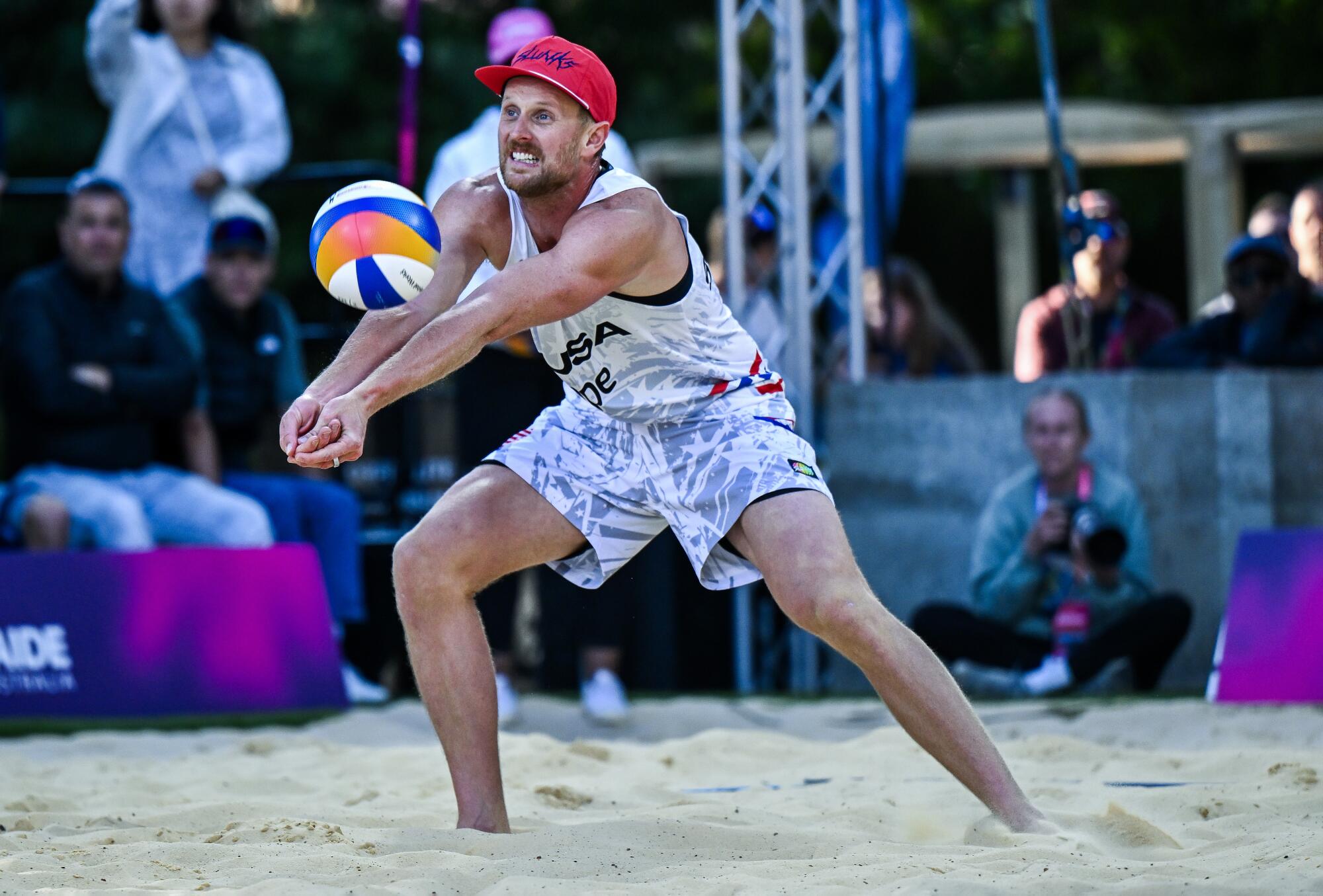
American Chaim Schalk digs the ball during a match against Cubans Nosien Diaz Amaro and Jorge Luis Alayo Moliner.

American Chaim Schalk digs the ball during a match against Cubans Nosien Diaz Amaro and Jorge Luis Alayo Moliner during the 2025 Beach Volleyball World Championships at on Nov. 20 in Adelaide, Australia.

(Mark Brake / Getty Images)

Rodriguez made Schalk live up to his promise. The couple went to their favorite fast-food joint, Cafe Rio, because it was something they bonded over during their overseas trip.

“She texted me, ‘Cafe Rio on you?’ after winning,” Schalk said. “And then she flew back [to California] the next day, and we went there.”

Rodriguez didn’t need any motivation to win gold to go out with her future fiancé, but it didn’t hurt. She said that Schalk keeps her level-headed when it comes to playing on the beach.

Schalk has played on the biggest beach volleyball stages. He represented Canada at the 2016 Summer Olympics in Rio. One of his proudest moments was defeating a Brazil team on its home soil.

Chaim Schalk and Ben Saxton of Canada compete against Pedro Solberg and Evandro Goncalves Oliveira Junior of Brazil.

Chaim Schalk and Ben Saxton of Canada play beach volleyball against Pedro Solberg and Evandro Goncalves Oliveira Junior of Brazil during the 2016 Olympics in Rio.

(Ezra Shaw / Getty Images)

“Beating Brazil in front of 15,000 fans is something that I’ll never forget,” Schalk said.

He called playing in the Olympics the pinnacle of any sport and making Team Canada has been the highlight of his career.

Schalk has had dual-citizenship since birth and has switched his affiliation to Team USA. He hopes to qualify for the 2028 Olympics in Los Angeles and play alongside Rodriguez. He is a two-time AVP League Champion and three-time winner on the AVP Tour.

His love for volleyball dates back to his time in Canada as a young boy playing with his brothers in their massive grassy backyard.

“I personally love volleyball. I love competing and love trying to win,” Schalk said.

Rodriguez grew up in St. Amant, La., and was focused on volleyball from a young age before playing the sport in high school and at Louisiana State.

American Toni Rodriguez plays a shot against Reika Murakami and Suzuka Hashimoto of Japan in 2022.

American Toni Rodriguez plays a shot against Reika Murakami and Suzuka Hashimoto of Japan during a Volleyball World Beach Pro Tour match in 2022.

(Matt Roberts / Getty Images)

The LSU graduate wanted to play indoor volleyball in college, but she couldn’t because of injuries and instead joined the beach volleyball team.

“Once I got to the LSU beach team and started learning the game and actually playing, I just came to find a new love for the sport,” Rodriguez said. “Once I started playing, there were a lot of opportunities to leave Louisiana and potentially play professionally.”

After three seasons at LSU, Rodriguez moved to California to begin her beach volleyball career. Schalk also left Alberta, Canada, to focus on his beach volleyball career.

“I moved in 2013 to California to train full time and play beach volleyball full time,” Schalk said, who along with Rodriguez lives in Gardena. “I didn’t know I would be here for this long, so it’s definitely different. I love California, and I think it’s a beautiful place to live and we’re lucky to live close to L.A.”

Rodriguez has won two FIVB gold medals. In 2024, she was part of the the first AVP League championship team and joined Molly Shaw winning silver, bronze and gold medals during three consecutive Challenger events in three different countries during a three-week span.

Schalk and Rodriguez have great affection for a sport that took them around the world before they met each other. Schalk said competing in Switzerland near the Swiss Alps was special.

“I have been there about eight times, but that place, for me, is my favorite place I’ve ever played at,” Schalk said.

While they chase AVP and Olympic wins, the couple also are planning a wedding after Schalk surprised Rodriguez with a bold question early in their relationship.

After only officially dating for two days following Rodriguez’s tournament, Schalk invited Rodriguez to Kauai, Hawaii, in January.

Rodriguez had a hunch he might propose because they had formed such a tight bond during their overseas trip.

They went on a hike with Schalk’s brother and kids to a spot with a beautiful jungle view and large swing.

Schalk’s family set up the proposal spot while everyone was walking to the site. Once they arrived, Schalk turned to Rodriguez, got down on one knee and asked her to marry him.

“I blacked out. It was perfect,” Rodriguez recalled.

The couple is set to get married this fall in El Segundo.
Source link

How reading Toni Morrison in chronological order rewrites U.S. history

About six months after Toni Morrison died in the summer of 2019, Literary Cleveland began hosting annual community tribute parties on the Nobel Prize-winning author’s birthday, Feb. 18. Lorain, Ohio — a suburb of Cleveland — is where Morrison was born and raised, and where she set several of her novels. During these gatherings, participants were prompted to read aloud from their favorite Morrison works, and share why they savored those particular lines.

Over time, these meetings began to feel increasingly intimate, even “sacred,” according to Literary Cleveland’s Executive Director Matt Weinkam, which prompted him, in tandem with Ohio Humanities head Rebecca Asmo, to brainstorm how to take their program state-wide. “This is Toni Morrison, one of our greatest writers,” Weinkam recalls thinking. “We needed to do something bigger.”

At the time, Weinkam and Osmo were also trying to figure out how to commemorate America’s semiquincentennial. Weinkam was listening to Morrison’s entire oeuvre on audio and realized that when you organize the 11 novels in a certain order, “they tell the history of America.” So how, he thought, “could you use the literature of Toni Morrison to view our country through a different lens — through her lens?” He says they knew honoring Morrison as a consequential figure not just in literature but also in the context of American history would be central to Ohio’s celebration of the semiquincentennial.

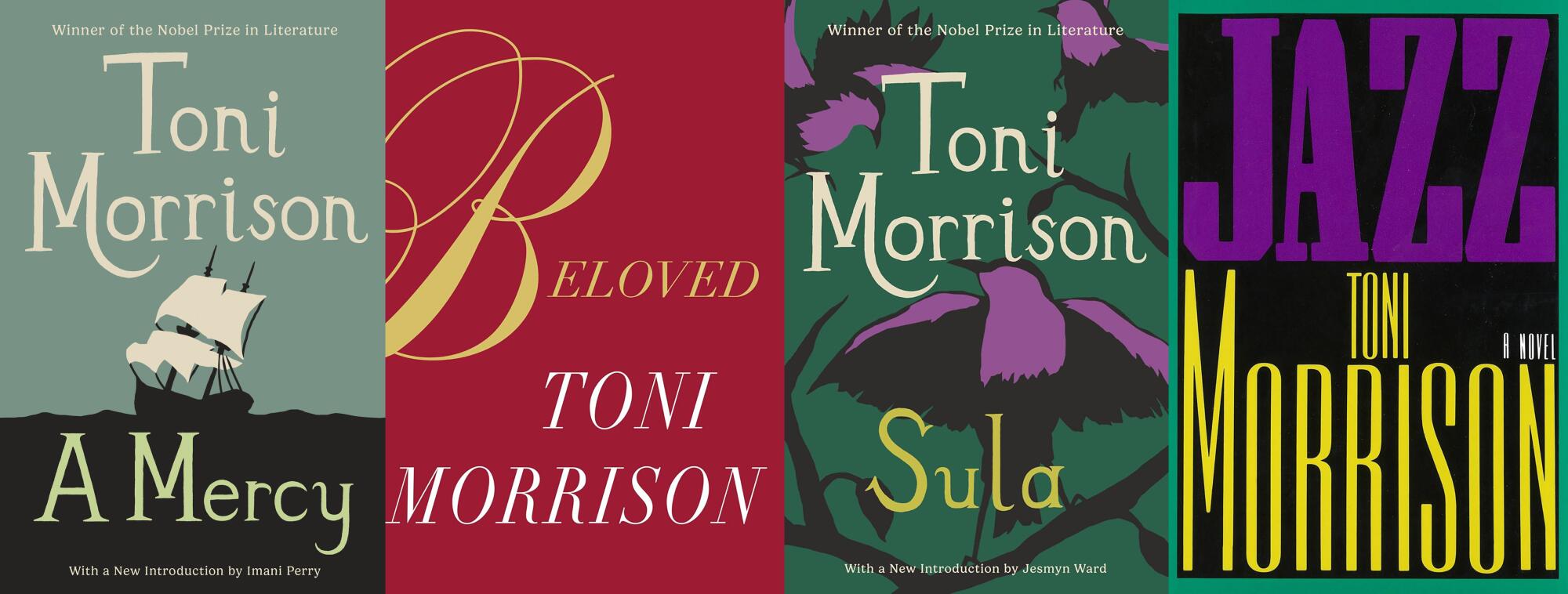
Book covers of "A Mercy," "Beloved," "Sula" and "Jazz" by Toni Morrison

“[But] only as the project was coming together did we strike on the fact that her novels trace American history from ‘A Mercy,’ set in 1690, through ‘God Help the Child,’ in the 2010s. Not only does her work re-center African Americans in the story of our country, it also tackles major events from our founding, through slavery, to the impact of Jim Crow, to the great migration and beyond.”

In the months leading up to the 250th anniversary, they decided to bring the Morrison salons they were curating in Cleveland to all 88 Ohio counties. For assistance they connected with Britt Lovett, a strategist, community leader and fellow Morrison acolyte.

“People say that reading Toni Morrison is challenging,” says Lovett. “[But] reading Toni Morrison is like my grandmother speaking to me.”

In February, on what would have been Morrison’s 95th birthday, they officially launched “Beloved: Ohio Celebrates Toni Morrison,” a yearlong homage including readings, workshops, lectures and a monthly book club that meets on Sunday evenings. They intentionally programmed the book club so that it would take readers through our U.S. history utilizing Morrison’s vision: Weinkam proposed reading Morrison’s novels in the order in which they are set rather than the order in which they were published. “That simple shift,” says Lovett, “changed everything.”

They began with “A Mercy,” one of Morrison’s later novels, published in 2008 — which is set in the late 17th century, before slavery took hold and the country became “racialized.” Next came “Beloved,” then “Sula” and “Jazz.” “Experiencing the novels this way reveals how Morrison traced generations of Black American life across centuries of our nation’s history,” Lovett says. “What may appear to be individual stories become part of a larger narrative about memory, freedom, family, belonging and the ongoing project of America itself.”

For Morrison, writing fiction was a form of “literary archaeology,” excavating history, and how the past hovers over the present. Her quest was what she termed “rememory.”

Eddie S. Glaude Jr. is a Princeton professor and author of “America, U.S.A.: How Race Shadows the Nation’s Anniversaries” who has studied Morrison. “She understood the ongoing national effort to disremember — this startling combination of dismembering and remembering — to protect the innocence of America,” Glaude says. “Instead, her novels relentlessly expose the horror and the magisterial efforts on the part of ordinary people to overcome them. In doing so, she takes us to the beating heart of this fragile experiment — something we desperately need to remember in this 250th year of the country.”

"The Black Book." Foreword and preface by Toni Morrison

In 1973, as an editor at Random House, Morrison published and collaborated with collectors in compiling “The Black Book,” a seminal volume that tells the story of the African American experience in America in the form of an encyclopedic scrapbook that spans from 1619 through the 1940s. There is no narrator, and this is intentional. The visuals — newspaper clippings, slave auction notices, patent applications by Black inventors, photographs, sheet music, relate their own powerful story “Black life as lived” — great joy juxtaposed with the tragedy and legacy of slavery. From her work on that groundbreaking assemblage emerged the idea for “Beloved,” which won the 1988 Pulitzer Prize for fiction.

For the record:

2:12 p.m. July 2, 2026An earlier version of this article misattributed Toni Morrison quotes about writing to “think the unthinkable” and be “relentlessly black” with no deference to the “white gaze” to Namwali Serpell.

Nearly seven years after Morrison’s death at 88, we are living in a golden age of Morrisonia. Three extraordinary new books, published this year, shed light on the brilliance and complexity of Morrison’s life and work, and place her as an American eminence, a visionary who saw fiction as a means through which to recast her country’s story. “On Morrison” by Namwali Serpell; “Toni at Random: The Iconic Writer’s Legendary Editorship” by Dana Williams; and a posthumously published collection of Morrison essays entitled “Language as Liberation: Reflections on the American Canon.” Serpell writes that “Morrison has shaped the way we think about everything.” Morrison herself said that she wrote to “think the unthinkable,” to write novels that were “relentlessly black,” giving no deference to the “white gaze.” Her refusal to sugarcoat the interior and exterior lives of her characters, whether enslaved or traumatized by the past — by events in American history — was purposeful.

“You’re confronted with horrific acts of violence,” Serpell says. “Not to present it in spectacular fashion, nor to feed any kind of voyeuristic or prurient interest on the part of the audience, but to use quiet language — beautiful language — in order to actually get us to step back and think about why this violence is happening and where it’s coming from.”

In that way, Morrison’s work was always a radical experiment — and is perhaps why, according to the American Library Assn., “The Bluest Eye” her 1970 debut — continues to be one of the most frequently “challenged” books in the U.S. “Beloved” runs a close second. But this also is among the reasons her books are considered must-reads in the classroom, and contemporary classics.

John Freeman is an executive editor at Knopf who oversees Morrison’s publishing program. “Her books persist today because they beckon us doubly: they invite us to look clearly at what America is, to come to grips with the fantasies and shadows developed to avoid this awful knowledge,” Freeman says. “They also tell us one phenomenal love story after another.”

Through her book club, cultural icon Oprah Winfrey introduced millions of readers to Morrison by featuring four of the author’s novels. “From ‘The Bluest Eye’ through ‘Beloved,’ ‘Jazz,’ ‘Home,’ ‘A Mercy’ and ‘Love,’ Morrison’s words have helped me become more of myself,” Winfrey says. “She understands the lives of Black women like no one else I’ve ever read. Reading her, I’ve often felt seen in places I didn’t know how to name.”

Book covers for "On Morrison" by Namwali Serpell, "Language as Liberation, "Toni at Random" by Dana A. Williams

(HarperCollins; Penguin Random House)

In Morrison’s essays, lectures and other public comments — including as a professor at Princeton for nearly two decades — she occupied the role of public intellectual, always teaching us how to view America’s evolution as a country, and how it became “racialized.”

In a Granta interview conducted late in her life, she challenged the interviewer to consider that the concept of “whiteness” is peculiarly American: “Think about it, “ she prompted. “If you come to this country from Germany or Russia, or anywhere you got off the boat, got on the land, in order to become an American, you have to be white. That’s the quality that brings the country, its people together — having a non-white population. My concept is that if you were from Sweden, you were Swedish. You didn’t have to say, ‘I’m a white Swede.’ You know what I’m saying?”

As we prepare to celebrate America’s 250th, it’s useful to reflect on how Morrison viewed the intersection of fiction, history and memory, how the mission of her fiction was to uncover truths omitted by the standard historical records and history’s “sages.” In her 1987 essay, “The Site of Memory,” she utilized a river as a metaphor to discuss how imagination excavates forgotten histories and people. “All water,” she wrote, “has a perfect memory and is forever trying to get back to where it was. Writers are like that: remembering where we were.”

Haber is a writer, editor and publishing strategist, and co-founder of the Ink Book Club on Substack. She was director of Oprah’s Book Club and books editor for O, the Oprah Magazine.

Source link