Why this weekend is an exceptional time to visit L.A.’s tide pools
The first time I visited a tide pool near Los Angeles, I didn’t actually know that’s what I was looking at.
“Why are all those people gathering over on those rocks?” I remember wondering. “What are they looking at?”
I was new to L.A., and it was my first time at Leo Carrillo State Beach in Malibu, one of several beaches along California’s coastline that features tide pools. Tide pools form in rocky segments of shoreline where, as the tide goes out, seawater collects in cracks and depressions. During low tide, an observer can easily see — without needing a snorkel or scuba set — the life typically underwater there, including sea stars, anemones, crabs and, albeit hard to spot, octopuses.
If you’ve never been to a tide pool, you’re in luck: This weekend is an exceptionally great time to go.
That’s because Thursday through Saturday, king tides will roll into Southern California’s coast line. It’s a seasonal phenomenon created when the sun and moon align in such a way that our coastline sees incredibly high and, important for our purposes, low tides. (To better understand the science behind king tides, check out this Exploratorium video.)
The California Coastal Commission asks the public each year for help in tracking king tides because the data help public officials understand future sea levels as climate change worsens. You can learn more about those efforts, including how to safely view impressively high tides near you, along with how to help, at coastal.ca.gov.
The timing of California’s king tides changes every year. In Southern California, we’re expecting to see king tides Thursday, Friday and Saturday. If you can’t make it out this time, the next king tide event is expected around Jan. 2 and 3.
To better understand the importance of tide pools, I spoke to Emily Yam, learning and public engagement director at the Aquarium of the Pacific in Long Beach. Yam said it’s important for people to visit tide pools because, once they see them, they begin to understand how important they are to protect.
Tide pools are “not that common,” Yam said. “It’s not like every single beach in all of America has a tide pool. It has to be geologically distinct. They have to have the rocks there to fill and go with the tide. We’re so lucky California has such a huge, really diverse coastline with lots of types of habitats.”
As we talked, Yam and I observed the animals in the aquarium’s “Stars of the Sea” exhibit, where visitors can reach into a touch pool to feel sea stars and other creatures that live in our tide pools. Yam encouraged me to carefully place my finger within the spines of a sea urchin for five seconds and feel as it hugged my finger. (Much more welcoming than some folks I’ve met at L.A. parties!)
I asked Yam about the best practices for visiting tide pools. Below you’ll find:
- How to assess the best time to go.
- How to observe without harming the environment.
- And how to spot some of the more elusive critters floating about tide pools.
Let’s dive in!

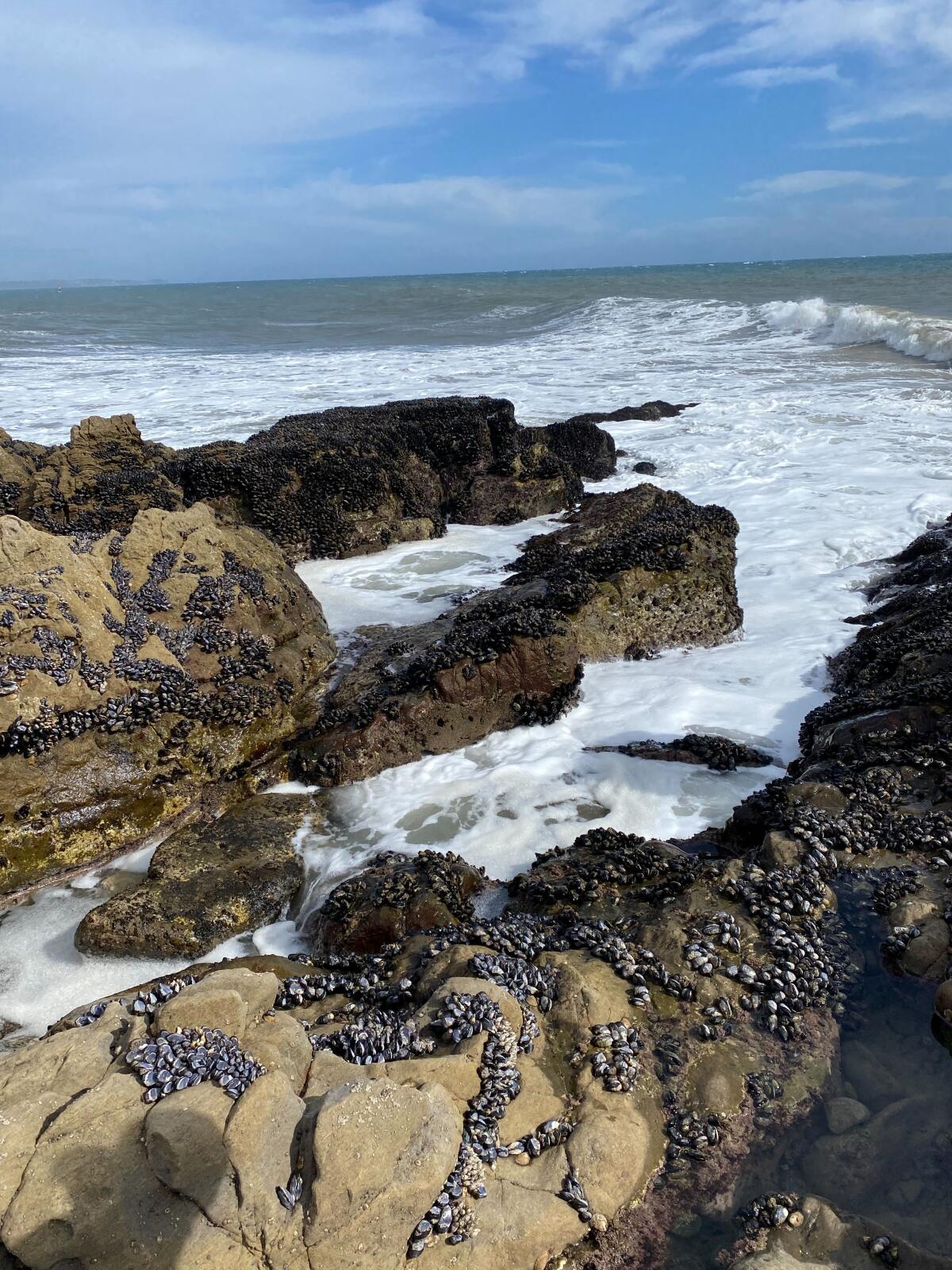
Mussels, like these at Leo Carrillo State Beach, attach themselves to rocks using strong fibers called byssal threads produced as liquid by the byssal gland. Once the liquid is exposed to seawater, it solidifies into a thread.
(Jaclyn Cosgrove / Los Angeles Times)
1. Check the tide data 🌊
Once you determine which tide pool you want to explore, visit NOAA’s tide data portal where you can find the estimated low and high tide.
For example, let’s say I wanted to go with my partner and friends to visit the Point Fermin tide pools in San Pedro on Friday, and I wanted to know when we should arrive. I could either use the map or list of stations to determine the best tide prediction model to use. I would use the Cabrillo Beach station — although it’d be OK if I used the Santa Monica Pier station because the data won’t vary significantly enough for my crew to miss the low tide.
But, being the perfectionist I am, I’d go to the Cabrillo Beach station page (9410650) and use the drop-down menu to select the date range relevant to me. I’d then click “Plot Daily” and see that on Friday, the tide will be at its lowest — an estimated -1.75 feet below sea level — at 3:49 p.m.
I’d then let my editor know I needed Friday afternoon off for a very important investigation.
2. Arrive early and in the right footwear 🪼
About seven hours after an extremely high tide, the king tide presents our local beaches with an extremely low tide.
I prefer to arrive at least two hours ahead of when the tide will be at its lowest, in part, because I’m a worrier. It’s also because parking at the beach can be stressful. That said, during king tides, the surf may still be choppy then, so just be mindful of when you enter the beach to start exploring.
You’ll want to make sure to pack chairs, blankets, snacks and water, all the usual beach day items. Because you’ll be at the beach later in the day, pack an extra jacket and blanket for the stubborn person in your party who swears they won’t get cold. (They will!)
In terms of shoes, you’ll want to wear something. Tide pools are too rocky for even someone like me, who hardly wears shoes, to go barefoot. Old athletic shoes, rubber boots or sandals can be good options. You should also plan to get wet, as the waves will still be coming onto the beach.
During this weekend’s surge of king tides, avoid the beach during high tide, and as always, mind all safety barriers and instructions. Three people were recently dragged off the beach in Big Sur during high surf. Please take good care during king tides.

A sea hare, starfish and anemones around the tide pools at Leo Carrillo State Beach.
(Photos by Jaclyn Cosgrove / Los Angeles Times)
3. Take care where you step. 🦀
Yam said tide poolers must be mindful of every single step.
“Even stuff that looks like a rock may not actually be a rock,” Yam said. “It could be aggregating anemones. It could be barnacles and other things.”
Going slow will also help you spot more sea life!

A view of the tide pools at Matador.
(Catherine Pearlman)
4. Consider staying in one place 🐟
Tide pools have a way of bringing out my childlike wonder, but I am realizing I must slow down if I ever want to see more sea life.
As Times contributor Catherine Pearlman pointed out in her piece about tide pool exploration, “I’ve found there are two strategies to discover the tide pools: Cover a great distance or sit for long periods at a good pool and wait for the sea life to move about. For the best experience, do a little of both.”
Yam takes a similar approach. She will take a stroll along the tide pool, looking for larger animals, before picking one spot to sit.
By sitting and waiting, you’ll be more likely to see something like a purple and orange Spanish shawl, a flamboyantly colored sea slug, munching through the algae, Yam said. “If you are patient and willing to look, a lot of times they’ll be teeny tiny, like, smaller than my thumbnail,” Yam said.
Urchins like to tuck into nooks and crannies because they like being in shade, she said, while anemones might look different because they’ve closed themselves to save water. (This results in them resembling colorful blobs.)
The hardiest animals like barnacles and mussels will be easiest to spot because they’ve adjusted to a way of life where they can live in and out of the water, closing themselves up to protect themselves from hungry birds, Yam said.
Deeper in the tide pool, you might spot fish or sting rays, as they need to be covered by water and will move with the sea.

Sea life in a tide pool at Dana Point.
(Catherine Pearlman)
5. Take only pictures (and video) 🐚
Unlike the aquarium’s touch pool, where you’re encouraged to feel the spiny skin of sea stars, you should not touch anything at a tide pool.
Actually, it is generally against the law — and just overall rude — to pick up or otherwise disturb critters and rocks in and around tide pools. Despite what you may have noticed on Instagram or other social media, “placing animals in buckets, even if for a short time may cause irreparable damage or stress for these organisms,” according to California State Parks.
California State Parks asks that visitors protect our fragile tide pools by following these rules:
- Never collect shells, rocks or organisms from the tide pools.
- Never remove animals from their pools. Observe them where they are.
- Never pull animals that are attached to the rocks.
- Never turn over rocks as this may disturb wildlife.
- Walk gently, taking care not to step on plants or animals.
Yam said even though sea stars have light sensors on the tips of their arms and can see light and dark, “they don’t have a centralized brain, so they don’t process and experience the world like we do,” Yam said, “but they do take in information from the world around them and move accordingly.”
In short, don’t scare ’em!

The tide pools at Crystal Cove.
(Catherine Pearlman)
6. Watch for bubbles 🦑
Especially after ugly crying to the 2020 documentary “My Octopus Teacher,” I really want to spot one of California’s eight-legged mollusks at a tide pool.
Yam acknowledge that this is no easy feat, as she’s visited tide pools many times and only spotted octopuses on a handful of occasions. Octopus will often hang out near rocks. Yam said there’s one giveaway that an octopus is near. “Look for bubbles because they’ll sometimes spurt out little bubbles,” she said. “And I think patience is the key.”
The last time I went to Leo Carrillo State Beach, my friend Bob spotted orange and purple ochre stars, five-armed chonks lying in a shallow pool and clinging to the rocks. We also saw bright green anemone and adorable little striped shore crabs.
It was six years after my first visit and after many return trips that I knew what I was looking at and all the awe-inspiring marine life that awaited me and my friends as we explored the rocky shoreline.


High surf in Manhattan Beach in January 2022.
(Carolyn Cole / Los Angeles Times)
3 things to do
1. All hail the king tide in Santa Monica
Climate Action Santa Monica will host its annual king tide celebration from 8 to 10 a.m. Saturday at Heal the Bay Aquarium (1600 Ocean Front Walk) in Santa Monica. Guests will document the tides in photos as part of a citizen science project through the California Coastal Commission. Participants can also tour the aquarium and learn about the changing ocean ecosystems. Register at eventbrite.com.
2. Squawk in the streets of Pasadena
The Moore Laboratory of Zoology will host a parrot roost watch from 4:15 to 5:30 p.m. Friday at Pasadena City Hall. Guests will observe hundreds of parrots and parakeets at a roosting site. All ages are welcome. Register at eventbrite.com.
3. Help restore Runyon Canyon in L.A.
The L.A. City Department of Recreation and Parks will host a restoration day in Runyon Canyon Park from 9 a.m. to noon Saturday at 2000 North Fuller Avenue. Junior urban ecology Ryan Kinzel will help participants as they install native plants, remove invasive weeds and clean up trash. Register at eventbrite.com.

The must-read

Waves splash on the sand in Seal Beach while Mt. Baldy is visible in the distance, covered in snow from the recent storms.
(Jason H. Neubert)
I am sure I am not alone at gazing longingly at the snow-dappled San Gabriel Mountains and wanting to dash up them to frolic along the powder-covered trails. Times staff writer Alex Wigglesworth wrote that the early-season storms that recently drenched Californians have significantly helped alleviate drought and essentially ended our risk of wildfire in the immediate future. The state is at 186% of its average rain so far this water year, but it’s still too soon to forecast how wet of a winter we will have. “The overall impact on our water supply is TBD [to be determined] is the best way to put it,” said Jeff Mount, senior fellow at the Public Policy Institute of California’s Water Policy Center. “We haven’t even really gotten into the wet season yet.” And, although California is seeing rain now, scientists caution, across the West, the weather is trending hotter and drier because of the burning of fossil fuels and resultant climate change.
May we enjoy it while it lasts and keep working for a brighter future.
Happy adventuring,

P.S.
The Verdugo Mountains have a new feline resident: a male mountain lion! The Arroyos & Foothills Conservancy shared trail camera footage of the big guy captured by local wildlife photographer Denis Callet. Although researchers regularly document pumas in the San Gabriel foothills, only three big cats have been recorded in the Verdugos since 2022, according to the conservancy. “He likely came from the San Gabriels on the northwestern end of the Verdugos. This is a powerful reminder of why preserving connectivity is so vital. Wildlife must be able to safely travel between the open space of the San Gabriel Mountains and the habitat islands of our urban area like the Verdugos, San Rafael Hills, and Griffith Park,” the conservancy noted. P-22 would be proud of you, buddy! (OK, he’d actually fight you, but let’s just live in Disney magic for a moment!)
For more insider tips on Southern California’s beaches, trails and parks, check out past editions of The Wild. And to view this newsletter in your browser, click here.