tall

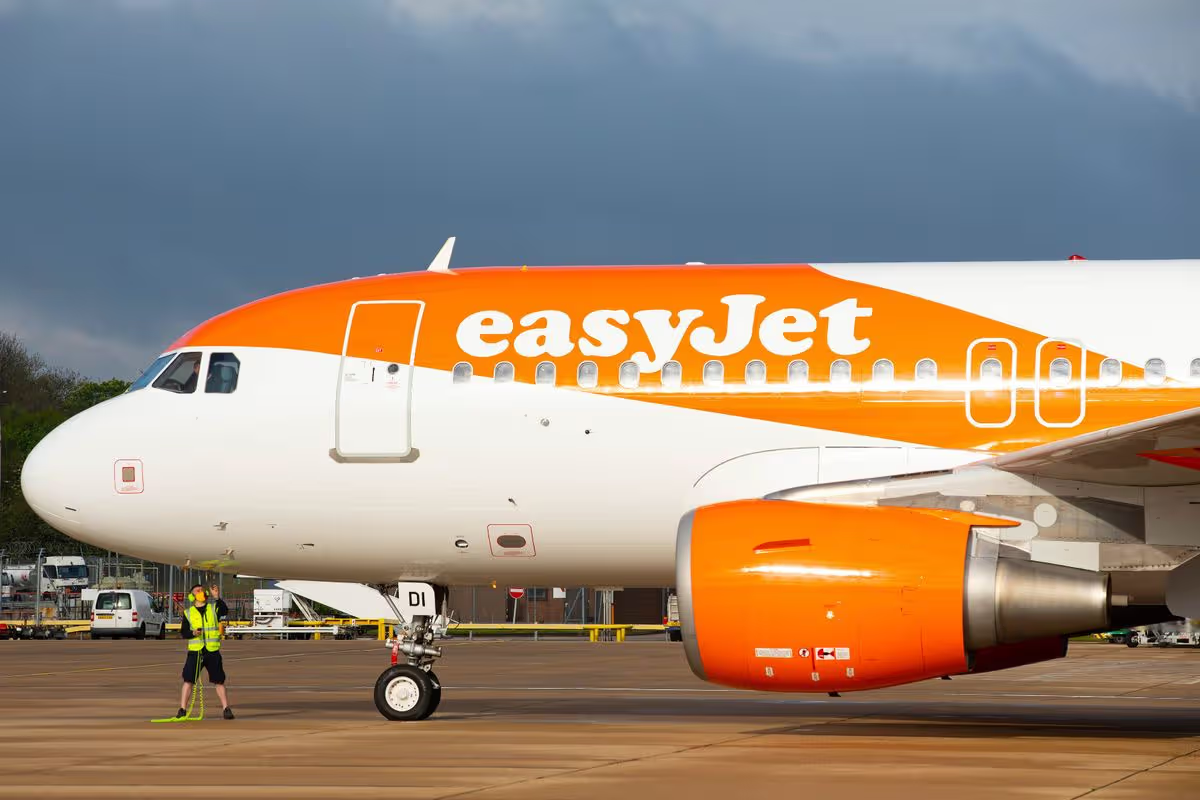
Flight misery over for tall passengers as easyJet shares new seats with extra legroom

The new seat will be installed from 2028 on hundreds of easyJet’s new aircraft, providing an extra two inches of improved knee and shin clearance

As budget airlines attempt to cram more and more passengers onto flights, it can feel as if the seat in front edges slightly closer each time you board a plane.

However, a “next generation” economy seat is on the horizon, which its creators claim will provide travellers with additional legroom without compromising space for airlines.

The Kestrel seat from Mirus Aircraft Seating, a British manufacturer, will be fitted from 2028 on hundreds of easyJet’s new aircraft, delivering an extra two inches of “improved knee and shin clearance” for passengers. It will enable easyJet to provide more legroom than most of its short-haul budget rivals.

READ MORE: Britain’s biggest car park operator to close 22 sites within days – full listREAD MORE: Warning as tourist is detained for going on a walk in holiday hotspot

The seat reshapes a passenger’s back, enabling their hips and spine to sit further back on the cushion so their knees and legs gain additional space at the front.

The back is constructed from carbon fibre rather than the traditional moulded plastic, producing a slimmer seat that provides crucial extra inches for the person behind.

A “fixed recline” of 22 degrees naturally shifts the passenger to the most efficient position in the seat, Mirus claims. Customers cannot manually recline the seat to annoy the passenger behind them.

A standard easyJet seat typically provides between 28 and 29 inches of room, meaning anyone who is six foot or taller will touch the seat in front with their knees. Some airlines on longer haul economy flights offer up to 34 inches of space.

“We’ve always had very comfortable leg room in easyJet,” said Kenton Jarvis, the airline’s chief executive. “This product is exceptionally comfortable, exceptionally light and allows a configuration that creates more space for the customer in the cabin.”

He explained easyJet wouldn’t be retrofitting any of its estimated 350 aircraft, stating: “There’s an expense to ripping off perfectly good seats and putting in and buying new ones.” The seats will instead appear in new orders of the Airbus A320neo and A321neo from 2028.

Research conducted this year by consumer group Which identified the short-haul carriers offering the tightest economy-class seat layout, or pitch, as Jet2, KLM, Lufthansa, Ryanair, SAS, TAP Air Portugal, Vueling and Wizz Air. All featured at least some seats with a 28-inch pitch.

The group noted that seat comfort also hinged on quality factors such as padding. By that measure, easyJet’s current seats achieved two out of five.

David Morgan, easyJet’s chief operating officer, commented: “We are delighted to be introducing the Mirus Kestrel seat across our future fleet.

“On top of the sustainability benefits, the additional legroom and enhanced comfort these seats will provide will also deliver an improved onboard experience for our customers, which we know they’ll love.”

READ MORE: ‘Text four letters to five-digit code’ this week if you have a mobile phone
Source link

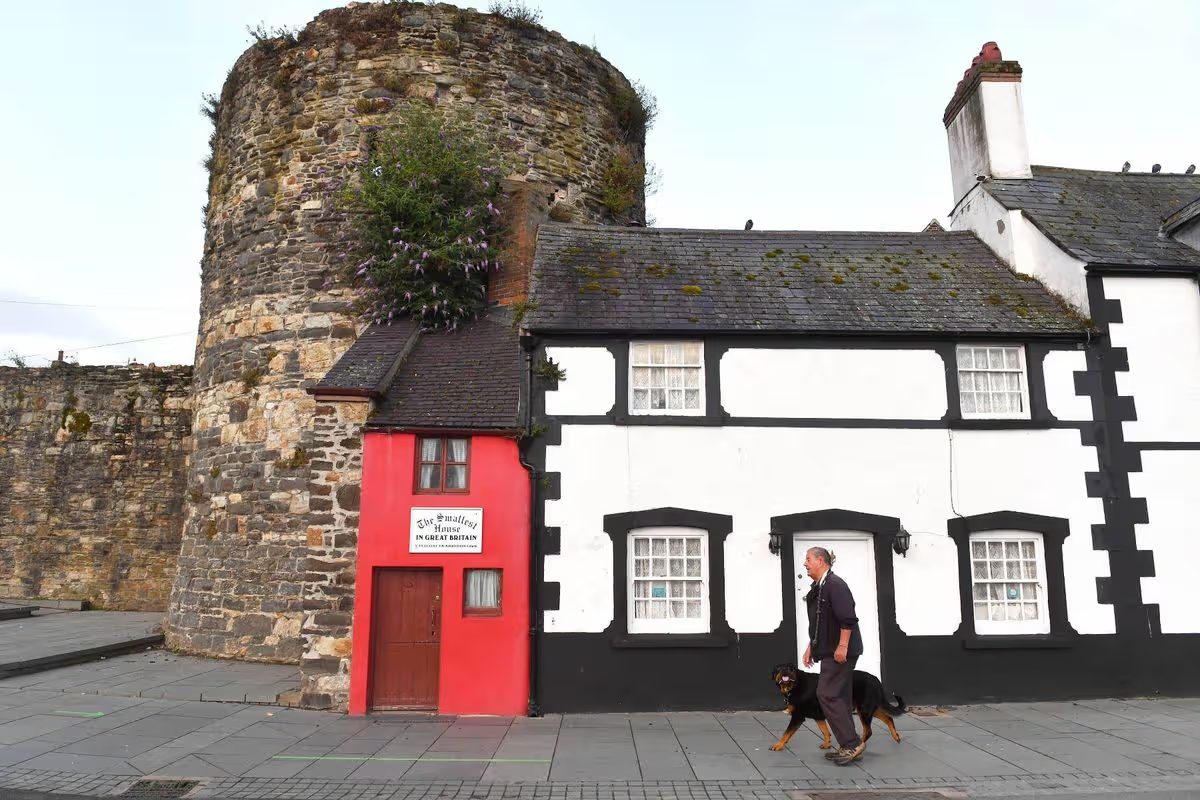
‘I own the smallest house in Britain and the last tenant was too tall to live there’

Owning the smallest house in Britain comes with its fair share of history and responsibility, but the owner’s ancestor only bought it for a mere £20

Year in, year out, tourists flock to this seaside village to see what is known as Britain’s tiniest home, and day in, day out, its owner is still in shock at just how much attraction it continues to gain.

Jan Tyley inherited the little red house in Conwyn, Wales, from her mother’s cousin back in 2015, and over 10 years later, she is heading up a small business that continues to boom, all thanks to its unusually small size.

Measuring just 72 inches wide and 122 inches high, it holds the official World Record of being the smallest house within the British Isles – a phenomenon that draws in roughly 50-60,000 visitors each year.

The origins of the place sit way back in her family, when her great-great-grandfather bought it in 1891 as a letting property with a sitting tenant. Jan shared: “He was called Robert Jones, and the sitting tenant was called Robert Jones, which has created a lot of confusion over the years.”

Tenants of the past

Robert, the tenant, was a six-foot-three fisherman who was living there up until 1899, when the local council decided that it was not, in fact, a house fit for human habitation.

“I’m 5’7″, and I have to duck to go in, and I frequently forget to come out again,” Jan joked. “So you can imagine what a sore back he must have had.”

Best holiday cottage deals in Wales

This article contains affiliate links, we will receive a commission on any sales we generate from it. Learn more
Sykes Cottages

From £35 per night

Sykes Cottages

See the deals

Wales is renowned for its stunning mountains, picturesque coastline and rich Celtic history. Sykes has a wide and varied collection of holiday cottages, houses and apartments across the country. Prices start from £35 per night with current deals.

There was no toilet, but instead a shared toilet with the cottages beside it, and so, they threatened to tear it down.

Disheartened and unsure what to do, the landlord was chatting to his friends at the pub, one of whom was the editor of the North Wales Weekly News, Roger Dawson, who suggested it may be the smallest in the country. This led them on a wild pursuit in which they travelled across the UK measuring numerous houses, after advertising the quest in newspapers.

In turn, the council agreed for it to stay put, but that nobody could actually live in it. “So being the enterprising chap, um, my great-great-grandfather said, ‘Well, I’ll turn it into a tourist attraction,'” Jan explained. In May 1900, it became a tourist attraction, and the family never looked back.

The building remains dressed as it was when it was last lived in in 1900, Jan confirmed. Unfortunately, being open to the public has meant they have seen a few items go missing over the years.

While it’s bursting with humorous stories and tales of those who once lived in this tiny abode, the reasoning for them inhabiting such an uncomfortably small space is a lot darker.

“It’s a real testament to the shortage of property in Conwy and how people wanted to live in a house of their own, because sadly the alternative was a poorhouse,” Jan explained.

“When Robert Jones, the last tenant, had to move out, that’s where he ended up. He was in the poorhouse, and sadly that’s where he died. So that’s why, although it’s tiny, people didn’t have a problem living there.”

During the 18th and 19th centuries in Wales, poorhouses were institutions designed for the less fortunate, with conditions made to be ‘prison-like’ in a bid to deter those in financial need from seeking help. Inhabitants were forced into rigid, segregated and often unsanitary living conditions, and so while the cottage was small, it was somewhere people could call their own.

According to records, there was shockingly a family of six all living within the tiny home – a mum and dad and four children. The little one’s beds were believed to be hammocks, which hooked on to the walls and sat in between the beams.

The house today

While the property remains in Jan’s hands, and with no looming threats from the council anytime soon, it continues to be a tourist attraction.

However, the one shift she has noticed in recent years is a rather unusual request, not from landlords or the council, but from YouTubers hoping to immerse themselves in the 1800s experience and share it online.

“I’ve had lots of YouTubers who say, ‘Oh, can we stay the night?’ and they think they’re the first one to think about it. Except, I probably get three or four of them a year.”

Although the house is closed during the winter, from March it is open seven days a week, from 10am right up until 4pm, and Jan has a team of people helping to keep the whole thing running.

“I have a team of eight lovely ladies who do the shift. So, we have two shifts a day. I take my turn on the door as well, but I live about half an hour’s drive away.”

Originally, Jan was living in Oxford, but after inheriting the property, she moved closer to the North Wales spot to take on its wealth of responsibilities.

But for her, it seems a worthwhile decision. She said: “It never ceases to surprise me how many people come to see it each year and from all over the world, which is amazing.

“I’m still amazed at how many people do come through our doors. We probably could get more if we were bigger, but then that wouldn’t be the point.”

Ensure our latest headlines always appear at the top of your Google Search by making us a Preferred Source. Click here to activate or add us as your Preferred Source in your Google search settings.

Source link