Surplus

‘How do I survive?’ Drought plagues Kenya’s Turkana amid surplus elsewhere | Drought News

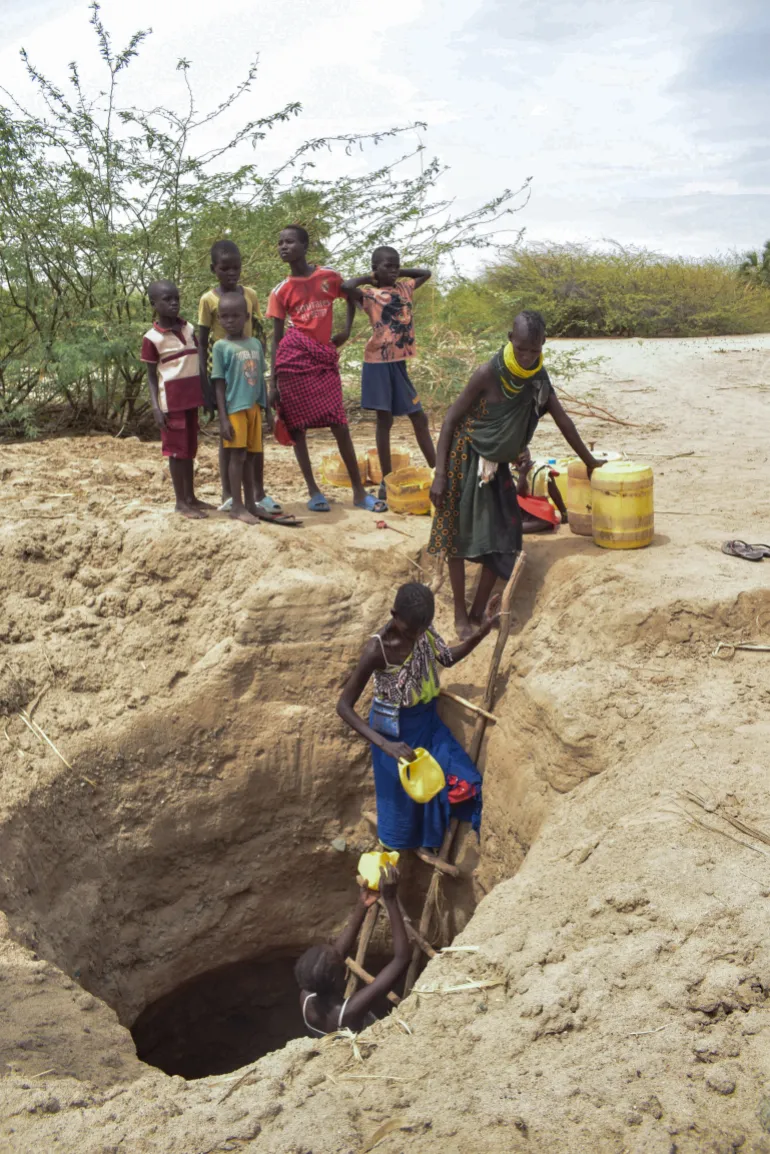
Turkana, Kenya – In the relentless heat of Kainama in Turkana county, Veronica Akalapatan and her neighbours walk several kilometres each day to a half-dried-up well surrounded by the parched earth of northern Kenya.

The dug-out hole in the ground with a wooden ladder is the only source of water in the area. Hundreds of people from several villages – and their livestock – share the well, most waiting hours to fill up small plastic buckets with meagre amounts of unclean water.

Recommended Stories

list of 3 itemsend of list

“Once we get here, we dig for water in the well and collect fruit. We wait for the water to fill the well,” says Akalapatan. “We take turns to fetch it because there is so little. There are many of us, and sometimes we fight over it.”

In Turkana, the land is rugged, roads disappear into dust, and villages are scattered across vast distances in a county of just more than a million people.

Despite it being the rainy season, weather experts warn that Turkana and other arid regions may receive little relief.

Authorities say drought is once again taking place, with 23 of Kenya’s 47 counties affected. An estimated 3.4 million people do not have enough to eat, at least 800,000 children show signs of malnutrition, and livestock – the backbone of pastoral life – are dying.

In Turkana alone, 350,000 households are on the brink of starvation.

“We are suffering from hunger,” Turkana elder Peter Longiron Aemun tells Al Jazeera.

“We don’t have water. Our livestock have died. We have nothing. We used to burn charcoal, but there are no acacia trees any more.”

Kenya is still recovering from one of its worst droughts in 40 years, which gripped the country between 2020 and 2023. The new weather crisis will likely make things worse.

But at the same time, experts note a stark paradox: Scarcity amid abundance.

Kenya
Veronica Akalapatan at the bottom of a hand-dug well after collecting water in Turkana county [Allan Cheruiyot/Al Jazeera]

Food loss and food waste

While families face acute water shortages and hunger – with boreholes broken down, and wells and streams dried up – Lake Turkana’s water levels have risen in recent years, displacing some shoreline communities.

In other areas, sudden heavy rains trigger flash floods in normally dry riverbeds – known locally as luggas – yet the land remains largely barren. The water comes too fast, runs off too quickly and cannot sustain agriculture.

At the same time, while droughts lessen food supplies and global donor funding cuts have reduced food aid, not too far away, experts say, there is a surplus of food that does not make its way to those who need it.

“In Kenya, a quarter of the population faces severe food insecurity, even as up to 40% of the food produced is lost or wasted each year,” according to a September report by the World Resources Institute (WRI).

Food loss occurs on farms, and during the handling, storage and transportation of supplies, while food waste occurs in households, restaurants and in the retail sphere, WRI researchers noted.

In parts of the North Rift – one of Kenya’s breadbaskets – farmers have recorded good harvests. But high prices and widespread poverty mean pastoralist families in Turkana cannot easily afford food transported from surplus regions.

Security adds another layer of strain. Competition over water and pasture fuels tensions, cattle raids persist, armed bandits operate in remote areas, and security forces struggle to contain violence amid logistical and political challenges.

“The biggest problem in drought areas is security,” says Joseph Kamande, a food trader in Wangige in central Kenya.

Still, he believes the country has the potential to feed itself with better planning.

“The land is vast. Some of it is arable,” he says, adding that “water is the solution.”

Untapped aquifers

In Turkana, though there is severe drought, there are also untapped natural resources.

Hundreds of metres underground are multiple aquifers, layers of rock and soil containing water. The government is hoping to tap into these sources.

In 2013, two major aquifers were discovered, the Napuu aquifer and the Lotikipi aquifer. The largest covers roughly 5,000km (3,100 miles) and holds about 250 trillion litres (66 trillion gallons) of water.

It is said to have the capacity to supply Kenya with water for decades.

However, much of the water is salty and expensive to purify, so the project has stalled.

“The big challenge is salinity,” says Turkana County Water Director Paul Lotum.

“The national government and partners are mapping out pockets where water is safe and reliable. We are working bit by bit to harness it for communities.”

Until then, relief food remains essential for Turkana communities.

The government’s disaster management teams and other agencies are distributing water and food. But supplies are stretched thin. And getting aid to those who need it most is nearly impossible in some areas.

“Most government organisations are either closed or running leaner programmes,” says Jacob Ekaran, Turkana’s coordinator for the National Drought Management Authority.

“The resource basket has shrunk. But the government is trying to do more with what it has.”

Kenya
A resident of Turkana displays wild berries collected for food in Loima, Turkana county. Families say the bitter berries have little nutritional value but are now a primary source of sustenance amid prolonged drought [Allan Cheruiyot/Al Jazeera]

‘I can’t find food’

When supplies run low, many people turn to wild berries and fruits.

In Lopur village, resident Akal Loyeit Etangana harvests berries that she then cooks in a small pot over an outdoor fire.

She says she has not had a proper meal in two weeks, so the fruit mixture keeps hunger away. Still, it carries almost no nutritional value.

“If it doesn’t rain, trees and leaves dry up. There is no water,” she laments, adding that clinics are also very far away and people have to walk long distances to get help.

In another village, Napeillim, resident Christine Kiepa worries that there is no food.

“I try to look for food. Sometimes it’s not there,” she says. “If I can’t find food, how do I survive?” she asks.

Villages in the region are slowly emptying. Male herders, who are usually the providers for their families, have moved to neighbouring counties in search of pasture and water for their dying livestock.

Only the elderly, women, young children and the weakest animals remain in the homesteads.

Still, there have been some gains in the region.

Since Kenya adopted a devolved system of government in 2013, Turkana has seen new schools and health centres built, irrigation schemes launched, boreholes drilled, and some roads tarmacked. Officials say investments in drought response have strengthened resilience.

“In the past, drought always degenerated into disaster. You would see reports of deaths,” says Ekaran from the drought management authority. “We are coming from one of the worst droughts in 40 years, but we did not record deaths. That is because of resilience building.”

Painful cycle

For generations, northern Kenya’s nomadic communities have depended on livestock. But climate change is forcing a reckoning. Calls for diversification – irrigation, drought-resistant crops and trees, large dams – have grown louder.

“We can change our community mindset,” says Rukia Abubakar, Turkana coordinator for the Red Cross.

“We can plant drought-resistant trees. We can do irrigation. Our soil is good for crop farming.”

These proposals are not new. They have surfaced after every drought, repeated in policy papers and political speeches.

Yet for many people in Turkana, the cycle feels painfully familiar and daily survival remains precarious.

Back in Kainama, Akalapatan and her neighbours walk back from the water well through the vast, arid landscape, carrying a collection of filled yellow plastic buckets.

They finally return to their small community of thatched huts.

Akalapatan has managed to collect 20 litres (5 gallons) of water for her family for the day.

Her son eagerly fills a cup and gulps it down.

But she knows that what she has is barely enough for everyone, and she will soon have to make the journey to the well again.
Source link

General Running Air Force Reserve Wants Surplus F-15E Strike Eagles, New F-15EX Eagle IIs

The commander of Air Force Reserve Command (AFRC) has said that he would like to field F-15E Strike Eagle and F-15EX Eagle II combat aircraft to help the command meet its commitment to supporting the overall Air Force mission. AFRC commander Lt. Gen. John P. Healy was speaking at the Air & Space Forces Association’s annual Warfare Symposium, where TWZ is in attendance.

Headquartered at Robins Air Force Base, Georgia, the AFRC is responsible for three numbered air forces, 34 flying wings, 10 flying groups, a space wing, a cyber wing, and an intelligence, surveillance, and reconnaissance wing. It also has other subordinate units that help to accomplish its total-force missions.

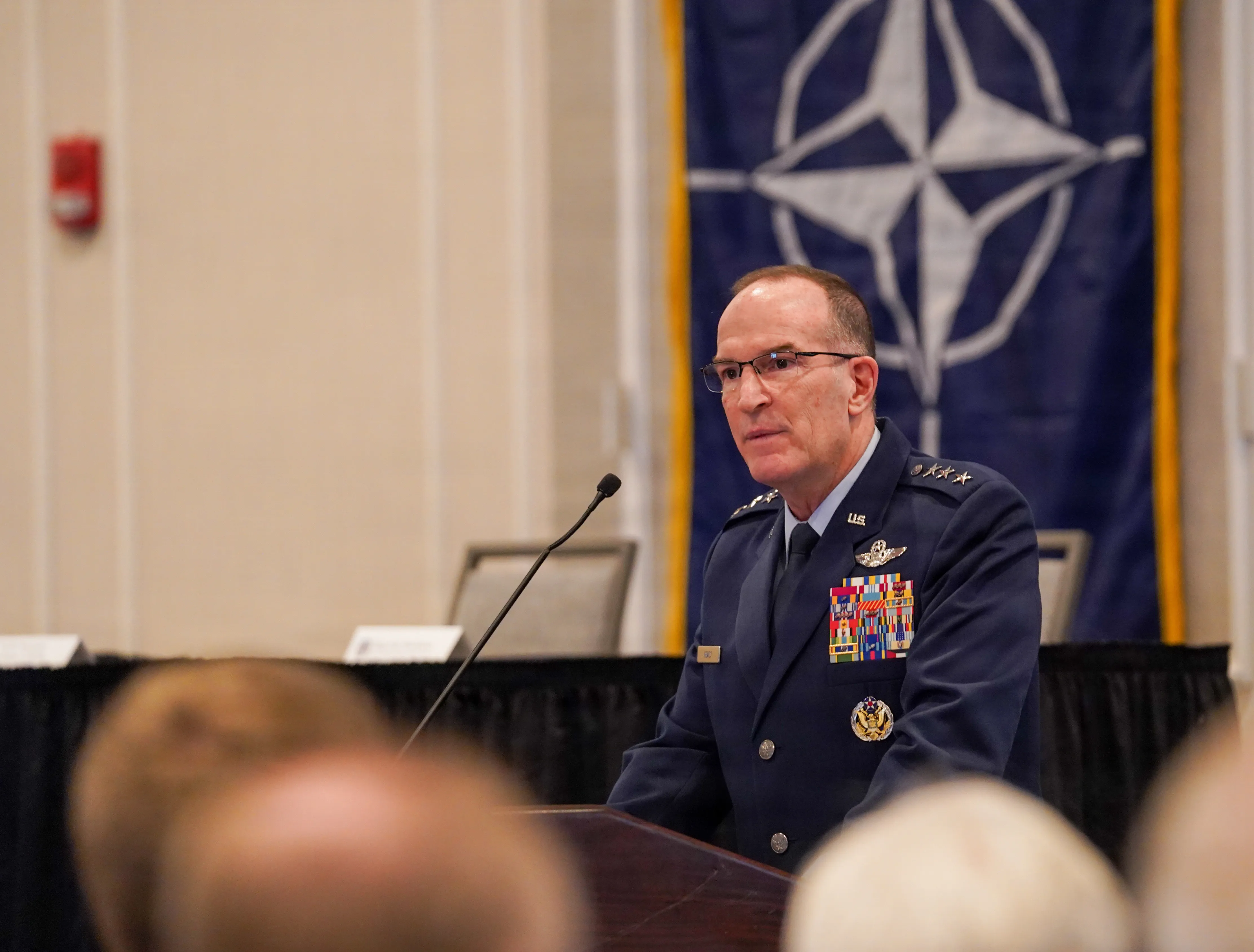
Lt. Gen. John P. Healy, Chief of Air Force Reserve, spoke at the NATO Interallied Confederation of Reserve Officers (CIOR) Winter Meeting in Norfolk, VA on January 28, 2026.
Lt. Gen. John P. Healy, Chief of Air Force Reserve, speaking at the NATO Interallied Confederation of Reserve Officers (CIOR) Winter Meeting in Norfolk, Virginia, on January 28, 2026. U.S. Army Maj. Tara-Lee Gardner

Healy was addressing how AFRC is grappling with how best to contribute to the Air Force’s 10-year fighter jet plan, which calls for purchasing more F-15EXs, F-35s, and F-47s, as it aims to have nearly 1,400 combat-coded tactical aircraft in service by 2030. The commander noted that the plan is not only “pretty ambitious” but also that, while it has been submitted to Congress, it is still very much a work in progress.

Nevertheless, Healy said that, whatever happens, the Air Force’s future fighter plans will rely heavily on the AFRC. At the same time, this organization is facing upcoming combat aircraft retirements, including the A-10 attack jet, which the Air Force wants to withdraw entirely.

U.S. Air Force Capts. Andrew Glowa, lead, and William Piepenbring, both with the 74th Fighter Squadron out of Moody Air Force Base, Ga., fly two A-10C Thunderbolt II over the skies of southern Georgia, Aug. 18, 2014. The 74th FS is one of two active-duty, combat-ready squadrons at Moody that performs close air support missions with the A-10. (U.S. Air Force photo by Staff Sgt. Jamal D. Sutter/Released)
U.S. Air Force Capts. Andrew Glowa, lead, and William Piepenbring, both with the 74th Fighter Squadron out of Moody Air Force Base, Georgia, fly two A-10Cs over the skies of southern Georgia, August 18, 2014. U.S. Air Force photo by Staff Sgt. Jamal D. Sutter/Released Tech. Sgt. Jamal Sutter

“As the commander of Air Force Reserve Command, I am keenly aware that some of my units are scheduled to divest without any plan of recapitalization,” Healy said. “Some could say I am loud and annoying when it comes to how we can ensure that we can maintain this fighting force,” he added, noting that in certain AFRC units, 100 percent of the airmen are combat veterans, and that he wants to ensure “that talent, that experience, doesn’t walk out the door during a normal, planned divestment.”

Healy is hopeful that the historic practice of aircraft divestment without recapitalization, something he said has existed over the last 14 years, is now on the way out.

“I think we’re finally at a point where we’re putting a stop to that,” Healy said. “We’re looking at maintaining our classic associations where we have them and recapping as the active duty can. For the remaining fighter units that we have that are divesting or scheduled for divestment, our full expectation is that we’re going to recap those with new weapons systems.”

There’s no doubt that many of the AFRC’s planned divestments are badly needed, with upward of 80 percent of the command’s fleet now being considered “legacy.” Healy continued: “You know, it’s code for old. Some of these airplanes need to be divested, but we also need to ensure that we are proportionately, concurrently fielded with new equipment.”

That’s where the F-15E and F-15EX could come into play.

“For every one of these A-10 units that are going away, I’m looking at if there’s a means by which we can get an F-15 unit behind it, whether it’s a Strike Eagle or an EX.”

A U.S. Air Force F-15E Strike Eagle assigned to the 336th Expeditionary Fighter Squadron parks on the runway before a flight at Kadena Air Base, Japan, May 13, 2025. The aircraft launched for a three-month deployment to the U.S. Navy Support Facility Diego Garcia, British Indian Ocean Territory, marking the first sustained U.S. fighter presence on the island and a major step forward in advancing Agile Combat Employment throughout the Indo-Pacific. (U.S. Air Force photo by Senior Airman Luis E. Rios Calderon)
A U.S. Air Force F-15E Strike Eagle assigned to the 336th Expeditionary Fighter Squadron parks on the runway before a flight at Kadena Air Base, Japan, May 13, 2025. U.S. Air Force photo by Senior Airman Luis E. Rios Calderon Senior Airman Luis E. Rios Calderon

Meanwhile, Healy said he’s also “pressing hard” to ensure that ARFC units divesting from the F-16 will be backfilled with F-35 stealth jets.

“We’ve got that combat capability,” Healy added. “We’ve got that combat experience. We need to leverage that.”

The AFRC boss also made the financial case for continuing to re-equip his command’s squadrons with new (or, failing that, newer) equipment.

According to the Air Force’s own factsheet, the AFRC provides around 14 percent of the total force within the service, while consuming only around four percent of the total manpower budget.

“My job is to constantly remind the programmers and remind the chief and the secretary of the value proposition, the advantage of the Reserve, because at the end of the day, we’re providing a little bit more money that we can reinvest into other things as well.”

Healy said that, when it comes to operating the F-16, an AFRC squadron does that “$12 million cheaper than the active duty can.”

Senior Airman Brandon Azocar, a crew chief assigned to the 482d Maintenance Squadron, marshals out an F-16 Fighting Falcon before its inaugural flight with the “367FS” tail flash at Homestead Air Reserve Base, Fla., April 4, 2025. Azocar launched the aircraft, piloted by Lt. Col. Dysart Cleeton, 367th Fighter Squadron commander. (U.S. Air Force photo by Master Sgt. Lionel Castellano)
A crew chief assigned to the 482d Maintenance Squadron marshals out a 67th Fighter Squadron F-16 at Homestead Air Reserve Base, Florida, April 4, 2025. U.S. Air Force photo by Master Sgt. Lionel Castellano Master Sgt. Lionel Castellano

The savings on F-15 units would be even more compelling, Healy argued, with an AFRC Strike Eagle squadron working out as $28 million cheaper than the active-duty equivalent, or $24 million in the case of the F-15EX.

There remains a question, however, around just how feasible it might be for the ARFC to get the F-15E or F-15EX. For all their undoubted capabilities, these types are both in short supply and high demand.

The Air Force’s planned F-15EX numbers have fluctuated repeatedly over the last few years. Under the Fiscal Year 2026 budget proposal, the Air Force’s program of record is now set to grow from 98 to 129 aircraft, with the addition of at least one more squadron, which will be converting from the A-10.

Originally, the Air Force had a minimum number of 144 F-15EX aircraft to replace the F-15C/D force. Some of the Eagle units have switched to other platforms since then, but units that fly A-10s, F-16s, and even F-15Es could end up getting F-15EX if the service chooses to go such a route. It seems quite possible that further growth of the program could occur, and that would seem to be a prerequisite if the ARFC is to get the Eagle II as well.

A formation of four U.S. Air Force F-15EX Eagle II fighter jets, assigned to Eglin Air Force Base, Florida, fly over the Gulf of America, Nov. 21, 2025. Secretary of the Air Force Troy Meink flew in the backseat of the lead jet as part of his visit to Eglin AFB. The flight oriented Meink to F-15EX tactics, techniques and procedures being developed and advanced by the 53d Wing to include weapons capacity, next-gen survivability, and next-generation radars, sensors and networking capabilities. (U.S. Air Force photo by Staff Sgt. Blake Wiles)
A formation of four U.S. Air Force F-15EX jets, assigned to Eglin Air Force Base, Florida, fly over the Gulf of America, November 21, 2025. U.S. Air Force photo by Staff Sgt. Blake Wiles Staff Sgt. Blake Wiles

When it comes to the F-15E, the Air Force inventory numbers 218 aircraft, of which 119 are powered by the older F100-PW-220 turbofan engines that produce some 23,500 pounds of thrust each. The other 99 have the F100-PW-229s, each of which is rated at 29,000 pounds of thrust.

The Air Force previously aspired to retire the Dash-220-powered jets by the end of Fiscal Year 2028.

The Air Force has argued that it needs to retire its older F-15Es to help free up resources for its future modernization plans, but lawmakers have been concerned about dwindling numbers of available tactical aircraft if this were to happen.

The possibility of transferring F-15Es from active-duty units to Air National Guard (or AFRC) units is something that TWZ has discussed in depth in this previous feature.

As far as the AFRC is concerned, the best chance of getting its hands on F-15Es will almost certainly be provided by the return stateside of the two squadrons of Dash-229-powered Strike Eagles currently at RAF Lakenheath in England. These are due to be replaced by F-35s in the future. For the time being, they are the only permanently forward-deployed F-15Es, which remain the service’s first choice for a wide variety of critical missions around the globe.

A U.S. Air Force F-15E Strike Eagle from the 48th Fighter Wing, RAF Lakenheath, approaches a KC-135 Stratotanker from the 100th Air Refueling Wing during exercise Ocean Sky, over the Atlantic Ocean, Oct. 15, 2025. The F-15E provides the joint warfighter unprecedented global precision attack capability against current and emerging threats, while complementing the Air Force’s air superiority fleet. (U.S. Air Force photo by Airman 1st Class Chloe Masey)
A U.S. Air Force F-15E from the 48th Fighter Wing, RAF Lakenheath, approaches a KC-135 Stratotanker from the 100th Air Refueling Wing during exercise Ocean Sky, over the Atlantic Ocean, October 15, 2025. U.S. Air Force photo by Airman 1st Class Chloe Masey Airman 1st Class Chloe Masey

Another option, and one we have explored in the past, would be to pass on the Dash-220-powered jets to the AFRC, and it is somewhat surprising the Air Force hasn’t floated this idea before when it has sought to offload the older, less-powerful Strike Eagles.

Asked by TWZ about the likelihood of F-15Es making their way to his command, the AFRC commander responded: “I am optimistic that we’ve at least got people listening to the value that we provide, the combat capability we provide, the experience that we provide. We’ve proven it over and over again. We’re efficient, we’re experienced, we’re 100 percent accessible as a reserve force, and we’re lethal in all these mission sets. I think our message is sounding in a positive way with senior leadership within the Air Force. I’m not going to cash the check yet, but I’m optimistic about our future in terms of recapitalizing some of our units.”

Many of the savings that the AFRC makes are a result of the efficiencies that are baked into its ‘business’ practices. Of the 67,000 airmen that make up the command, 14,000 are full-timers.

“Those full-timers are the ones that keep the lights on day-to-day,” Healy continued. Our business model is such that a typical unit will have 25 percent full-timers, and they run that unit for 28 days of the month. It’s only that one weekend a month that we’re at 100 percent — full strength. So those cost savings, right there, are what allow us to realize benefits. It adds up when we start putting it into big numbers like that.”

Whether examples of the F-15E Strike Eagle or F-15EX Eagle II end up on Air Force Reserve Command ramps remains to be seen, but in Lt. Gen. John P. Healy, that component has a strong advocate for making that happen.

Contact the author: thomas@thewarzone.com

Thomas is a defense writer and editor with over 20 years of experience covering military aerospace topics and conflicts. He’s written a number of books, edited many more, and has contributed to many of the world’s leading aviation publications. Before joining The War Zone in 2020, he was the editor of AirForces Monthly.


Source link