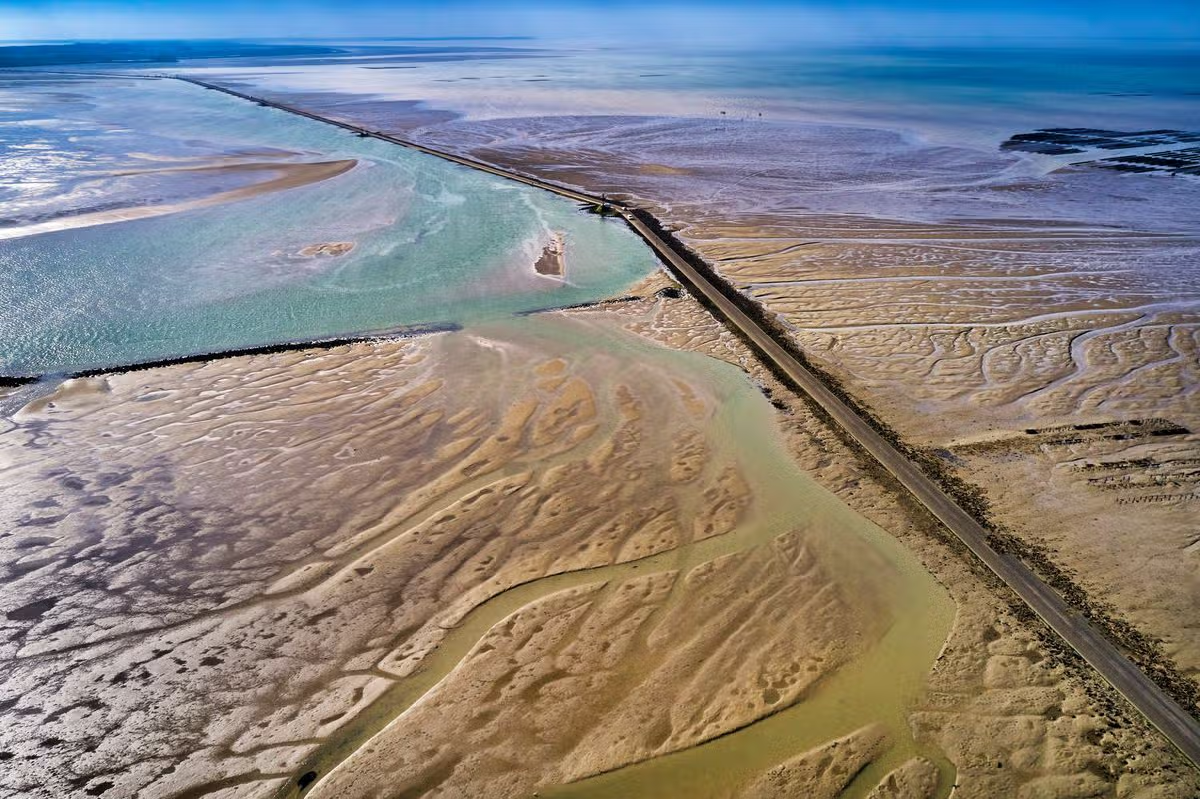
submerged

Town that’s been submerged for 2,400 years just reappeared right by huge tourist hotspot

A remarkably preserved town that has been underwater for a whopping 2,400 years has reappeared in a tourist holiday hotspot – anchored in the past and frozen in time

In an extraordinary turn of events, a town has reappeared after being submerged under water for more than 2,000 years – and it remains largely untouched.

In the popular holiday hotspot of southeastern Turkey, archaeologists uncovered a 2,400-year-old town beneath the Dicle Dam Lake. Despite being submerged for thousands of years, the town appeared eerily frozen in time, with remarkably preserved mosques, religious schools, and tombs that once made up an ancient community.

Due to a lack of human disruption, the town, near the district of Eğil, and near Diyarbakır, has remained protected and untouched under the water’s still surface. “In the images taken by the teams or when the water recedes, we can see that these historical structures have preserved their integrity and remain standing in a solid condition,” Dr. İrfan Yıldız, a researcher at Dicle University, said.

READ MORE: The seaside town with beautiful beaches and 23C May temperatures ‘begging Brits to come’READ MORE: Popular airline reduces Europe flights and cancels others until June 14

The mosque and tombs beneath the water are said to be associated with the Prophet Elisha, as well as the Ottoman-era Caferiye, also known as Lala Kasım, Madrasa, and the Byzantine-era Deran Bath. Experts have noted just how extraordinary it is to have such well-preserved structures underwater.

The discovery of the settlement, published by Dicle University, is now offering archaeologists insight into the region’s prehistoric past and its transformation over the millennia. But how did this foregone town, that once had a thriving community, find itself lost in time and engulfed under water?

The Dicle Dam Lake was formed by a dam built in 1986 and completed in 1997, which was required as a vital water source for the region. But before this, the Eğil district, part of the Tigris River Valley, had been home to ancient communities.

Its residents date back to the Hittites and Ottoman empires, which once used prehistoric tombs. While the region is said to have served as a vital gateway for Assyrians, Persians, Hurrians, Mitanni, Romans, and Byzantine citizens.

Before the dam was completed and flooding engulfed parts of the region, some important sites were removed, while other parts were simply abandoned. The reservoir was filled, and the ancient town remained untouched, lost beneath the water.

While it’s been one of the most fascinating discoveries, the ruins are at risk of being lost if measures aren’t taken to protect them due to shifting water levels, sediment activity and possible erosion. Dr Yıldız, who described the find as “extraordinary”, is championing the extension of studies to protect the heritage site.

He said: “Underwater archaeological studies can be carried out on these remains.” It’s thought that further studies on the former town could help uncover more of the region’s history and the lives of the citizens who called it home, all those years ago.

Do you have a travel story to share? Email webtravel@reachplc.com

Source link

Bodies of Chinese tourists missing in Australia found in submerged car

March 12 (UPI) — Police divers in Australia’s Greater Sunshine Coast region on Thursday recovered the bodies of two missing Chinese backpackers after they were found dead inside their SUV vehicle beneath floodwaters.

The 26-year-old man and 23-year-old woman were found near Kilkivan, 100 miles northwest of Brisbane, after a major search operation by police and the State Emergency Service using helicopters and drones when the pair failed to arrive at their destination.

“Dive squad officers from the state dive unit arrived and retrieved two deceased persons from a car that had been washed off the road at Kilkivan. The formal identification process is still underway but it is believed that the two, as reported, are a 26-year-old male and a 23-year-old female who are international tourists,” said Queensland Police Minister Dan Purdie.

Purdie said their families had been notified and authorities were working with the Chinese Consulate in Brisbane.

Bundaberg Police Chief Inspector Grantley Marcus said the pair were driving from Brisbane to Mundubbera, where they were due to begin jobs picking fruit.

“They didn’t arrive and a friend of theirs from Australia contacted police on Tuesday and reported them as missing.”

Marcus said the families of the deceased were en route to Australia and pledged police would do everything they could to assist them when they arrived.

The couple was named by 7News as Yuchen Guo, 23, from Shandong Province in eastern China, and Qingwei Qiu, 26, from Fujian Province in the southeast of the country.

Extreme rainfall has seen large areas of Queensland hit with severe flooding in recent days, with some river levels still rising. Parts of the state recorded their highest three-day rainfall totals Sunday through Tuesday.

Glen Hartwig, mayor of nearby Gympie, said the deaths of the pair were “an absolute tragedy” and called for more to be done to make tourists aware of the danger from flooding.

“These people have come to Australia to see our beautiful country and tragically they’ve ended up losing their lives. We warn people about biosecurity when they come into the country, but I also think we need to warn them about the dangers of floodwaters,” he said.

“We’re very grateful that they chose to come and see our country and we’re so sorry for their loss and the pain that [family members] are now feeling,” added Hartwig.

Founder of the Women’s Tennis Association and tennis great Billie Jean King (C) smiles with representatives after speaking during an annual Women’s History Month event in celebration of the 50th anniversary of Title IX in Statuary Hall at the U.S .Capitol in Washington on March 9, 2022. Women’s History Month is celebrated every March. Photo by Bonnie Cash/UPI | License Photo

Source link