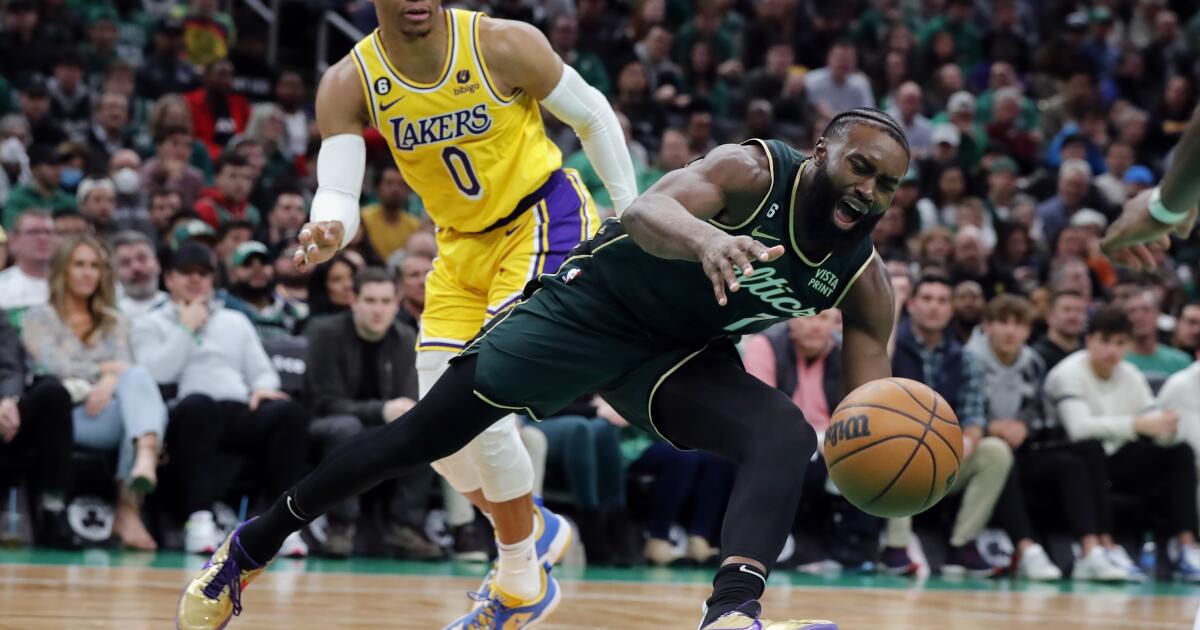
Jaylen Brown, Beverly Hills police and video stoking racial bias claim
Boston Celtics star Jaylen Brown was in the middle of a brand event at a Beverly Hills mansion on Valentine’s Day when police showed up.
It was 7 p.m., and the music for the event — an invite-only gathering for his 741 Performance brand — had long been silent. Brown came down to talk to an officer, expressing confusion at why police had been called.
“We’re just trying to have an event — a panel talking about culture, talking about future, talking about leadership, and for whatever reason I feel like we’re being targeted,” Brown said in a video of the encounter posted on social media.
He asked the officer why the city was shutting it down. “It’s beyond my pay grade,” the officer replied. “They want it shut down.”
The video immediately went viral, with many questioning why the city shut down what appeared to be a calm event. The debate was framed by a series of incidents in recent years in which the local Police Department was accused of profiling Black people.
Beverly Hills officials issued a statement defending their actions. But it didn’t take long for the city to reverse course, issuing an apology to the NBA star and the owner of the home that hosted the event, Oakley founder James Jannard, for initially putting out inaccurate information.
Brown told ESPN he is considering legal action against the city, saying the episode tarnished his and his brand’s image.
“I feel offended by it,” he said. “It’s hard to say that you were not being targeted.”
Beverly Hills officials insist the city did not unfairly single out Brown and stressed the incident was a code-enforcement matter, not one involving policing issues.
The police’s presence at the event on Trousdale Place was prompted by a resident reporting “excessive vehicles on the street,” Beverly Hills Deputy City Manger Keith Sterling said in an email to The Times. A traffic control officer then found “high vehicular traffic, numerous parking violations (including a vehicle blocking a driveway and several vehicles parked in the wrong direction) and numerous people congregating in the driveway.”
“Code enforcement was on site for several hours and observed what they believed to be well in excess of 50 people congregating for an event, which would require a public assembly permit for the safety of event attendees,” he added.
There was also the sound of a generator, which would require a permit, a check-in table, a metal detector and a temporary wall with branding, Sterling said.
Brown’s function occurred during the NBA’s All-Star Weekend in Los Angeles. Sterling noted there were six other NBA-related events in the city at that time.
“The City was aware that the event was timed to coincide with NBA All-Star Weekend but did not have details on who was sponsoring or participating in the event,” Sterling wrote. “The event was shut down for safety reasons alone without regard to the event sponsor or participants.”
Still, the incident revived questions of policing in Beverly Hills — a majority white city in which Black residents make up about 2% of the population.
Some advocates called on Atty. Gen. Rob Bonta to investigate allegations of racial profiling in Beverly Hills. Bonta’s office declined to comment.
In 2020, the Beverly Hills Police Department launched a special detail — the Rodeo Drive Team — amid complaints over what residents and shop owners said was a “criminal element” along the famed shopping corridor. Officers were tasked with combating what officials said was a rise in thefts, people spending money obtained by defrauding the state’s unemployment system and quality of life issues like loud music and the smell of marijuana drifting into stores, according to a 2021 Times investigation. One document The Times reviewed that year showed about 90% of those arrested by the task force were Black.
The task force was disbanded after just two months.
Attorneys Bradley Gage and Benjamin Crump filed a class-action lawsuit against the city in 2021 that remains ongoing. The lawsuit claims none of the arrests led to convictions and some were never prosecuted because police lacked probable cause to make the initial arrest.
The department has denied allegations that it targeted Black shoppers, saying in a statement in 2021 that officers are “committed to keeping our community safe while enforcing the law with respect and dignity for all.”
Shortly after the task force was disbanded, Salehe Bembury, then the vice president of sneakers and men’s footwear for Versace, was carrying a Versace shopping bag and crossing Rodeo Drive next to the luxury store when police stopped him for jaywalking, told him to put his hands behind his back and searched him for weapons.
Body camera footage showed Bembury repeatedly said he was uncomfortable and thought the pat-down was “excessive,” adding he’d designed the shoes inside the bag he was carrying. He started recording on his cellphone.
“I’m getting f— searched for shopping at the store I work for and just being Black,” Bembury said in the recording, holding up the Versace bag. One of the officers involved in the stop disagreed, saying Bembury was changing “the narrative.”
“It’s a very dangerous, scary situation for people of color, and one that we want to remedy so everyone is treated fairly. I don’t know why that’s such a novel idea, but it seems to be a foreign concept for a lot of folks,” Gage said.
In his clients’ lawsuit against the city, two plaintiffs say they were arrested for riding a scooter on the sidewalk. Another allegedly was jailed for three days after officers pulled him and his friend over on their way to the beach for stopping about three inches over the limit line at an intersection. He never was charged with a crime, according to the complaint.
Mike Asfall, president of Beverly Hills/Hollywood Branch of the NAACP, said he’s been working behind the scenes with city officials and the police chief over issues of race and policing. Asfall was honored in February by the Beverly Hills City Council in recognition of Black History Month.
“I do know that we’ve had obstacles,” he said. “We shouldn’t have to walk on eggshells or tiptoe around things just because of the color of our skin. But what I’m not going to do is create more of a rift to give us a problem that’s going to create drama for us.”
Staff writer Cierra Morgan contributed to this report.