Saab

Saab Unveils Stealthy Supersonic ‘Fighter Drone’ Concept

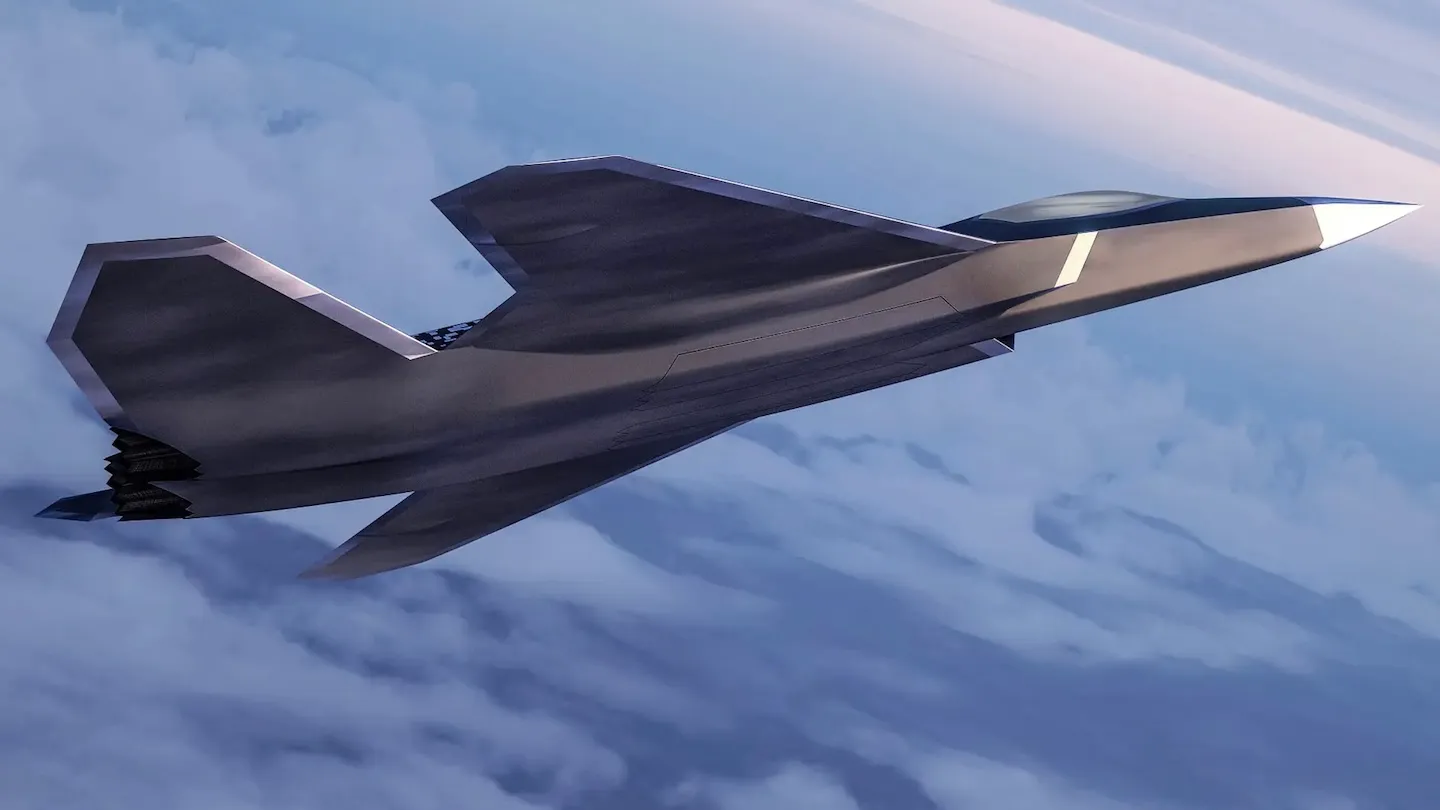
Saab has unveiled its roadmap for its Autonomous Collaborative Platform (ACP) program, a stealthy, supersonic ‘fighter drone,’ which could enter service in the 2030s with the Swedish Air Force and potentially other customers. The aerospace and defense company is already working on two uncrewed technology demonstrators and today presented a full-scale mock-up of an operational drone that those two aircraft could inform. This drone, compared to the U.S. Air Force Collaborative Combat Aircraft (CCA), for example, is a higher-end proposition, more advanced, larger, and with superior performance than those being test flown in the United States.

TWZ was among other members of the media who were briefed on the ACP program by Peter Nilsson, the head of Saab’s Advanced Programs business unit. He was talking at Malmen Air Base in Sweden, during an event to celebrate the Swedish Air Force’s 100th anniversary.

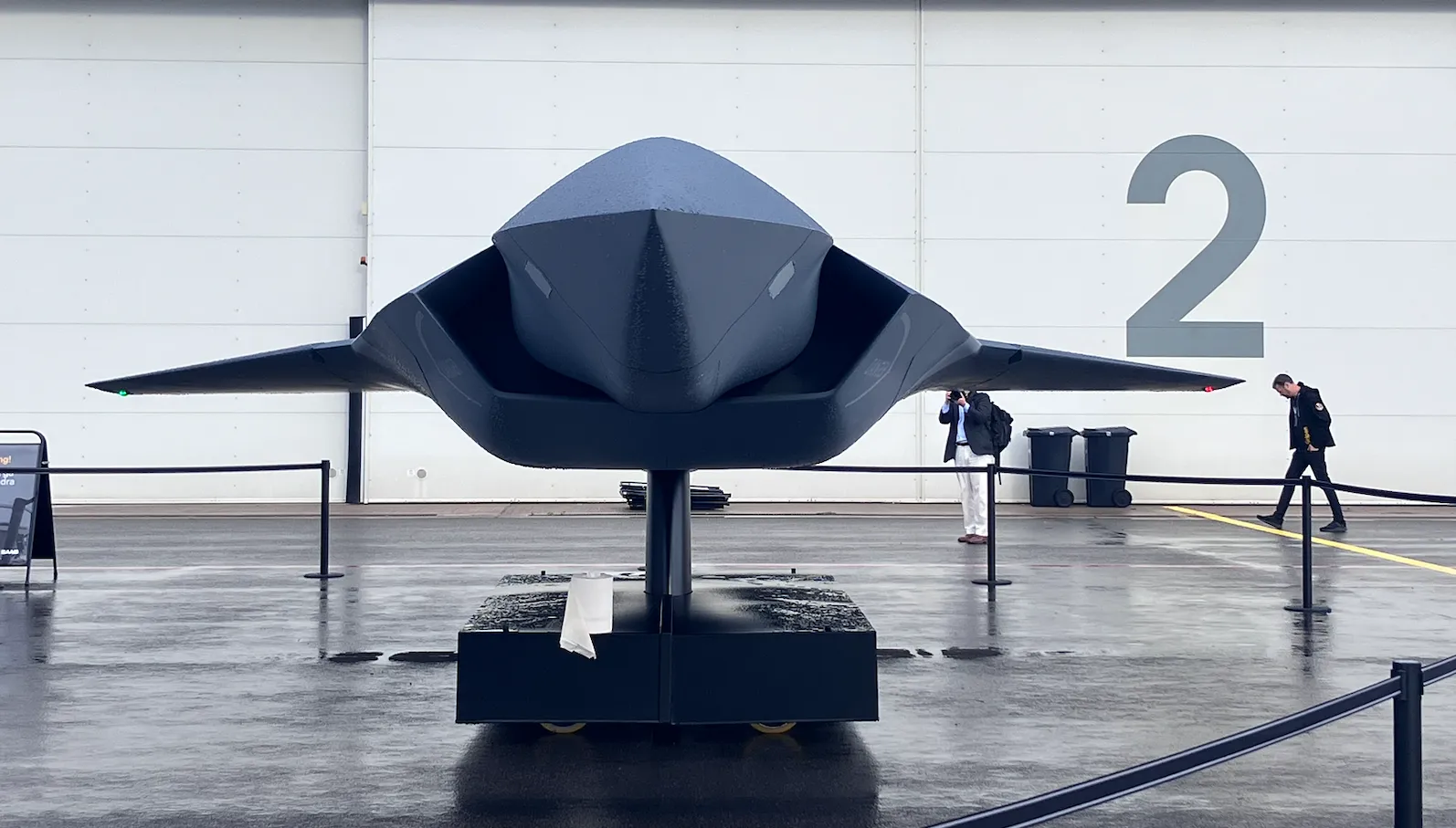
A head-on view of the full-size aircraft A3 mockup. Thomas Newdick

As for the name, Nilsson confirmed that, before settling on ACP, Saab had used the Collaborative Combat Aircraft (CCA) and Unmanned Aerial System (UAS) nomenclature. Meanwhile, the ACP falls under Sweden’s overarching KFS project, which stands for Koncept för Framtida Stridsflygplan, or Concept for Future Combat Aircraft.

The most significant element of the announcement was the full-scale mock-up of what Saab is calling aircraft A3. The idea of this is to show how a potential high-end ACP could look, and the kinds of capabilities it might bring, provided the company is awarded a development contract.

A rear three-quarter view of the full-size aircraft A3 mockup. Note the serrated stealthy engine nozzle. Thomas Newdick

Broadly speaking, aircraft A3 has a lot in common with a previous concept that the company released back in 2024.

The concept retains the same tailless, stealthy configuration, with significant internal capacity for fuel and internal stores. The stealthy, chisel-type DSI air intakes remain on either side of the fuselage, but the prominent bulge roughly above where the engine nozzle would be is removed. The overall geometry remains similar: a sleek, blended wing/body configuration with cropped wings and a prominent chine running around the arrow-like forward edges, giving it something of a resemblance to the Cold War-era Saab Draken fighter, with its distinctive double-delta wing.

An overhead view of aircraft A3 as seen in a slide from a Saab presentation. Thomas Newdick

In the meantime, Saab is working on aircraft A1 and A2, uncrewed technology demonstrators that are being funded by the Swedish Ministry of Defense.

The first of these, A1, is expected to fly within the next 15 months,” according to Nilsson. The defense ministry called upon Saab to “go from concept to first flight within 36 months,” providing what Nilsson described as a “quite challenging” timeline.

Aircraft A1 uses the same GE Aerospace F414 engine that powers the Saab Gripen E/F crewed fighter. The turbofan produces around 22,000 pounds of thrust and will ensure A1 has supersonic performance.  However, for Saab, the main goal of A1 is to demonstrate that the company can build and fly a low-observable drone.

Saab provided imagery of wind-tunnel models of the A1. Overall, it appears loosely similar to the A3 mockup, with the exception of the twin, outward-canted tailfins. Aircraft A1 will have capacity for an internal weapons bay, although it will not be used for stores release tests. The next test article, aircraft A2 will have an internal weapons bay, and will presumably be used to test ordnance. Otherwise, A2 will be used for tests of other advanced technologies, including new materials and sensors.

Above and below: Two images showing wind tunnel models of aircraft A1. Thomas Newdick
Thomas Newdick

No artwork of aircraft A2 was provided, but Nilsson said it will be “not quite” identical to A1, in terms of appearance. It will also be powered by the F414.

The F414 was selected due to its availability and the fact that the company has plenty of experience with the engine due to the Gripen E/F program. Saab is looking at other potential powerplants for the A3, but acknowledged that, should Sweden buy a productionized ACP, the engine commonality would be a big advantage, including, for example, when an engine needs to be changed at a remote airbase. This kind of maintenance is central to the Gripen concept of operation and would be retained for the ACP.

Saab is contracted until 2030 to develop the A1 and A2 demonstrators. What happens next will depend on the Swedish Ministry of Defense, and there is currently no agreement for a follow-on ACP contract, which would see the design advanced to a production-oriented prototype like the A3.

An underside view of the aircraft A3 concept as seen in Saab promotional material. Thomas Newdick

“We have floated the view that this would be a great asset to the Gripen E, but right now there is no commitment,” Nilsson remarked. Saab envisages the Gripen E serving as a tactical mission commander for one or more ACPs, working in conjunction with the company’s GlobalEye airborne early warning and control (AEW&C) aircraft, a type also ordered by Sweden. Outside of Sweden, the drone could work with a wide variety of other crewed platforms, too.

Pending investment from the Swedish government, Saab may decide to use its own funds for early development of the A3. However, Nilsson noted that “if a customer does not come along I don’t know when my CEO will stop me spending — you need a customer to buy into this.”

Saab’s broader ACP vision is based on an advanced platform that offers both low-observable features and supersonic performance.

The resulting drone should be capable of undertaking “high-risk missions in heavily defended airspace.” As well as air-to-air combat, missions would include electronic warfare, suppression of enemy air defenses, and deep precision strike.

If Sweden buys into the idea, a development contract could be expected around 2030. Thereafter Saab thinks it could have the A3 aircraft in the air sometime in the early 2030s, leading to initial operational capability from the mid-2030s.

The roadmap for the ACP program, as envisaged by Saab, with a crewed fighter glimpsed in the bottom right-hand corner. Thomas Newdick

With the ACP program, Saab hopes to stake its claim as the “first-mover in the segment” for high-end ‘loyal wingman’-type aircraft.

But even if the Swedish Air Force isn’t swayed by Saab’s ACP offer, the company is seeing the related spiral development as fundamental to its future as a builder of crewed combat aircraft, too.

The same basic architecture now being developed for the ACP could provide a technological and conceptual base for a future (crewed) Gripen successor. This would be required by the Swedish Air Force sometime after 2055. If there is demand, Saab says it could start development of such an aircraft in the mid-2030s.

A slide from a Saab presentation outlines how the high-end ACP development effort could feed into a new crewed fighter design. Thomas Newdick

A rendering of a potential future crewed combat aircraft that appeared in Saab’s presentation reveals a slightly more detailed version of a concept shown in the past. Namely, a design apparently tailored for high speed, as well as low observability. Some of the same features found in the A3 concept — notably the overall blended wing/body and cropped wings — appear in the crewed combat aircraft, although this adds outward-canted tail surfaces, mounted on booms that project relatively far beyond the engine nozzle. The nose and forward fuselage bear a resemblance to the F-35, and, overall, the aircraft seems to be around the same size as the U.S. design, perhaps a little larger.

A slide from a Saab presentation shows a rendering of a future crewed fighter design. Thomas Newdick

For its part, the Swedish Air Force is still weighing up whether it wants to pursue a crewed successor to the Gripen, if it will abandon crewed fighters altogether, or if it will seek to join a foreign sixth-generation fighter program. A decision on this is likely sometime between 2028 and 2030.

Speaking to journalists at Malmen today, Brigadier-General Niclas Magnusson, the deputy commander of the Swedish Air Force, called for closer collaboration between the service and industry as Sweden seeks to define its future air combat requirements.

“We have to research and find the limits of what we are able to do,” Magnusson said, adding that he expected the future Swedish Air Force to field both crewed and uncrewed platforms.

That decision is still to come but will also be informed by the relative costs of the Gripen (more of which may still be acquired), higher-end drones, and potential future crewed platforms.

When it comes to the ACP, Nilsson suggested that the life-cycle cost will be around a third that of the Gripen, although acquisition cost won’t be as low as that.

“The problem is that this bloody aircraft is too low cost,” Nilsson added, pointing to the Gripen E.

Ultimately, the cost of the ACP will depend on the degree of capability that the customer demands.

Potentially, a single ACP could cost half as much as a Gripen. Open-source reports suggest that the Gripen E typically comes with a flyaway cost of roughly $70-80 million.

If the ACP is to offer “high-end survival,” Nilsson explained, then a customer would likely be able to field two to three ACPs for each Gripen. The ratio “is not one to 10.”

While Saab also wants to offer the ACP to other Gripen E/F operators as a priority, the fate of the program remains heavily dependent on larger questions about the future of the Swedish Air Force.

Swedish defense firm Saab today announced that it had signed a contract to provide 16 Gripen E fighters to Ukraine. Once they arrive in the country, the jets will likely provide Ukraine with its most capable combat aircraft, and the development comes after Stockholm agreed to donate up to 16 of the previous-generation Gripen C/Ds to Ukraine. Handover of the Gripen C/Ds in Ukraine is slated to take place in early 2027, while the Gripen Es are scheduled for delivery starting in 2029.
Saab Gripen E. Saab Saab

The program gives Saab a solid, and potentially unique, entrance into the CCA space. As we’ve said for years, fourth-generation fighters can remain highly relevant when paired with CCAs — and with a drone as advanced as this, potentially even more so.

The ACP will still come with a significant cost, but that could be offset by reducing or eliminating the need for a fifth- or sixth-generation crewed fighter for certain air forces.

For now, Saab’s high-end loyal wingman remains a proposal rather than a committed production program, but the company is clearly positioning it as more than another experimental drone. The A1 and A2 demonstrators are intended to prove the technologies needed for a survivable, supersonic, low-observable uncrewed aircraft, while the A3 concept unveiled today illustrates where Saab believes those technologies could ultimately lead.

Whether Stockholm opts for a new Saab-developed crewed fighter, joins an international sixth-generation program, or moves toward a force built around a greater mix of crewed and uncrewed aircraft, the ACP work gives the country a way to explore those possibilities without committing to one of them yet.

Contact the author: thomas@thewarzone.com
Thomas Newdick is a staff writer at TWZ, where he covers military aviation, defense technology, weapons systems, and international security. Based in Berlin, Germany, he reports on conflicts, military modernization efforts, and emerging aerospace technologies around the world, with a particular interest in airpower and its role in contemporary warfare. His reporting is informed by deep expertise in modern and historical airpower, particularly in Europe, with a focus on military aviation, air campaigns, and aerospace developments across the continent and beyond.


Source link

NATO Picks Saab GlobalEye To Replace Aging E-3 AWACS Fleet

The next NATO airborne early warning and control (AEW&C) platform will be Saab’s GlobalEye, as announced today during the alliance’s summit in Ankara, Turkey. The decision to buy up to 10 GlobalEyes for NATO comes after Sweden, France, and Canada all selected the platform, and amid a flurry of new orders for military equipment as part of a wider alliance defense spending drive.

NATO Secretary General Mark Rutte said today that NATO will begin formal negotiations with Saab regarding the acquisition of the GlobalEye. The system will combine Saab’s Erieye Extended Range radar, other sensors, and a command and control (C2) system on a Canadian-made Bombardier Global 6500 bizjet airframe. At this point, Saab has not signed a contract or received an order.

“We are honored and proud to support NATO in its next-generation AEW&C capability,” said Micael Johansson, president and CEO of Saab. “We are confident that GlobalEye is the right choice for the alliance, delivering proven capability, adaptability and long-term operational advantage. Today’s announcement clearly positions GlobalEye as the world-leading solution for advanced airborne early warning and control. We look forward to the next steps in the negotiations.”

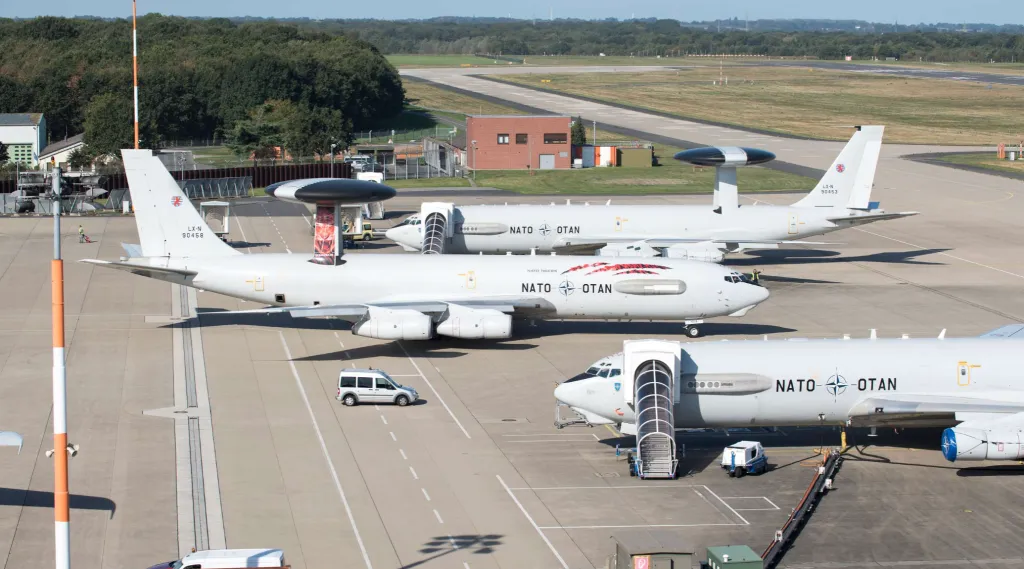
The alliance badly needs a replacement for its fleet of 14 Boeing E-3A Sentry Airborne Warning And Control Systems (AWACS) aircraft that are operated by the NATO Airborne Early Warning & Control Force (NAEW&CF), home-stationed at Geilenkirchen Air Base in Germany.

NATO E-3s on the flight line at Geilenkirchen Air Base. Melanie Becker/Luftwaffe

The GlobalEye’s path to success with NATO has been somewhat circuitous.

Back in 2023, NATO had announced its plan to “take steps toward acquiring” six Boeing E-7A Wedgetail AEW&C aircraft, the first part of an effort known as Initial Alliance Future Surveillance and Control (iAFSC).

NATO’s original choice of the E-7 took into account price and availability, as well as previous E-7 acquisition programs, namely in Australia, South Korea, Turkey, the United Kingdom, and the United States.

At that time, NATO determined that the E-7 was “the only known system currently capable of fulfilling the strategic commands’ essential operational requirements and key performance parameters and available for delivery within the timeframe required.”

But last November, the Dutch Ministry of Defense announced that NATO had dropped its plan to buy E-7s, saying that the program had lost its “strategic and financial basis.” The decision was also driven by confusion about the future of the U.S. Air Force’s Wedgetail plans.

At that point, the State Secretary for Defense of the Netherlands, Gijs Tuinman, said that the goal was to have a new AEW&C aircraft operational by 2035, referencing the date that the E-3s will reach the end of their service life.

A Saab Gripen E flies alongside a GlobalEye. Saab

Last year, Saab said that they would be able to get the GlobalEye into operational service with NATO in 2031.

The Netherlands was one of seven partner members in the AWACS replacement program, alongside Belgium, Germany, Luxembourg, Norway, Romania, and the United States. However, the United States later departed the program.

Dropping the E-7 meant the GlobalEye became the only realistic candidate, as the only other in-production jet-powered Western AEW&C aircraft. The turboprop, carrier-capable Northrop Grumman E-2D Hawkeye is also still being built.

Also in its favor is the fact that the GlobalEye has already been ordered by France to replace its E-3F Sentry fleet, and by Sweden, and has been selected by Canada. Saab has pitched the aircraft to Denmark and Finland, with a view to them potentially jointly operating the type. The company has also confirmed that Germany and Poland have both shown “interest” in the GlobalEye.

GlobalEye AEW&C. For editorial use only.
Saab GlobalEye. Saab

Meanwhile, demand for AEW&C aircraft is growing across Europe as the security environment continues to deteriorate. Russia’s ongoing aggression has reinforced the need for persistent wide-area surveillance and airspace control, while a broader range of operational scenarios is also driving renewed interest in airborne early warning capabilities.

Poland is among the latest countries to invest in the capability, taking delivery of two Saab 340 twin-turboprop AEW&C aircraft fitted with Saab’s earlier Erieye radar. Similar aircraft have also been delivered to Ukraine, reflecting the growing importance of these platforms on NATO’s eastern flank.

Saab presented the first Saab 340 AEW&C aircraft to Poland during a ceremony in Linköping, Sweden, on September 29, 2023, just two months after Poland placed an order for two of these aircraft. Saab

The appearance of Russian drones inside or close to NATO airspace has only added urgency to the requirement. AEW&C aircraft offer a critical look-down capability that makes them well suited to detecting and tracking low-flying threats, including uncrewed aircraft and cruise missiles, that can be difficult for ground-based radars to spot. At the same time, they provide an airborne picture of activity across the battlespace, monitoring Russian military aircraft while also keeping watch over potentially hostile movements on the ground and at sea.

Saab notes that the GlobalEye is particularly capable at identifying low-observable and stealthy threats, as well as drones, ballistic and hypersonic missiles, even in complex environments characterized by heavy clutter and electronic jamming.

GlobalEye walk-around tour with Saab thumbnail

GlobalEye walk-around tour with Saab


Unclear at this stage is what will happen with NATO’s previous plans to field a crewed AEW&C aircraft as part of an integrated network of sensors, also including drones, and other aircraft types that can operate in a surveillance-gathering capacity, and space-based systems.

This reflected U.S. Air Force thinking, in which the E-7 has been viewed more as a solution to bridge the gap between the retirement of its own aging E-3s and a future space-based radar capability and other classified systems. Much of this has been driven by concerns about the survivability of traditional AEW&C platforms in more contested airspace.

A rendering depicting a U.S. Air Force E-7 Wedgetail. U.S. Air Force

For NATO nations in Europe, switching from the E-7 to the GlobalEye also reinforces the importance of investing in the continent’s own defense industry. Increasingly, officials in Europe are looking to local manufacturers to meet their defense needs, part of a wider effort to reduce their traditional reliance on the United States, which is seen as a less reliable strategic partner under the Trump administration.

Meanwhile, and in response to the deteriorating security situation facing Europe, the NATO Summit that kicked off today has seen a flurry of big-ticket acquisition programs announced. Here, however, the U.S. defense industry was well represented.

Denmark, Finland, Germany, and Norway today announced they would acquire up to five Northrop Grumman MQ-4C Triton high-altitude, long-endurance (HALE) drones. These will enhance NATO’s Alliance Ground Surveillance (AGS) fleet that operates from Sigonella Air Base in Italy and currently flies five Q-4-series drones under the name RQ-4D Phoenix. As well as operating in the Mediterranean and Black Sea, NATO noted that these drones will also fly in the increasingly strategic Arctic and the High North regions.

A depiction of an MQ-4C Triton in NATO markings. Northrop Grumman

“Our collaboration with NATO and the U.S. Navy strengthens the alliance’s ground and maritime surveillance capabilities, said Jane Bishop, vice president and GM of Northrop Grumman’s Global Surveillance segment. “Like Phoenix, Triton conducts ISR at higher altitude and with longer endurance than medium-altitude systems, and is poised to provide NATO new levels of capability and operational flexibility to monitor and protect maritime interests from the Mediterranean to the High North.”

Unclear is whether the NATO Triton variant will be significantly different from the U.S. Navy’s, which focuses on broad-area maritime surveillance and can also conduct signals intelligence (SIGINT) work.

Other maritime patrol procurement includes an initial two P-8A Poseidon aircraft for Denmark. These will also be of particular value in the Arctic and the High North, as well as in the context of Greenland, which Trump has repeatedly said should be under U.S. control. Denmark joining the P-8 community also offers the potential for close cooperation in anti-submarine warfare with Canada, Germany, Norway, and the United Kingdom, all of which are Poseidon customers.

“With maritime patrol aircraft, Denmark’s ability to enforce sovereignty and monitor the region is significantly strengthened,” Danish Defense Minister Jeppe Bruus said in a statement.

Meanwhile, the NATO Summit today also saw Belgium, Croatia, France, Poland, Spain, Turkey, and the United Kingdom launch a program to establish a Multinational Fleet operating the Airbus A400M airlifter.

Flare jettison by an Airbus A400M. Airbus RAMADIER Sylvain

The multinational air transport initiative builds on the model of the Multinational MRTT Fleet (MMF), which operates a ‘pooling and sharing’ arrangement with Airbus A330 Multirole Tanker Transport (MRTT) aircraft on behalf of NATO.

The new A400M Multinational Fleet will address strategic airlift capability gaps among European allies, many of which lack a transport aircraft in the A400M class.

Alongside the A400M agreement, NATO announced the incorporation of Finland as a new member of the Multinational MRTT Fleet, which already included the Netherlands, Luxembourg, Norway, Germany, Belgium, the Czech Republic, Sweden, and Denmark. Nine A330 MRTTs are now in service from a total order of 12 for the MMF.

8 augustus 2021, Duitsland, Multinational Role Tanker Transport Unit (MMU) De NAVO heeft een vliegtuigen pool voor tank- en transportvliegtuigen. 6 Europese partners nemen op dit moment deel aan dit internationale samenwerkingsverband.  De Airbus A310-300 en A330 vliegtuigen zijn bedoeld voor militaire luchtvaart als opvolger van oudere tankvliegtuigen zoals KDC-10 en KC-135. Foto: Airbus A330
An Airbus A330 Multirole Tanker Transport (MRTT) of the Multinational MRTT Fleet (MMF). Airbus Arnoud Schoor

In terms of missiles, Europe still remains heavily reliant upon the United States, but efforts are being made to at least shift more production and sustainment capabilities to the continent.

With that in mind, today saw Lockheed Martin announce two initiatives to strengthen NATO’s missile industrial base by addressing both new production capacity (ATACMS) and lifecycle sustainment (PAC-3), two weapons systems that are also fundamental to Ukraine’s warfighting potential, and in constant demand from Kyiv.

For the ATACMS, Lockheed Martin has signed a memorandum of understanding covering local production of the munitions in Europe, leveraging Rheinmetall’s manufacturing capabilities.

Meanwhile, Lockheed Martin will work with Germany, the Netherlands, Poland, and Sweden to explore a dedicated PAC-3 missile maintenance facility in Europe. The proposed facility will support NATO allies operating PAC-3 Missile Segment Enhancement (MSE) and PAC-3 Cost Reduction Initiative (CRI) interceptors.

While the GlobalEye deal still has to be negotiated and finalized, today’s announcement effectively cements the type as NATO’s next airborne early warning platform. It also marks another major victory for Saab in the increasingly competitive AEW&C market, while underscoring a broader shift toward European-developed defense capabilities as the alliance races to modernize in response to the rapidly evolving security environment.

Contact the author: thomas@thewarzone.com

Thomas Newdick is a staff writer at TWZ, where he covers military aviation, defense technology, weapons systems, and international security. Based in Berlin, Germany, he reports on conflicts, military modernization efforts, and emerging aerospace technologies around the world, with a particular interest in airpower and its role in contemporary warfare. His reporting is informed by deep expertise in modern and historical airpower, particularly in Europe, with a focus on military aviation, air campaigns, and aerospace developments across the continent and beyond.


Source link

Airbus Looks To Sweden’s Saab As Europe’s Sixth-Gen Fighter Plans Unravel

With the pan-European Future Combat Air System (FCAS), which is supposed to include a crewed New Generation Fighter (NGF) aircraft, mired in difficulty, Airbus has raised the possibility of teaming with Saab on the manned tactical component of it — the fighter. As well as France and Germany, Spain is a part of the pan-European FCAS as a junior partner, while Belgium has also joined it. The recent statements mark one of the clearest indications yet that Airbus is actively exploring post-FCAS alternatives, or, at the least, a major overhaul of the program’s structure.

Speaking on the sidelines of the Airbus Defense Summit at Airbus Defense & Space’s Manching site near Munich last week, that company’s CEO, Michael Schoellhorn, said that he was keen to cooperate with Sweden and Saab on a new fighter.

Concept artwork of the NGF future fighter. Dassault Aviation

Schoellhorn’s words were provided in an exclusive interview by Johan Wendel, a reporter and analyst for the Swedish Dagens Industri financial newspaper.

At this point, it’s worth recalling that the FCAS nomenclature is also used by the British and Swedish future combat air initiatives. The British effort is now mainly known as the Global Combat Air Program (GCAP).

FCAS System of Systems thumbnail

FCAS System of Systems


Noting that FCAS was in trouble in its current guise, he confirmed that Airbus has been in contact with both the Swedish and German governments on the issue, with “productive but confidential” discussions.

“We are open to a number of things. For Airbus, the crewed fighter aircraft is still an open question,” Schoellhorn told Dagens Industri, when asked if the company is considering developing a crewed fighter together with Saab.

The Airbus boss then reiterated that the company “will be involved in the development of a sixth-generation fighter aircraft.”

Schoellhorn recently visited Sweden and reflected that “Sweden and Saab are candidates with extensive expertise” in the field of fighter design and production. “We have difficulties that everyone knows about. That is why it is time to actively explore other options, which is what we are now doing,” he added, in reference to the FCAS program.

BRUSSELS, BELGIUM - MARCH 13: Michael Schoellhorn, CEO of Airbus Defence and Space, speak during a keynote conference at the inaugural edition of the Brussels European Defence Exhibition & Conference (BEDEX) on March 13, 2026 in Brussels, Belgium. The new BEDEX event has been created in partnership with the Belgian Ministry of Defence and Armed Forces to showcase the European and NATO defence industries, as Belgium and other European countries increase defence spending in response to the current geopolitical climate. (Photo by Omar Havana/Getty Images)
Michael Schoellhorn, CEO of Airbus Defense and Space. Photo by Omar Havana/Getty Images

As TWZ only recently reported, questions around FCAS continue to grow.

For a long time, tensions have been evident within the FCAS program, with its two main partners, France and Germany, increasingly at odds. German defense officials are reportedly frustrated by what they see as disproportionate French demands for control and workshare in the project. For a while now, there have been reports that Germany is exploring alternative paths, including the possibility of separating itself from France within the program entirely.

Within France, Dassault CEO Éric Trappier recently declared the FCAS project dead if Airbus refuses to cooperate, while President Emmanuel Macron has made efforts to resuscitate the program.

French group Dassault Aviation Chief Executive Eric Trappier poses in front of the full-scale model of the Systeme de Combat Aerien Futur (SCAF), the Future Combat Air System (FCAS) on the Dassault Aviation's static display during the International Paris Air Show on June 18, 2019 at Le Bourget Airport, near Paris. (Photo by ERIC PIERMONT / AFP) (Photo by ERIC PIERMONT/AFP via Getty Images)
French group Dassault Aviation Chief Executive Eric Trappier poses in front of the full-scale model of the NGF. Photo by ERIC PIERMONT/AFP via Getty Images

Now, Sweden, with its position as a builder of tactical aircraft in the West, has emerged as a possible lifeline for FCAS, something that Schoellhorn acknowledged to Dagens Industri.

“We will be involved in the development of such an aircraft. The structure within FCAS could be improved. That could lead to two fighter aircraft within FCAS, or to another form of cooperation, and Sweden and Saab are candidates with extensive expertise in this field.”

When asked whether this was an Airbus tactic to put pressure on Dassault, Schöllhorn pointed to “many” previous cooperations between his company and Saab.

“We are not flirting,” he added. “We want to build sixth-generation fighter aircraft as soon as possible. I do not want to see sixth-generation fighter aircraft bought from the United States, as Europe did with the fifth generation.”

Here, he pointed to the growing customer base for the U.S.-made F-35 in Europe and the prospect that, in the future, the sixth-generation F-47 might also be offered for export in the region, although this might only be in a watered-down form.

Shown is a graphical artist rendering of the Next Generation Air Dominance (NGAD) Platform. The rendering highlights the Air Force’s sixth generation fighter, the F-47. The NGAD Platform will bring lethal, next-generation technologies to ensure air superiority for the Joint Force in any conflict. (U.S. Air Force graphic)
A rendering of the U.S. Air Force’s sixth-generation fighter, the F-47. U.S. Air Force graphic Secretary of the Air Force Publi

Of course, GCAP, the British-led rival to FCAS, with the Tempest crewed fighter as its centerpiece, could be another option, but there are big questions surrounding the future of that program, too. As well as the United Kingdom, GCAP involves Italy and Japan.

An artist’s impression of the Tempest future fighter. BAE Systems

“We must act now,” Schöllhorn said, to prevent Europe from looking beyond the pan-European FCAS for its next crewed fighter.

“If we are to have something that can be called sixth generation and that is airborne before the 2040s, we have to act now. We are waiting impatiently to see what the politicians will decide. If we are still in limbo at the end of the year, that would be very challenging,” Schöllhorn added.

As for GCAP, in which Sweden previously had a limited involvement, before stepping away from it, Schöllhorn also refused to rule out rolling the different projects together.

“GCAP is an existing alternative that could be considered,” he explained. “The defense industry submits proposals; the politicians decide what is to be done.”

Then there is the drone issue, or, more accurately, the Collaborative Combat Aircraft, or CCA, issue.

While cooperative projects to develop fighters and their surrounding ecosystems have floundered, CCAs, as a concept, have forged ahead.

The Air Force’s Experimental Operations Unit, under Air Combat Command, concluded a critical exercise with Collaborative Combat Aircraft recently at Edwards Air Force Base, California, putting principles of the new Warfighting Acquisition System into practice. The exercise employed the YFQ-44A aircraft and represents a shift toward the new concept of earlier, operator-driven experimentation to inform tactics and procedures that will accelerate the delivery of this transformative capability to the warfighter.
The Anduril YFQ-44A is one of the first two aircraft ordered under the U.S. Air Force’s Collaborative Combat Aircraft program. U.S. Air Force U.S. Air Force photo by Ariana Ortega

“Everyone has seen the need for CCA. There is a European race underway to find the model for CCA in various European countries,” said Schöllhorn.

The Airbus CEO underlined the fact that the company is also developing combat drones and that future uncrewed fighters are part of the plan. “There will not be a one-size-fits-all solution,” Schöllhorn added. “Perhaps we should not all go into the same niche, such as air-to-ground. The goal is to deliver the versatility, but also the scale that Europe will need.”

Airbus and Kratos are already pitching the stealthy XQ-58A Valkyrie drone to Germany, and Airbus has also been working on a stealthy CCA-like concept of its own, known as Wingman. Meanwhile, Boeing Australia has teamed up with Rheinmetall, the largest arms manufacturer in Germany, to offer the MQ-28 Ghost Bat drone to the German military.

A rendering of the Airbus Wingman CCA-like drone. Airbus

Once again, Sweden could provide a key partner to Airbus on CCA-type developments, whether part of a broader FCAS effort or separate.

As we have reported in the past, Sweden is also moving ahead with plans for a new-generation combat aircraft, with Saab undertaking continued conceptual studies for future fighter systems. However, it remains unclear if there will definitely be a crewed successor to the Swedish Air Force’s current Gripen fighter, or if the ongoing studies will lead to a combat air ‘ecosystem’ comprised of different types of drones. A combination of crewed and uncrewed platforms remains possible, too.

A Saab study for a supersonic uncrewed platform with a weight of more than five tons, as part of its F-series. SVT screencap via X

Interestingly, Schöllhorn also put forward the possibility of Airbus working alongside Sweden for the airborne early warning and control (AEW&C) segment, specifically Saab’s GlobalEye aircraft.

“If we were to join forces, we could be a very capable team that could contribute many future capabilities,” said Schöllhorn of this idea.

The CEO noted that a NATO procurement decision on its future AEW&C platform is currently under review. Meanwhile, France has chosen the GlobalEye to replace its E-3F Sentry Airborne Warning & Control System (AWACS) fleet.

Only today, Canada announced plans to buy GlobalEye, ​rather than the competing Boeing E-7 Wedgetail, which has suffered from delays and cost overruns.

Saab currently installs the GlobalEye system on the Canadian-made Bombardier Global 6500 airframe, but Schöllhorn does not rule out the possibility of a new AEW&C aircraft based on an Airbus airframe. Here, the Airbus boss pointed to the ongoing program to furnish the Indian Air Force with AEW&C aircraft based on A320 airliner airframes.

Returning to the issue of a sixth-generation crewed fighter for Europe, whether Airbus and Saab ultimately forge a formal partnership, the broader situation is abundantly clear. With the pan-European FCAS stalled by political and industrial infighting, GCAP facing its own uncertainties, Europe’s future fighter landscape is at something of a crossroads. The pressure to deliver a credible European sixth-generation combat aircraft is intensifying.

Contact the author: thomas@thewarzone.com

Thomas is a defense writer and editor with over 20 years of experience covering military aerospace topics and conflicts. He’s written a number of books, edited many more, and has contributed to many of the world’s leading aviation publications. Before joining The War Zone in 2020, he was the editor of AirForces Monthly.


Source link

What the Alex Saab Paradox in Colombia’s Elections Means

Venezuela is becoming increasingly important in Colombia’s presidential election, though not necessarily from a policy perspective. The three leading candidates are not offering radically new approaches toward Caracas. Instead, they broadly accept that Colombia will not shape Venezuela policy in a vacuum, but within a regional framework increasingly defined by Washington.

Even among the Colombian Right, the differences are narrower than the rhetoric sometimes suggests. Some candidates favor preserving parts of the thaw in relations initiated under Gustavo Petro, while others align themselves more openly with the Trump administration’s emerging three-phase approach toward Venezuela, combining pressure, negotiation, and eventual normalization while maintaining support for María Corina Machado and the democratic opposition.

The real competition is happening elsewhere.

As Bogotá increasingly adapts itself to strategic realities designed in Washington, Venezuela has become less a matter of concrete policy and more a source of symbolic legitimacy inside the Colombian Right. The question is no longer simply who has the best Venezuela strategy, but who is most closely aligned with the hemisphere’s most internationally legitimized anti-chavista figure.

Both Paloma Valencia and Abelardo de la Espriella have sought proximity to Machado, likely recognizing her growing political value among Colombian-Venezuelan voters and sectors of the Colombian Right that increasingly view her as a hemispheric democratic symbol after July 28, 2024. Early in the electoral cycle, both candidates publicized meetings with Machado and members of her team, presenting themselves as politically aligned with the Venezuelan opposition’s struggle. Valencia recently traveled to Panama to meet Machado personally, while De la Espriella has repeatedly emphasized his relationship with anti-chavista circles to position himself as part of a broader regional conservative realignment.

Yet the two candidacies embody very different political instincts.

Support from figures close to Machado, Trump-world Republicans, Miami exile networks, and conservative media ecosystems now carries political value extending far beyond Venezuela itself.

Valencia represents a more traditional conservative internationalism tied to institutional anti-chavismo, democratic legitimacy, and Atlanticist conservatism. De la Espriella, meanwhile, has increasingly embraced a far more populist style of politics, openly presenting himself as a Colombian version of Nayib Bukele that promises to build ten CECOT-style mega prisons in Colombia.

That contradiction becomes particularly striking when placed alongside one of the defining professional relationships of De la Espriella’s career: his representation of Alex Saab during the height of the CLAP era. Saab became one of the clearest symbols of late-stage chavismo’s corruption architecture, embodying the opaque financial networks, sanctions arbitrage, and humanitarian corruption that increasingly defined the Maduro era.

The irony of Saab’s former lawyer attempting to embody Colombia’s hardest anti-chavista and anti-corruption posture is difficult to ignore. But the contradiction also reveals something deeper about contemporary Latin American politics, where anti-establishment rhetoric and proximity to opaque power structures are no longer necessarily disqualifying contradictions.

The contradictions are perhaps most visible within parts of the Venezuelan opposition’s own media ecosystem. Some anti-chavista pundits spent years cultivating reputations as uncompromising anti-corruption crusaders, often accusing opposition figures of moral weakness, accommodationism, or hidden financial interests. Their enthusiastic support for Abelardo de la Espriella, despite his long professional relationship with Alex Saab during the height of the CLAP era, suggests that ideological affinity and political aesthetics are increasingly overriding the moral rigidity that once characterized parts of anti-chavista discourse.

Venezuela’s role in the Colombian election is not primarily about foreign policy. It is about political identity.

At the same time, other sectors of Machado’s broader international coalition appear more naturally aligned with Valencia’s institutional conservatism. The result is an increasingly visible fragmentation within the anti-chavista ecosystem itself, one that reflects broader tensions inside the Latin American Right between institutional conservatism, populist maximalism, and Bukele-style punitive politics.

Washington has only reinforced those dynamics. As the US once again becomes the principal external actor shaping Venezuela’s political future, different Colombian candidates increasingly compete to position themselves as the preferred interlocutors of the emerging regional order. Support from figures close to Machado, Trump-world Republicans, Miami exile networks, and conservative media ecosystems now carries political value extending far beyond Venezuela itself.

In that sense, Venezuela’s role in the Colombian election is not primarily about foreign policy. It is about political identity.

And perhaps more importantly, it may also offer a glimpse into the future political terrain of a post-transition Venezuela itself. If chavismo eventually collapses or evolves into some form of negotiated transition, the country will not emerge into a region defined by liberal democratic consensus. It will emerge into a hemisphere shaped by Bukele, Milei, Trumpism, social media maximalism, and deep public exhaustion with traditional political elites.

The rise of figures like De la Espriella suggests that the post-chavista Right may not necessarily resemble the liberal democratic opposition that spent decades fighting chavismo. It may instead reflect a harsher, more punitive, and more performative political culture, one forged not despite the region’s prolonged crises, but because of them.

Source link