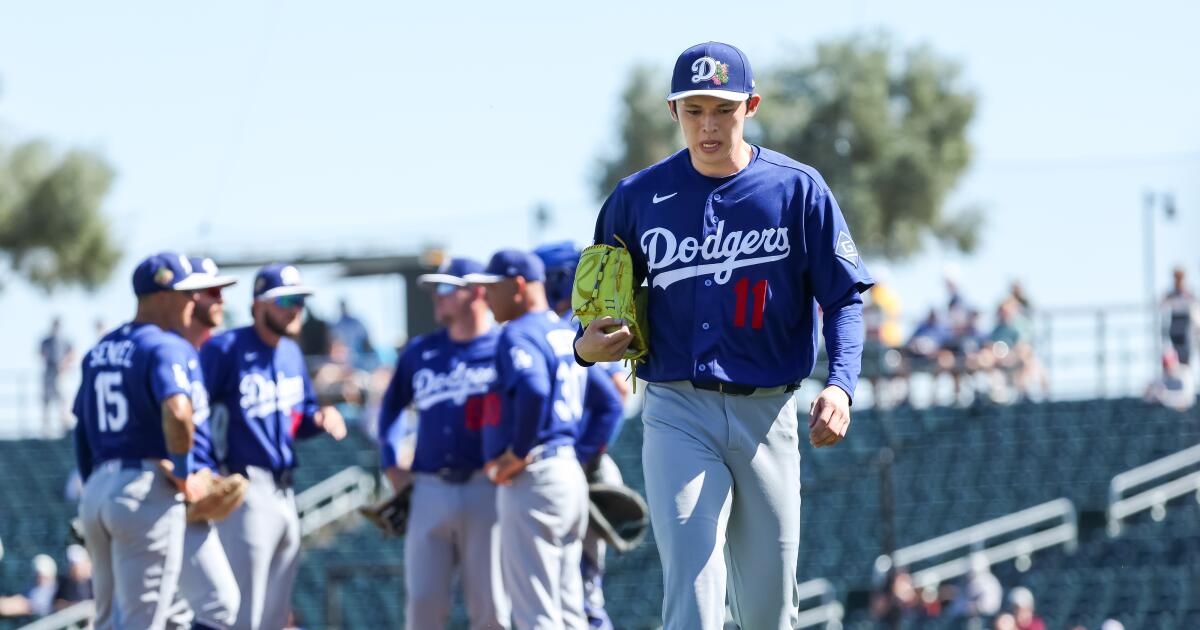
Roki

Why the Dodgers are preaching patience with Roki Sasaki as a starter

By the time Dodgers right-hander Roki Sasaki reached the blue backdrop set up in the Surprise Stadium interview room, he’d diagnosed the issue.

“I think it’s because of the two-seamer,” Sasaki said through an interpreter. “It kind of caused my forearm to pronate a little more. Also my arm slot was a little down.”

Those arm-side misses had, after three straight walks, prompted manager Dave Roberts to temporarily pull Sasaki from his most recent spring training appearance. But even though that start, marred by a wild third inning, brought Sasaki’s Cactus League ERA to 13.50, he’ll enter his Freeway Series start Monday with a spot in the regular-season rotation already secured.

Roberts has repeatedly made that point clear.

However, when asked directly if Sasaki was one of the Dodgers’ 13 best pitchers right now, Roberts gave an indirect answer: “He is going to start the season in the rotation.”

Answering why the organization has been so bullish on the decision requires zooming out.

“As we look out two, three, four, five, six years, it is imperative for us to integrate talented young players under our roster,” president of baseball operations Andrew Friedman said during an interview with The Times last week. “And that requires patience. And we have to have that even with the insanely high expectations we have.

“We have to be able to balance those two things, or there are a lot of cautionary tales of large-revenue teams who have had a run of success, and then they fall off the cliff.”

Sasaki, 24, is one of those young players the Dodgers are counting on to bridge the gap.

When Sasaki was posted by Nippon Professional Baseball’s Chiba Lotte Marines before last season, upward of 20 teams expressed their interest in the young phenom who was coming to the United States through amateur international free agency.

In his debut season, he produced a 4.72 ERA through eight starts — before an injury the Dodgers described as a right shoulder impingement sidelined him for much of the rest of the season. When Sasaki returned, it was as a reliever, a role he thrived in through the postseason.

Sasaki enters Year 2 with just 47 major-league innings under his belt, including the regular season and playoffs.

“On top of all those other things that you’re adapting to and learning, you’re also learning a new ball,” Friedman said. “Roki could really command his fastball in Japan, and right now it hasn’t been as good. So how much of that is the ball, how much of it is mindset, how much of it is delivery just getting out of whack? All of those are fair questions, but I think it speaks to, we have to have a level of grace with this and work with him to continue his development.

“Because we’ve seen it at an extremely high level, and now it’s on all of us to help him get back to that.”

NPB baseballs are slightly smaller, tackier and have higher seams than MLB baseballs. Players making the transition to MLB also have to adjust to a different strike zone, style of play and the off-the-field challenges of living in a foreign country.

The season before Sasaki signed with the Dodgers, his future teammate Yoshinobu Yamamoto and the Cubs’ Shota Imanaga set the bar high with relatively smooth transitions. But they were also coming over at later stages in their careers.

“We’re very mindful that this guy is essentially two years, three years behind Yamamoto,” Roberts said, “as far as on the progression side, the development side.”

Sasaki has shown he can be effective out of the bullpen, but pigeonholing him in a relief role at this stage of his career would be a disservice to him and the organization.

The Dodgers have identified the addition of the two-seamer as a development that could help Sasaki stick as a major-league starter.

“It’s our job as coaches to get a player to understand the value of having a ball bear in and get in on right-hand hitters to keep them off the outside part of the plate,” Roberts said. “There’s a little bit of trying to pronate too much — trying to make the ball move, versus trusting his grip and his throw. But that’s a coach’s responsibility to [figure out,] how do we get him there, along with him feeling comfortable.”

The Dodgers have decided that, at least for now, the best setting for that growth is the major leagues. Across the industry, there’s an understanding that the gap between Triple-A and the big leagues is bigger than ever. That makes evaluating players in Triple-A all the more difficult.

“He’s not close to a finished product,” Roberts said. “But he’s 24. … You could look at a team that would potentially sign a veteran, turnkey starter, but we’ve got to get him to cut his teeth and deal with some things. That’s part of the growth.”

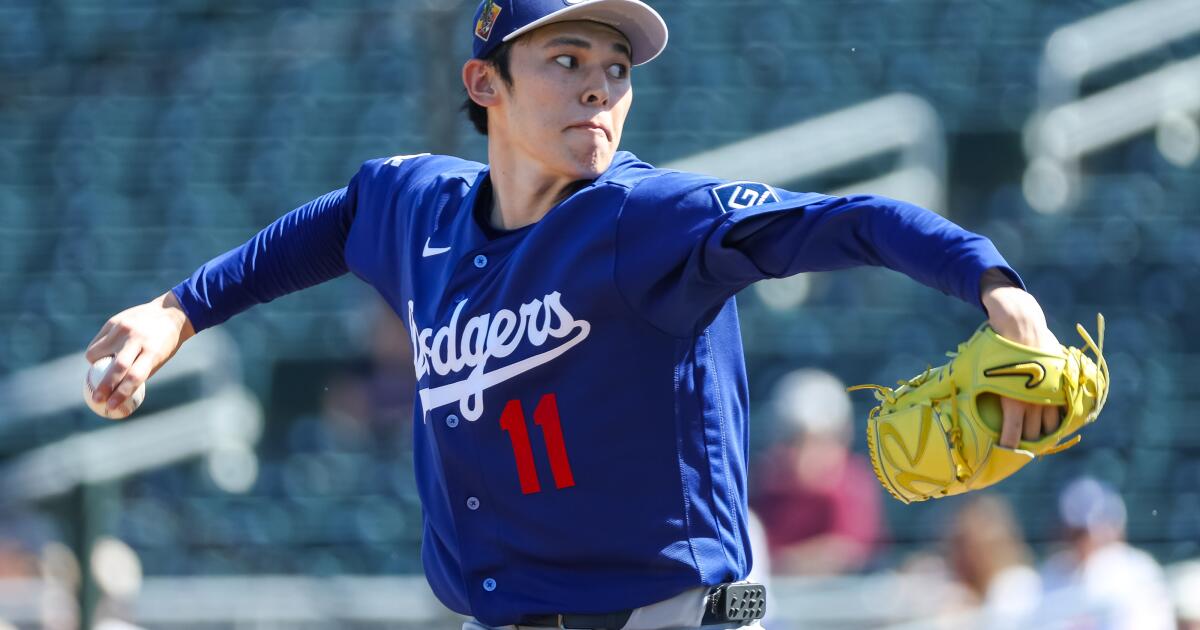
Source link

Dodgers’ Roki Sasaki makes strides in outing against minor leaguers

p]:text-cms-story-body-color-text clearfix”>

It hasn’t been the smoothest spring training for right-hander Roki Sasaki as he prepares for his second season with the Dodgers.

Sasaki’s first two starts in Cactus League play featured some problems with command and plenty of hard contact. But with left-hander Blake Snell and right-hander Gavin Stone sidelined with shoulder issues, Dodgers manager Dave Roberts left no doubt where Sasaki stood as he got ready to pitch in a B-game against White Sox minor leaguers on Tuesday.

“Having Blake [Snell] late to the season, which we know, [and] Gavin Stone, late to the season, as we know, we’re going to need Roki,” Roberts said. “With the buildup, I just don’t see a world in which he doesn’t break with us as a starter, and so, we’re going to need those innings.”

Sasaki took a promising step forward on a minor-league field at Camelback Ranch.

The hard-throwing right-hander threw 59 pitches, 40 for strikes, across four innings while striking out nine of the 13 batters he faced and allowing two to reach base.

Although Roberts did not see Sasaki’s outing, he heard rave reviews from members of the organization who attended.

“They said it was electric,” Roberts said after the Dodgers’ 4-1 win over the Arizona Diamondbacks at Camelback Ranch. “They said [he was touching] 98 to 100 [mph]. The fastball was spraying a little early, but then he locked it in. And then the split was on-play, short, lot of swing-and-miss. Couldn’t have asked for a better day.”

Sasaki surrendered a single through the right side of the infield to the first batter he faced, then proceeded to strike out the next seven batters. His only other hiccup came in the third inning, when he hit Jason Matthews with a stray breaking ball on a full count.

“I actually felt pretty bad the last couple days, but today I was able to make an adjustment, so that’s what I really need for right now,” Sasaki said via an interpreter after his outing. “I think I can keep moving forward.”

Sasaki was shelled in his second Cactus League start last week, yielding four runs, three walks, a single and a grand slam to the Cleveland Guardians at Goodyear Ballpark. He was lifted from the game without recording an out, only to get re-inserted in the second inning to complete two scoreless innings.

Sasaki noted mechanical issues as the reason for his struggles after the game. Tuesday, he said he felt much better, focusing on his core and obliques.

“I was actually focusing on core, oblique stuff,” Sasaki said. “I think it’s all about mechanics. If my mechanics are really good, my command is good too.”

Roberts took away plenty of value from the outing, even one against a lineup of minor leaguers.

“There’s still value in getting hitters out and seeing guys swing and miss,” Roberts said. “I think we accomplished what we wanted to today, we built him up. Obviously, built up some confidence. So, just go from there.”

Source link

How Dodgers’ Roki Sasaki looked in his second Cactus League start

p]:text-cms-story-body-color-text clearfix”>

Roki Sasaki’s struggles from his first Cactus League start carried over into Tuesday’s game against the Cleveland Guardians at Goodyear Ballpark.

The Dodgers right-hander gave up three walks and two hits, including a grand slam to Guardians slugger Kyle Manzardo, before he was lifted after 23 pitches. He displayed no command, missing arm side repeatedly and throwing only eight strikes. None of the five batters he faced in the first inning saw a first-pitch strike.

But then, he flashed the tantalizing potential that the Dodgers saw when they signed him before last season.

Re-inserted into the game to start the second inning, which is allowed in spring training, the 24-year-old settled down and retired all six batters he faced in his last two innings of work while throwing 22 pitches — 13 for strikes — in the Dodgers’ 5-4 win.

Working in a healthy mix of fastballs, cutters and splitters, Sasaki struck out two and was able to limit hard contact, which had been an issue for him in the first inning and in his first start last week against the Arizona Diamondbacks. The home run by Manzardo recorded an exit velocity of 104.6 mph.

“I wasn’t overly concerned,” Dodgers manager Dave Roberts said. “But it was good to see him bounce back.”

Sasaki said through an interpreter after he was lifted from the game that something felt off about his upper-body mechanics. He made a simple adjustment and found success in it.

“It was actually my upper body,” Sasaki said. “My lower half actually felt pretty good. My upper body felt a little off, so I was trying to make an adjustment.”

Said Roberts when asked about Sasaki missing arm side: “Maybe he’s trying to be a little too fine and/or just a little bit out of sync with the delivery. That’s why you have spring training, you work though it, you’ve got to be able to make in-game adjustments. As he gets more experienced, you would expect that to happen in the inning rather than sit for 20 minutes, come in and reset.”

Source link