White House address: Trump says Iran war goals nearing completion

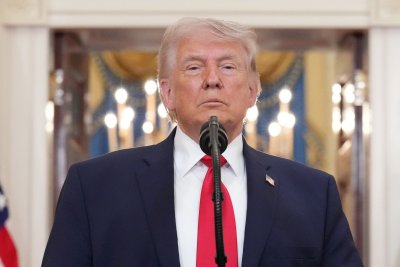
April 1 (UPI) — President Donald Trump told the nation Wednesday night that the U.S. military was close to achieving its goals in the war against Iran and would bomb the nation “back to the stone ages where they belong” over the next two weeks to finish the job.
In the nearly 20-minute, prime-time address to the nation, Trump repeated claims of military successes in the war, while offering little new information about the progress of Operation Epic Fury.
He said U.S. forces “have delivered swift, decisive, overwhelming victories on the battlefield” and “never in the history of warfare has an enemy suffered such clear and devastating large-scale losses in a matter of weeks.”
“Our enemies are losing and America, as it has been for the five years under my presidency, is winning and now winning bigger than ever before,” he said.
Trump offered no specifics on how or precisely when the war will end, while claiming the military objectives he announced shortly after the war began in late February were “nearing completion.”
“We’re going to finish the job. And we’re going to finish it very fast. We’re getting very close,” he said.
In his early Feb. 28 address, he said the military goals were to defend the American people by eliminating threats posed by Iran; ensure its proxy militias no longer destabilize the region and attack U.S. forces; destroy its missile capabilities, missile industry and navy; and ensure the Iranian regime does not obtain a nuclear weapon.
His first address notably encouraged regime change, urging Iranians to “take over your government.”
In his address Wednesday night, Trump claimed regime change had occurred, though there has been no clear indication Iran is under fundamentally different leadership.
Democrats were quick to criticize Trump over what they called shifting military objectives and for failing to lay out an exit plan.
“This war of impulse & illusion is plagued by confused, chaotic & contradictory objectives — none seem to have been achieved,” Sen. Richard Blumenthal of Connecticut said in a statement.
Trump also said the U.S. military was fighting the war to help its allies, while calling on those who receive oil that transits through the important Strait of Hormuz chokepoint to “take care of that passage.”
Iran has been maintaining a blockade of the important trade route through which 20% of global oil and liquefied natural gas flow by attacking tankers that attempt passage.
The near halt in energy deliveries through the route has drive up gas prices at pumps in the United States and across the world but also the price of oil on the markets to $106.05 a barrel for Brent crude, compared to about $72 before the war.
He instructed those nations reliant on the Hormuz Strait to seize it from Iran.
“They must cherish it. They must grab it and cherish it,” he said. “They can do it easily. We will be helpful, but they should take the lead in protecting the oil that they so desperately depend on.”
But even if they do not act, “when this conflict is over, the strait will open up naturally,” he said. “It’ll just open up naturally.”
While briefly touching on the economic effects of the war on Americans, he blamed Iran for attacking tankers and Persian Gulf countries while assuring them that the economic situation would have been worse if they hadn’t attacked Iran and allowed it to secure a nuclear weapon.
“This is yet more proof that Iran can never be trusted with nuclear weapons. They will use them and they will use them quickly,” he said. “It would lead to decades of extortion, economic pain and instability worse than you can ever imagine.”
Threats against Iran were also made. Despite ssaying the U.S. military will “hit them extremely hard over the next two weeks,” American forces will attack key oil and electric generating plants if Iran does not reach an agreement with the United States, seemingly to end the war.
Trump late last month offered Iran an ultimatum to reach an agreement with the United States to reopen the Strait of Hormuz or have its energy facilities obliterated. He gave them an April 6 deadline.
On Tuesday, the president told reporters that a deal with Iran was unnecessary.
In concluding his address Wednesday night, he referred to the war as “a true investment in your children and grandchildren’s future.”
“Tonight, every American can look forward to a day when we are finally free from the wickedness of Iranian aggression and the specter of nuclear blackmail,” he said.