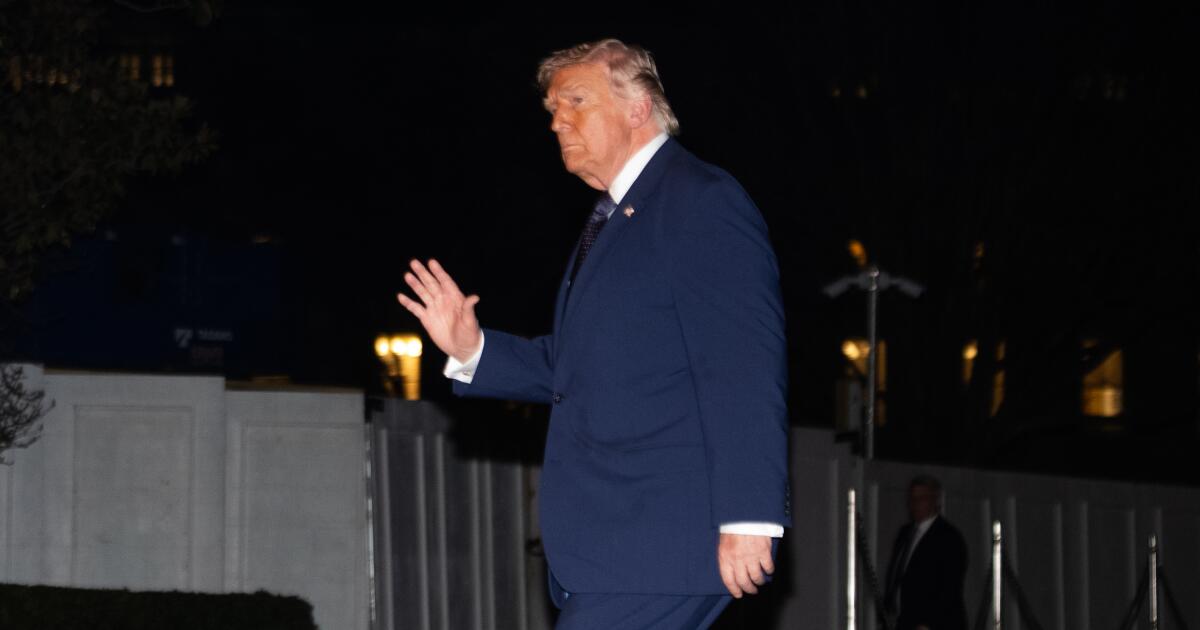
President Trump’s aura of invincibility is starting to vanish. Three new polls — including the usually Trump-hospitable Rasmussen — suggest that Joe Biden did a better job as president.
Worse still (for Trump), he’s underwater on immigration, foreign policy and the economy — the very trifecta that powered his return. An incumbent taking on water like that is no longer steering the ship of state, he’s bobbing in the deep end, reaching for a Mar-a-Lago pool noodle.
To be fair, Democrats have a proud tradition of snatching defeat from the jaws of victory. But suppose — purely hypothetically — that this sticks. Suppose Democrats win the midterms. And suppose a Democrat captures the White House in 2028.
Then what?
Trumpism isn’t a political movement so much as a recurring event. You don’t defeat it; you board up the windows and wait.
Even if Trump does not attempt a third term (a gambit the Constitution frowns upon), he will remain the dominant gravitational force in Republican politics for as long as he is sentient and within Wi-Fi range.
Which means any Democratic administration that follows would be well-advised to consider it is governing on borrowed time. In American politics, you are always one scandal, one recession or one deepfake video away from packing your belongings into a cardboard box.
Trump’s MAGA successor (whoever he or she might be) will inherit millions of ardent believers, now seasoned by experience, backed by tech billionaires and steeped in an authoritarian worldview.
So how exactly does the country “move on” when a sizable slice of its elite class appears to regard liberal democracy as more of an anachronism than a governing philosophy?
This is not an entirely new dilemma. After the Civil War, Americans had to decide whether to reconcile with the rebels or punish them or some mix of the two — and the path chosen by federal leaders shaped the next century through Reconstruction, Jim Crow and the long struggle for civil rights.
At Nuremberg, the Allies opted for trials instead of firing squads. Later, South Africa’s post-apartheid government attempted to achieve reconciliation via truth.
Each moment wrestled with the same problem: How do you impose consequences without becoming the very thing you were fighting in the first place — possibly sparking a never-ending cycle of revenge?
Which brings us to even more specific questions, such as where does Trumpism fit into this historical context — and should there be any accountability after MAGA?
Start with Trump himself. Even if he is legally immune regarding official acts, what about allegations of corruption? Trump and his family have amassed billions since returning to office.
It is difficult to picture a future Democratic administration hauling him into court, especially if Trump grants himself broad pardons and preemptive clemency on his way out of office.
So if accountability comes, it would probably target figures in his orbit — lieutenants, enablers, assorted capos not covered by pardons. But is even this level of accountability wise?
On one hand, it is about incentives and deterrence. If bad actors get to keep the money and their freedom, despite committing crimes, they (and imitators) will absolutely return for an encore.
On the other hand, a Democratic president might reasonably decide that voters would prefer lower grocery bills to more drama.
Trump himself offers a cautionary tale. He devoted enormous energy to retribution, grievance and settling scores. It is at least conceivable that he might have been in stronger political shape had he devoted comparable attention to, say, affordability.
There is also the uncomfortable fact that the past Trump indictments strengthened him politically. Nothing energizes a base like the words “They’re coming for me,” especially when followed by the words “and you’ll be next,” next to a fundraising link. Do Democrats want to create new martyrs and make rank-and-file Americans feel like “deplorables” who are being persecuted for their political beliefs?
So perhaps the answer is surgical. Focus on ringleaders. Spare the small fry. Proceed in sober legal tones. Make it about the law, not the spectacle.
Even this compromise would invite a backlash. Democrats, it seems, are damned if they do and damned if they don’t.
Unfortunately, there is no tidy answer. Too much punishment risks looking like vengeance. Too little risks sparking another sequel.
It may sound melodramatic to say this might be the most important question of our time. But while this republic has endured a lot, it might not survive the extremes of amnesia or revenge.
Choosing the narrow path in between will require something rarer than a landslide victory: justice with restraint.
WASHINGTON — U.S. Atty. Gen. Pam Bondi repeatedly sparred with lawmakers on Wednesday as she was pressed over the Justice Department’s handling of the Jeffrey Epstein investigation and faced demands for greater transparency in the high-profile case.
Bondi accused Democrats and at least one Republican on the House Judiciary Committee of engaging in “theatrics” as she fielded questions about redaction errors made by the Justice Department when it released millions of files related to the Epstein case last month.
The attorney general at one point acknowledged that mistakes had been made as the Justice Department tried to comply with a federal law that required it to review, redact and publicize millions of files within a 30-day period. Given the tremendous task at hand, she said the “error rate was very low” and that fixes were made when issues were encountered.
Her testimony on the Epstein files, however, was mostly punctuated by dramatic clashes with lawmakers — exchanges that occurred as eight Epstein survivors attended the hearing.
In one instance, Bondi refused to apologize to Epstein victims in the room, saying she would not “get into the gutter” with partisan requests from Democrats.
In another exchange, Bondi declined to say how many perpetrators tied to the Epstein case are being investigated by the Justice Department. And at one point, Rep. Thomas Massie (R-Ky.) said the Trump administration was engaging in a “cover-up,” prompting Bondi to tell him that he was suffering from “Trump derangement syndrome.”
The episodes underscore the extent to which the Epstein saga has roiled members of Congress. It has long been a political cudgel for Democrats, but after millions of files were released last month, offering the most detail yet of Epstein’s crimes, Republicans once unwilling to criticize Trump administration officials are growing more testy, as was put on full display during Wednesday’s hearing.
Among the details uncovered in the files is information that showed Commerce Secretary Howard Lutnick had closer ties to Epstein than he had initially led on.
Rep. Becca Balint (D-Vt.) asked Bondi if federal prosecutors have talked to Lutnick about Epstein. Bondi said only that he has “addressed those ties himself.”
Lutnick said at a congressional hearing Tuesday that he visited Epstein’s island, an admission that is at odds with previous statements in which he said he had cut off contact with the disgraced financier after initially meeting him in 2005.
“I did have lunch with him as I was on a boat going across on a family vacation,” Lutnick told a Senate panel about a trip he took to the island in 2012.
As Balint peppered Bondi about senior administration officials’ ties to Epstein, the back and forth between them got increasingly heated as Bondi declined to answer her questions.
“This is not a game, secretary,” Balint told Bondi.
“I’m attorney general,” Bondi responded.
“My apologies,” Balint said. “I couldn’t tell.”
In another testy exchange, Rep. Ted Lieu (D-Torrance) pressed Bondi on whether the Justice Department has evidence tying Donald Trump to the sex-trafficking crimes of Jeffrey Epstein.
Bondi dismissed the line of questioning as politically motivated and said there was “no evidence” Trump committed a crime.
Lieu then accused her of misleading Congress, citing a witness statement to the FBI alleging that Trump attended Epstein gatherings with underage girls and describing secondhand claims from a limo driver who claimed that Trump sexually assaulted an underage girl who committed suicide shortly after.
He demanded Bondi’s resignation for failing to interview the witness or hold co-conspirators to account. Other Democrats have floated the possibility of impeaching Bondi over the handling of the Epstein files.
Beyond the Epstein files, Democrats raised broad concerns about the Justice Department increasingly investigating and prosecuting the president’s political foes.
Rep. Jamie Raskin of Maryland, the top Democrat on the House Judiciary Committee, said Bondi has turned the agency into “Trump’s instrument of revenge.”
“Trump orders up prosecutions like pizza and you deliver every time,” Raskin said.
As an example, Raskin pointed to the Justice Department’s failed attempt to indict six Democratic lawmakers who urged service members to not comply with unlawful orders in a video posted in November.
“You tried to get a grand jury to indict six members of Congress who are veterans of our armed forces on charges of seditious conspiracy, simply for exercising their 1st Amendment rights,” he said.
During the hearing, Democrats criticized the Justice Department’s prosecution of journalist Don Lemon, who was arrested by federal agents last month after he covered an anti-immigration enforcement protest at a Minnesota church.
Bondi defended Lemon’s prosecution, and called him a “blogger.”
“They were gearing for a resistance,” Bondi testified. “They met in a parking lot and they caravanned to a church on a Sunday morning when people were worshipping.”
The protest took place after federal immigration agents fatally shot two U.S. citizens, Renee Good and Alex Pretti, in Minneapolis.
Six federal prosecutors resigned last month after Bondi directed them to investigate Good’s widow. Bondi later stated on Fox News that she “fired them all” for being part of the “resistance.” Lemon then hired one of those prosecutors, former U.S. Atty. Joe Thompson, to represent him in the case.
Bondi also faced questions about a Justice Department memo that directed the FBI to “compile a list of groups or entities engaged in acts that may constitute domestic terrorism” by Jan. 30, and to establish a “cash reward system” that incentivizes individuals to report on their fellow Americans.
Rep. Mary Gay Scanlon, (D-Pa.) asked Bondi if the list of groups had been compiled yet.
“I’m not going to answer it yes or no, but I will say, I know that Antifa is part of that,” Bondi said.
Asked by Scanlon if she would share such a list with Congress, Bondi said she “not going to commit anything to you because you won’t let me answer questions.”
Scanlon said she worried that if such a list exists, there is no way for individuals or groups who are included in it to dispute any charge of being a domestic terrorists — and warned Bondi that this was a dangerous move by the federal government.
“Americans have never tolerated political demagogues who use the government to punish people on an enemy’s list,” Scanlon said. “It brought down McCarthy, Nixon and it will bring down this administration as well.”
Just five days after Philip Glass, one of the world’s most famous and revered living composers, canceled the world premiere of his “Lincoln” symphony at the Kennedy Center, President Trump announced he would close the nation’s premier arts center for two years for major renovations.
The arts world — already spinning from the sweeping changes to the venue that began almost a year ago when Trump fired the board and installed himself as chairman — was gobsmacked by the shocking news. And although the president said in a social media post that the closure was about building a “World Class Bastion of Arts, Music, and Entertainment, far better than it has ever been before,” speculation abounded that the unexpected move was more about saving face.
Embarrassment could have been a factor in the rash decision, but Trump is not a man who appears to be afflicted by that particular emotion, which takes its cue from a certain amount of self-awareness and humility. For this reason, I am venturing another guess about the president’s motive for pulling the rug out from under the storied venue: retribution.
If ungrateful artists don’t want to play at the Kennedy Center, the Kennedy Center will no longer be around for them to use. Take that.
The Kennedy Center was supposed to mark a vainglorious Trump’s ascendance to the pinnacle of cultural cachet, but instead the culturati shunned and humiliated him — refusing to join his party. New York City high society did the same before he was president. It was a pattern both familiar and painful. So Trump, like the man-child he is, took his ball and went home.
In this case, that ball happens to be the complex that serves as the symbolic seat of the nation’s vibrant, messy, questioning, deeply political and hugely alive arts and culture scene. To lose access to this beating heart — and all that it represents — is a grievous loss for our national identity. Its meaning was enshrined in President Kennedy’s vision for the center, and written on its walls, as the realization of a country, “which commands respect throughout the world not only for its strength but for its civilization as well.”
Like many of Trump’s controversial construction projects, the wholesale re-imagining of the Kennedy Center will likely face immediate and lengthy pushback in court. This could mean that it never gets done, and the center remains closed indefinitely. Or we could wake up tomorrow to news that bulldozers have arrived onsite and have begun the process of razing architect Edward Durell Stone’s historic 1971 building — as happened with the East Wing of the White House.
Roma Daravi, the center’s vice president of public relations, wrote in an email that the renovations would include, “Repairing and, where necessary, replacing elements on the exterior of the building to ensure the long-term preservation and integrity of the structure,” as well as getting the building up to code and making fixes to the center’s “HVAC, plumbing, electrical, fire protection, vertical transportation systems, and technical stage systems,” as well as improving parking. She also wrote that the center, which hosts 2 million visitors annually, is working closely with the National Symphony Orchestra, and will “continue to support them with funding at the same level as recent years.”
Nonetheless, the most frightening thing about this new era under Trump is that anything is possible, and we sometimes don’t know exactly what that means until it is far too late.
I’m Arts Editor Jessica Gelt, and here’s your arts and culture news for the week.
On our radar
Yunchan Lim performs next weekend with the L.A. Philharmonic.
(LA Phil)
Dudamel Conducts Beethoven and Lorenz Playwright Jeremy O. Harris reconceptualizes Johann Wolfgang von Goethe’s play “Egmont,” with narration by actor Cate Blanchett and maestro Gustavo Dudamel leading the Los Angeles Philharmonic in Beethoven’s complete incidental music. The evening begins with the world premiere of Ricardo Lorenz’s “Humboldt’s Nature,” inspired by the South American travels of philosopher and naturalist Alexander von Humboldt, followed by 2022 Van Cliburn winner Yunchan Lim performing Robert Schumann’s “Piano Concerto in A minor, Op. 54.” 8 p.m. Thursday; 11 a.m. Feb. 13; 8 p.m. Feb. 14; 2 p.m. Feb. 15. Walt Disney Concert Hall, 111 S. Grand Ave., downtown L.A. laphil.com/events
A scan of the face Nes-Hor, an ancient Egyptian priest whose mummy is featured in “Mummies of the World: The Exhibition” at the California ScienceCenter.
(California ScienceCenter)
Mummies of the World The scientific study of naturally and intentionally preserved corpses illuminates the lives of ancient people, past cultures and the present in this exhibition that includes more than 30 real-life mummies. 10 a.m.-5 p.m., through Sept. 7. California ScienceCenter, 700 Exposition Park Drive. californiasciencecenter.org
Ann Noble as “Richard III” at A Noise Within.
(Daniel Reichert)
Richard lll Guillermo Cienfuegos directs this fast-paced reinterpretation of William Shakespeare’s history play, reset in 1970s Britain with Ann Noble in the title role as one of the most fascinating villains ever. Sunday through March 8. A Noise Within, 3352 E. Foothill Blvd., Pasadena. anoisewithin.org
You’re reading Essential Arts
The week ahead: A curated calendar
FRIDAY The Abduction from the Seraglio Pacific Opera Project performs its “Star Trek”-themed parody of Mozart’s in L.A. for the first time in a decade. 7:30 p.m. Friday and Saturday; and 3 p.m. Sunday. Thorne Auditorium, Occidental College, 1600 Campus Road. pacificoperaproject.com
Thomas Adès and Yuja Wang Composer Adès leads the L.A. Phil in Tchaikovsky’s “Francesca da Rimini , Op. 32,” the U.S. premiere of William Marsey’s “Man With Limp Wrist” and Adès own work “Aquifer”; and pianist Wang performs Prokofiev’s “Piano Concerto No. 2 in G minor, Op. 16.” 8 p.m. Friday; 2 p.m. Saturday and Sunday. Walt Disney Concert Hall, 111 S. Grand Ave., downtown L.A. laphil.com
Rickie Lee Jones performs Friday and Saturday at the Wallis.
(Amy Harris / invision/ap)
Rickie Lee Jones The singer, musician and songwriter brings her genre-defying vocals, crisscrossing rock, R&B, pop, soul and jazz, to the Wallis for two shows. 7:30 p.m. Friday and Saturday. The Wallis, 9390 N. Santa Monica Blvd., Beverly Hills. thewallis.org
Laguna Beach Music Festival Violinist Stefan Jackiw is joined by Kevin Ahfat on piano, the Parker Quartet and story artist Xai Yaj for a program featuring Beethoven and Janáček on Friday; and on Saturday, Jackiw, Ahfat and the Parker Quartet, along with clarinetist Yoonah Kim and musicians from the Colburn School perform works by American composers Florence Price, Leonard Bernstein, Eric Nathan and Aaron Copland, conducted by Steven Schick. 8 p.m. Friday; 7 p.m. Saturday. Laguna Playhouse, 606 Laguna Canyon Road, Laguna Beach. philharmonicsociety.org
SATURDAY asses.masses Patrick Blenkarn and Milton Lim’s immersive, eight-hour video game experience — with intermissions, refreshments and a meal included — involves unemployed donkeys demanding that humans surrender their machines and give the animals back their jobs. 1 p.m. Saturday. UCLA Nimoy Theater, 1262 Westwood Blvd. cap.ucla.edu
Chicano Camera Culture: A Photographic History, 1966 to 2026 The exhibition examines Chicana/o/x lens-based image-making through 150 works by nearly 50 artists. Through Sept. 6. The Cheech, 3581 Mission Inn Ave., Riverside; through July 5. Riverside Art Museum, 3425 Mission Inn Ave. riversideartmuseum.org
Katie Holmes stars in “Hedda Gabler” at the Old Globe Theatre in San Diego.
(Jan Welters)
Hedda Gabler Katie Holmes headlines this new version of Henrik Ibsen’s classic drama adapted by Erin Cressida Wilson and directed by Barry Edelstein. Through March 15. Old Globe Theatre, 1363 Old Globe Way, San Diego. theoldglobe.org
Just Me – Pico Union This concert by the award-winning ensemble Tonality, led by founder and Artistic Director Alexander Lloyd Blake, honors and shares the stories of transgender and non-binary individuals. 7 p.m. Saturday. The Pico Union Project, 1153 Valencia St., Los Angeles. ourtonality.org
Mandy Patinkin in Concert: Being Alive The stage-and-screen star, accompanied by Adam Ben-David on piano, performs Broadway and classic American tunes written by Irving Berlin, Stephen Sondheim, Cole Porter and Harry Chapin. 8 p.m. Saturday. Carpenter Center, 6200 E. Atherton St., Long Beach. carpenterarts.org
The orchestral collective Wild Up performs Saturday at the Broad.
(Ian Byers-Gamber)
Wild Up The orchestral collective presents “The Great Learning, Paragraphs 2 and 7” by Cornelius Cardew, a community collaboration with 30 pre-appointed non-musicians. 8 and 10 p.m. Saturday. The Broad, 221 S. Grand Ave., downtown L.A. thebroad.org
SUNDAY From Fugue to Fantasia: Debussy, Mozart, and More Colburn alum and violinist Blake Pouliot is joined by Jonathan Brown on viola and percussionist Matthew Howard. 4 p.m. Sunday. Thayer Hall, Colburn School, 200 S. Grand Ave., downtown L.A. colburnschool.edu
MONDAY American International Paderewski Piano Competition Twenty-five young professional pianists vie for a $10,000 grand prize named for Ignacy Jan Paderewski, a celebrated European concert pianist and composer, who helped lead Poland’s battle for independence after World War I and later served as the nation’s prime minister. 1 p.m. Monday-Wednesday; 11 a.m. Feb. 13 and 5 p.m. Feb. 14. Murphy Recital Hall, Loyola Marymount University, 1955 Ignatian Circle. paderewskimusicsociety.org
Right in the Eye Jean-François Alcoléa, Fabrice Favriou and Thomas Desmartis play more than 50 instruments in this live concert, designed by Alcoléa, that serves as a soundtrack for 12 silent shorts by pioneering filmmaker Georges Méliès. 7 p.m. Monday. USC Cinematic Arts, Norris Cinema Theatre at the Frank Sinatra Hall, 3507 Trousdale Parkway. https://cinema.usc.edu/events/event.cfm?id=72935
TUESDAY House on Fire The new music trio of Andrew Anderson, Wells Leng and Richard An perform a program of works for pianos, keyboards and other instruments by Tristan Perich, Erin Rogers, Matthias Kranebitter, Yifeng Yvonne Yuan, Erich Barganier, and group members An and Leng 8 p.m. Tuesday. 2220 Arts + Archives, 2220 Beverly Blvd. pianospheres.org
sex, lies and videotape The Los Angeles Film Critics Assn. presents a screening of Steven Soderbergh’s breakout 1989 indie starring James Spader, Andie MacDowell, Peter Gallagher and Laura San Giacomo with Giacomo in conversation with critic Lael Loewenstein. 7:30 p.m. Tuesday. Egyptian Theatre, 6712 Hollywood Blvd. egyptiantheatre.com
WEDNESDAY Amadeus A new production of Peter Shaffer’s music-infused drama stars Jefferson Mays as Salieri, Sam Clemmett as Mozart and Lauren Worsham as Constanze, with Tony Award winner Darko Tresnjak directing. The Pasadena Conservatory of Music will offer 10-minute Micro Mozart Concerts before every performance Wednesday through March 8. Pasadena Playhouse, 39 S. El Molina Ave. pasadenaplayhouse.org
Yefim Bronfman The pianist performs works by Schumann, Brahms, Debussy and Beethoven in a Colburn Celebrity Recital. 8 p.m. Wednesday. Walt Disney Concert Hall, 111 S. Grand Ave., downtown L.A. laphil.com
Here Lies Love Snehal Desai directs an all-new production of the musical about former First Lady of the Philippines Imelda Marcos, with concept, music and lyrics by David Byrne and music by Fatboy Slim and choreography by William Carlos Angulo. Through March 22. Mark Taper Forum, 135 N. Grand Ave., downtown L.A. centertheatregroup.org
THURSDAY Intersect Palm Springs Arts + Design Fair Collectors, designers and curators convene in the Coachella Valley to present new work and share ideas with one another and the public. 4-6 p.m. VIP only and 6-8 p.m.Thursday; 11 a.m.-6 p.m. Feb. 13-15; 11 a.m.-5 p.m. ; Feb. 16. Palm Springs Convention Center, 277 N. Avenida Caballeros. intersectpalmsprings.com
Culture news and the SoCal scene
More on the Kennedy Center Times classical music critic Mark Swed weighed in on the Kennedy Center’s closure with a deeply knowledgeable piece about the history of the storied venue, and how it has always been a place marked, and sometimes marred, by politics — just never in this way. “The Kennedy Center proved political from Day 1. Leonard Bernstein was commissioned to write a theatrical piece for the center’s opening in 1971, which turned out to be an irreverent ‘Mass’ — musically, liturgically, culturally and, most assuredly, politically. Most of all it was an unmistakable protest against the Vietnam War. In his own protest, President Nixon stayed home,” Swed writes.
Many nights at the opera Meanwhile, arts and entertainment writer Malia Mendez penned a lovely piece announcing L.A. Opera’s 2026-27 season — the first under its new music director, Domingo Hindoyan, who takes over after longtime leader James Conlon steps down. Fun fact: Hindoyan and soon-to-depart Los Angeles Philharmonic music director Gustavo Dudamel have been friends since their days together in Venezuela’s world-renowned youth orchestra El Sistema.
Mark your calendar On Thursday, Malia scored another exclusive, reporting on LACMA’s announcement that the David Geffen Galleries, the pinnacle of a two-decade campus transformation, will officially open April 19. Museum members will have two weeks of priority access to the galleries, with general admission beginning May 4. It was nearly a decade ago that business magnate David Geffen made a record-high $150-million donation toward the construction of a new museum building to be designed by Pritzker Prize-winning architect Peter Zumthor. The $720-million structure will serve as the new home for LACMA’s permanent collection with 90 exhibition galleries organized thematically rather than by medium or chronology. “It’s kind of a worldview,” LACMA Director and Chief Executive Michael Govan told The Times. “It’s big enough that it can hold the world.”
Will Swenson stars as “Sweeney Todd” at the La Mirada Theatre for the Performing Arts.
(Jason Niedle / TETHOS)
A bloody good time Comedian, musical theater star and “Seinfeld” alum Jason Alexander directed a revival of “Sweeney Todd: The Demon Barber of Fleet Street” at La Mirada Theatre for the Performing Arts, and Times theater critic Charles McNulty was there to catch it. “Alexander’s production of ‘Sweeney Todd’ has breadth and heft, but also intimacy and lightness,” McNulty writes in his review.
New Hammer hires Exciting staffing news arrives from the Hammer Museum at UCLA, which announced two new leadership appointments: Michael Wellen has been named the museum’s new chief curator; and Regan Pro is being brought on in the newly created role of chief of learning, engagement, and research, taking the lead on public programs and community partnerships, as well as K-12, family, and university initiatives. Both new hires will report to museum director Zoë Ryan. Wellen arrives from London’s Tate Modern where he is currently senior curator of international art; and Pro is a longtime arts leader and educator who most recently served as the deputy director of public programs and social impact at the Lucas Museum of Narrative Art.
Alexander Shelley has been named music director of Pacific Symphony.
(Curtis Perry)
Taking the baton Pacific Symphony announced its 2026-27 Classical Series, marking the orchestra’s 48th season, and its first under the leadership of its new artistic and music director, Alexander Shelley. The season’s two opening programs will celebrate the 20th anniversary of the Renée and Henry Segerstrom Concert Hall, and the 40th anniversary of Segerstrom Center for the Arts. The opening night celebration in September features violinist Joshua Bell, after which Shelley will guide the season through a series of classic works, beginning with Mahler’s Second Symphony. A season highlight will be a program called America 250, which celebrates the country’s semiquincentennial and includes work by Leonard Bernstein, Igor Stravinsky and Aaron Copland. Also on the calendar: John Adams’ Pulitzer Prize-winning opera, “Nixon in China,” and a two-week Beethoven Revolution Festival.